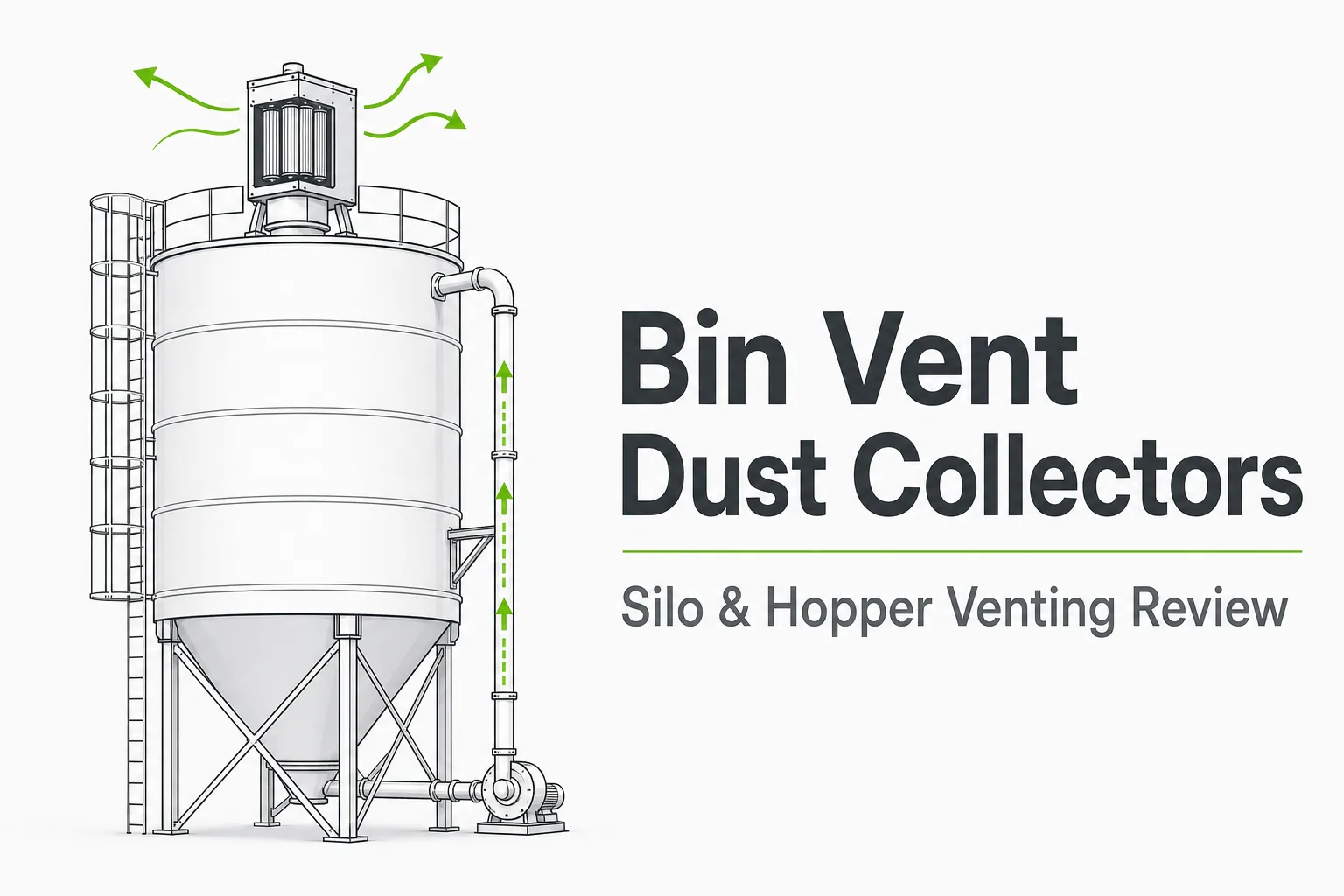
Every time a silo is filled, the incoming material pushes an equal volume of air out. With pneumatic conveying, that displaced air leaves fast and loaded with dust — and without a filter on the vessel, it leaves through whatever opening it finds: the roof vent, the level sensor port, or a dust cloud around the truck bay.
The bin vent dust collector exists for exactly this point. This article explains what a bin vent is, how it works during filling, how it differs from a central baghouse, where the equipment is used, how flat bag and round bag configurations compare, what combustible dust adds to the review, and what data AIER needs to select a unit. It is written for plant engineers, project buyers and EPC teams planning storage and conveying systems as part of industrial dust collection. AIER’s catalog covers both bin roof dust collectors and flat bag bin top units; this article supports the selection review and does not replace project engineering or local requirements.
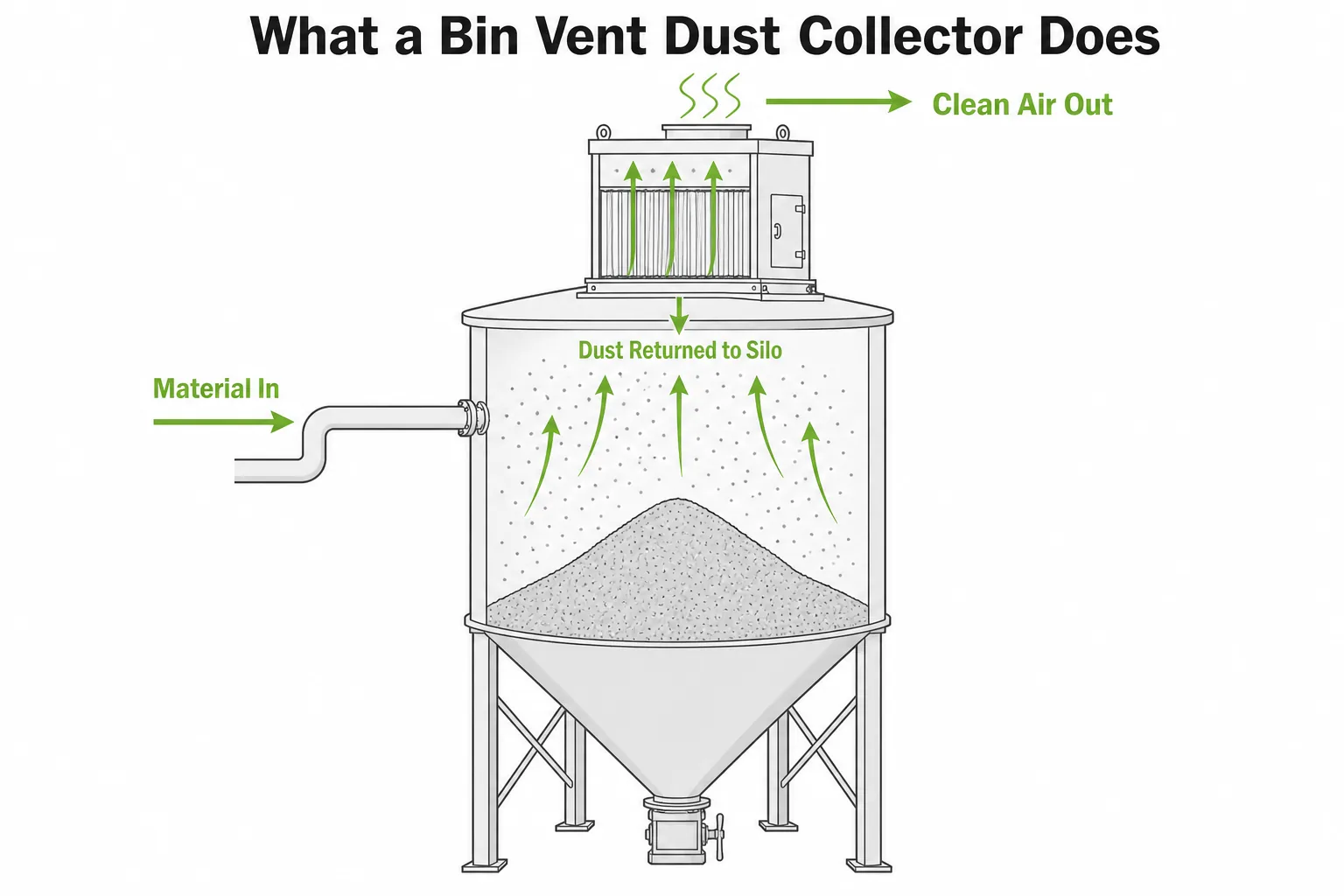
A bin vent dust collector sits on the vessel roof, filters the air displaced during filling and returns the captured dust to the silo.
What Is a Bin Vent Dust Collector?
A bin vent dust collector is a point-of-source filter unit installed on top of a silo, bin or hopper that captures dust from the air displaced during filling and returns it directly to the vessel.
The same equipment appears under several names — bin vent, bin vent filter, silo bin vent, silo top filter or silo dust collector — and they all describe the same idea: filter the vessel’s own venting air at the vessel, instead of piping it away to a remote collector. Because the captured dust falls back into the stored product, nothing is lost and nothing needs a separate discharge route.
That last point is what separates bin vents from every other collector type in the plant: there is no hopper, no rotary valve and no dust bin to empty. The filter housing, the cleaning system and the vessel roof connection are the whole machine — which is why, per the AIER catalog description, the units stay compact, occupy little space and run with low resistance. Where the bin vent sits among the other types of dust collectors is mapped in our overview article.
How a Bin Vent Works During Silo Filling
The working cycle follows the filling operation itself: air in, air filtered, dust returned.
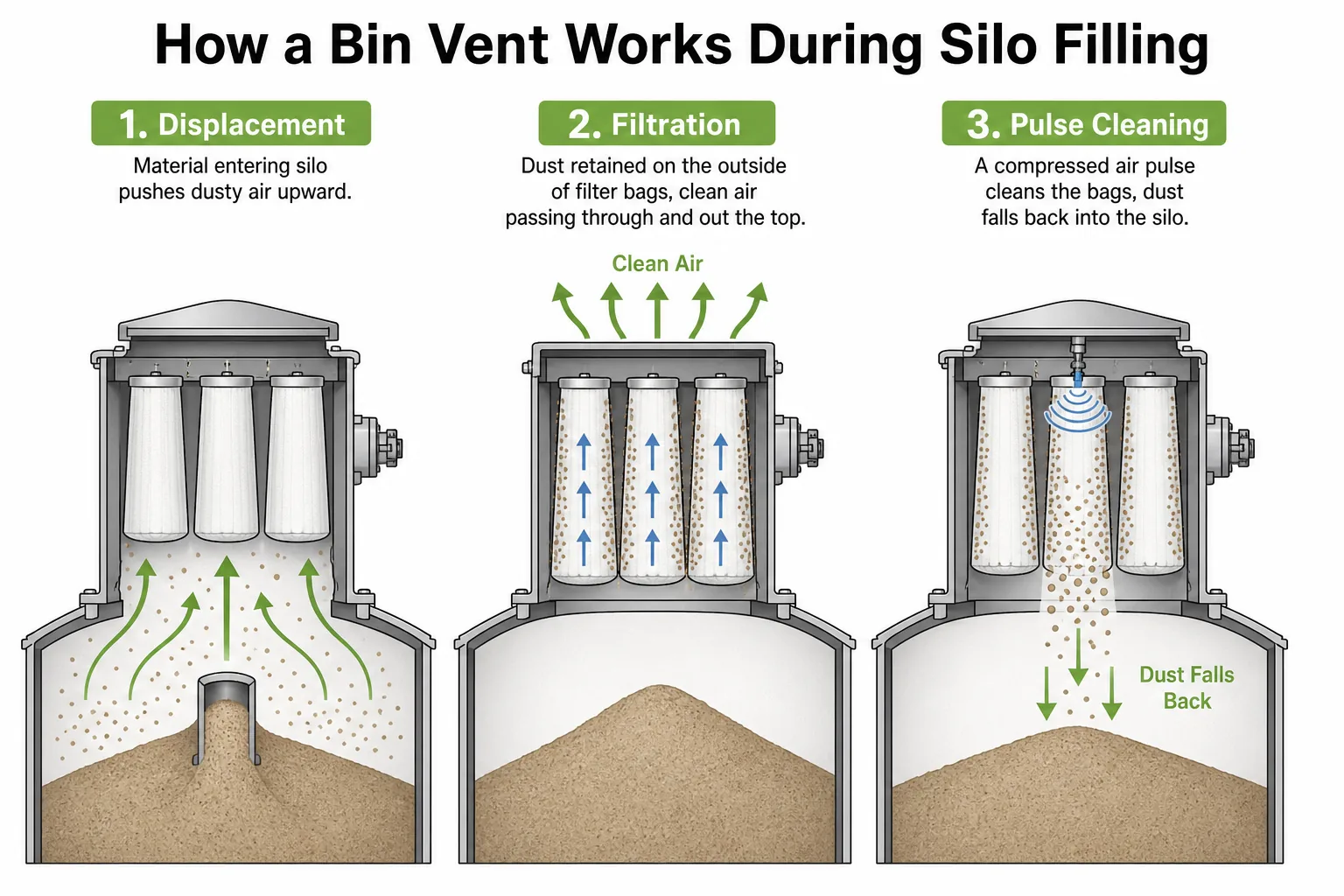
Material entering the vessel displaces dusty air upward through the filter elements; pulse cleaning drops the collected dust straight back into the silo.
- Displacement: as material enters — from a pneumatic conveying line, bucket elevator or belt transfer — an equal air volume is pushed out of the vessel, carrying fine dust upward.
- Filtration: the displaced air passes through the filter elements in the bin vent housing; dust is retained on the media surface and cleaned air is released.
- Pulse cleaning: compressed air pulses knock the accumulated dust off the elements — the AIER catalog units use adjustable pulse cleaning with differential pressure display — and the dust falls back into the vessel below. The cleaning principle is the same one used in full-size collectors, covered in our pulse jet baghouse working principle article.
With pneumatic conveying the duty is harder than it looks: the conveying air adds to the displaced volume, arrives in surges and can carry a high dust load. That is why vessels fed by dense or dilute phase systems are sometimes fitted with a filter receiver — a larger filter vessel that terminates the conveying line — while simpler transfer points are handled by a standard bin vent. Which arrangement fits is a review question, not a catalog default.
Bin Vent vs Baghouse: Point-of-Source vs Central System
The bin vent question usually arrives as a comparison: should this vessel vent through its own filter, or be piped into the plant’s central baghouse?
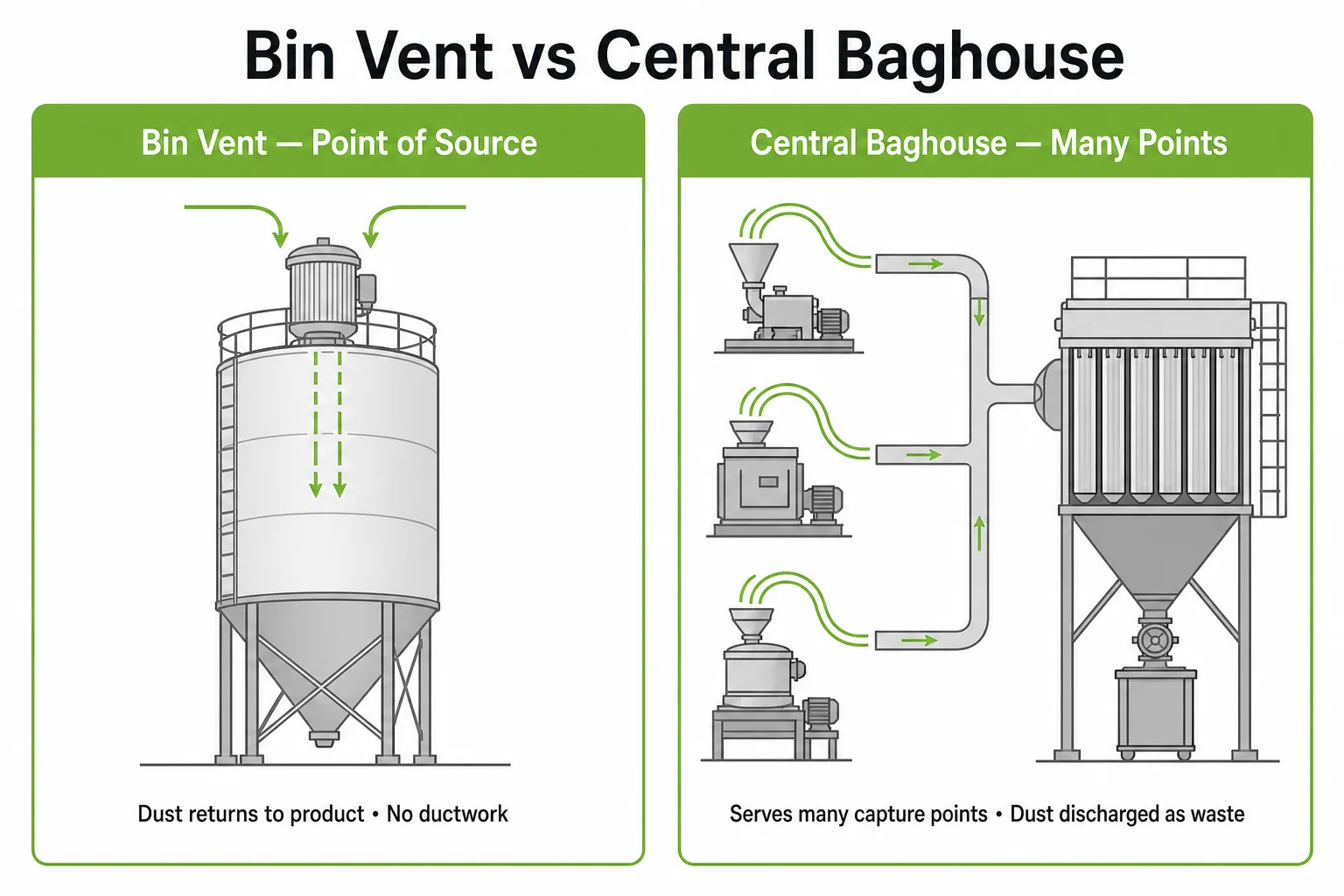
A bin vent filters the vessel’s air at the vessel and returns dust to the product; a central baghouse serves many points through ductwork and discharges dust as waste.
| Review Point | Bin Vent | Central Baghouse |
|---|---|---|
| Where filtration happens | On the vessel roof | At a remote collector through ductwork |
| Captured dust | Returns to the stored product | Collected as waste needing discharge and handling |
| Ductwork | None | Branch design, balancing and fan sizing required |
| Serves | One vessel per unit | Many capture points at once |
| Fits best | Storage venting where product value matters | Process dust from multiple continuous sources |
The two are not competitors so much as different jobs: a plant with ten silos and five process capture points will often end up with bin vents on the silos and a central system for the process — and the split follows the same planning logic described in our dust collection system design article: map every dust point first, then decide which ones justify duct runs.
Where Bin Vents Are Used
Bin vents follow bulk material storage, so they appear across the same industries the AIER catalog lists for its bin roof units: new energy, mining, metallurgy, building materials, machinery, chemicals and grain processing.
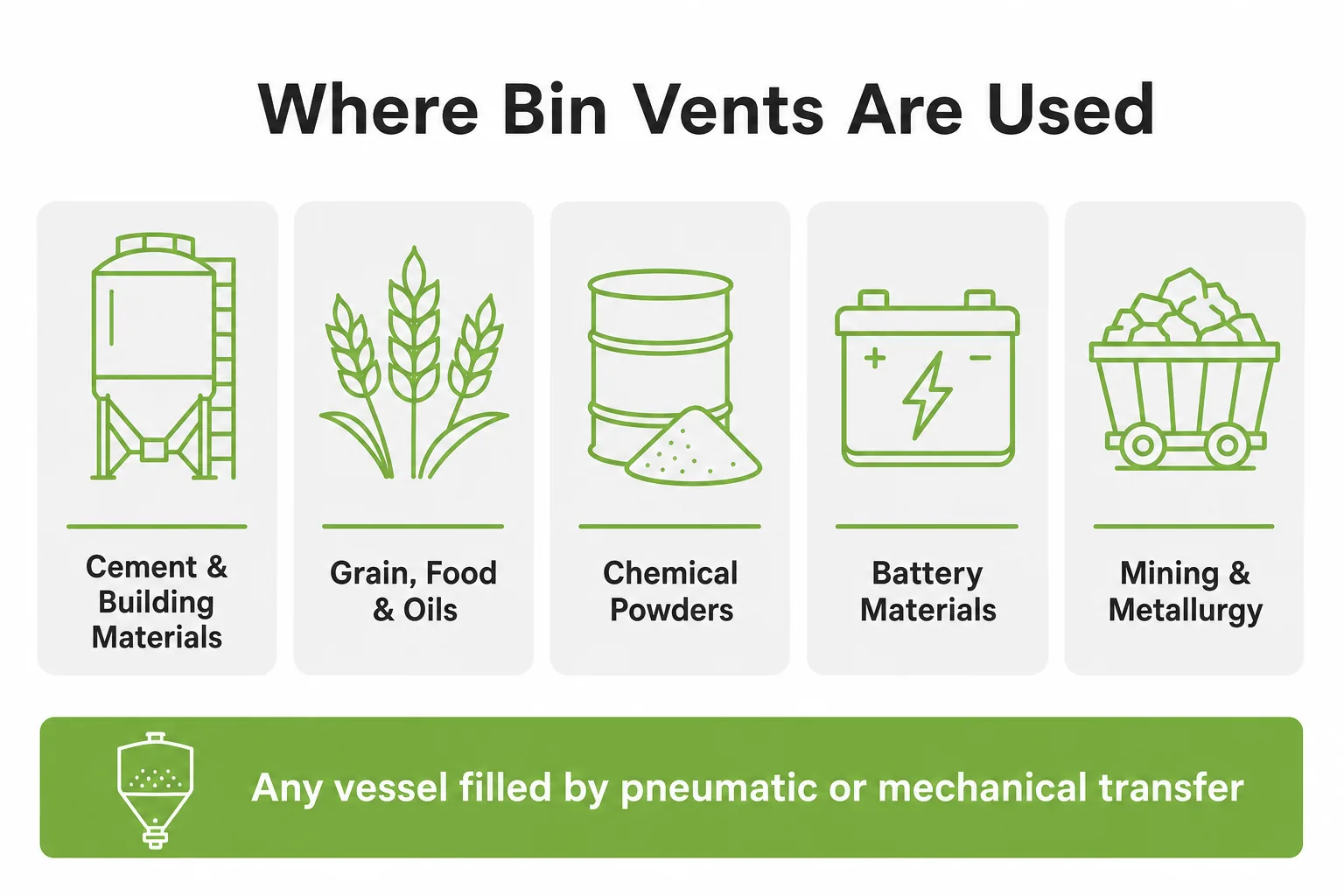
Any vessel that receives dusty bulk material by pneumatic or mechanical transfer is a bin vent candidate — cement, grain, chemical powders and battery materials are the classic cases.
| Application | Typical Duty |
|---|---|
| Cement and building materials | Cement silo dust collector duty on truck-filled and conveyor-filled silos |
| Grain, food and oils | Bunker and silo venting on grain processing and food powder storage |
| Chemical powders | Venting on raw material and intermediate storage bins |
| New energy and battery materials | Storage venting for powder handling in battery material plants |
| Mining and metallurgy | Transfer and storage points on belt and pneumatic conveying systems |
Flat Bag vs Round Bag Bin Vent Configurations
Inside the housing, the filter elements decide how the unit behaves — and the AIER catalog covers two configurations for bin top duty.
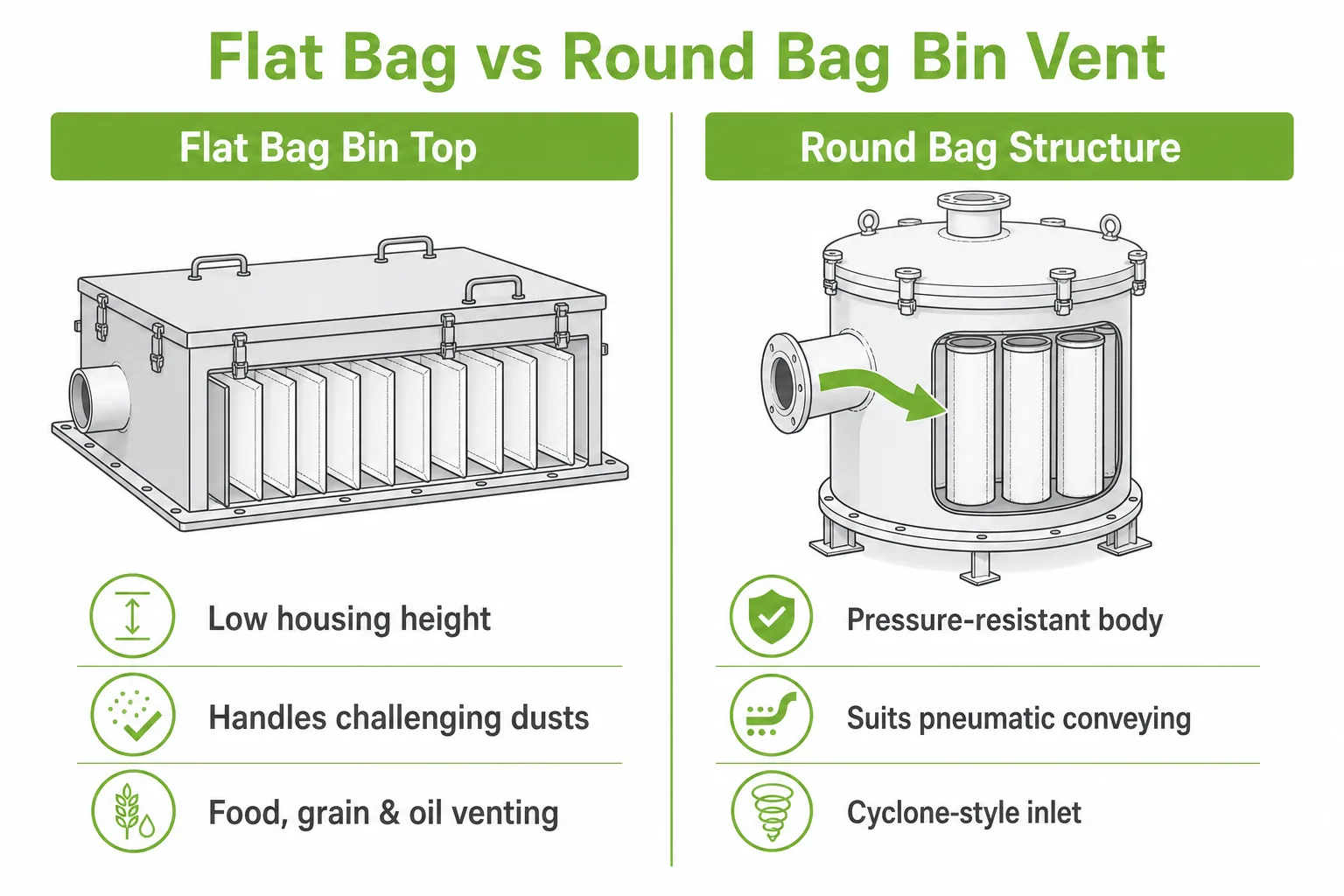
Flat bag units keep the housing low and handle challenging dusts; round bag structures take pressure and suit pneumatic conveying duty.
- Flat bag bin top units: the flat bag dust collector design packs filtration area into a low housing, which suits height-limited silo tops; per the catalog, flat bags also handle more challenging dusts, and the configuration is widely used in food, grain and oil storage venting.
- Round bag structures: the round bag dust collector platform uses a pressure-resistant circular body — the catalog design for high-pressure conveying conditions — with a cyclone-style inlet that drops coarse dust before it reaches the bags, and filter media selected per material.
Neither configuration is universally better: roof space, conveying pressure, dust behavior and hygiene requirements decide. Food and grain duty adds its own review points — media suitability and cleaning access among them — which belong in the inquiry, not in assumptions.
Combustible Dust Review Points for Silo Venting
Many of the materials stored in silos — grain, flour, sugar, starch, some chemical and metal powders — are combustible dusts, and a storage vessel with a filter on top is part of the safety review, not outside it.
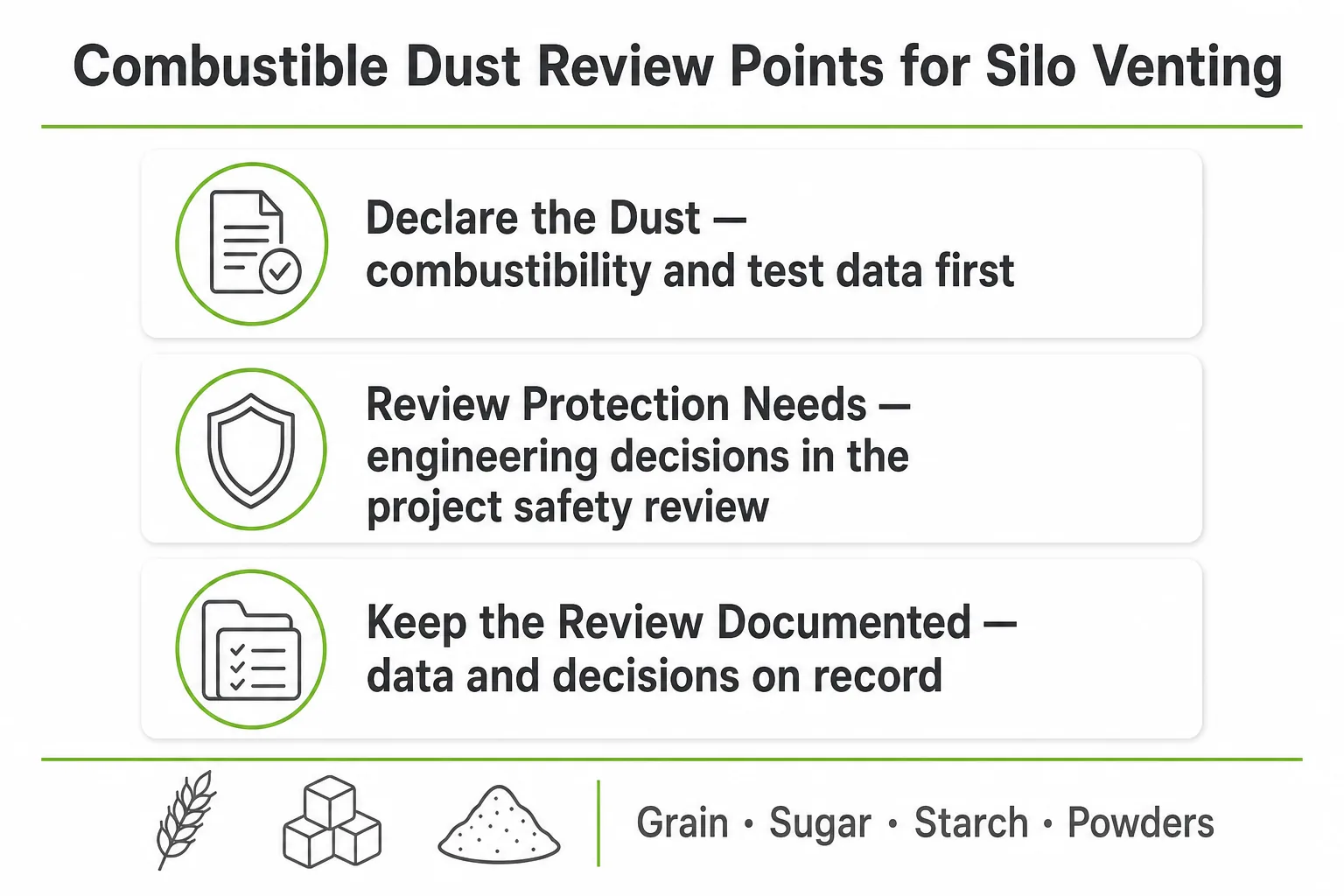
Combustible dust declaration, protection review and documentation belong in every silo venting project that handles grain, food powders or other combustible materials.
- Declare the dust: whether the stored material is combustible, and what test data exists, is the first question — it changes the equipment review before any sizing starts.
- Review protection needs: venting, isolation and other protective measures on the vessel and the filter are engineering decisions made in the project safety review; equipment suppliers support that review with accurate unit data rather than replacing it.
- Keep the review documented: the process side of this — what a documented review covers and who owns it — is described from a buyer’s perspective in our dust hazard analysis article. For grain storage specifically, OSHA’s grain handling page outlines why these facilities get dedicated attention.
None of this makes bin vents complicated to buy — it makes the data declaration non-optional. A combustible dust question discovered after installation is far more expensive than one declared in the inquiry.
Common Bin Vent Selection Mistakes
Most bin vent problems AIER hears about start in the selection stage, and they repeat across industries.
- Sizing by vessel volume instead of filling rate: the filter sees the displaced airflow, which follows how fast material enters — not how big the silo is.
- Ignoring pneumatic conveying air: dilute phase systems push conveying air through the vessel on top of displacement; a unit sized for gravity filling chokes on it.
- Treating all dusts alike: filter media that works on cement may be wrong for food powder hygiene or for fine, challenging dusts — media selection follows the material.
- Skipping the combustible dust declaration: grain, sugar and starch storage reviewed as if the dust were inert leaves the safety review incomplete.
- Forgetting the roof as a workplace: the unit needs cleaning access and element replacement room on top of a silo — maintenance planned at ground level fails at height.
- Using a bin vent where a system belongs: a vessel is one dust point; process capture points nearby may still need a designed central system, and pretending one roof filter covers both ends badly.
Information AIER Needs for a Bin Vent Review
A bin vent review is short when the inquiry carries the right data — most of it already exists in the conveying system design.
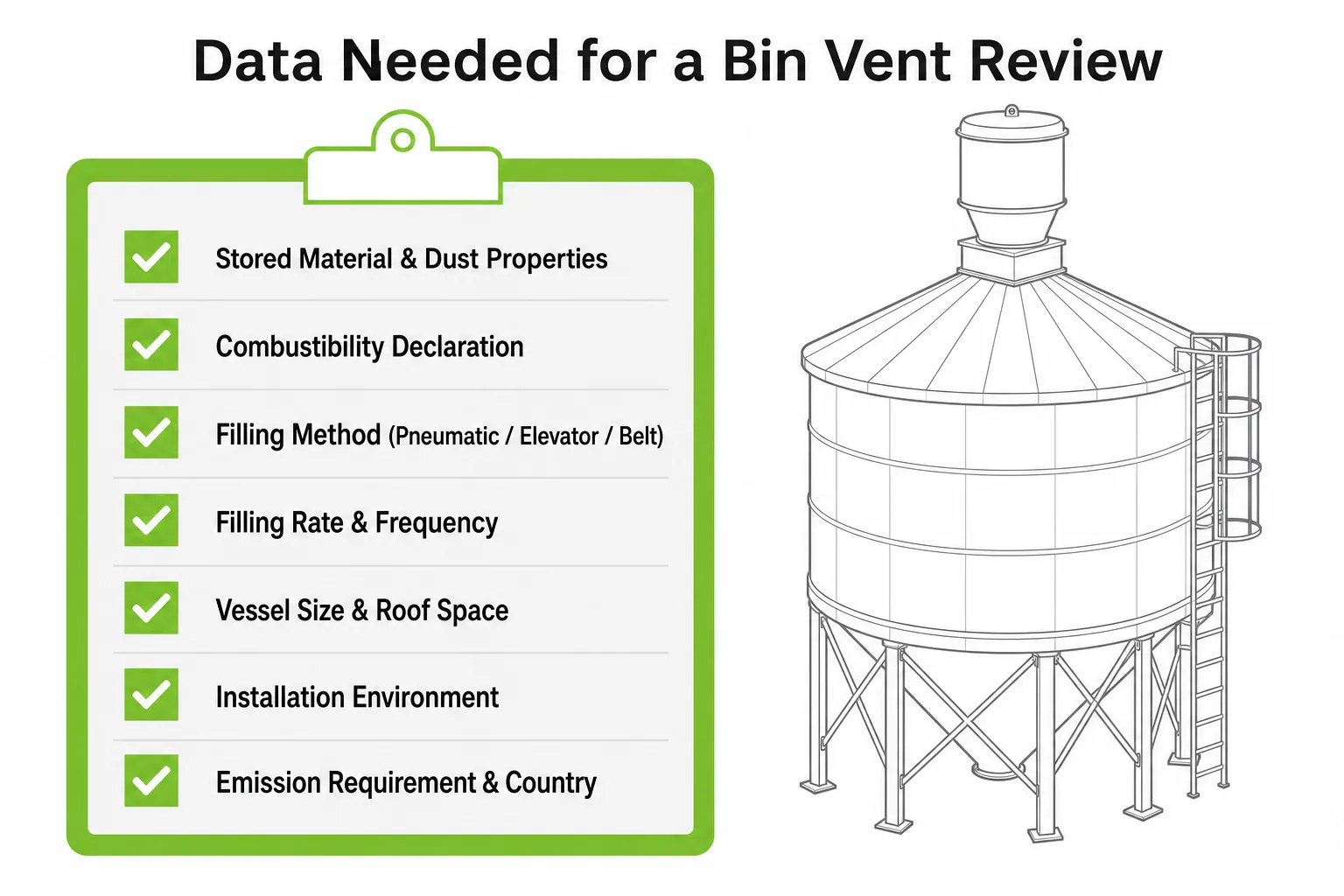
Material properties, filling method and rate, vessel details and the installation environment are the data AIER reviews before recommending a bin vent configuration.
| Data to Prepare | Why It Matters |
|---|---|
| Stored material and dust properties | Decides filter media, and combustibility must be declared |
| Filling method: pneumatic, elevator, belt | Sets the real airflow the filter must handle |
| Filling rate and frequency | Drives displaced air volume and cleaning duty |
| Vessel size and roof space | Decides flat bag vs round bag configuration and access |
| Number of vessels and layout | Bin vents per vessel vs a ducted arrangement |
| Installation environment | Outdoor weather protection and compressed air availability |
| Emission requirement and country | Defines what the vented air must achieve |
If your project includes silo, bin or hopper venting, contact AIER with the stored material, filling method and rate, vessel details and installation country. AIER will review whether a flat bag or round bag bin vent configuration fits each vessel — or whether the layout points to a different arrangement — with the reasoning shown.
FAQ
What is a bin vent dust collector?
A bin vent dust collector is a compact filter unit mounted on top of a silo, bin or hopper. It captures dust from the air displaced while the vessel is filled and returns the collected dust directly to the vessel through pulse cleaning, so no material is lost and no separate dust discharge is needed.
How does a bin vent work during silo filling?
Incoming material displaces an equal volume of air, which rises through the filter elements in the bin vent housing. Dust is retained on the media, cleaned air is released, and compressed air pulses periodically knock the dust back down into the vessel. The unit works hardest during filling and rests between deliveries.
What is the difference between a bin vent and a baghouse?
A bin vent filters one vessel’s venting air on the vessel itself and returns dust to the stored product, with no ductwork. A central baghouse serves many capture points through a designed duct system and collects dust as waste that needs discharge and handling. Storage vessels usually suit bin vents; multi-point process dust usually suits a central system.
Do bin vents work with pneumatic conveying systems?
Yes, but the review changes: conveying air adds to the displaced volume, arrives in surges and raises the dust load, so the unit must be sized for the real airflow rather than the vessel size. High-duty conveying lines are sometimes terminated with a filter receiver instead of a standard bin vent — the conveying data decides which fits.
Does AIER manufacture bin vent dust collectors?
Yes. AIER’s dust collection catalog includes bin roof dust collectors with adjustable pulse cleaning and differential pressure display, and flat bag bin top units used in food, grain and oil storage venting. Round bag pressure-resistant structures cover high-pressure conveying duty. Configuration for a specific vessel is handled as a selection review based on the material and filling data.
What information is needed to select a bin vent filter?
Provide the stored material and its dust properties including combustibility, the filling method and rate, vessel size and roof space, the number of vessels, the installation environment and the emission requirement with the installation country. AIER reviews the displaced airflow and dust behavior before recommending a flat bag or round bag configuration.