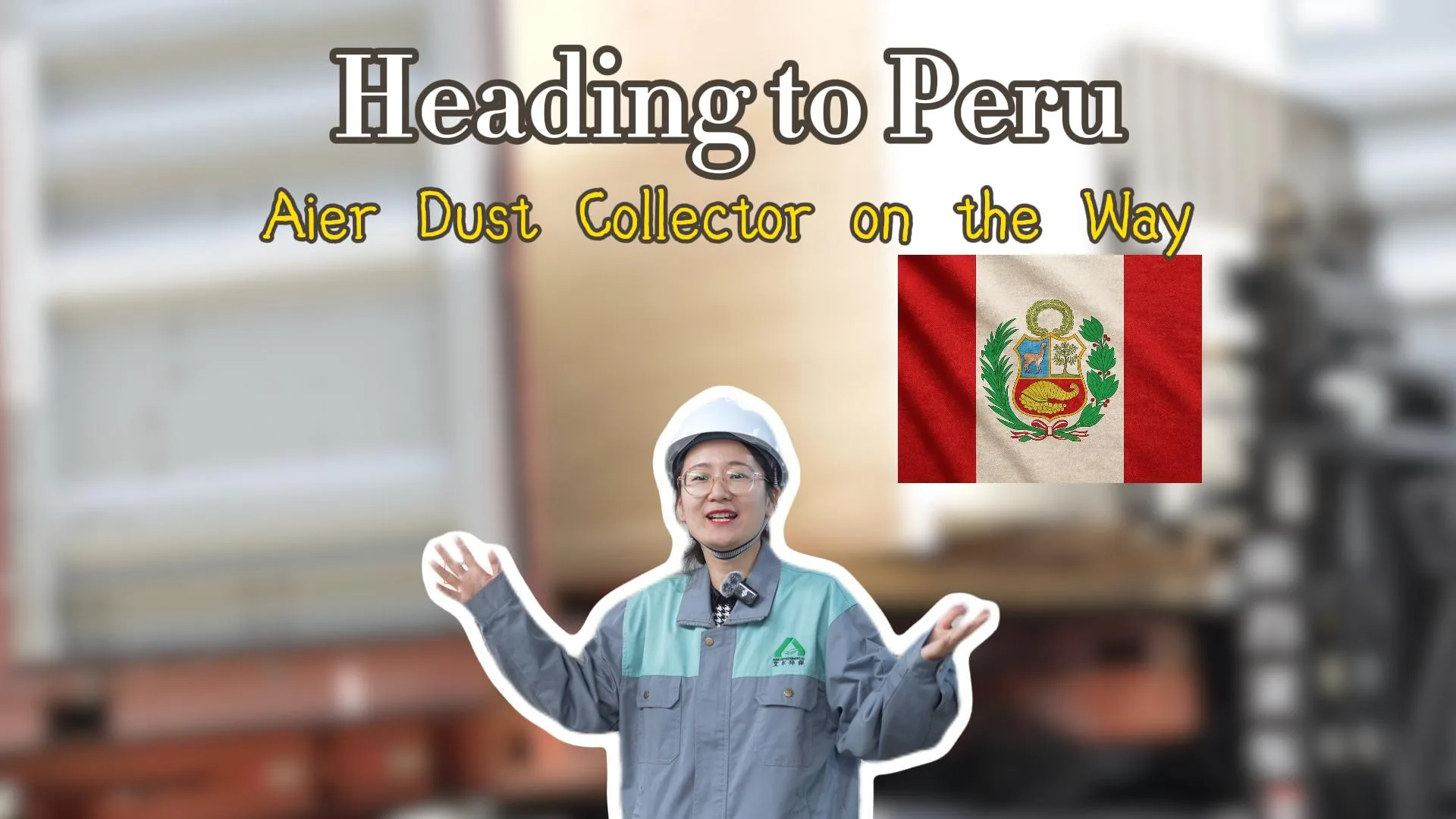
AIER Environmental Protection has completed another South America export: an industrial dust collector successfully shipped to Peru after manufacturing and final inspection. The system will serve industrial dust control and air pollution treatment at the client’s production site. Click the image above to watch the delivery video on YouTube.
Project at a glance:
- Destination: Peru, South America
- Equipment: industrial dust collector, custom-designed per operating conditions
- Design priorities: filtration performance, stable continuous duty, low O&M cost
- Status: completed, inspected and shipped under AIER quality control
Custom-Designed for the Operating Conditions
The dust collection system was designed against the client’s declared operating conditions — dust type, airflow, duty pattern and layout — rather than picked from a size chart. The design priorities were the practical ones plant teams live with: effective filtration, stable performance over continuous duty, and low operating and maintenance cost across the equipment’s service life — improving the working environment while supporting the site’s environmental compliance.
What Custom Design Means in Practice
For a dust collection project, “customized” is a sequence of decisions, not a label. The dust characteristics decide the collector platform; the platform and the gas conditions decide the filter media; the duty pattern decides the cleaning system settings; and the site layout decides the housing arrangement, access and discharge path. Skipping any step shows up later as high pressure drop, short filter life or a collector that never quite captures what it was bought for.
That review logic — matching the collector platform and filter media to the dust before any brand or price discussion — is the same one AIER applies across its industrial dust collection range, from bag dust collectors to cartridge and sintered plate platforms.
Inspection Before Shipment
Throughout manufacturing and final inspection, AIER implemented its internal quality control procedures, verifying key components and overall system performance against project specifications and relevant international standards before the equipment left the factory — the discipline that makes long-distance export projects predictable for the client on the receiving end.
For an ocean-freight project, that inspection stage also covers what travel does to equipment: protective packing for the housing and filter elements, fastener checks after test assembly, and marking that lets the site team stage components in installation order rather than unpacking a puzzle. Small details, but they are the difference between a commissioning week and a commissioning month.
Documentation and Delivery
Long-distance projects are won and lost in the paperwork as much as the workshop. This delivery shipped with the records the receiving team needs: arrangement drawings, factory inspection results, installation guidance and the operating notes that make start-up predictable. Once the system is running, the same logic that sized it becomes the maintenance baseline — watch the pressure drop trend, keep the cleaning system healthy, and service the filter elements on condition rather than on the calendar. The system-level thinking behind that approach is the same one covered in our dust collection system design article.
Growing Presence in South America
This shipment reinforces AIER’s ongoing expansion in South America and its delivery capability for international dust collection projects, where documentation, inspection records and shipping coordination matter as much as the equipment itself. For clients in mining, processing and manufacturing across the region, that predictability is often the deciding factor between a local compromise and an engineered system.
Every dust collector successfully shipped to Peru, Chile or any other South American destination follows the same sequence: declared conditions, matched platform, verified performance, documented handover. It is not a dramatic story — which is exactly the point. Predictable engineering is what industrial buyers on the receiving end of a long supply chain actually need.
If your facility in Peru or elsewhere in South America is planning a dust collection project, contact AIER with the dust type, airflow and operating conditions — the equipment review starts from the dust.