Buying an industrial dust collector for combustible dust is not only an airflow or filter area decision. If the dust can burn or explode when dispersed in air, the project also needs a safety review before the collector, ductwork, hopper discharge, fan arrangement and installation layout are finalized.
This article explains how dust hazard analysis, NFPA 660 awareness and combustible dust review points affect dust collector buying decisions. It is written for plant engineers, safety teams and project buyers who need to prepare the right information before discussing an industrial dust collection system with AIER. It does not replace a formal DHA, local compliance review, laboratory dust testing or qualified safety professional assessment.
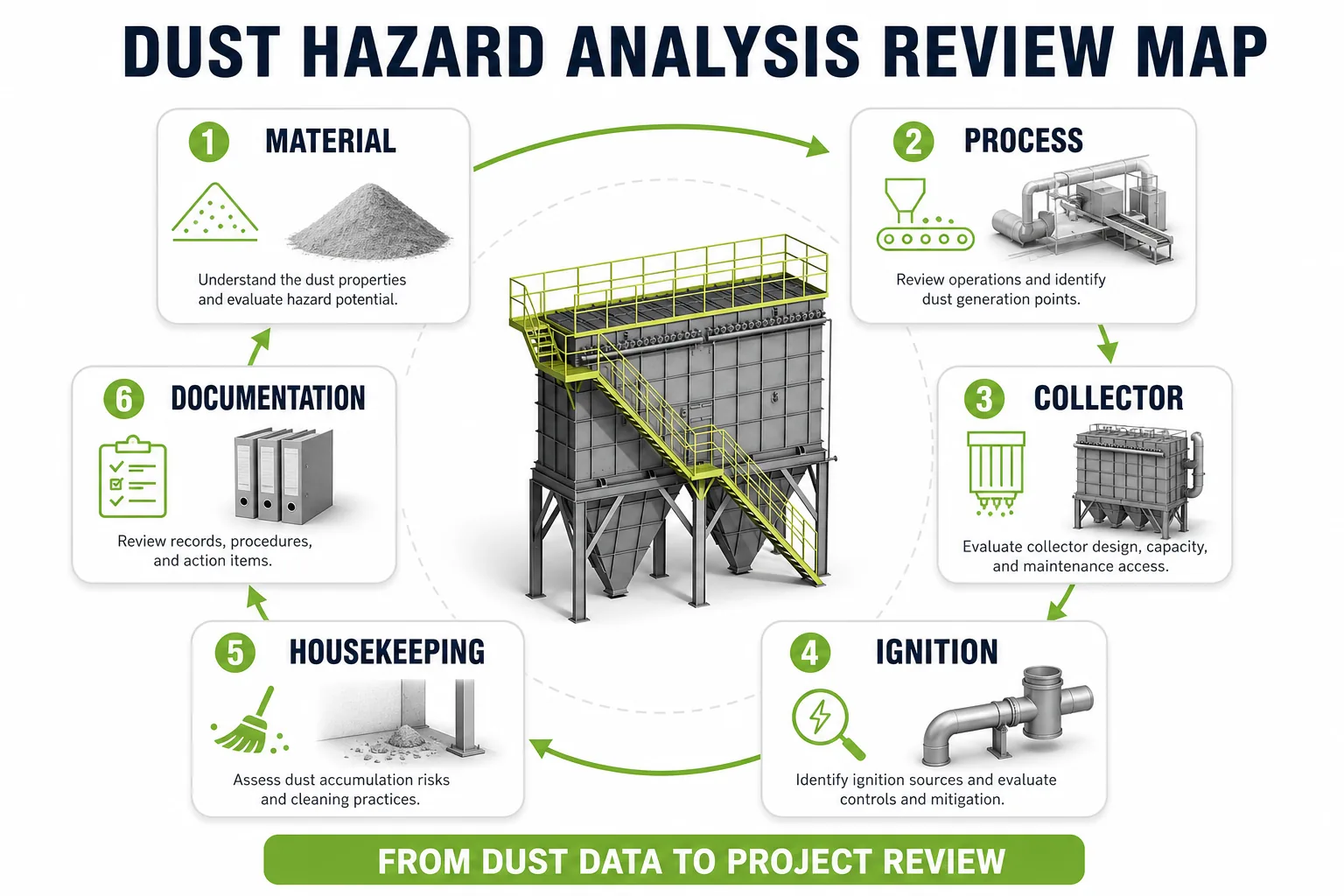
Dust hazard analysis connects material data, process conditions, dust collection equipment, ignition sources, housekeeping and documentation into one safety review.
What Is a Dust Hazard Analysis?
A dust hazard analysis is a documented review used to identify where combustible dust may create fire, flash fire or explosion hazards in a process or facility.
For a dust collection project, the analysis is important because the collector is often one of the places where dust concentration, airflow, filter surfaces, discharge points and possible ignition sources meet. A collector that looks correct from a filtration standpoint may still need additional review for explosion venting, suppression, isolation, grounding, location or housekeeping.
| DHA Review Area | Why It Matters for Dust Collectors | Data to Prepare |
|---|---|---|
| Dust material | Different powders have different combustibility and explosibility behavior | Material name, SDS, dust sample test data if available |
| Process points | Dust generation, conveying, transfer and cleaning methods affect risk | Process flow, dust source map, operating schedule |
| Collector layout | Collector location and duct routing affect protection and isolation review | Layout drawing, duct paths, indoor or outdoor placement |
| Ignition sources | Sparks, hot work, static discharge and hot surfaces can change the safety review | Equipment list, upstream process risks, grounding practices |
| Existing safeguards | Protection devices and operating procedures must be understood before upgrades | Explosion venting, isolation, suppression, maintenance records |
AIER can review dust collection system data, collector type, duct arrangement, filter media requirements and project conditions. A formal DHA or compliance determination should be handled by qualified safety professionals according to the site, material, jurisdiction and applicable standards.
Why NFPA 660 Matters for Dust Collector Buyers
NFPA 660 is important because it consolidates combustible dust safety requirements into a unified standard framework. For buyers, the practical takeaway is not to treat a dust collector as an isolated machine purchase. The collector should be reviewed as part of the process, dust material, building layout and protection strategy.
When combustible dust may be present, buying only by airflow, filtration area or price can miss critical project questions:
- Has the dust been tested, or is the team relying on assumptions?
- Is the collector handling dry combustible dust, sticky dust, hot dust or mixed dust?
- Will the collector be installed indoors or outdoors?
- Could a deflagration propagate back through the inlet duct or clean air side?
- Does the system need venting, suppression, isolation or other protective measures?
- Who will verify the final safety and compliance requirements for the site?
The answer is not the same for every plant. A food powder, metal dust, pharmaceutical dust, carbon black dust or plastic fines application may require different review data and different engineering decisions. The role of an equipment supplier is to support the system review with accurate collector and ductwork information, not to replace the safety assessment.
NFPA 660, NFPA 652 and Combustible Dust Standards
NFPA 652 was widely used as a fundamental combustible dust standard, while NFPA 660 has consolidated combustible dust and particulate solids guidance into a broader unified structure. For buyers, this means older documentation, drawings or safety discussions may still reference NFPA 652, while newer projects may need to consider NFPA 660-related expectations.
This article does not interpret NFPA standards or provide compliance instructions. Instead, it focuses on what a dust collector buyer should prepare before asking suppliers, safety professionals or local authorities to review a project.
| Topic | Buyer-Level Question | Why It Affects Equipment Review |
|---|---|---|
| DHA status | Has the facility completed or updated a dust hazard analysis? | Collector configuration should follow the project risk review |
| Dust testing | Are KSt, Pmax, MIE or other relevant test data available? | Protection strategy cannot be based only on dust name |
| Collector placement | Will the collector be indoors, outdoors or near occupied areas? | Location can affect venting, discharge direction and access |
| Isolation | Could flame or pressure travel through connected ductwork? | Duct connections may need isolation review |
| Documentation | Are drawings, equipment data and operating assumptions recorded? | Safety review depends on traceable project information |
For official combustible dust safety information, buyers should consult qualified professionals and authoritative sources such as NFPA and OSHA combustible dust information.
The Dust Explosion Pentagon Explained
The dust explosion pentagon is a simple way to explain why combustible dust can become dangerous. It includes five elements: combustible dust, oxygen, dispersion, ignition source and confinement. If these elements exist together under the right conditions, a fire or explosion hazard may be present.
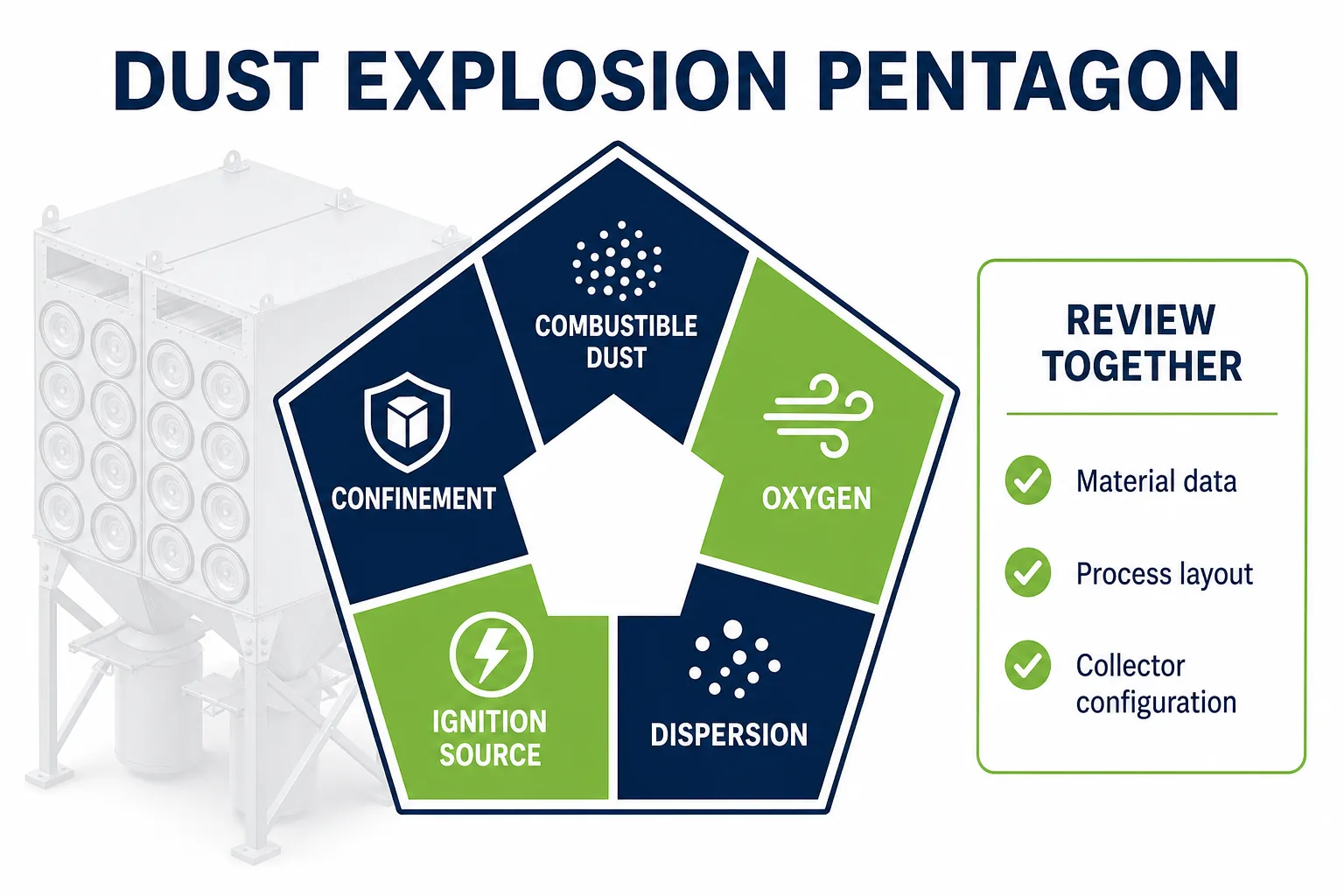
The dust explosion pentagon helps buyers understand why dust material, airflow, ignition control and equipment layout should be reviewed together.
| Pentagon Element | Dust Collector Connection | Buyer Review Point |
|---|---|---|
| Combustible dust | Dust is concentrated in filters, hoppers and ductwork | Confirm material properties and testing needs |
| Oxygen | Most dust collectors move air as the conveying medium | Understand whether inerting or other measures are relevant |
| Dispersion | Dust is suspended by airflow inside ducts and collector chambers | Review airflow, dust loading and cleaning pulses |
| Ignition source | Sparks, hot particles, static discharge or hot surfaces may enter the system | Review upstream process and ignition control |
| Confinement | Collector housings, ducts and vessels can confine pressure | Review venting, suppression, isolation and location |
This framework is useful for early project discussions, but it is not a substitute for testing or a formal hazard analysis. A low-volume dust source can still deserve review if the material is combustible and the process creates dispersion and ignition risk.
What Dust Data Should Be Prepared Before Collector Selection?
Dust collector selection should not begin with the equipment model alone. For combustible dust service, buyers should prepare material, process and layout data before asking for a collector recommendation.
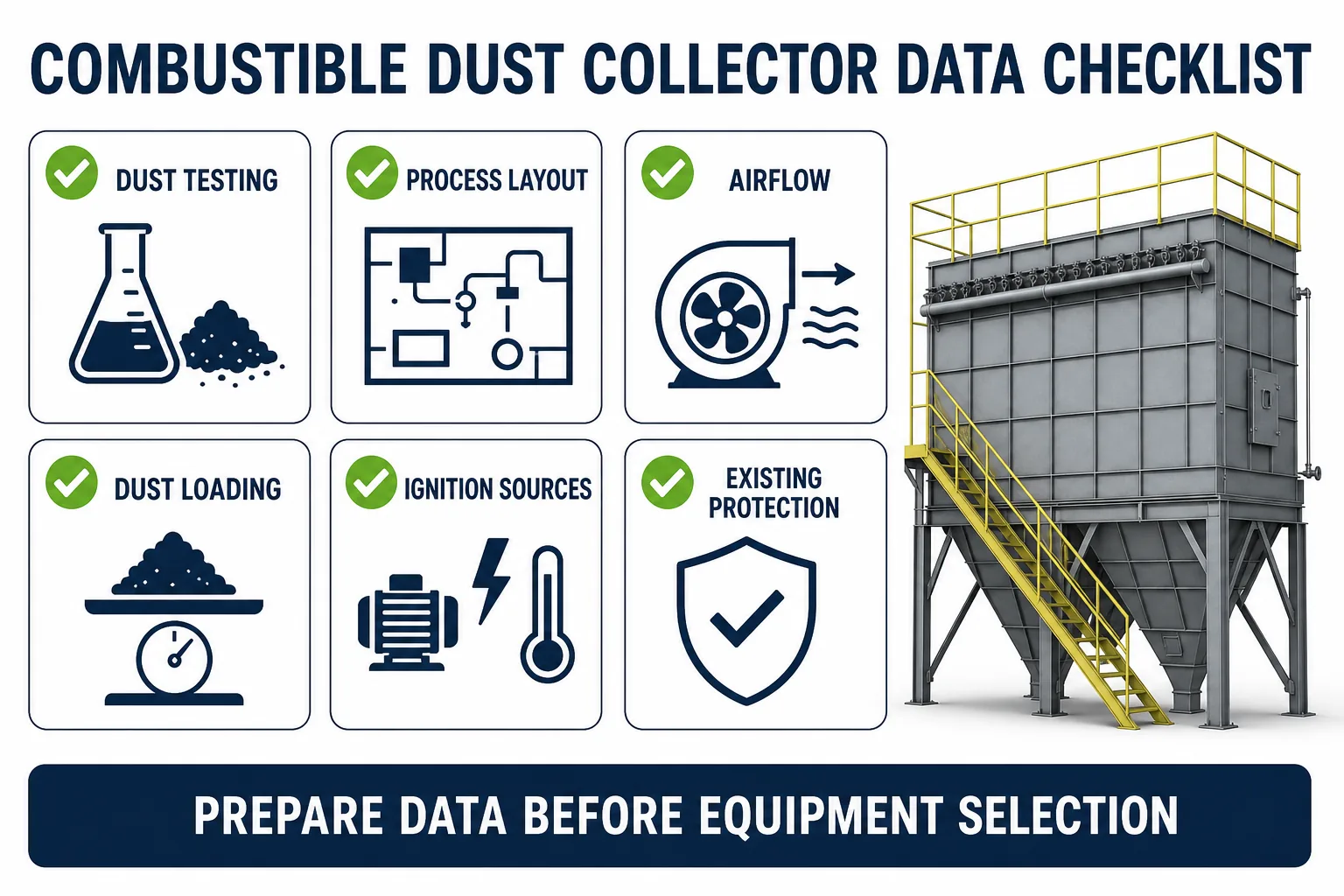
Combustible dust projects need material, process, layout and protection data before the collector configuration can be reviewed.
Material and Dust Test Data
Useful material information may include the dust name, SDS, particle size, moisture, temperature, dust loading and whether dust testing has been completed. Depending on the project, safety professionals may request test values such as KSt, Pmax, MIE or other parameters. AIER should not guess these values from the dust name.
Process and Airflow Data
Process information should show where dust is generated, how it is captured, whether multiple points operate at the same time and whether sparks or hot particles may enter the system. This connects directly to the previous article on dust collection system design, because airflow, duct routing and collector location affect both performance and safety review.
Collector and Layout Data
Important layout information includes collector location, duct length, inlet and outlet routing, clean air discharge, access space, hopper discharge method and whether the collector is near occupied areas, walls, traffic routes or process equipment. A collector selected without layout context may need redesign later. Storage silos and hoppers bring their own venting arrangement into this picture — how those units are reviewed is covered in our bin vent dust collector article.
Dust Collector Review Points for Combustible Dust
When combustible dust may be present, the dust collector review should include more than filter area and fan capacity. The following points should be discussed before procurement, especially for new installations, process changes or replacement projects.
| Review Point | What to Check | Why It Matters |
|---|---|---|
| Collector type | Baghouse, cartridge, sintered plate or wet collection route | Different collectors handle dust loading, cleaning and protection interfaces differently |
| Filter media | Temperature, moisture, static risk, chemical exposure and dust release behavior | Incorrect media can increase pressure drop or create operating issues |
| Explosion protection interface | Whether venting, suppression, isolation or other measures need review | Protection decisions depend on DHA and project-specific data |
| Hopper discharge | Dust storage, rotary valve, bin, bagging or continuous discharge | Accumulated dust and poor discharge can create operational and safety concerns |
| Housekeeping and access | Cleaning routes, filter replacement access and dust accumulation areas | Maintenance practices affect long-term risk control |
For example, a baghouse dust collector may fit heavy dust loading and filter bag service access, while a cartridge dust collector may fit compact layouts or fine dust applications. A sintered plate dust collector may be considered where high filtration efficiency and surface filtration are important. The final choice still depends on dust properties, airflow, layout and safety review — a broader map of the platforms is in our types of dust collectors overview.
If filter media is part of the concern, the earlier article on dust collector filter bags can help buyers understand how temperature, moisture, chemical exposure and static risk affect bag material selection.
Explosion Protection, Isolation and Collector Location
Explosion protection and isolation are specialized engineering topics. A buyer should not select them from a generic checklist without project-specific analysis. However, buyers can prepare better questions before discussing a project with suppliers and safety professionals.
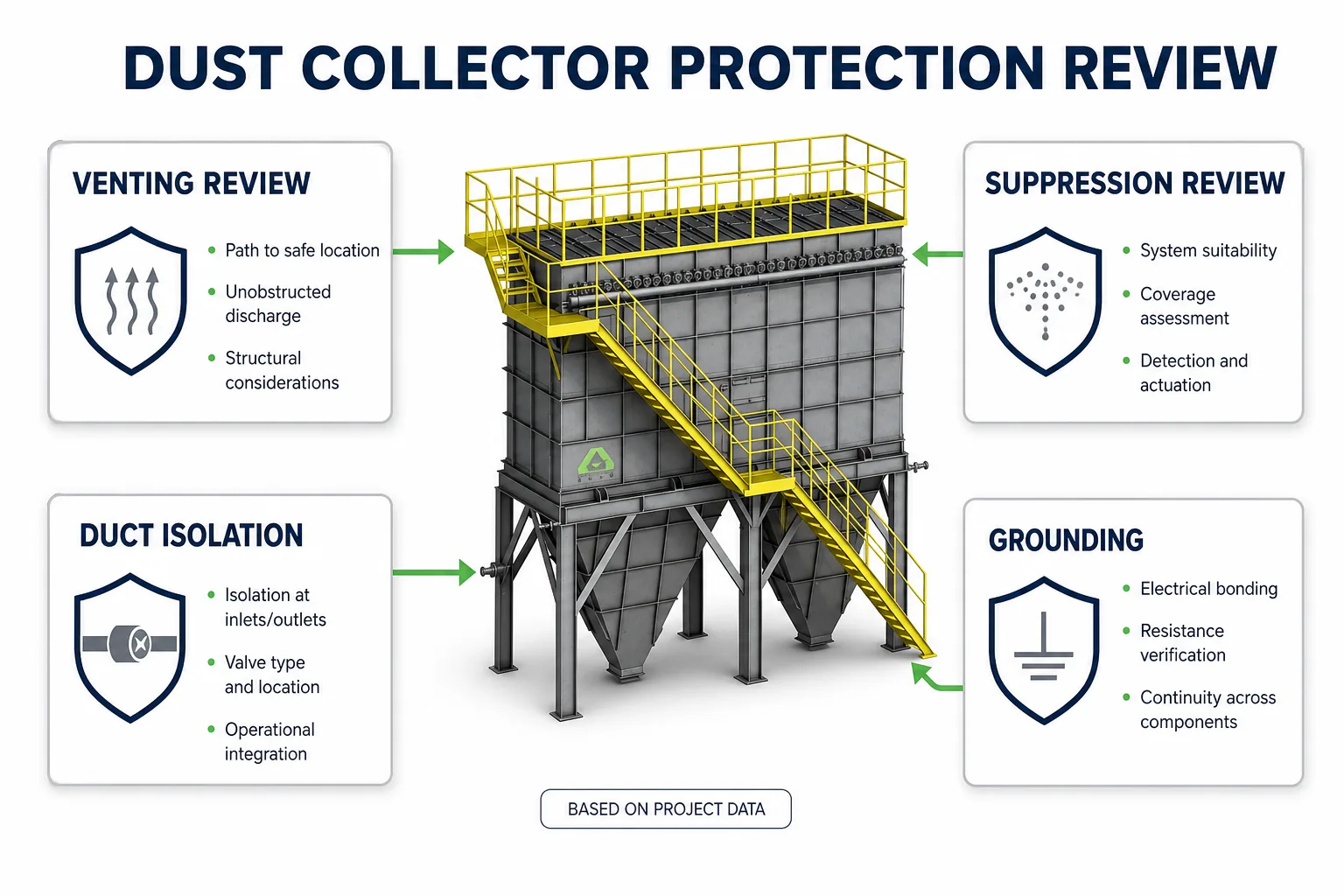
Explosion protection, isolation and collector location should be reviewed from project data, not from generic equipment labels.
Explosion Venting and Suppression
Some combustible dust collector applications may require deflagration venting, suppression or other engineered protective measures. The correct method depends on dust characteristics, collector volume, location, duct connections and applicable requirements. AIER can provide collector dimensions and configuration information for review, but the design decision should be made by qualified professionals.
Inlet and Outlet Isolation
Connected ductwork can create a path for flame or pressure propagation. This is why inlet and outlet isolation may be part of the review for combustible dust systems. Buyers should provide duct routing, branch layout, fan position and clean air discharge information so the system can be evaluated properly.
Collector Location
Collector location affects access, discharge direction, vent routing, building layout and maintenance. Indoor and outdoor installations may lead to different review requirements. A layout drawing should be prepared before the equipment quotation is finalized.
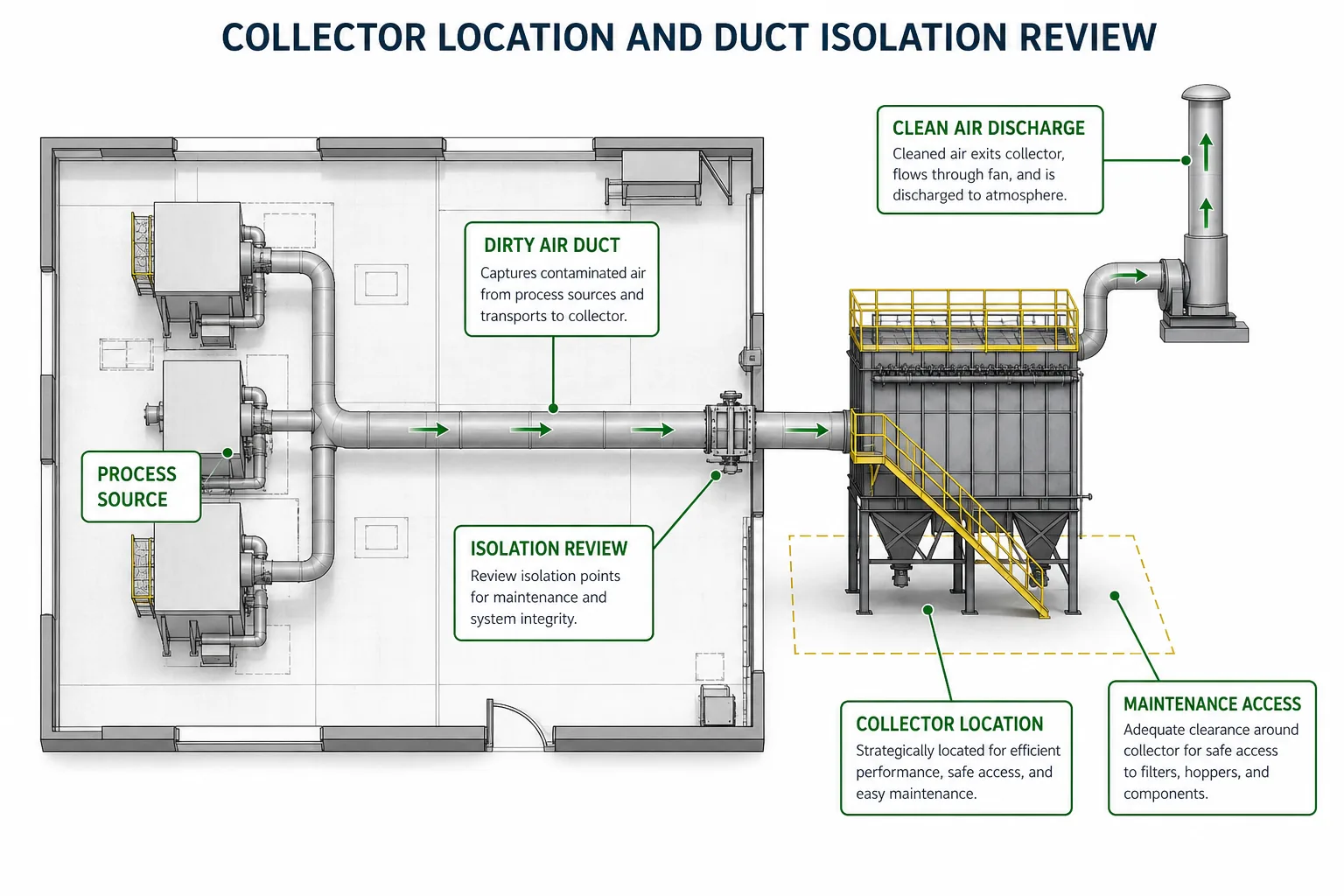
Collector location, duct isolation and clean air discharge should be considered early, because they can affect both safety review and installation design.
Common Mistakes When Buying a Dust Collector for Combustible Dust
Combustible dust projects often go wrong when the buyer treats safety review as a late-stage accessory. The collector should be reviewed early enough that layout, protection interface, maintenance access and documentation can still be adjusted.
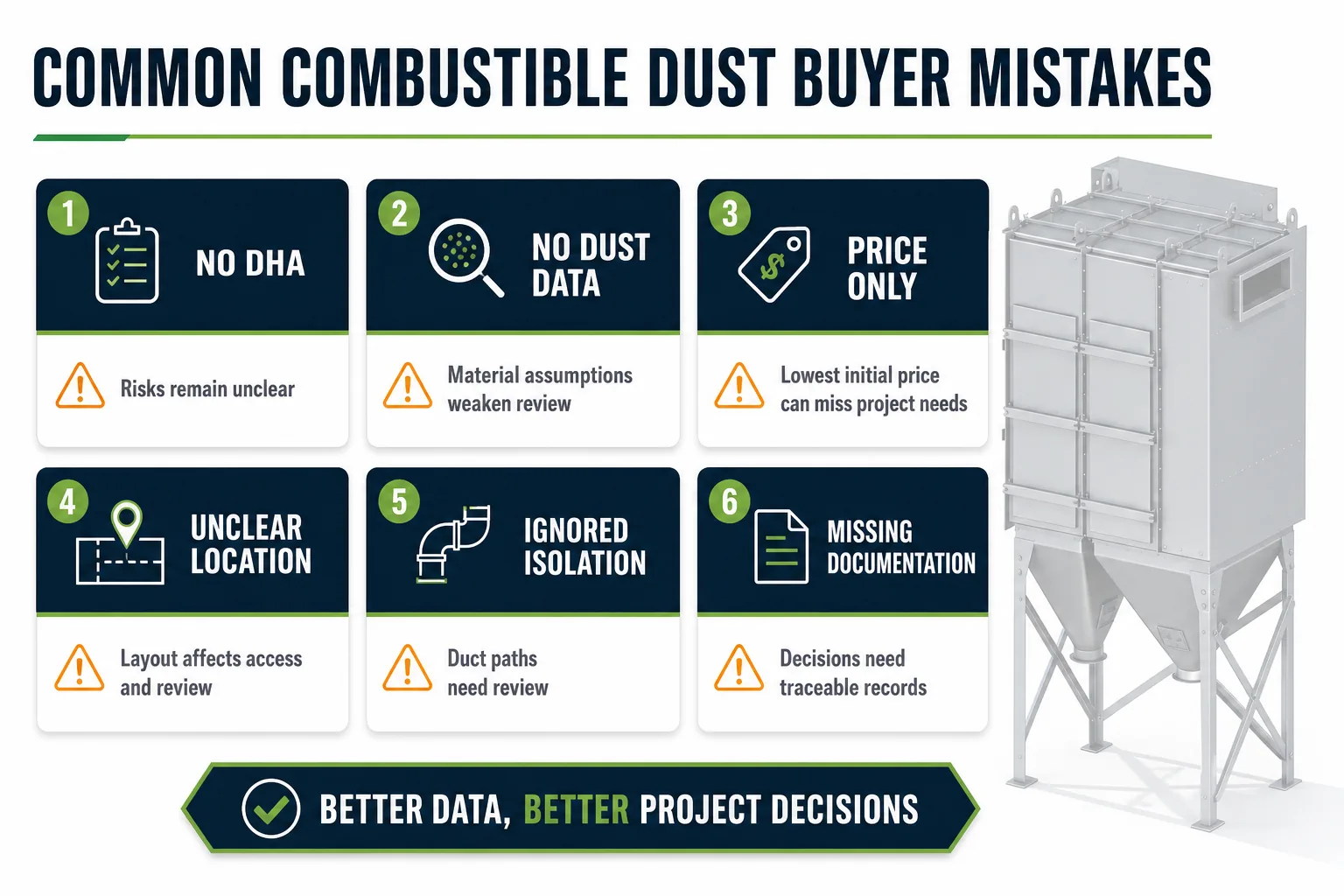
Common buyer mistakes include missing dust data, delayed safety review, unclear collector location and comparing only equipment price.
- Assuming all dust is the same: material name alone is not enough to judge combustibility or explosion severity.
- Buying before reviewing the DHA: equipment configuration should follow the project safety review, not the other way around.
- Using generic explosion-proof language: buyers should ask what data, protection method and documentation support the claim.
- Ignoring duct isolation: a protected collector can still be connected to unreviewed ductwork.
- Leaving collector location until the end: vent direction, access space and building constraints can change the system design.
- Missing housekeeping and discharge details: dust accumulation and poor discharge can create ongoing risk after installation.
What AIER Can Review Before a Dust Collection Project
AIER can support the equipment and system side of a combustible dust collection project. The goal is to help the buyer prepare accurate information for collector selection and safety review, while recognizing that formal DHA and compliance decisions must be handled by qualified safety professionals.
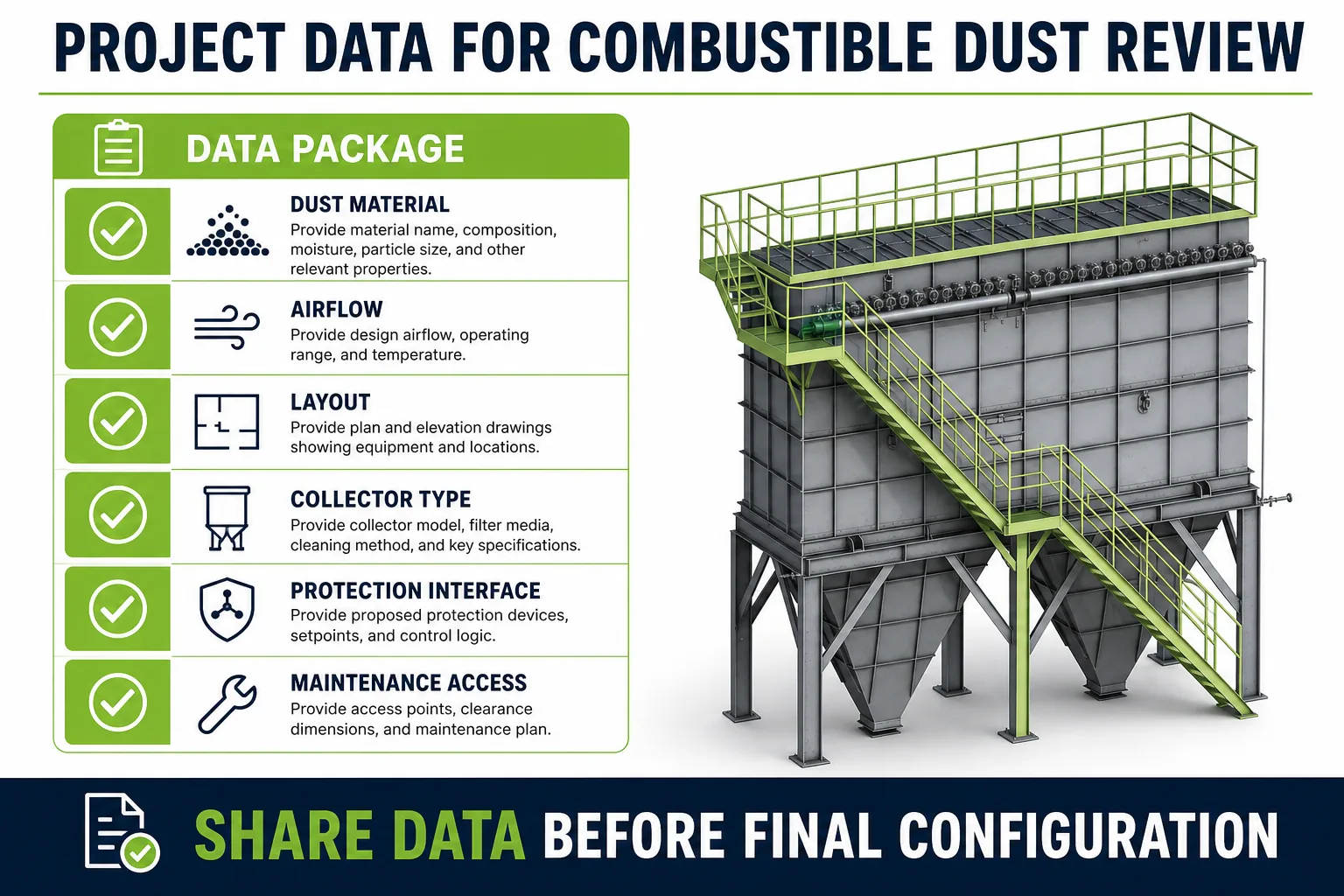
AIER can review dust collection system configuration more efficiently when dust material, airflow, layout and safety review data are prepared.
| Data to Share With AIER | How It Helps the Review |
|---|---|
| Dust material and test information | Helps avoid choosing collector components based on assumptions |
| Dust source map and airflow requirement | Supports collector sizing, duct routing and capture review |
| Plant layout and installation location | Helps review access, discharge, duct routing and equipment arrangement |
| Existing DHA or safety review notes | Helps align the equipment discussion with project safety requirements |
| Preferred collector type or existing equipment | Helps compare new design, replacement or upgrade options |
| Maintenance and housekeeping constraints | Helps avoid designs that are difficult to inspect, clean or service |
If you are planning a new combustible dust collection system or upgrading an existing collector, contact AIER with your dust material, process layout, airflow requirement and any existing DHA or safety review information. AIER can review the dust collection equipment configuration and help prepare the system data needed for further project evaluation.
FAQ
What is a dust hazard analysis?
A dust hazard analysis is a documented review that identifies where combustible dust may create fire, flash fire or explosion hazards in a facility. It should be performed by qualified professionals using project-specific material, process and equipment data.
Is NFPA 660 replacing NFPA 652?
NFPA 660 consolidates combustible dust guidance that previously existed across several NFPA standards, including NFPA 652. Buyers should ask qualified safety professionals how current standards apply to their facility and project.
What is the dust explosion pentagon?
The dust explosion pentagon includes combustible dust, oxygen, dispersion, ignition source and confinement. If these elements exist together under the right conditions, a fire or explosion hazard may be present.
Does every dust collector need explosion protection?
No single answer fits every dust collector. Explosion protection depends on dust properties, process conditions, collector design, location, duct connections and applicable safety review results.
What dust test data is needed before selecting a dust collector?
Depending on the material and project, safety professionals may request data such as KSt, Pmax, MIE, particle size, moisture, dust loading and other test results. Equipment selection should not rely only on dust name.
Can AIER complete a dust hazard analysis for my facility?
AIER can review dust collection system data, collector configuration and equipment fit. A formal DHA or compliance review should be completed by qualified safety professionals according to your facility, material and local requirements.