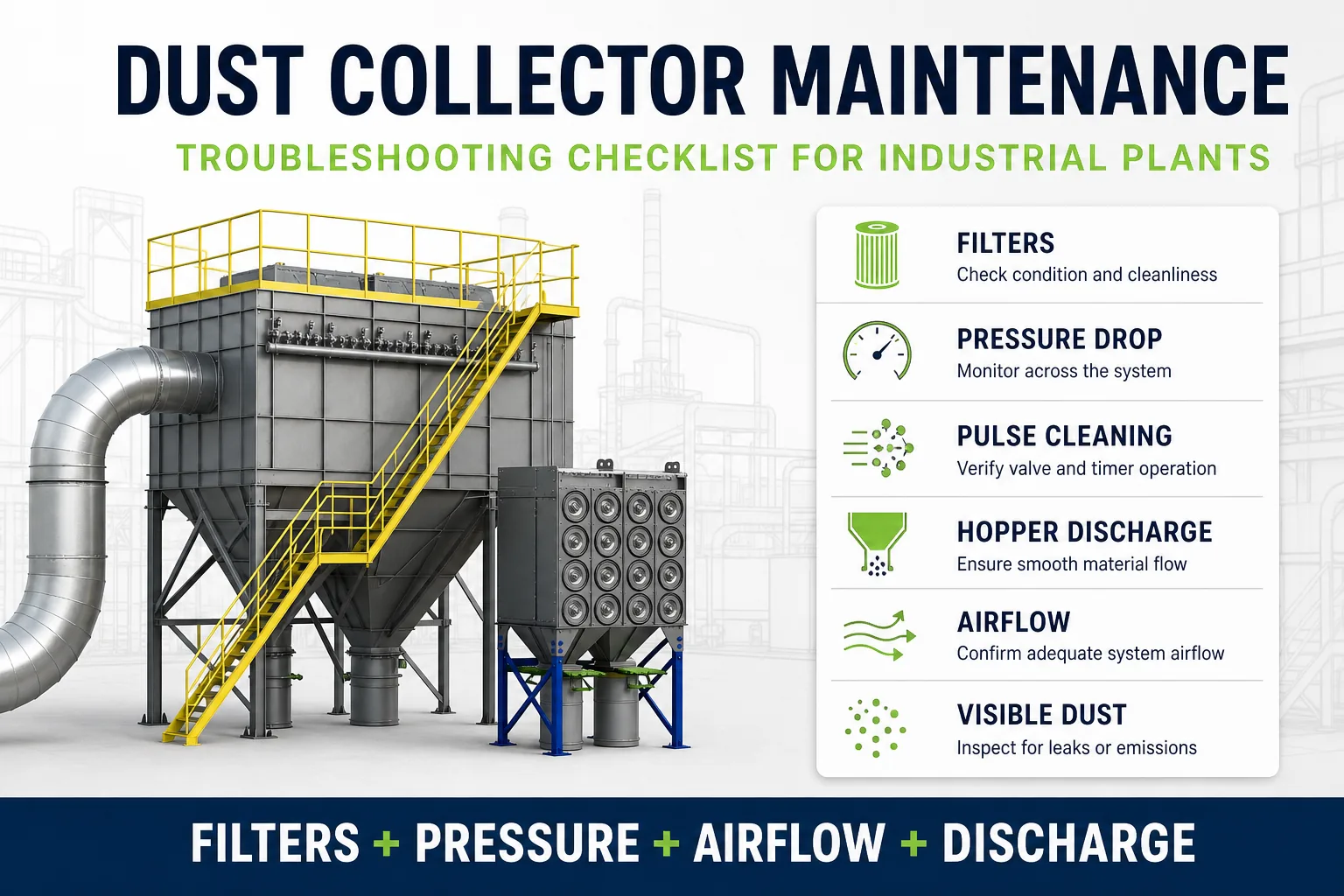
Dust collector maintenance is not just replacing filters when the system alarms. In an industrial plant, maintenance should keep capture airflow stable, keep pressure drop within the expected operating range, prevent dust buildup, protect filter life and make sure the system remains practical to inspect and service.
This article explains dust collector maintenance and troubleshooting for industrial plants. It is written for production managers, maintenance teams, plant engineers and project buyers who operate industrial dust collection systems. It does not replace site inspection, combustible dust safety review, local regulations or the equipment manual for a specific installed system.
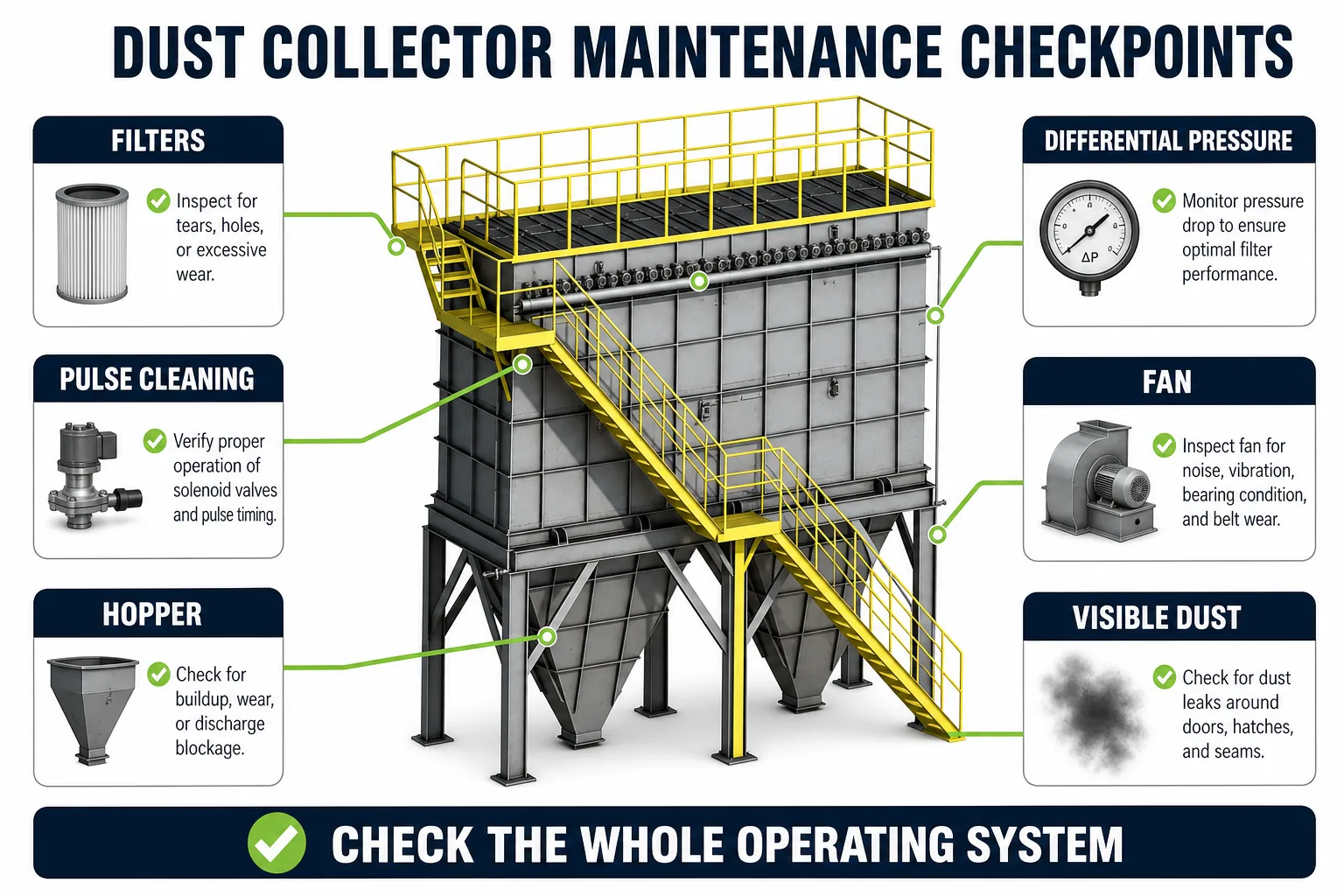
Dust collector maintenance should review filters, pressure drop, cleaning system, dust discharge, ductwork, fan condition and visible emissions as one operating system.
What Should Dust Collector Maintenance Include?
Dust collector maintenance is the routine inspection and correction of filters, pressure drop, cleaning system, dust discharge, airflow, ductwork and access points so the collector can keep capturing dust safely and consistently.
A good maintenance program does not start with a single replacement part. It starts with operating evidence: what changed, when it changed, what the differential pressure shows, whether airflow has dropped, whether dust is escaping and whether discharge or cleaning systems are working as intended.
| Maintenance Area | What to Check | Why It Matters |
|---|---|---|
| Filter condition | Bags, cartridges, pleated bags or sintered plates | Damaged or overloaded filters can raise pressure drop or release dust |
| Differential pressure | Normal trend, sudden rise, sudden drop or unstable reading | Pressure behavior is one of the fastest troubleshooting signals |
| Pulse cleaning | Compressed air pressure, pulse valves, controller and cleaning sequence | Poor cleaning can shorten filter life and reduce airflow |
| Hopper discharge | Dust level, bridge formation, rotary valve, bin or bagging system | Dust should leave the collector instead of building up inside it |
| Ductwork and fan | Leaks, damper position, vibration, belt condition and airflow balance | A collector can look faulty when the real problem is upstream or downstream |
The right inspection frequency depends on dust loading, operating hours, material type, temperature, moisture, process stability and safety requirements. High dust loading or sticky dust usually needs closer review than a clean, stable process.
Daily, Weekly and Monthly Dust Collector Inspection Points
Inspection schedules should be adjusted by the plant and equipment manual, but many industrial systems can be organized into daily, weekly and monthly review points. The goal is to catch small changes before they become production stoppages.
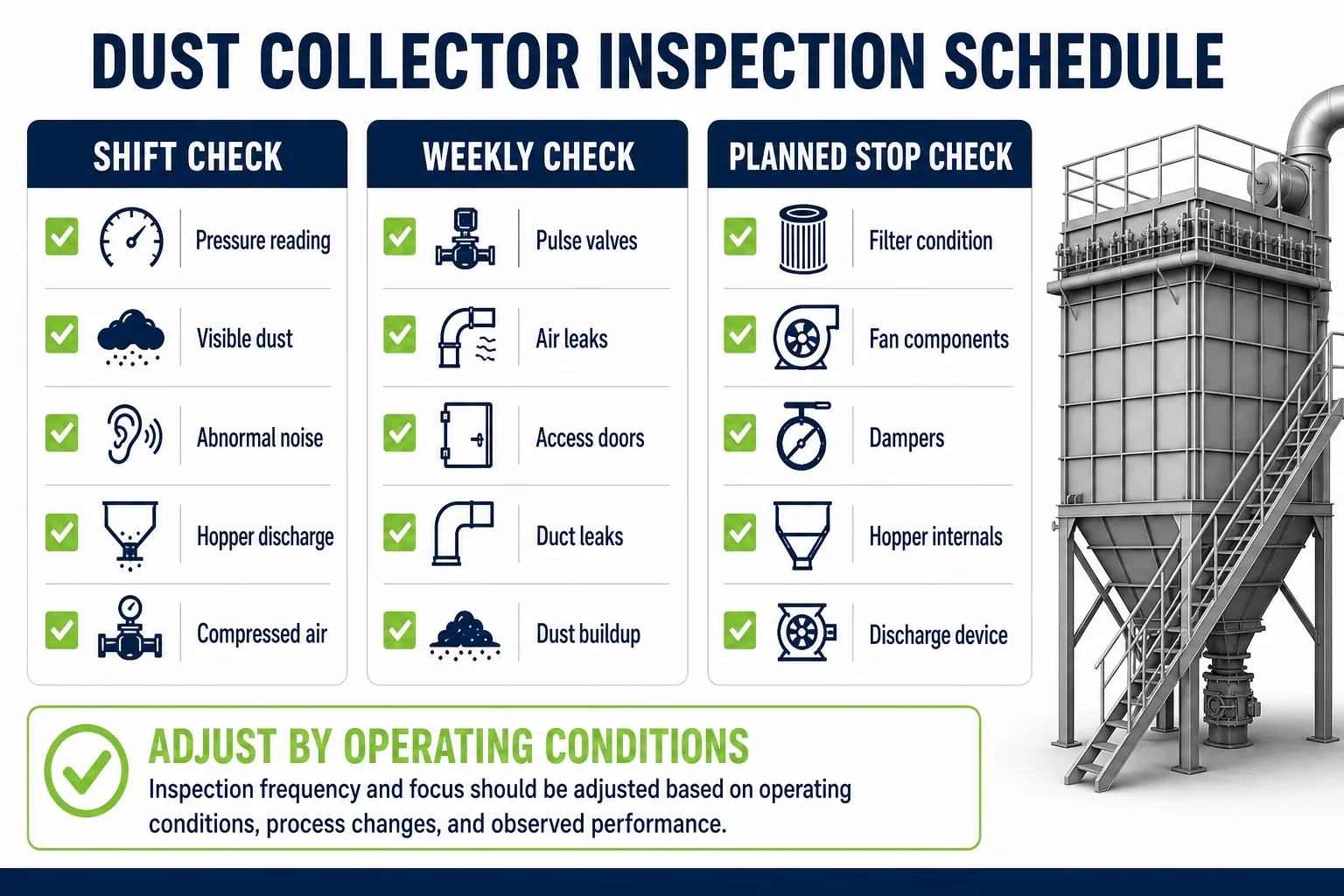
Maintenance frequency should be adjusted by operating conditions, but structured daily, weekly and monthly checks help teams notice changes earlier.
| Inspection Level | Typical Checkpoints | Action if Abnormal |
|---|---|---|
| Daily or shift check | Differential pressure, visible dust, abnormal noise, hopper discharge, compressed air status | Record the reading and check whether the change matches production conditions |
| Weekly check | Pulse valves, air leaks, access doors, duct leakage, dust buildup around pickup points | Clean, repair leaks and verify whether airflow improves |
| Monthly or planned stop check | Filter condition, fan components, dampers, hopper internals, discharge device and structural access | Plan replacement, deeper cleaning or engineering review if trends continue |
| After process change | New material, increased loading, added pickup points, changed production rate | Recheck airflow, pressure drop and collector capacity assumptions |
Plants handling combustible dust should also coordinate maintenance with the facility safety program, dust hazard analysis, housekeeping plan and local requirements. This article focuses on equipment operating review; the previous article on dust hazard analysis and NFPA 660 review points covers safety review boundaries in more detail.
Pressure Drop and Differential Pressure Checks
Differential pressure is one of the most useful operating signals in dust collector troubleshooting. It compares pressure before and after the filter section and helps show whether the filters are clean, loaded, damaged or not being cleaned effectively.
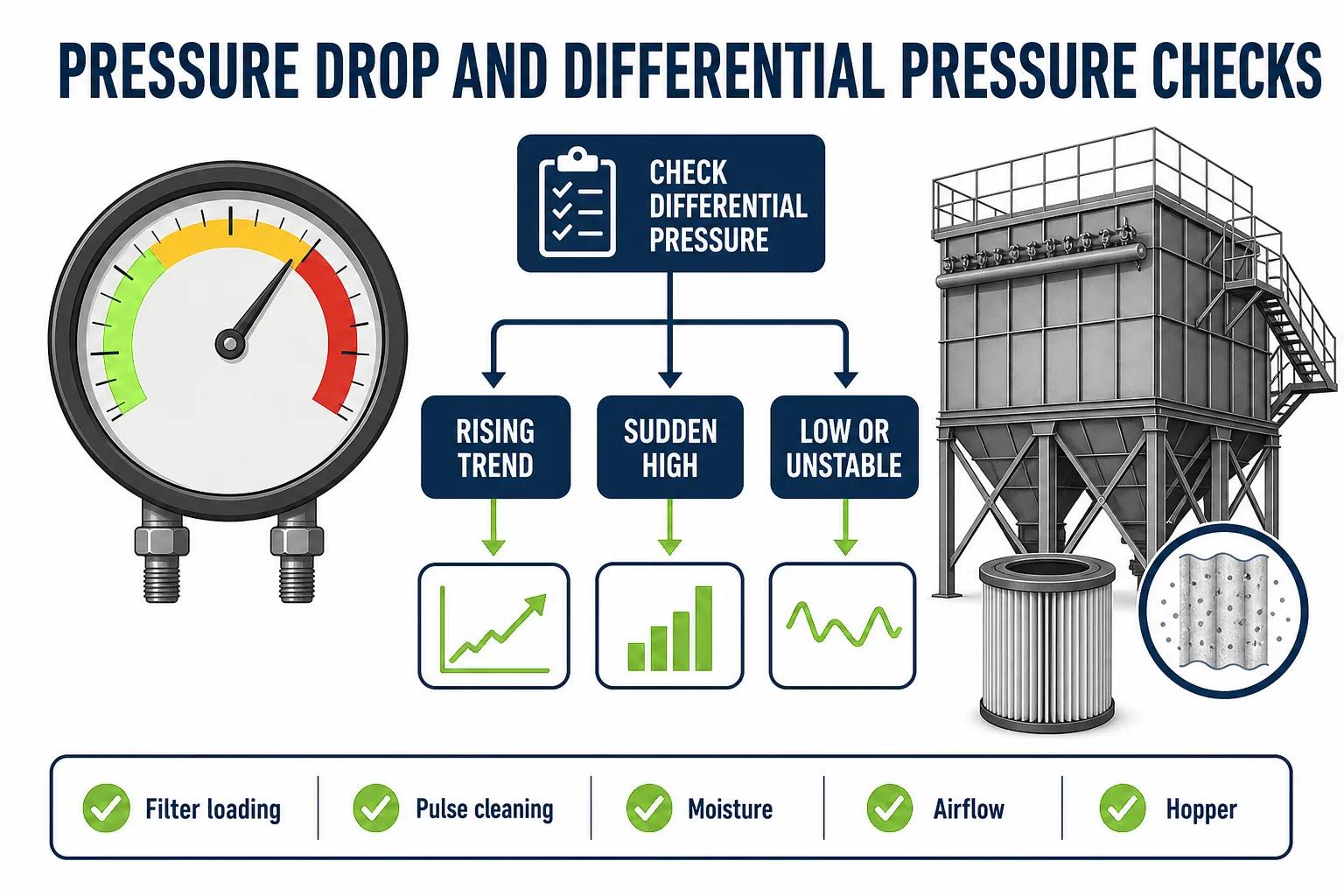
Pressure drop troubleshooting should look at the trend, not only one reading, because production loading and cleaning performance both affect the result.
| Pressure Drop Symptom | Possible Cause | First Checks |
|---|---|---|
| Gradually rising pressure drop | Filter loading, sticky dust, weak cleaning, excessive airflow or moisture | Check cleaning cycle, compressed air, dust properties and filter condition |
| Sudden high pressure drop | Blocked duct, hopper overfill, wet dust, failed pulse cleaning or process upset | Check hopper, duct restriction, pulse system and recent process changes |
| Very low pressure drop | Filter damage, bypass leak, open access door or insufficient airflow | Check emissions, seals, filter seating, fan status and damper position |
| Unstable pressure reading | Sensor issue, tubing blockage, pulse interference or fluctuating process load | Check gauge tubing, sensor location and operating schedule |
A high dust collector pressure drop does not always mean the collector is too small. It may be a cleaning problem, compressed air problem, wet dust problem, filter media mismatch or ductwork issue. If the trend continues after basic checks, the system may need engineering review.
Troubleshooting Poor Dust Capture and Low Airflow
Poor dust capture is not always caused by the collector itself. A large collector can still perform poorly if capture hoods are too far from the dust source, ducts leak, branches are unbalanced, dampers are closed or the fan cannot overcome system resistance.
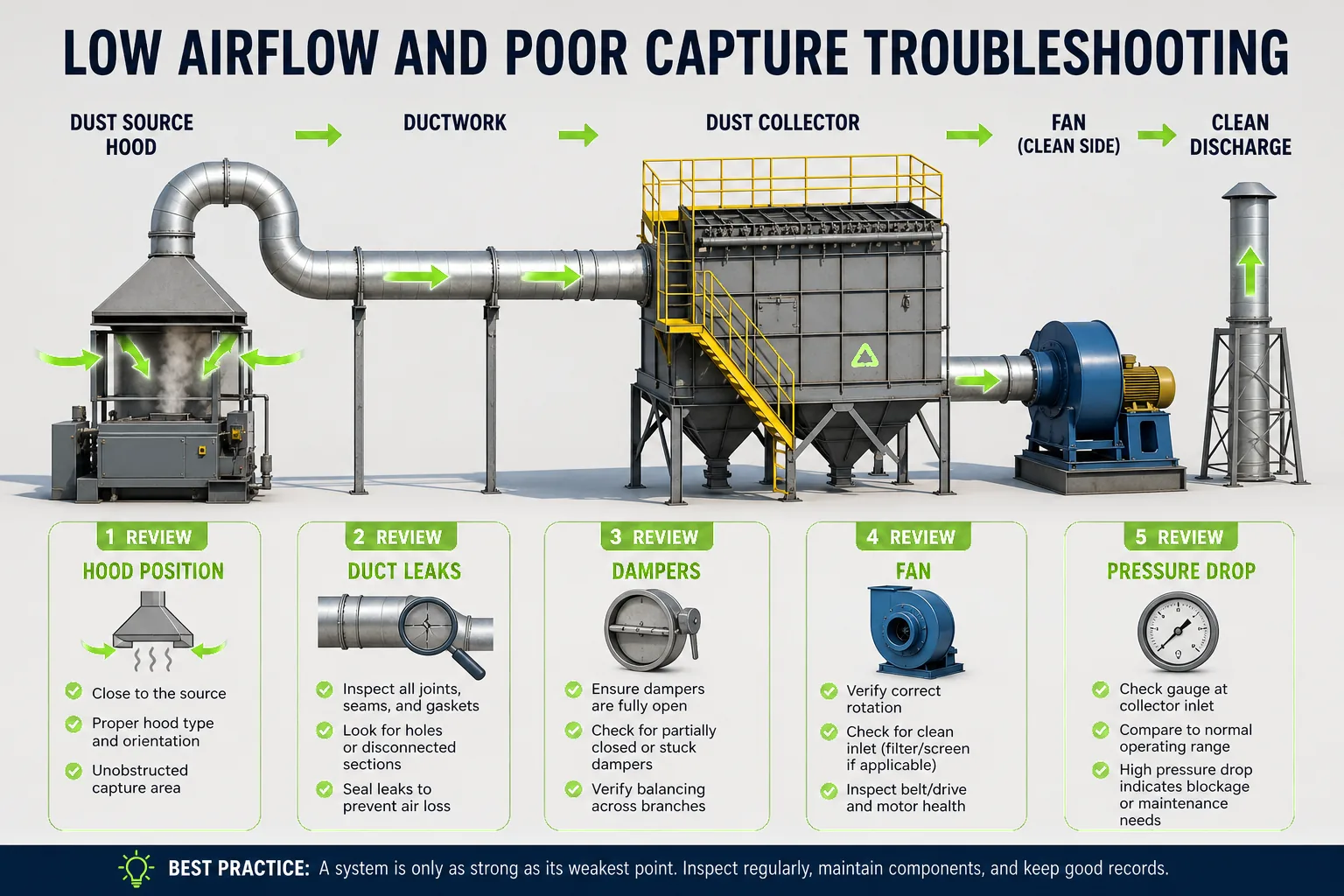
Low airflow troubleshooting should start at the dust source and move through hoods, ducts, fan performance and collector condition before replacing major equipment.
Start at the Capture Point
Check whether the hood or enclosure still matches the process. Production changes, new material feed points, open access doors, side drafts or operator modifications can reduce capture efficiency even when collector airflow has not changed.
Review Ductwork and Dampers
Duct leaks, dust buildup, sharp elbows, closed dampers or added branch lines can reduce airflow at the pickup point. If the system has changed since installation, the assumptions in the original dust collection system design may no longer match the plant.
Check the Fan and Clean Air Side
Fan belt slip, impeller buildup, vibration, wrong rotation, worn components or blocked discharge can reduce airflow. In a negative pressure system, fan performance should be reviewed together with collector pressure drop and duct resistance.
Pulse Cleaning, Compressed Air and Filter Problems
Pulse cleaning problems are a common reason for rising pressure drop and shortened filter life. In pulse jet collectors, compressed air must be dry, stable and delivered through functioning valves and blow pipes. Weak or irregular cleaning can leave dust cake on the filters, while excessive cleaning can damage media or waste compressed air.
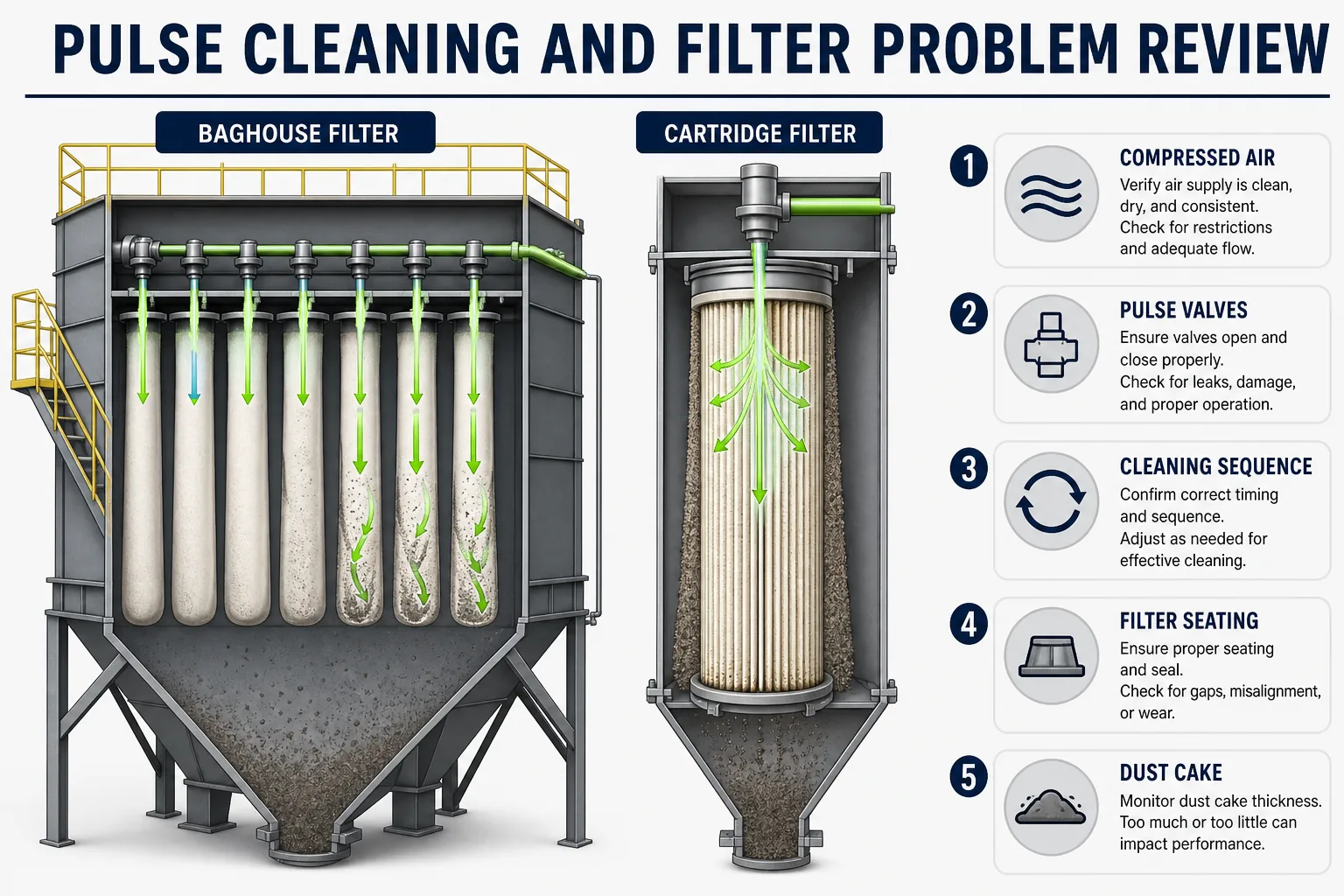
Pulse cleaning review should check compressed air supply, valve function, cleaning sequence, filter seating and dust cake behavior.
| Problem Area | What It Can Cause | What to Review |
|---|---|---|
| Low compressed air pressure | Weak cleaning and rising pressure drop | Air supply, regulator, receiver and pressure stability |
| Moist compressed air | Sticky dust cake and filter blinding | Dryer, drain, piping and seasonal humidity changes |
| Failed pulse valve | Uneven cleaning across filter rows | Valve response, diaphragm, wiring and controller output |
| Poor filter seating | Dust leakage or bypass | Gaskets, clamps, cages, tubesheet and installation practice |
| Wrong filter media | Short life, high pressure drop or poor release | Temperature, moisture, chemical exposure and dust behavior |
For baghouse systems, filter bag material and replacement decisions should also consider dust type, temperature, moisture, corrosion and static risk. The earlier article on dust collector filter bags explains these selection factors in more detail.
Hopper Discharge, Dust Buildup and Leak Points
A dust collector is not working correctly if captured dust stays inside the collector too long. Hopper buildup, bridging, blocked discharge valves and poor bin handling can increase maintenance problems and may affect safety review for certain materials.
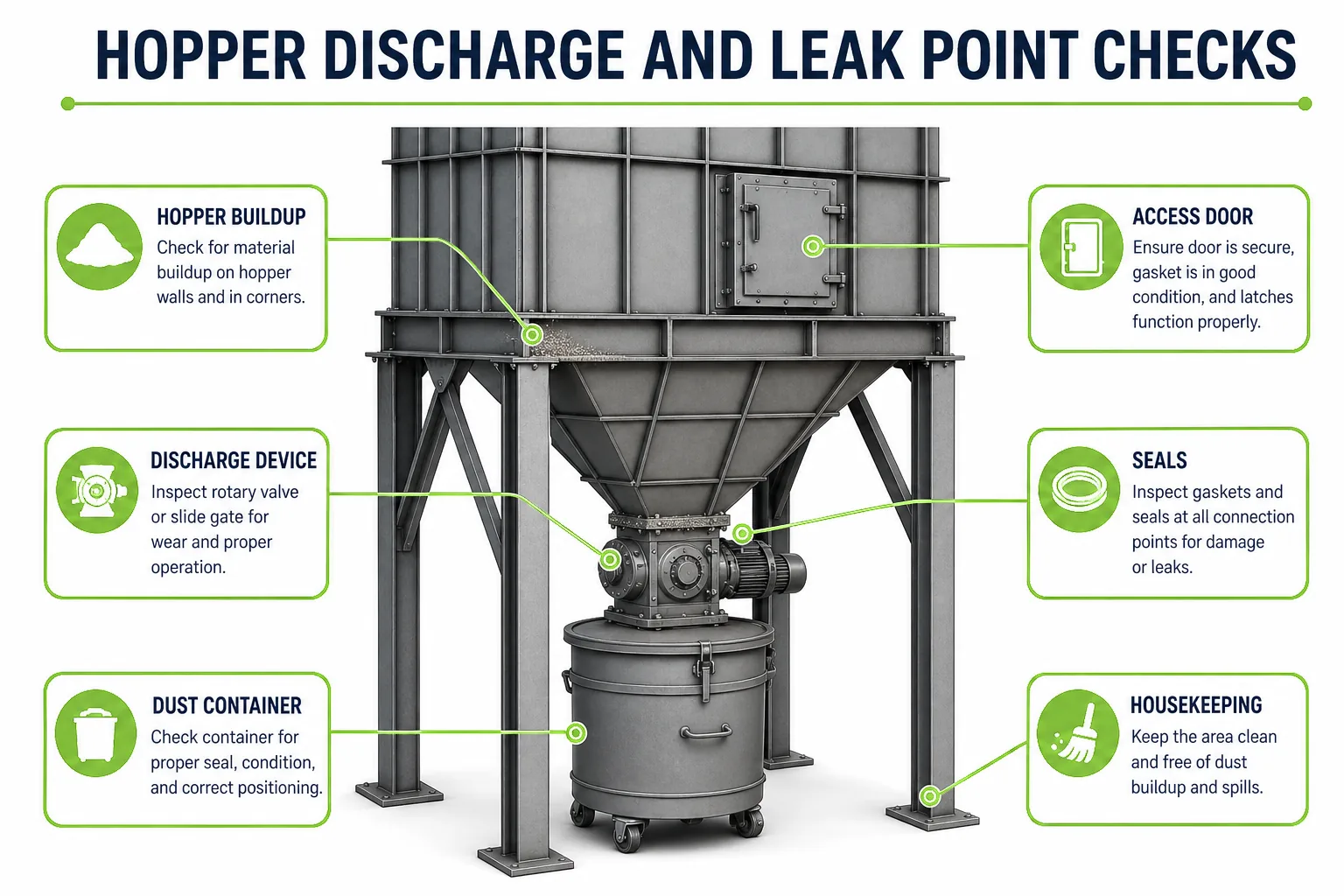
Hopper discharge and leak points should be inspected because dust must leave the collector instead of accumulating inside the system.
- Hopper bridging: dust forms an arch and stops flowing into the discharge device.
- Overfilled dust container: dust backs up into the hopper and reduces useful storage space.
- Leaking access doors: air leakage affects airflow and can release dust around the collector.
- Worn seals or gaskets: bypass leakage can cause visible emissions or low pressure readings; some plants use EPA Method 22 style visual checks as a quick screening habit for fugitive dust.
- Blocked rotary valve or screw conveyor: captured dust cannot leave the collector at the required rate.
Maintenance teams should also check whether dust around the collector comes from the process, duct leakage, filter failure, discharge handling or housekeeping gaps. The visible dust location often points to the next troubleshooting step.
Maintenance Differences Between Baghouse, Cartridge and Sintered Plate Collectors
Different collector types share the same maintenance logic, but the inspection details are not identical. A baghouse, cartridge collector and sintered plate collector can all require pressure drop checks, cleaning system review and dust discharge inspection, but the filter elements and service methods differ. On the cartridge side, media selection and the replacement signals worth trending are covered in our dust collector filter cartridge article.
| Collector Type | Maintenance Focus | Common Review Point |
|---|---|---|
| Baghouse dust collector | Filter bags, cages, pulse cleaning, hopper discharge and access space | Bag wear, poor sealing, high pressure drop or filter bag replacement timing |
| Cartridge dust collector | Cartridge condition, pleat loading, compressed air cleaning and dust release | Fine dust blinding, moisture sensitivity or short cartridge life |
| Sintered plate dust collector | Plate surface, cleaning performance, seal condition and pressure trend | Surface loading, cleaning stability and suitability for fine dust |
| Flat bag dust collector | Compact access, flat bag arrangement and cleaning consistency | Maintenance access in height-limited layouts |
| Round bag dust collector | Bag rows, pulse alignment, hopper access and seal inspection | Stable cleaning and replacement planning for bag systems |
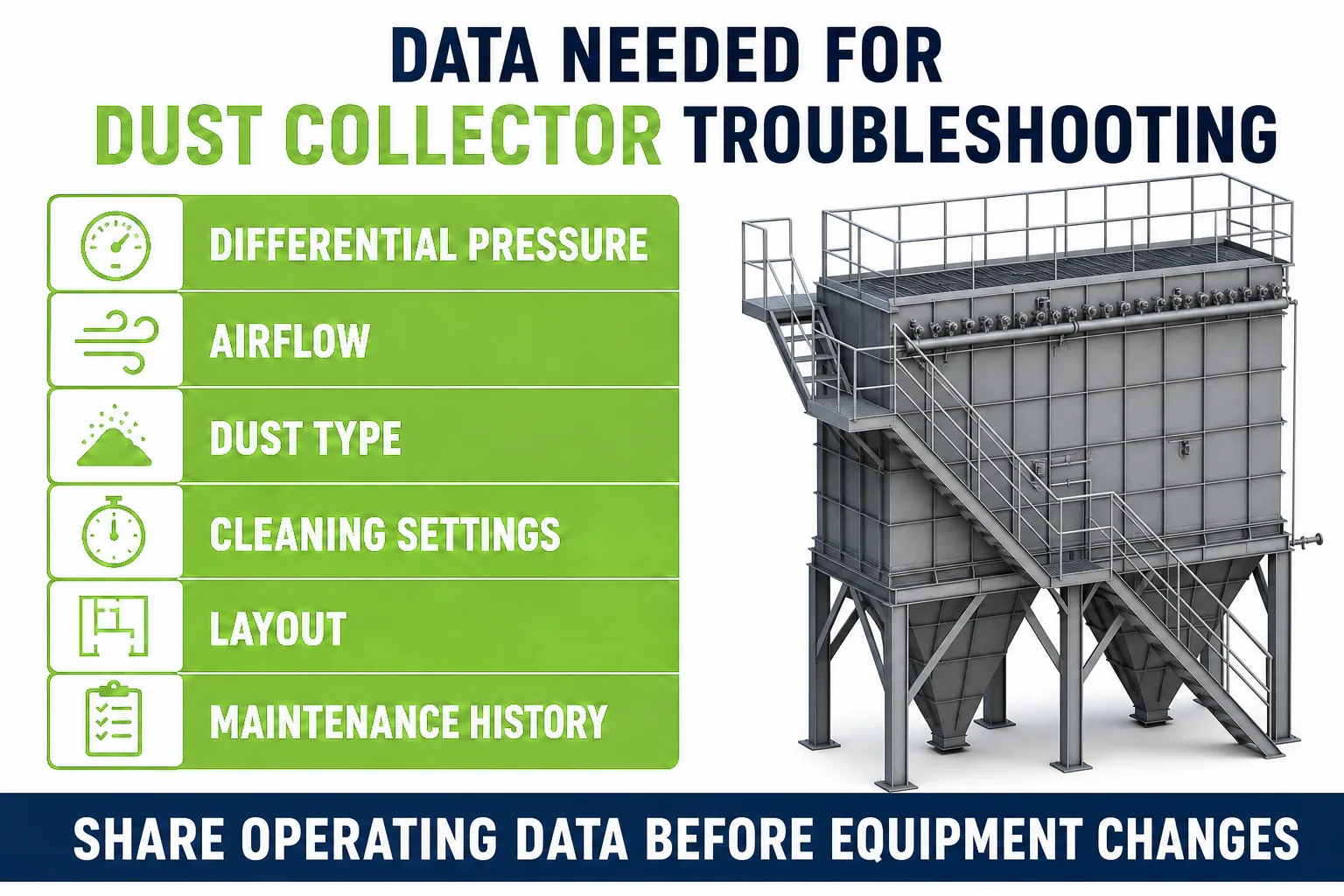
AIER can review dust collector issues more efficiently when pressure trend, airflow, dust type, cleaning settings, layout and maintenance history are prepared.
When Maintenance Becomes a System Design Problem
Some problems cannot be solved by replacing filters or cleaning the hopper. If the same issue returns after maintenance, the system may need a design review. This often happens when the dust loading, production rate, pickup points or duct routing have changed since the original installation.
| Repeated Symptom | Possible System-Level Issue | Review Direction |
|---|---|---|
| Filters blind too quickly | Wrong media, high air-to-cloth ratio, moisture or heavy loading | Review filter area, airflow, dust properties and cleaning method |
| Capture remains weak after filter replacement | Hood design, duct leakage, fan capacity or branch imbalance | Review source capture and ductwork layout |
| High pressure drop returns quickly | Dust condition, excessive airflow, undersized collector or cleaning mismatch | Review collector sizing and operating assumptions |
| Dust builds up in ducts or hopper | Low conveying velocity, poor discharge design or sticky dust | Review duct routing, hopper discharge and material behavior |
| Frequent unplanned shutdowns | System no longer matches production conditions | Review process changes, capacity and maintenance access |
In these cases, maintenance data becomes valuable engineering evidence. Pressure trends, filter replacement history, process changes, dust loading and airflow measurements can help AIER judge whether the issue is maintenance-related or design-related.
Information AIER Needs Before Reviewing a Dust Collector Issue
Before asking AIER to review a dust collector problem, collect operating data instead of only describing the symptom. This helps avoid unnecessary equipment changes and makes the troubleshooting discussion more precise.
| Data to Prepare | Why AIER Needs It |
|---|---|
| Collector model, filter type and installation year | Shows what equipment configuration is being reviewed |
| Differential pressure trend | Shows whether the problem is sudden, gradual or unstable |
| Dust material, moisture and temperature | Helps judge filter loading, cleaning behavior and material compatibility |
| Airflow or fan data | Helps determine whether capture and system resistance are aligned |
| Pulse cleaning settings and compressed air status | Helps identify cleaning system faults |
| Photos of hoods, ducts, hopper and visible dust | Helps locate where the problem starts |
| Maintenance and replacement history | Shows whether the issue repeats after normal service |
If your dust collector has repeated high pressure drop, poor capture, visible emissions, short filter life or unstable airflow, contact AIER with your operating data, layout photos and maintenance history. AIER can review whether the issue is likely related to filters, cleaning, dust discharge, ductwork, fan performance or system sizing.
FAQ
How often should an industrial dust collector be maintained?
An industrial dust collector should be inspected according to operating hours, dust loading, material behavior and the equipment manual. Many plants use shift, weekly and planned-stop checks, then adjust frequency when pressure drop, emissions or production conditions change.
What causes high pressure drop in a dust collector?
High pressure drop can be caused by overloaded filters, weak pulse cleaning, wet or sticky dust, excessive airflow, hopper buildup, blocked ducts or filter media mismatch. The pressure trend should be reviewed before replacing major equipment.
Why is dust escaping from a dust collector?
Dust can escape because of damaged filters, poor filter seating, leaking access doors, bypass gaps, overloaded airflow or discharge handling problems. Visible dust location helps determine whether the issue starts inside the collector or around the system.
How do you troubleshoot low airflow in a dust collection system?
Start at the capture point, then check hoods, dampers, duct leaks, dust buildup, fan condition, discharge blockage and collector pressure drop. Low airflow is often a system problem, not only a collector problem.
When should dust collector filters or bags be replaced?
Filters or bags should be replaced when they are damaged, blinded, leaking dust, causing repeated high pressure drop or no longer responding to proper cleaning. Replacement timing depends on dust, temperature, moisture, airflow and maintenance history.
What data should be collected before asking AIER to review a dust collector problem?
Prepare dust material, differential pressure trend, airflow or fan data, filter type, cleaning settings, photos of hoods and ducts, hopper discharge condition and maintenance history. These details help AIER review the likely cause more accurately.