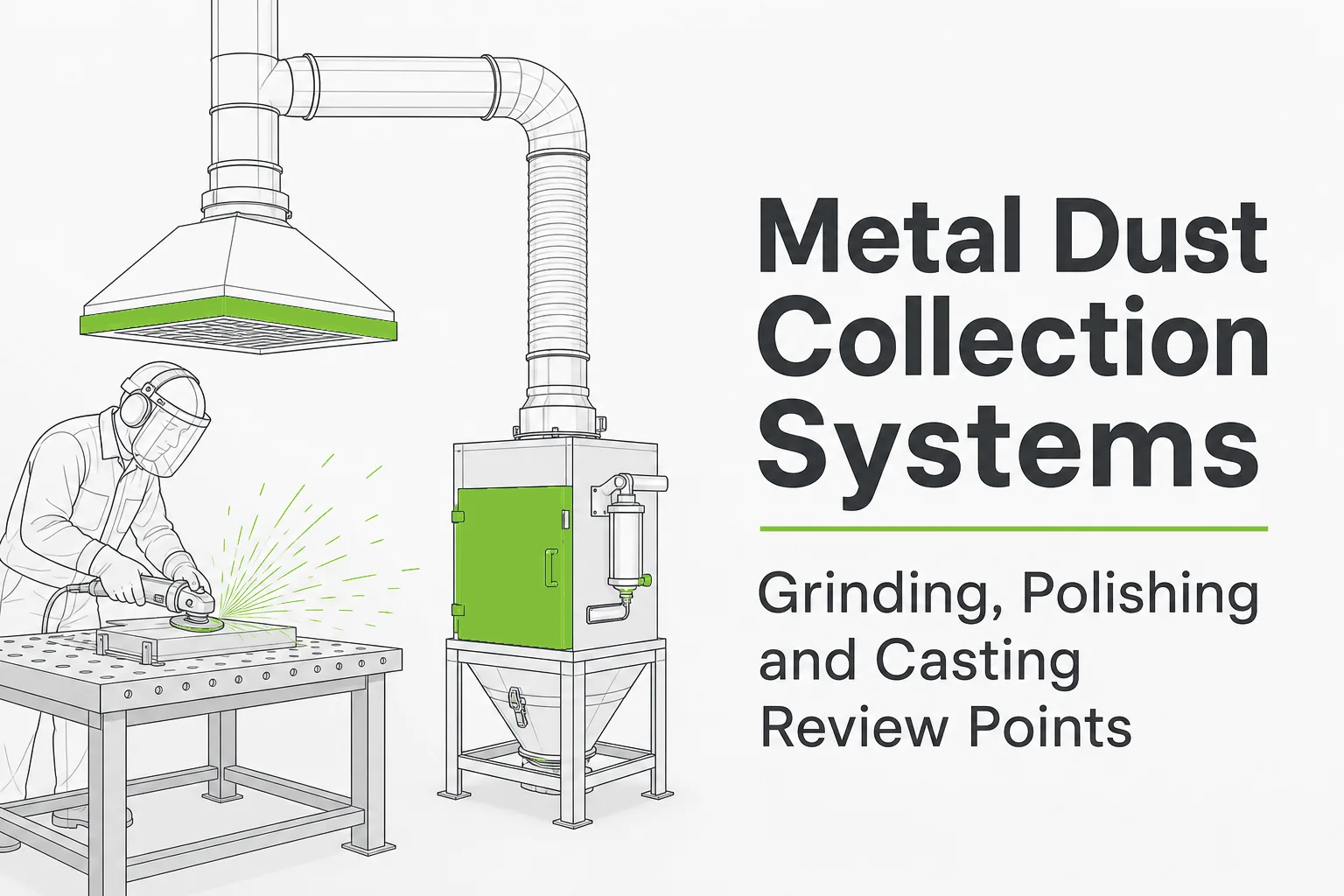
Metal dust behaves differently from almost every other industrial dust. It is heavy, it wears out equipment, it often arrives together with sparks, and in some alloys the fine fraction is combustible. A metal dust collection system that ignores any of these points tends to announce the mistake within the first year of operation.
This article reviews how metal dust collection works in industrial plants: what makes the dust different, where it comes from, when combustibility must be checked, how source capture and filter platforms are selected, and what project data AIER needs for a system review. It is written for plant engineers, EHS managers and project buyers in metalworking, casting and smelting operations planning industrial dust collection systems — not for woodshop or benchtop hobby dust collection, which is a different equipment class with different rules. It does not replace a safety evaluation, local regulations or site-specific engineering design.
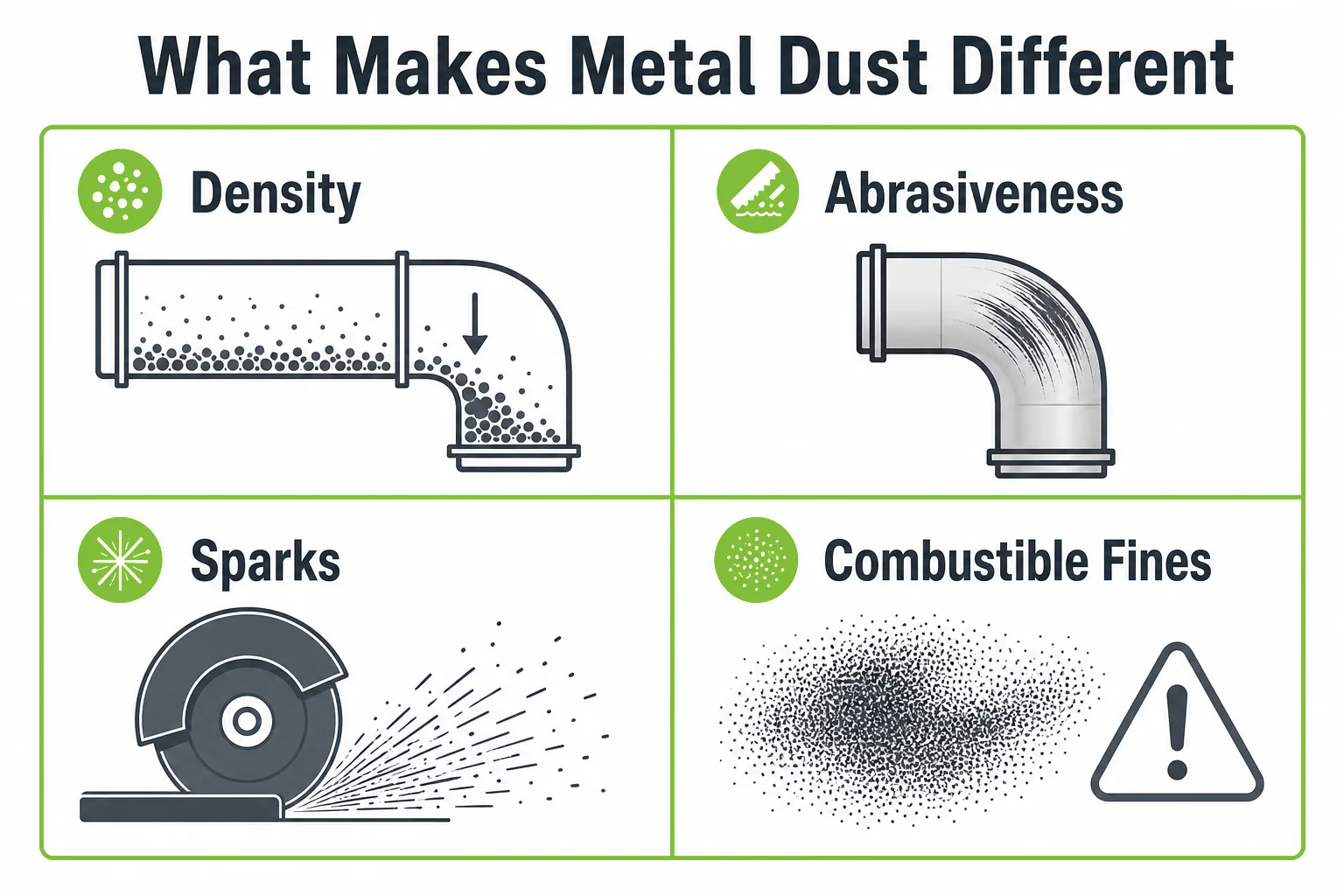
Metal dust is denser, more abrasive and often spark-laden compared with general industrial dust, and some fine metal fractions are combustible.
What Makes Metal Dust Different
Four properties separate metal dust collection from general dust duty, and each one changes a design decision somewhere in the system.
- Density: metal particles are heavy. They settle in ducts that would carry lighter dust without trouble, so duct routing and transport velocity deserve more attention than the collector itself usually gets.
- Abrasiveness: grinding grit and metal fines sand-blast elbows, inlets and filter media from the inside. Wear points need reinforcement or wear-friendly design, and inlet baffles matter.
- Sparks: grinding, cutting and some finishing processes send glowing particles into the duct. A spark that reaches the filter media damages it at best; on the wrong dust it becomes an ignition source.
- Combustible fines: fine particles of some metals — aluminum, magnesium and titanium are the common examples — can be combustible. The coarse chip from machining and the fine fraction from polishing are different materials from a safety point of view.
None of these properties shows up in an airflow number. They come from the material, the alloy and the process, which is why a metal dust review starts with what is being worked, not with a collector model.
Where Metal Dust Comes From
Most industrial metal dust collection projects trace back to a handful of process families, each with its own dust character.
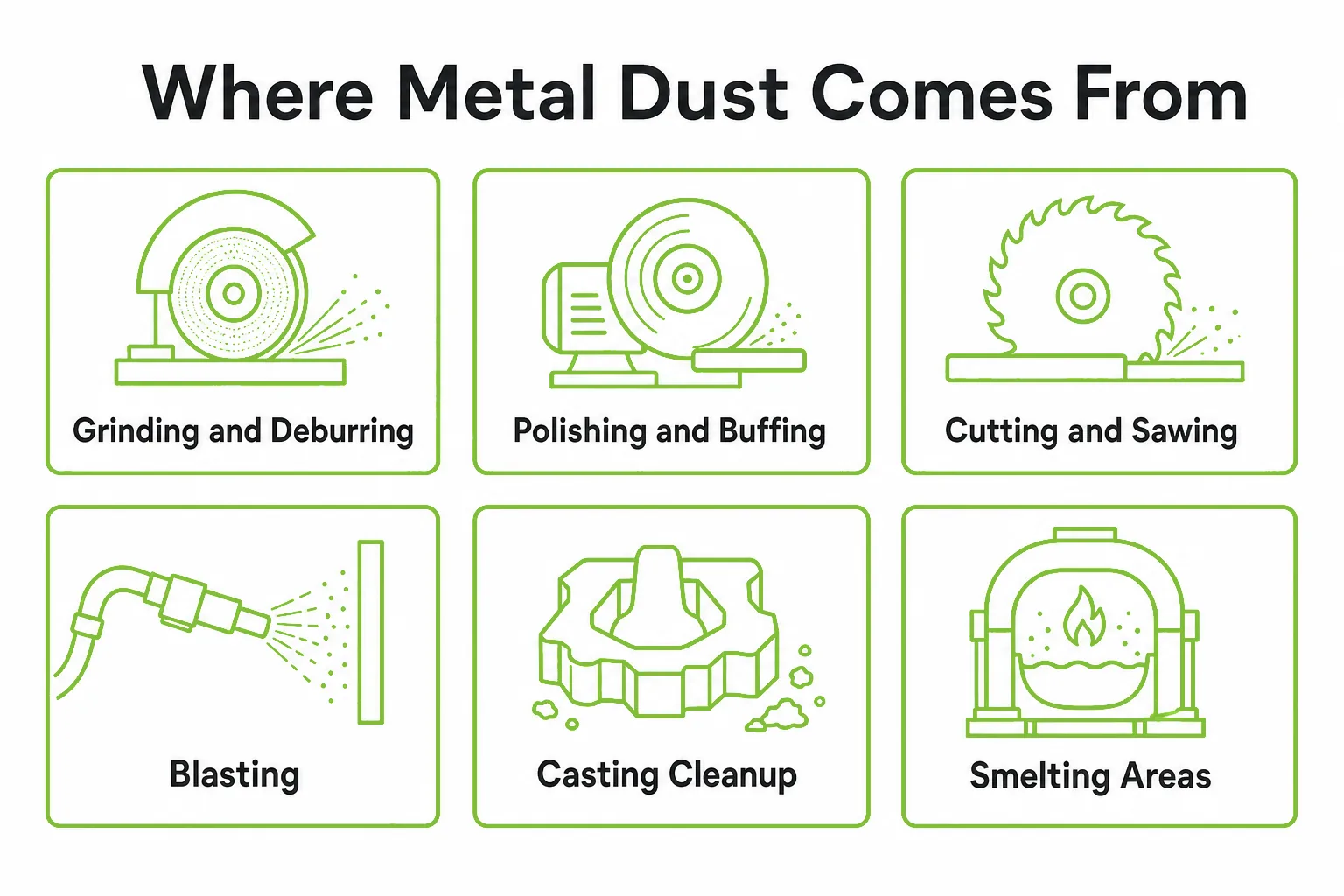
Typical metal dust sources include grinding and deburring, polishing and buffing, cutting, blasting, casting cleanup and smelting areas.
| Process | Typical Dust Character | Common Review Concern |
|---|---|---|
| Grinding and deburring | Coarse to medium particles mixed with abrasive grit, spark-laden | Spark handling, abrasion, grinding dust collector sizing per station |
| Polishing and buffing | Very fine metal fines, often mixed with polishing compound | Fine fraction combustibility, media blinding from compounds |
| Cutting and sawing | Medium particles with sparks or hot chips | Spark pre-separation, duct settling |
| Blasting | Heavy mixed dust of media and removed material | High load, abrasion, media recovery |
| Casting shakeout and cleanup | Mixed metal and sand dust, heavy and abrasive | High load, coarse-fine mix, housekeeping |
| Smelting and melting areas | Fine fume-like dust, hot gas, demanding duty | Temperature, filter platform choice, difficult dust behavior |
A plant often has several of these at once, which raises the question of what can share a system and what must stay separate — a question that belongs in the review stage, not after installation.
Is Your Metal Dust Combustible?
This is the first question AIER asks on any aluminum, magnesium or titanium application, and it should be answered before any equipment discussion. According to OSHA, combustible dust — including certain fine metal dusts — can create fire and explosion hazards when suspended or accumulated, and dedicated standards such as NFPA 484 apply to combustible metals. This article does not interpret those requirements; it lists what buyers should have reviewed.
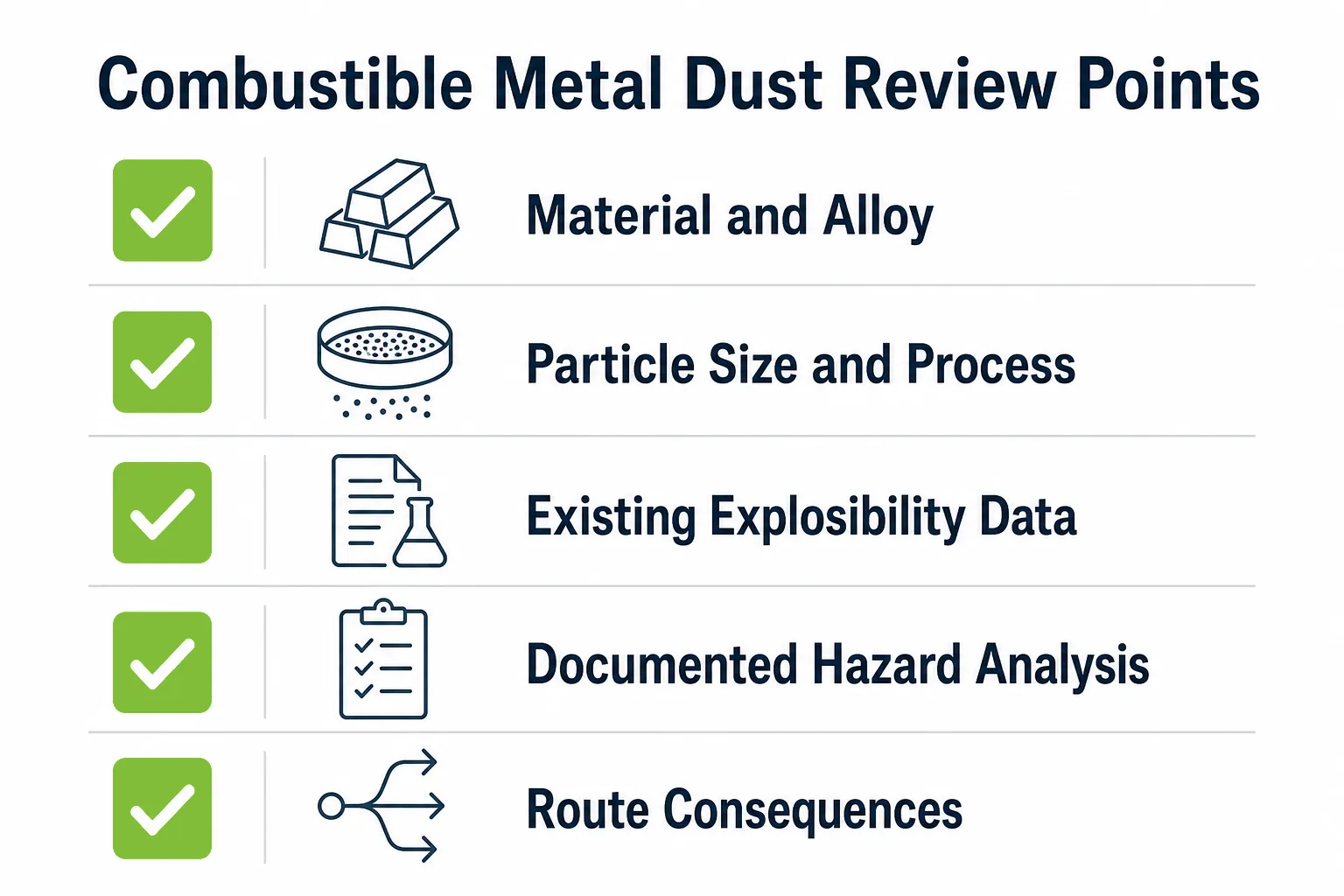
Combustible metal dust review starts from the material, alloy, particle size and process before any collector is selected.
- Material and alloy: the base metal and alloy decide whether combustibility is even in question; mixed-material stations need the most careful look.
- Particle size and process: fine polishing and buffing fines are more reactive than coarse machining chips of the same metal; the process defines the fraction you actually collect.
- Existing test data: if the plant already has dust explosibility test data, it shapes the whole review; if not, testing comes before equipment selection, not after.
- Hazard analysis: combustible dust applications should go through a documented review — our dust hazard analysis article explains what that process covers from a buyer’s perspective.
- Route consequences: a combustible finding changes the system design and can change the collection route itself — some combustible metal duties are handled with wet-type collection routes in industry practice. That route decision belongs to the safety review with project data, not to a product catalog.
For non-combustible metal dust — steel grinding in most cases, casting sand mixes and similar duties — the review moves directly to capture and filtration. For anything with combustible potential, the safety review leads and the equipment follows.
Capturing Metal Dust at the Source
Because metal dust is heavy, it does not drift far — it drops. That makes source capture both more important and more effective than for light dusts: a hood close to the process catches what would otherwise land on the floor within a few meters.
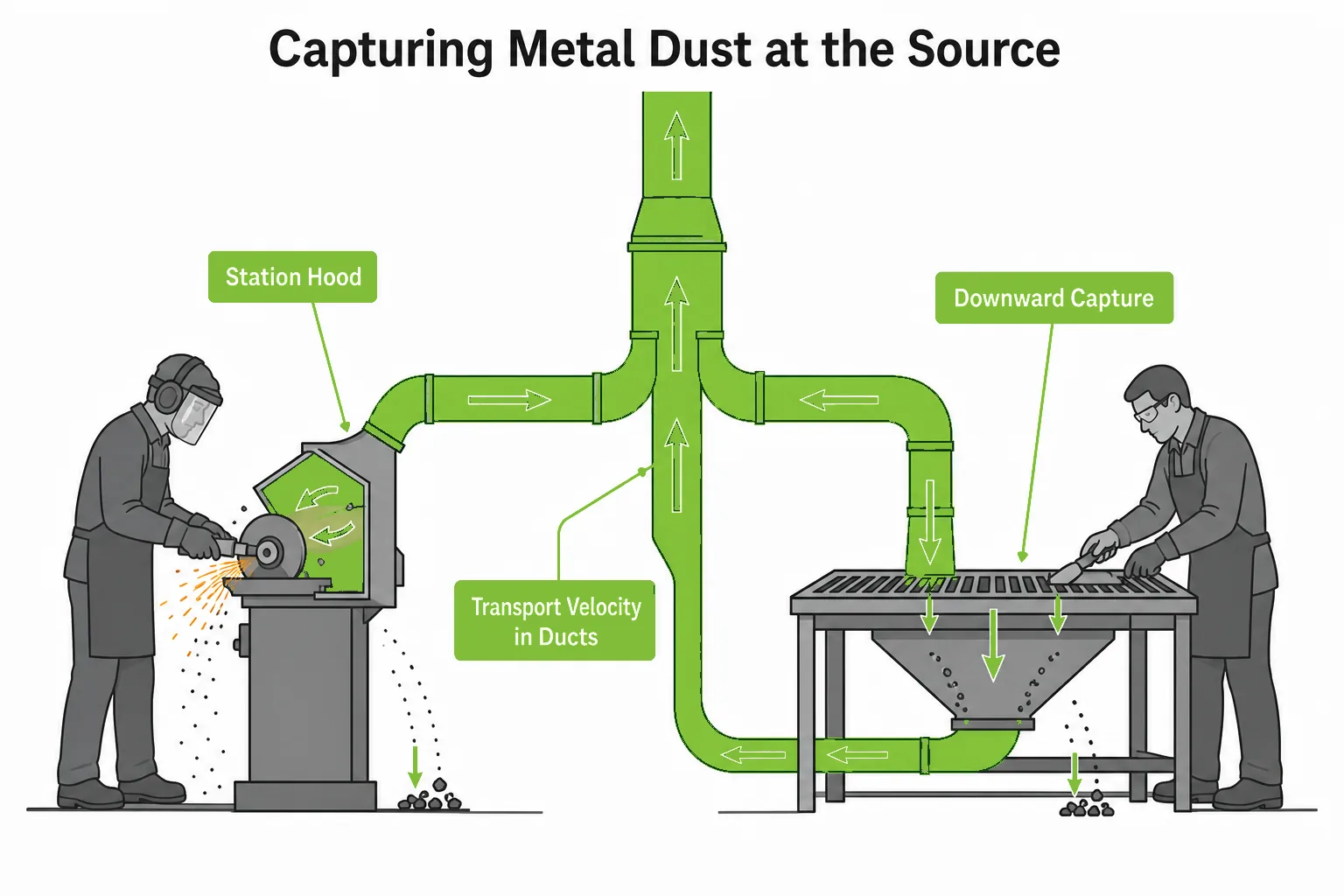
Heavy metal dust drops fast, so capture hoods and enclosures close to the process do most of the work before the ductwork and collector.
- Station hoods and enclosures: grinding and polishing stations suit close-fitting hoods or partial enclosures that catch dust and sparks at the wheel.
- Downdraft-style capture: benchwork and manual finishing often capture downward, using the dust’s own weight instead of fighting it.
- Duct transport: dense dust needs enough transport velocity to stay airborne in the duct; long horizontal runs and lazy branch design are where metal dust systems silently fail.
- System planning: capture points, branch balancing and fan sizing are one design exercise — the same review logic as our dust collection system design article, applied to a heavier dust.
Filter Equipment for Metal Dust
AIER supplies three filter platforms that cover most metal dust duties, and the dust character — not the airflow — decides among them. Spark-prone processes add a pre-separation stage before any of them. Where these three sit in the wider family is mapped in our types of dust collectors overview.
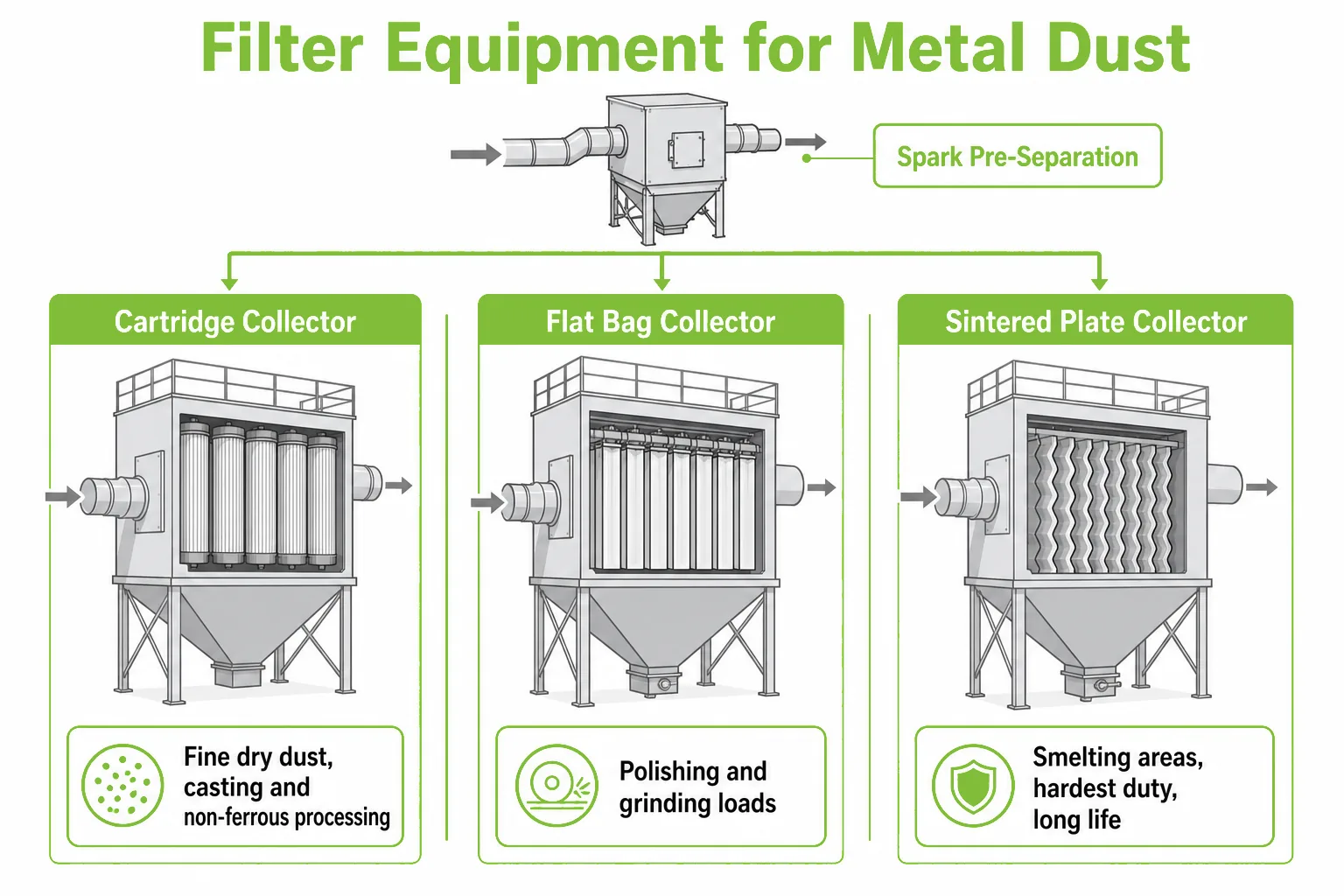
Cartridge, flat bag and sintered plate platforms cover most metal dust duties, with spark pre-separation ahead of the filter media where processes generate sparks.
| Filter Platform | Where It Fits for Metal Dust | Review Points |
|---|---|---|
| Cartridge dust collectors | Fine, dry dust in casting and non-ferrous metal processing; compact station units | Load limits, spark pre-separation, media selection |
| Flat bag dust collector | Polishing and grinding dust at higher loads; smelting-area duties per the AIER catalog | Bag material, cleaning cycle, abrasion protection at the inlet |
| Sintered plate dust collector | Metallurgy and non-ferrous smelting sections where dust is difficult and filter life matters most | Rigid sintered elements, very long service life, near-zero media maintenance |
Between cartridge and bag platforms, the general selection logic from our baghouse vs cartridge dust collector comparison applies, with metal dust pushing the answer toward robust media and spark management. The sintered plate platform sits above both for the hardest duties: its rigid elements shrug off dust that shortens fabric life, which is why the AIER catalog lists it for non-ferrous smelting and other high-difficulty sections.
Metal Dust vs Metal Fume
Plants that grind metal usually weld it too, and the two emissions are often confused because both are “metal in the air.” They are different problems.
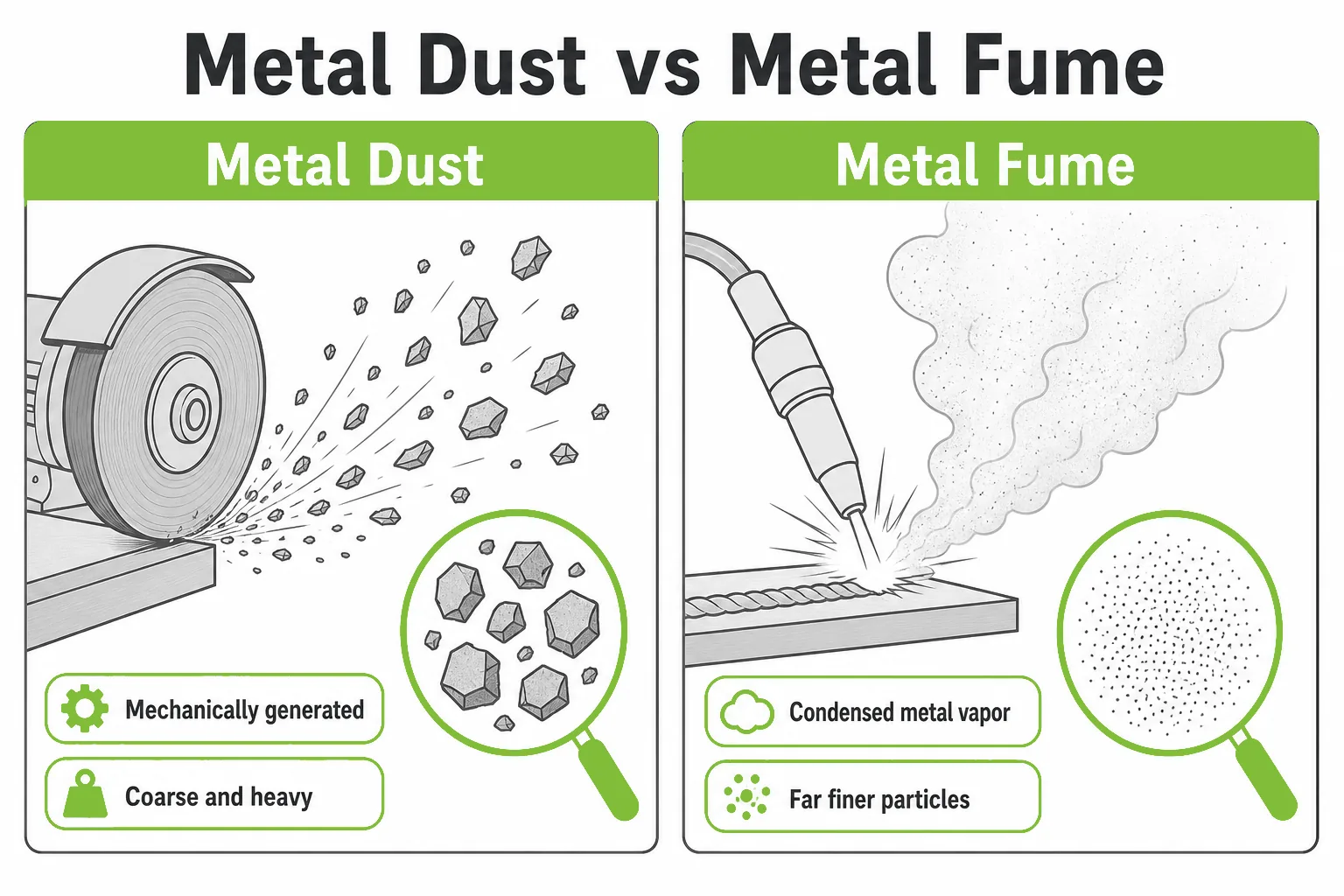
Metal dust is mechanically generated and relatively coarse; welding fume is condensed metal vapor and far finer — they are reviewed as separate duties.
Metal dust is mechanically generated — ground, cut or blasted off the workpiece — and the particles are comparatively large and heavy. Metal fume is condensed metal vapor from welding or thermal cutting, and its particles are far finer. Fume calls for its own capture strategy and filter review, which we cover in the robotic welding fume extraction article. Mixing the two duties in one system without a review is a common source of undersized filtration, because the fume fraction drives the media requirement while the dust fraction drives the load.
Common Mistakes in Metal Dust Collection Projects
These are the selection-stage gaps AIER sees most often on metal dust applications.
- Skipping the combustibility question: the aluminum polishing line gets a standard collector because the steel line has one; the fine fraction was never checked.
- No spark pre-separation: grinding sparks travel further down ducts than intuition suggests; media damage shows up as a filter quality complaint when it is a layout issue.
- Copying light-dust design habits: duct velocities and branch layouts that work for light dust let heavy metal dust settle and plug.
- Mixing incompatible streams: combining dusts from different materials or processes in one collector without review can create both performance and safety problems; what can share a system is a review question.
- Ignoring abrasion: elbows, inlets and the first meter of the collector take the wear; unprotected designs fail early and repeatedly.
- Forgetting housekeeping and discharge: dense dust fills hoppers quickly; an undersized or ignored discharge path turns the collector into a storage bin.
Information AIER Needs for a Metal Dust Review
A metal dust collection system review moves fastest when the inquiry includes the material and process picture instead of only an airflow target. This is the information AIER uses to judge capture, routing, spark handling and the filter platform.
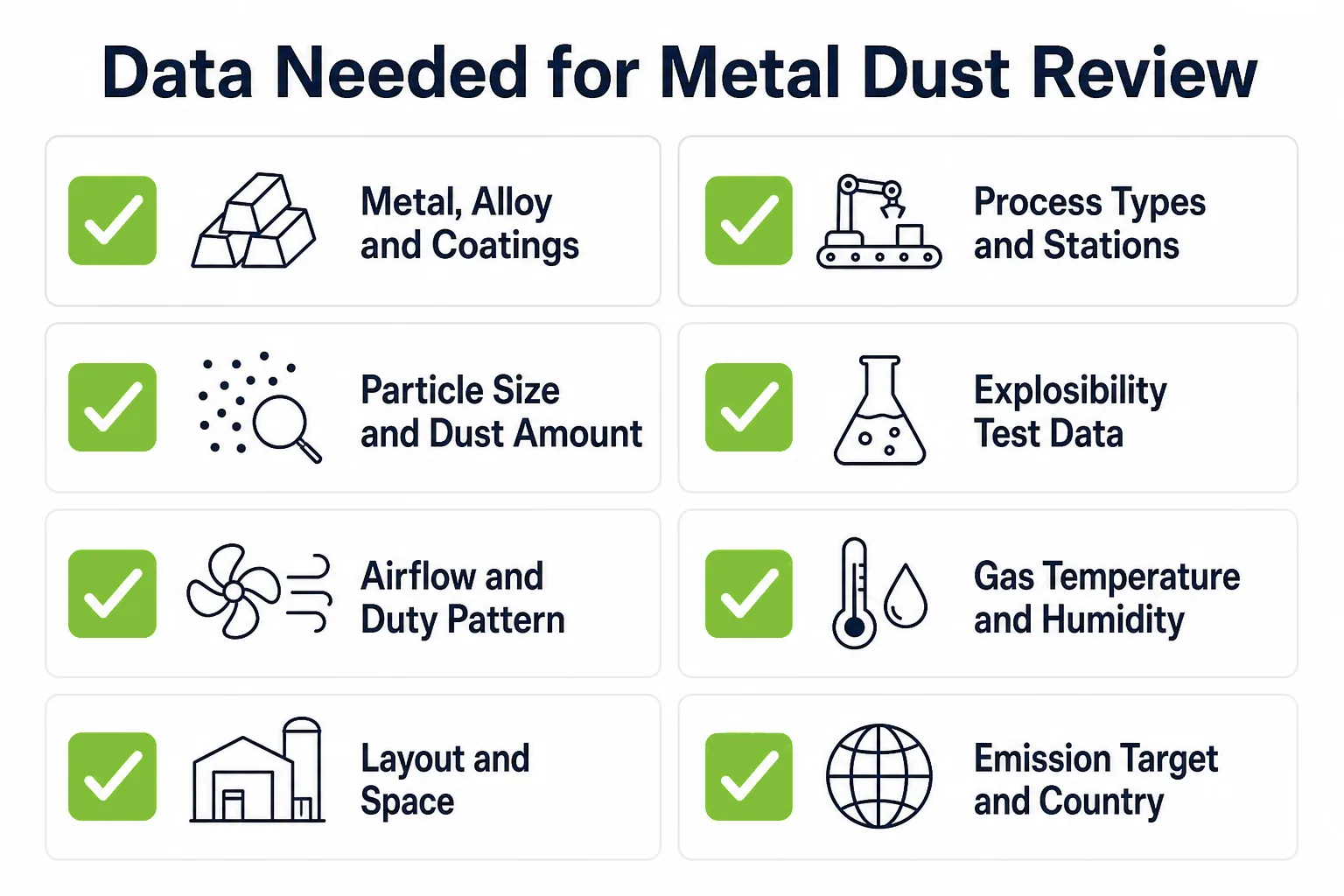
AIER reviews the metal and alloy, process stations, particle size, combustibility data, airflow and site conditions before recommending a system.
| Data to Prepare | Why It Matters |
|---|---|
| Metal, alloy and any coatings or compounds | Decides combustibility screening and media compatibility |
| Process types and number of stations | Defines dust character, spark risk and capture layout |
| Particle size and dust amount | Drives platform choice and load design |
| Existing dust explosibility test data (such as Kst screening), if any | Shapes the safety review and the collection route |
| Airflow and duty pattern per station | Sizes branches, transport velocity and the collector |
| Gas temperature and humidity | Affects media selection, especially near casting and smelting |
| Layout and available space | Decides central versus station units and duct routing |
| Emission target and installation country | Defines filtration grade and project requirements |
If your plant handles grinding, polishing, casting or smelting dust, contact AIER with your metal and alloy, process list, particle size, any combustibility data, airflow and emission target. AIER will review the capture layout, spark handling and whether a cartridge, flat bag or sintered plate platform fits your dust — and flag the cases where a safety review must lead the route decision.
FAQ
What is a metal dust collection system?
A metal dust collection system captures dust from processes such as grinding, polishing, cutting, casting and smelting at the source and filters it through equipment selected for dense, abrasive and sometimes spark-laden dust. It differs from general dust collection in duct transport design, spark handling, abrasion protection and the combustibility review for certain metals.
Is metal dust combustible?
Some metal dusts are. Fine particles of aluminum, magnesium and titanium are the common combustible examples, and fine polishing fractions are more reactive than coarse chips of the same metal. Any application involving these materials should go through a dust hazard review with explosibility data before equipment is selected; steel grinding dust in most ordinary duties is handled as standard industrial dust.
What dust collector works best for grinding and polishing dust?
Grinding and polishing dust at higher loads suits bag platforms such as the flat bag dust collector, which the AIER catalog lists for polishing and grinding duty. Fine, dry dust at moderate loads can suit cartridge collectors in compact station layouts. Spark pre-separation ahead of the media is reviewed for both, and the final choice comes from the dust data.
Do metal dust systems need spark pre-separation?
Processes that generate sparks — grinding, cutting and some finishing work — should have spark pre-separation or arresting ahead of the filter media. Sparks that reach the media damage it and, on combustible dusts, become an ignition risk, so the spark path is reviewed together with the capture layout.
What is the difference between metal dust and welding fume collection?
Metal dust is mechanically generated and relatively coarse and heavy; welding fume is condensed metal vapor and far finer. They drive different capture strategies and different filter reviews, and mixing them in one system without review often undersizes the filtration. Welding fume duty is covered separately in the robotic welding fume extraction article.
What information is needed for a metal dust collection quote?
Provide the metal and alloy, any coatings or polishing compounds, the process types and station count, particle size and dust amount, any existing explosibility test data, airflow, gas temperature and humidity, layout constraints, the emission target and the installation country. AIER reviews the capture layout, spark handling and filter platform against the actual dust condition.