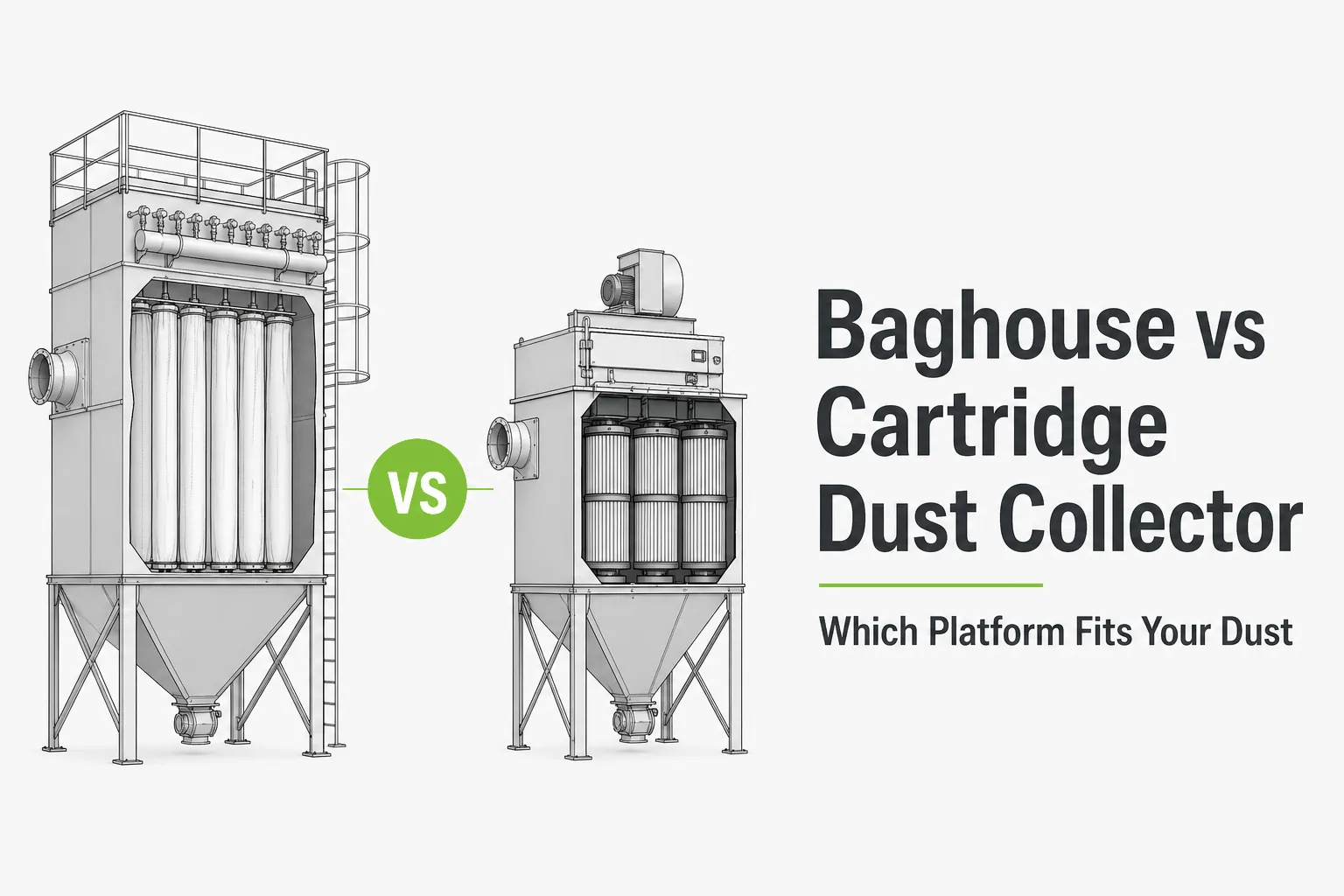
The baghouse vs cartridge dust collectors question comes up in almost every industrial dust collection project. Both platforms filter dusty air through media, both clean themselves with compressed air pulses, and both are offered by the same suppliers — which is exactly why the choice confuses buyers. The difference is not which one is better; it is which one matches the dust.
This article compares the two platforms side by side: how the filter shape changes everything downstream, where each design fits, when plants run both, and what project data AIER uses to recommend a platform. It is written for plant engineers, project buyers and EPC teams planning industrial dust collection systems. AIER manufactures both platforms, so this comparison has no side to sell — the dust decides. It does not replace engineering design or local emission requirements for a specific project.
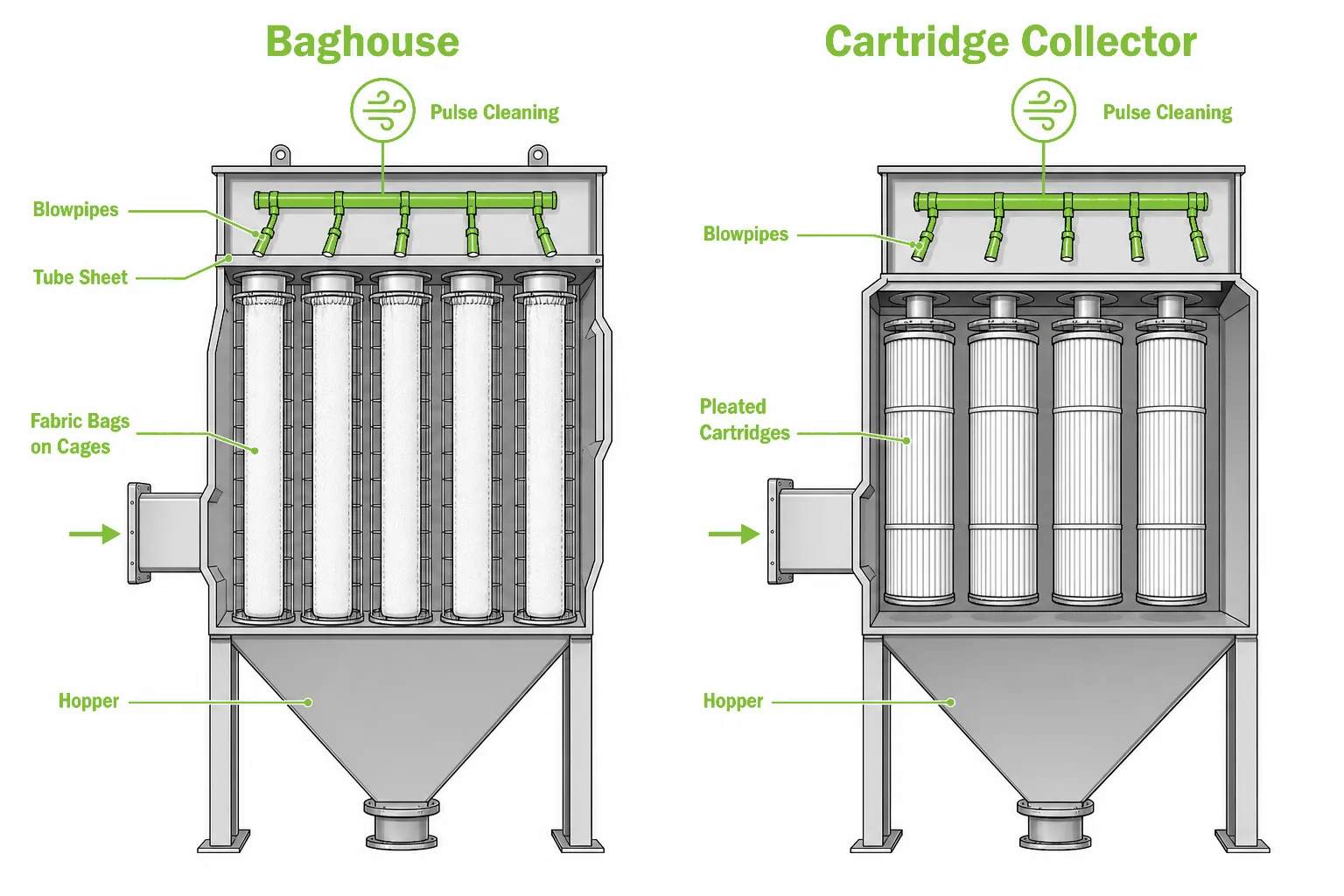
A baghouse filters through fabric bags on support cages; a cartridge collector filters through pleated cartridges — the same job, done with a different filter shape.
Baghouse and Cartridge Dust Collectors at a Glance
Baghouses and cartridge collectors are the two most common types of dust collectors in industrial plants, and they share more than they differ. Both pull dusty air into a housing, hold the dust on the outside of a filter element, pass cleaned air to a clean air plenum, and blast the dust off with compressed air pulses so it falls into a hopper.
A baghouse — such as the AIER bag dust collector — uses long fabric bags supported by steel cages. A cartridge collector — such as AIER cartridge dust collectors — uses shorter cylindrical elements with deeply pleated media. The pulse cleaning platform underneath is the same idea in both; how it works is covered in our pulse jet baghouse working principle article.
Because the cleaning system, fan logic and hopper handling are so similar, the real comparison comes down to one physical difference with many consequences: the shape of the filter element.
The Core Difference: Filter Shape and Filter Area
A filter bag is a smooth tube of felt or woven fabric, typically a few meters long. A cartridge folds its media into hundreds of pleats around a short cylinder. That folding is the whole story.
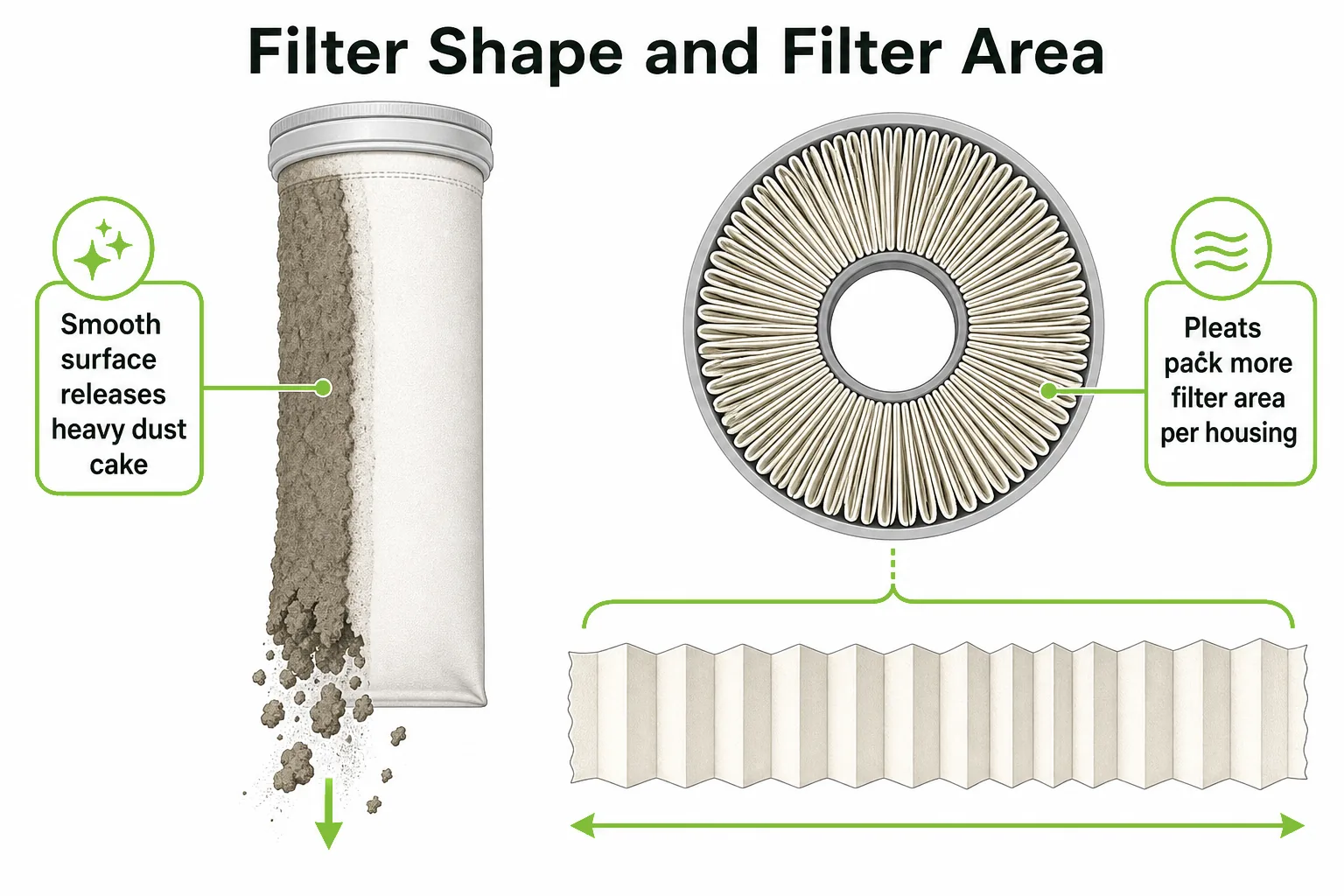
Pleating packs far more filter area into the same housing volume, while a smooth bag surface releases heavy dust cake more easily.
- Filter area per footprint: pleated cartridges carry several times the media area of bags in the same housing volume, so a cartridge collector is usually the smaller box for the same airflow.
- Cake release: a smooth bag surface lets a heavy or coarse dust cake shear off cleanly during the pulse. Pleats can trap sticky, fibrous or high-load dust in the folds, where the pulse cannot reach it.
- Media choice: bags are sewn from a wide range of fabrics — polyester, aramid, PPS, P84, fiberglass, PTFE-finished — which gives baghouses a wider temperature and chemistry envelope. Cartridge media favors fine, dry dust duty. Fabric selection logic is covered in our dust collector filter bags article.
- Element handling: replacing bags means pulling cages and bags one by one from the top; replacing cartridges is usually a faster door-access swap, but there are more surface details to seal.
Baghouse vs Cartridge: Side-by-Side Comparison
The table below summarizes how the two platforms behave across the review points that decide most projects.
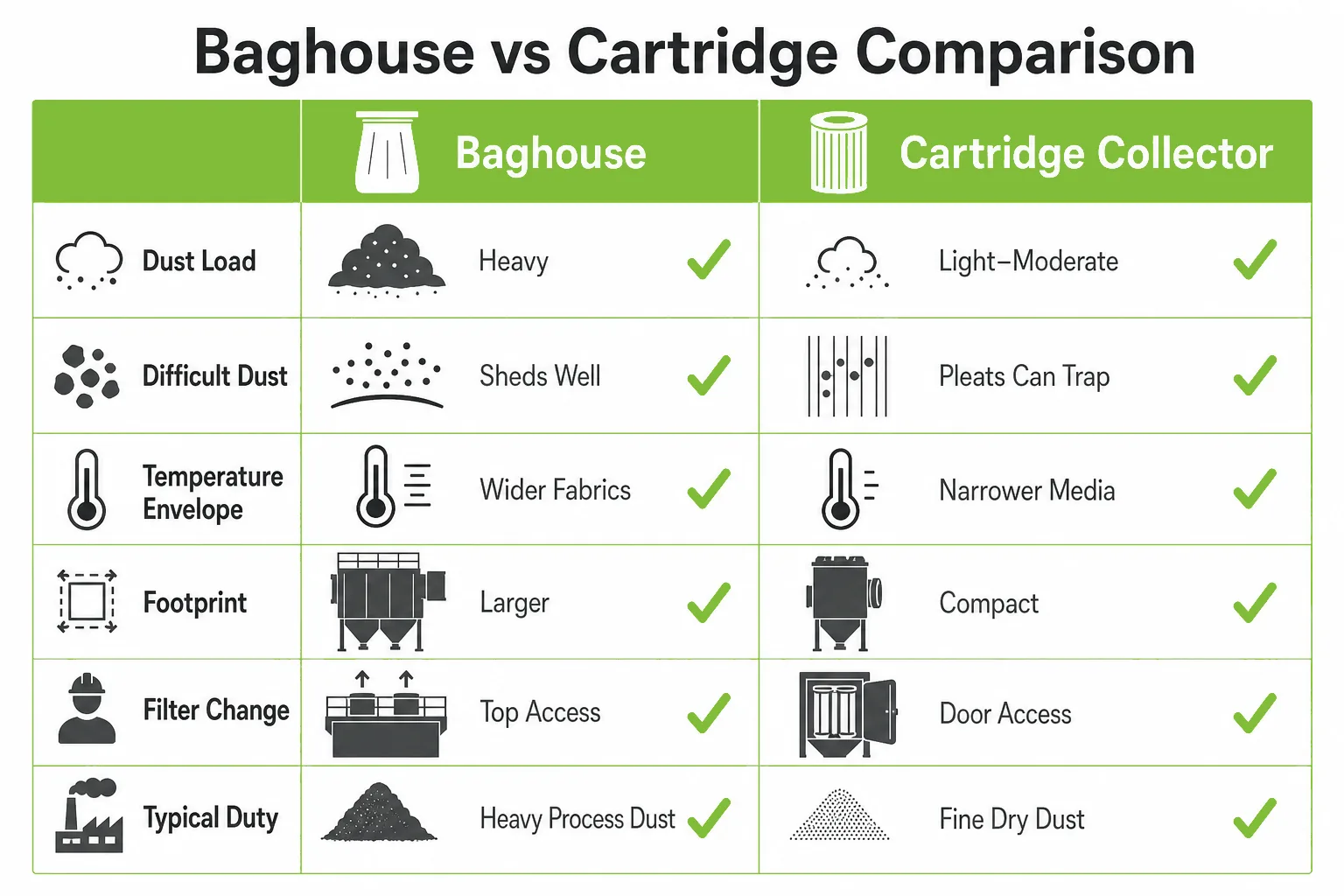
Baghouse vs cartridge comparison across dust type, load, temperature, footprint and maintenance pattern — the dust data decides which column wins.
| Review Point | Baghouse | Cartridge Collector |
|---|---|---|
| Dust particle size | Coarse to fine; forgiving with mixed dust | Strongest on fine, dry dust |
| Dust load | Handles heavy, continuous loads well | Prefers light to moderate loads; heavy load fills pleats |
| Sticky, fibrous or hygroscopic dust | Smooth bags shed difficult cake better | Pleats trap difficult dust; usually the wrong platform |
| Gas temperature envelope | Wider, via high-temperature fabrics | Narrower; media options are more limited |
| Footprint for the same airflow | Larger housing, taller structure | Compact; fits next to production lines |
| Filter replacement | Slower, top access, bag and cage handling | Faster, door access, fewer lifting steps |
| Filter cost pattern | Lower cost per element, more elements | Higher cost per element, fewer elements |
| Typical duties | Mining, smelting, heavy process dust, hot gas | Welding fume, grinding, powder handling, fine dry dust |
Energy use and pressure drop depend more on system design and cleaning settings than on the platform itself, so treat vendor claims in either direction as a review question rather than a rule. The comparison that matters is always run against your dust, not a generic table — including this one.
When a Baghouse Is the Better Fit
A baghouse earns its larger footprint when the dust or the gas condition is demanding.
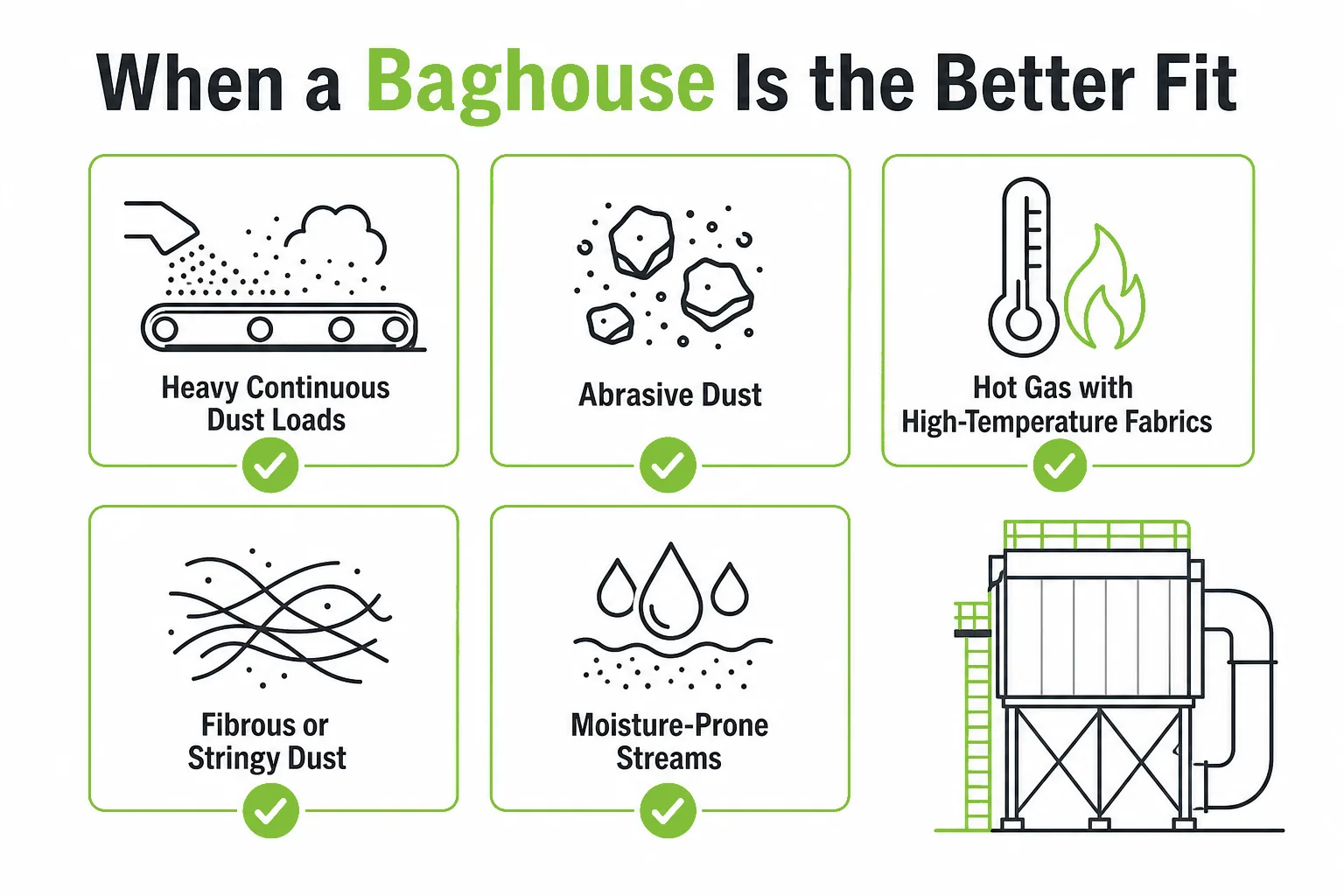
Baghouses suit heavy and continuous dust loads, abrasive or fibrous dust and hot gas duties where fabric selection carries the design.
- Heavy, continuous dust loads: smelting, mining, mixing and bulk material handling generate more dust per hour than pleats can comfortably shed.
- Abrasive dust: a worn bag is a cheap, fast replacement; abrasion management through inlet design and media choice is well understood on bag platforms.
- Hot gas: aramid, PPS, P84 and fiberglass bags extend the temperature envelope far beyond standard cartridge media.
- Fibrous or stringy dust: textile, wood-like and fiberglass dusts bridge across pleats but release from smooth bags.
- Moisture-prone streams: no fabric enjoys condensation, but a smooth bag surface tolerates borderline humidity better than pleated folds.
When a Cartridge Collector Is the Better Fit
A cartridge collector wins where the dust is fine and dry and the plant values space and fast filter service.
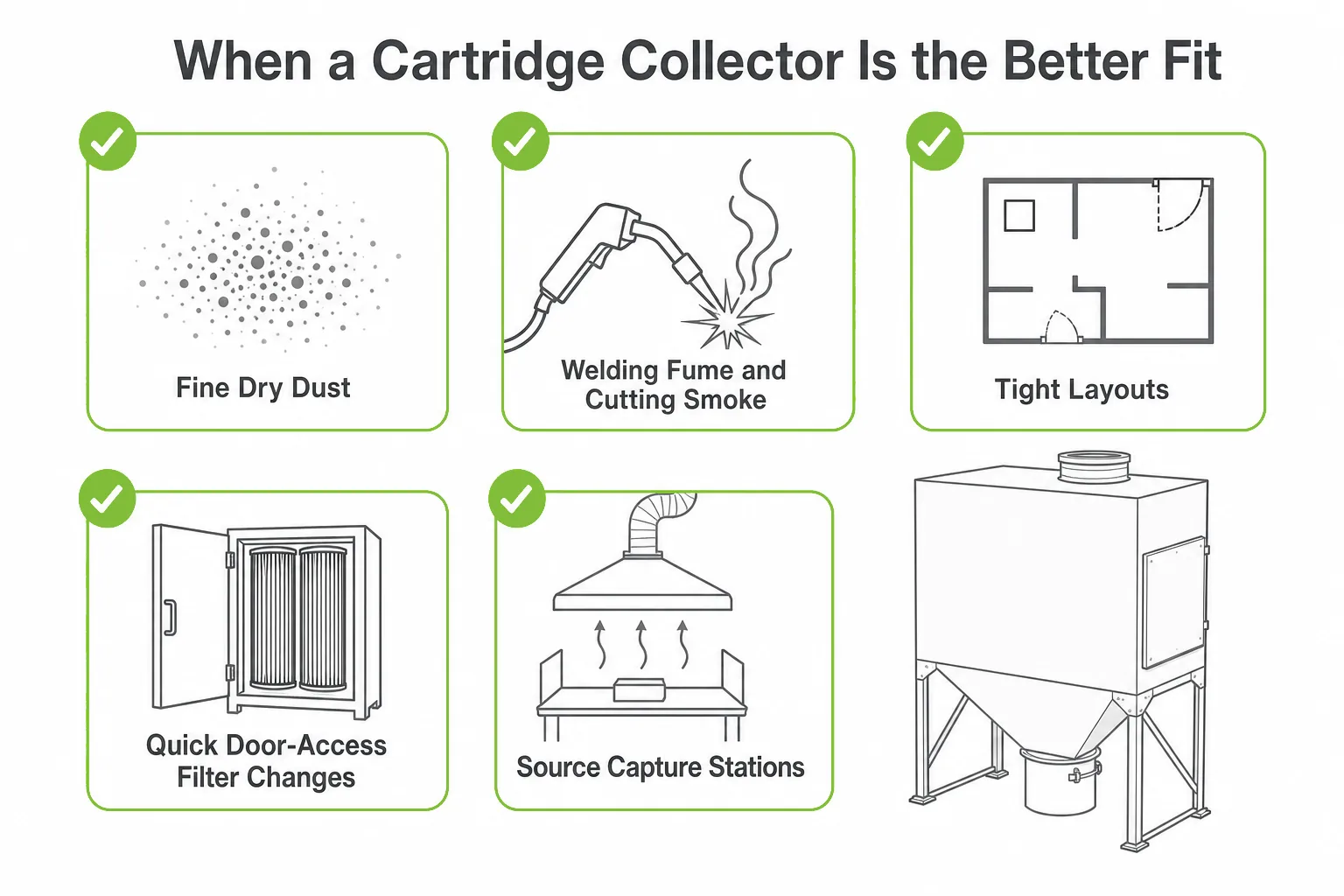
Cartridge collectors suit fine dry dusts such as welding fume and powder handling, compact layouts and plants that want quick filter changes.
- Fine, dry dust: welding fume, laser and plasma cutting smoke, grinding and polishing dust, and light powders are classic cartridge duties — how those duties come together plant-wide is covered in our metal dust collection article.
- Tight layouts: the high media area per housing volume puts a cartridge collector next to the production line instead of outside the building.
- Frequent product changes: door-access cartridge swaps shorten downtime where filters are changed often.
- Emission polish: fine-dust media and membrane options reach demanding outlet targets on the right duty.
- Source capture systems: robot welding cells and similar source-capture setups usually pair with cartridge platforms for exactly these reasons.
When Plants Use Both
The comparison is not always either-or. Many plants run both platforms, each on the duty it handles best.
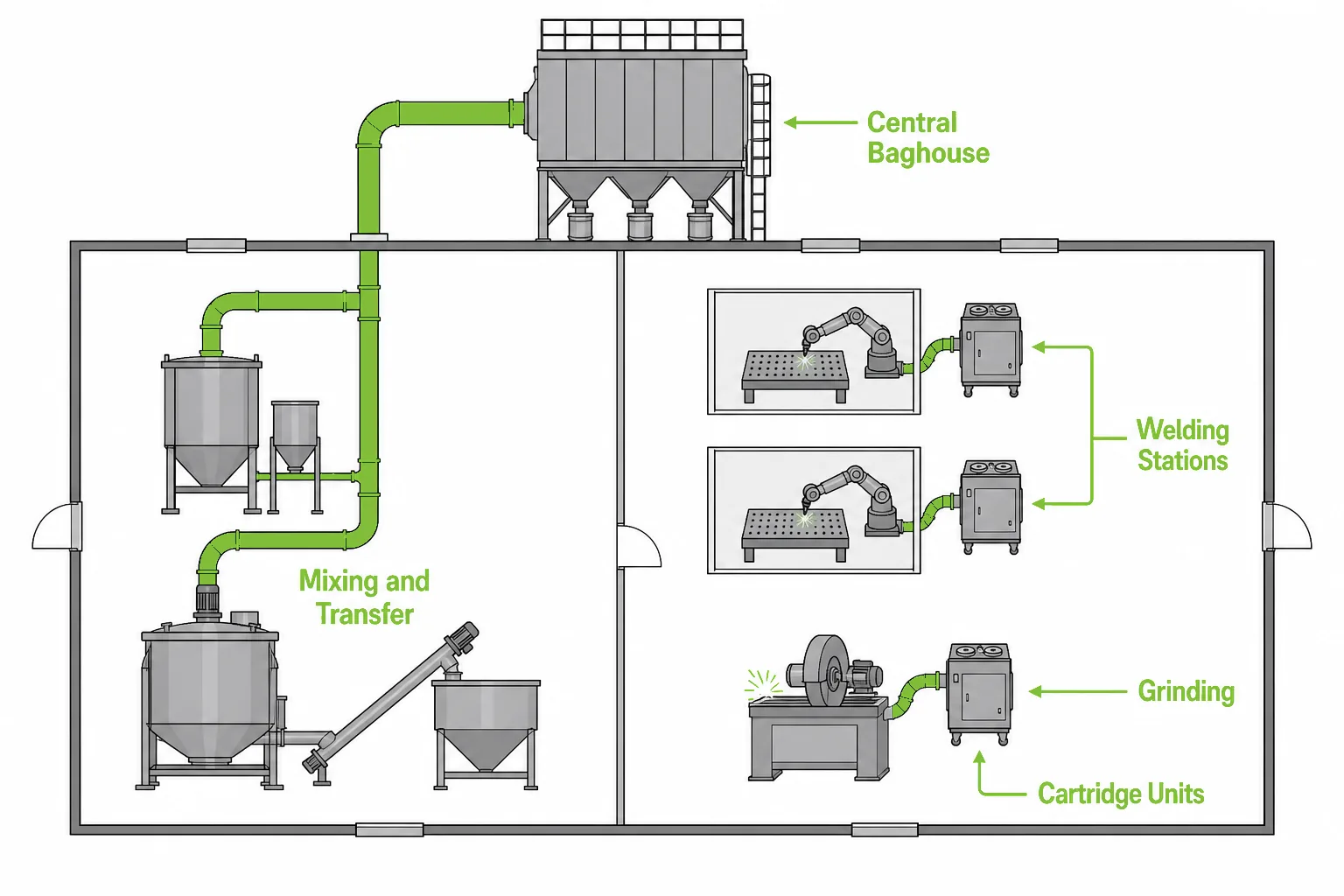
Many plants run a baghouse on the heavy process dust and cartridge collectors on fine dust points — each platform on the duty it handles best.
A typical pattern: a central baghouse carries the heavy process dust from mixing, transfer and bulk handling, while compact cartridge units sit at welding, grinding or powder stations where the dust is fine and the floor space is tight. There is also a middle form — the AIER pleated bag dust collector uses pleated bags that add media area to a bag-style platform, which suits retrofits that need more filter area in an existing housing.
Splitting duties this way keeps each collector inside its comfort zone, but it only works when the ductwork and airflow are planned as one system. That planning logic is covered in our dust collection system design article.
Common Mistakes When Choosing Between Baghouse and Cartridge
Most platform regrets AIER reviews trace back to one of these selection-stage patterns.
- Choosing by footprint alone: the compact box is attractive until sticky or heavy dust fills the pleats; the dust properties outrank the floor plan.
- Putting difficult dust on cartridges: fibrous, hygroscopic or high-load dust belongs on bags — no cleaning setting rescues clogged pleats.
- Ignoring gas temperature: a duty that needs high-temperature fabric has already made the platform decision for you.
- Comparing filter prices instead of filter economics: cost per element means little without replacement frequency, element count and downtime per change.
- Forgetting the maintenance reality: who changes the filters, how often, and with what access decides much of the lifetime cost. Our dust collector maintenance article covers what that routine actually involves.
- Treating the platform as the system: capture hoods, duct velocity and fan sizing decide performance together with the collector, whichever platform you pick.
Information AIER Needs to Recommend a Platform
AIER manufactures bag, flat bag, pleated bag and cartridge collectors, so the platform recommendation is a data decision, not a catalog preference. This is the information that decides it.
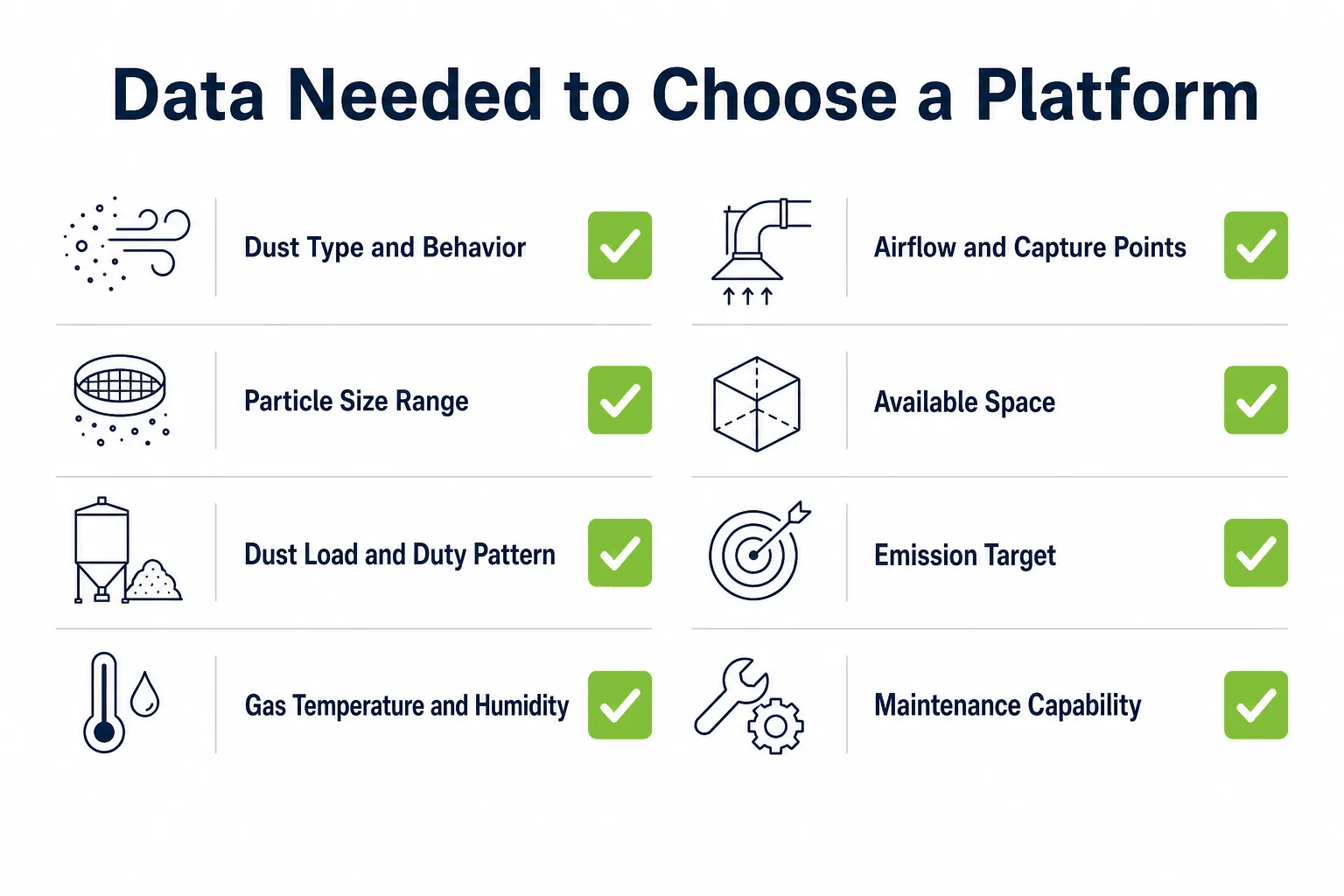
AIER reviews dust type, particle size, load, temperature, humidity, airflow and site conditions before recommending a baghouse or cartridge platform.
| Data to Prepare | Why It Matters |
|---|---|
| Dust type and behavior (sticky, fibrous, hygroscopic, abrasive, combustible) | The single biggest platform decider |
| Particle size range | Fine dry dust points to cartridges; coarse or mixed dust to bags |
| Dust load and duty pattern | Heavy continuous loads favor bag platforms |
| Gas temperature and humidity | Sets the media envelope and may decide the platform outright |
| Airflow and number of capture points | Sizes the collector and shapes the system layout |
| Available space and installation position | Compact layouts favor cartridges; open pads allow either |
| Emission target | Drives media grade and membrane options |
| Maintenance capability and access | Decides how filter changes fit the plant’s routine |
If you are weighing a baghouse against a cartridge collector, contact AIER with your dust type, particle size, load, temperature, humidity and airflow. AIER will review which platform — or which combination — fits your condition, with the reasoning shown, not just a model number.
FAQ
What is the difference between a baghouse and a cartridge dust collector?
Both filter dust with pulse jet cleaning, but a baghouse uses long fabric bags on support cages while a cartridge collector uses shorter pleated elements. Bags shed heavy and difficult dust better and accept a wider range of fabrics; pleated cartridges pack more filter area into a compact housing and suit fine, dry dust.
Which is better, a baghouse or a cartridge dust collector?
Neither is better in general. Baghouses win on heavy loads, abrasive or fibrous dust and hot gas; cartridge collectors win on fine dry dust, tight layouts and fast filter changes. The dust type, particle size, load and gas condition decide the platform, which is why the comparison should be run against real project data.
Can a cartridge collector replace a baghouse?
Sometimes. If the dust is fine, dry and the load is moderate, a cartridge collector can replace a baghouse in a smaller footprint. If the dust is heavy, sticky, fibrous or the gas is hot, the pleats and media limits usually rule it out. The replacement question is a dust data review, not a like-for-like swap.
Do baghouses and cartridge collectors use the same cleaning system?
Yes, both platforms typically clean with compressed air pulses fired into the filter elements — the pulse jet principle. The cleaning hardware is similar; what differs is how the filter shape releases the dust cake, which is why the same pulse system performs differently on the two platforms.
Which costs more, a baghouse or a cartridge collector?
It depends on the duty, so treat any general price claim carefully. Cartridge elements cost more per piece but there are fewer of them and changes are faster; bags cost less per piece but there are more of them and changes take longer. Purchase price, filter replacement pattern and downtime together form the real comparison, and that calculation needs project data.
What information is needed to choose between baghouse and cartridge?
Provide the dust type and behavior, particle size range, dust load, gas temperature and humidity, airflow, available space, emission target and your maintenance routine. AIER reviews the platform choice against the actual dust condition and shows the reasoning behind the recommendation.