When a cartridge collector underperforms, the housing rarely gets the blame it deserves — and the cartridge inside rarely gets the attention it deserves. The element decides the filtration, carries the dust load, eats the pulse cleaning and eventually wears out. Choosing the wrong media, or running a spent set months too long, costs more than the cartridges themselves: energy, emissions and unplanned downtime.
This article explains what a dust collector filter cartridge is, why the pleated design works, how the common media types differ, how to match the cartridge to the dust, which signals mean replacement, when cleaning helps and when it does not, and what data AIER reviews before recommending elements. It is written for plant engineers, maintenance owners and buyers running industrial dust collection equipment. AIER’s catalog covers cartridge collectors as a core product line — and, just as relevant here, it states plainly where cartridges are not the right element. This article supports the selection review and does not replace project engineering.
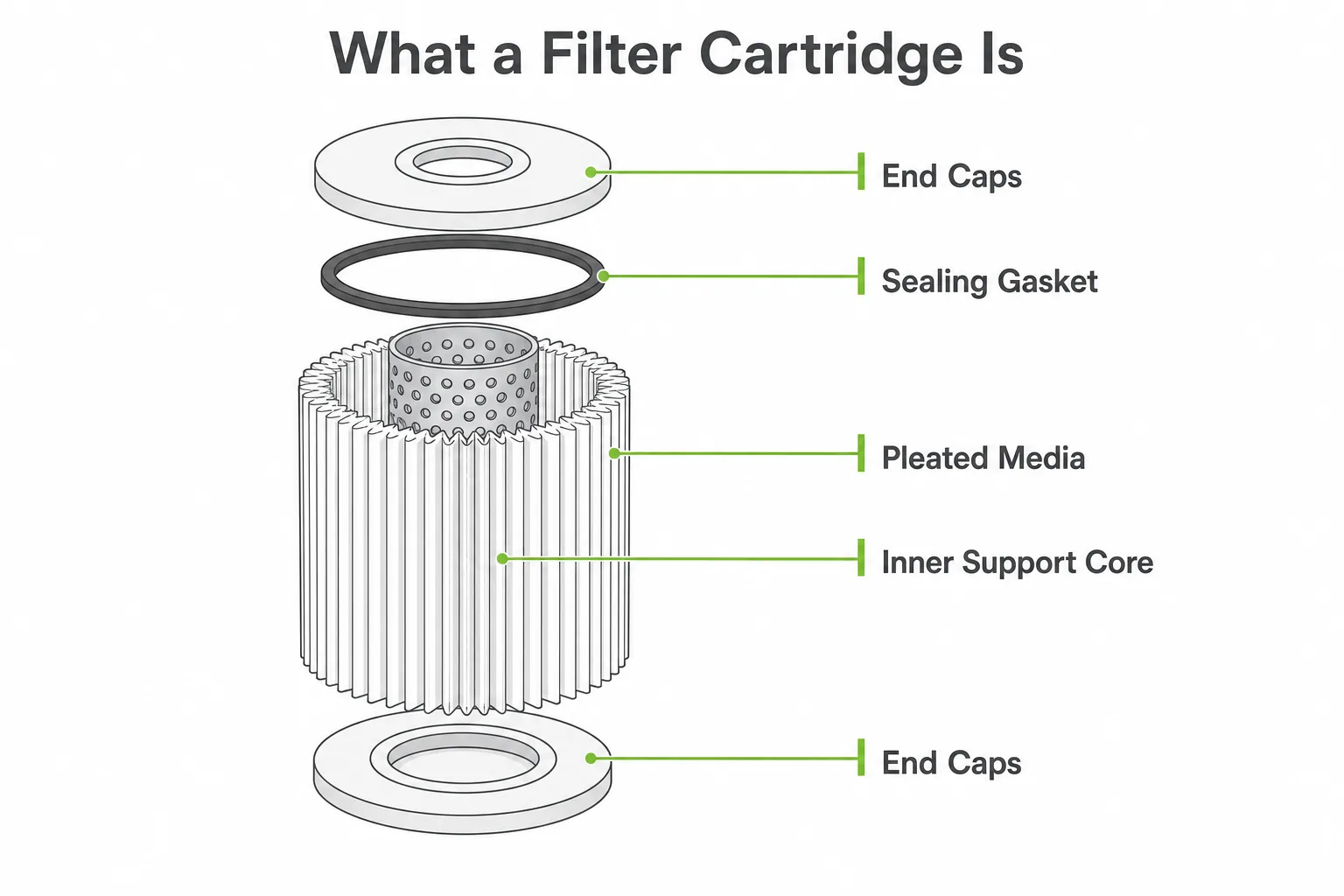
A filter cartridge is a complete replaceable element: pleated media around a support core, closed by end caps and sealed against the tube sheet by a gasket.
What Is a Dust Collector Filter Cartridge?
A dust collector filter cartridge is a cylindrical filter element made of pleated media wrapped around a rigid support core, closed with end caps and sealed with a gasket — the replaceable heart of a cartridge dust collector.
Four parts define the element. The pleated media does the filtration and decides most of the performance. The inner core keeps the element from collapsing under pressure drop and pulse cleaning. The end caps close the cylinder and carry the mounting geometry. The gasket seals the element against the tube sheet — the one part buyers most often ignore and the leak path most often found in emission complaints.
On the equipment side, per the AIER catalog, cartridge collectors use a downflow field design that helps cleaning, large-airflow cartridges keep the housing compact, and element replacement is designed to be simple and fast to shorten downtime. The cartridge dust collector platform serves industries from new energy and automotive to casting, tobacco and pharmaceutical duty — but the housing only performs as well as the elements inside it.
Why Pleated Design Packs More Filter Area
The pleats are the whole point of the cartridge concept: folding the media back and forth packs several times more filter area into the same physical volume than a plain cylindrical surface could offer.
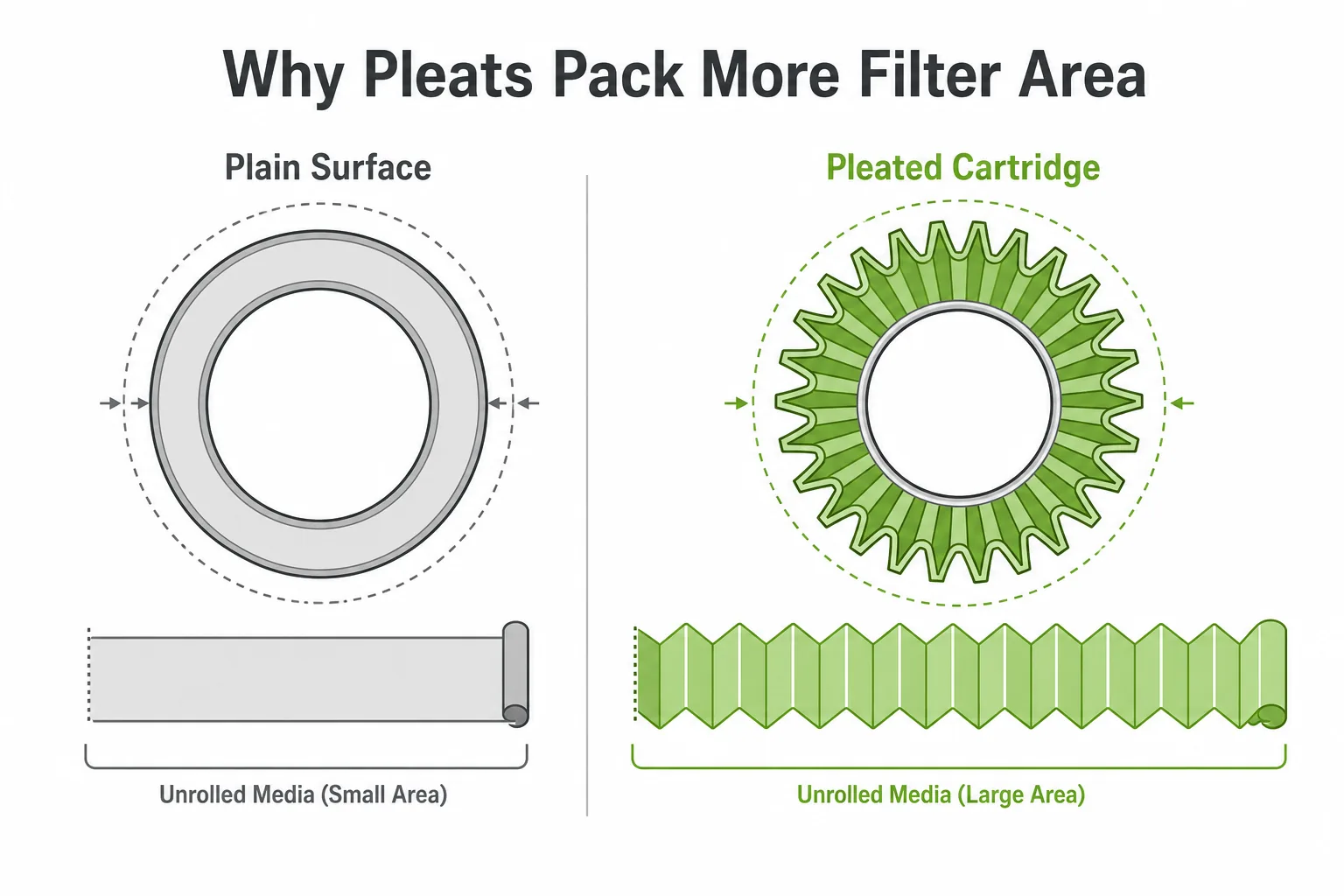
Folding the media multiplies the filtration area inside the same element volume — the reason cartridge collectors stay compact for their airflow.
More area in less space is why, per the AIER catalog, large-airflow cartridges can shrink the collector footprint so noticeably — a factor in the platform choice covered in our baghouse vs cartridge dust collector comparison.
The same geometry sets the limit. Pleats sit close together, and dust must travel into and out of those narrow valleys. Fine, dry dust releases well under pulse cleaning; sticky, moist or fibrous dust bridges the pleats and stays. That single trade — more area, tighter spacing — explains most of where cartridges excel and where they fail, and it is why the dust decides the element, not the other way around.
Cartridge Media Types: Polyester, Membrane and Nanofiber
Most industrial cartridge filters are built on a few media families, and the differences are practical rather than academic.
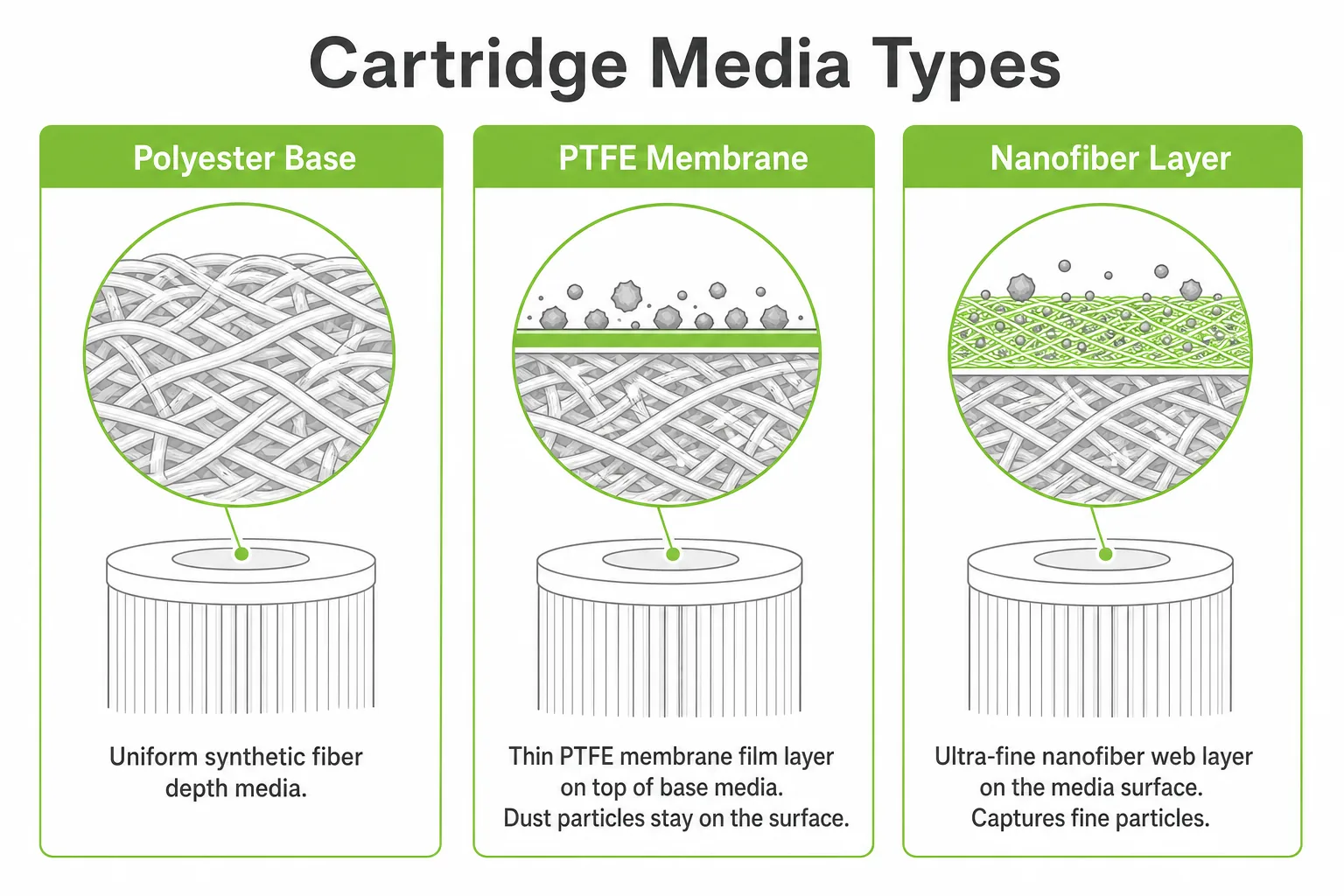
Polyester carries standard dry duty, PTFE membrane adds surface release for sticky fine dust, nanofiber layers improve fine particle capture — the dust decides which earns its cost.
| Media | How It Works | Where It Fits |
|---|---|---|
| Polyester (spunbond) | Depth-loading synthetic media; the standard base — and the media listed in the AIER cartridge catalog | General dry industrial dust at everyday temperatures |
| PTFE membrane laminate | A membrane on the surface keeps dust from embedding; the cake releases cleanly on pulsing | Fine, agglomerating or moisture-sensitive dusts; emission-critical duty |
| Nanofiber coated | A fine fiber layer on the surface captures fine particles early and builds cake fast | Fine dry dust such as welding fume, laser fume and light powders |
Treatments stack on top of the base media: antistatic versions where the dust or the process demands charge dissipation, and flame-retardant treatments where sparks or hot particles are a risk. These options are configuration decisions made against the actual working conditions — the review point is declaring the conditions, not memorizing the catalog.
Matching the Cartridge to the Dust
Cartridge selection is dust characterization wearing a different name. The same element that runs for years on one dust chokes in weeks on another.
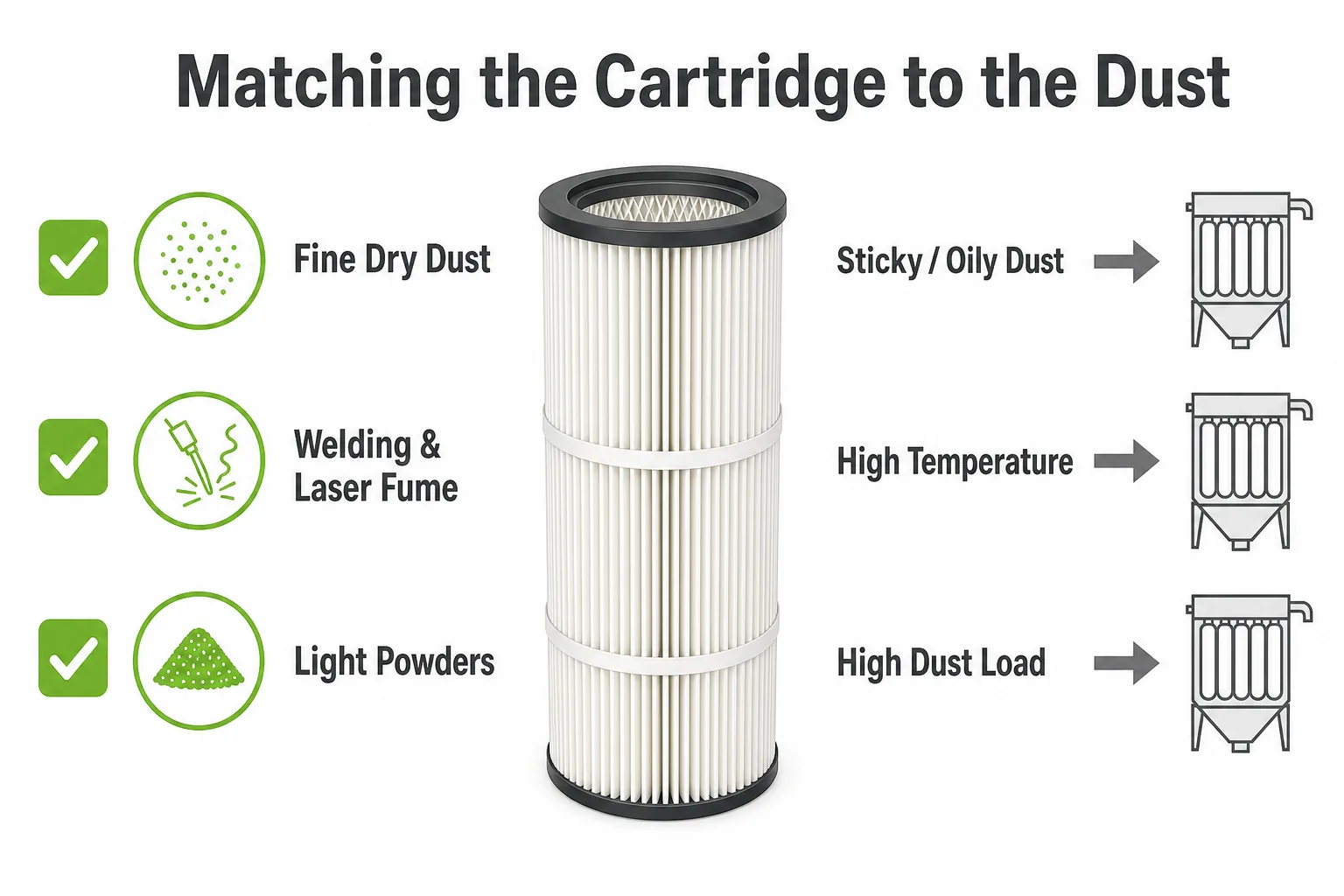
Fine dry dust is cartridge territory; sticky, hygroscopic and high-temperature duties push the review toward other filter elements.
| Dust Situation | Review Direction |
|---|---|
| Fine, dry dust — welding fume, laser fume, light powders | Core cartridge duty; nanofiber or membrane media improves capture and release |
| Abrasive dust — casting, grinding, blasting returns | Media wear and pleat protection reviewed; inlet design matters as much as media |
| Sticky, oily or hygroscopic dust | Pleat bridging risk — membrane media sometimes helps, but often another element fits better |
| High temperature or high dust concentration | Per the AIER catalog, cartridge collectors are not suited to these duties — pleated bag and flat bag platforms take over |
| Combustible dust | Declare the combustibility data; equipment and element review follows the safety review |
The high-temperature and high-concentration boundary deserves emphasis because it comes from AIER’s own catalog rather than from sales positioning: where cartridges cannot be applied, the pleated bag dust collector continues the compact-element idea with fabric bag durability. A supplier with both platforms has no reason to force cartridges onto the wrong dust — which is exactly what makes the boundary trustworthy. Where both sit in the full collector family is mapped in our types of dust collectors overview.
The bag-side equivalent of this review — fabric selection by temperature, moisture and chemistry — is covered in our dust collector filter bags article, the sister piece to this one.
Replacement Signals: When the Cartridge Is Done
Cartridges do not fail on a schedule; they fail on signals. These are the ones worth trending.
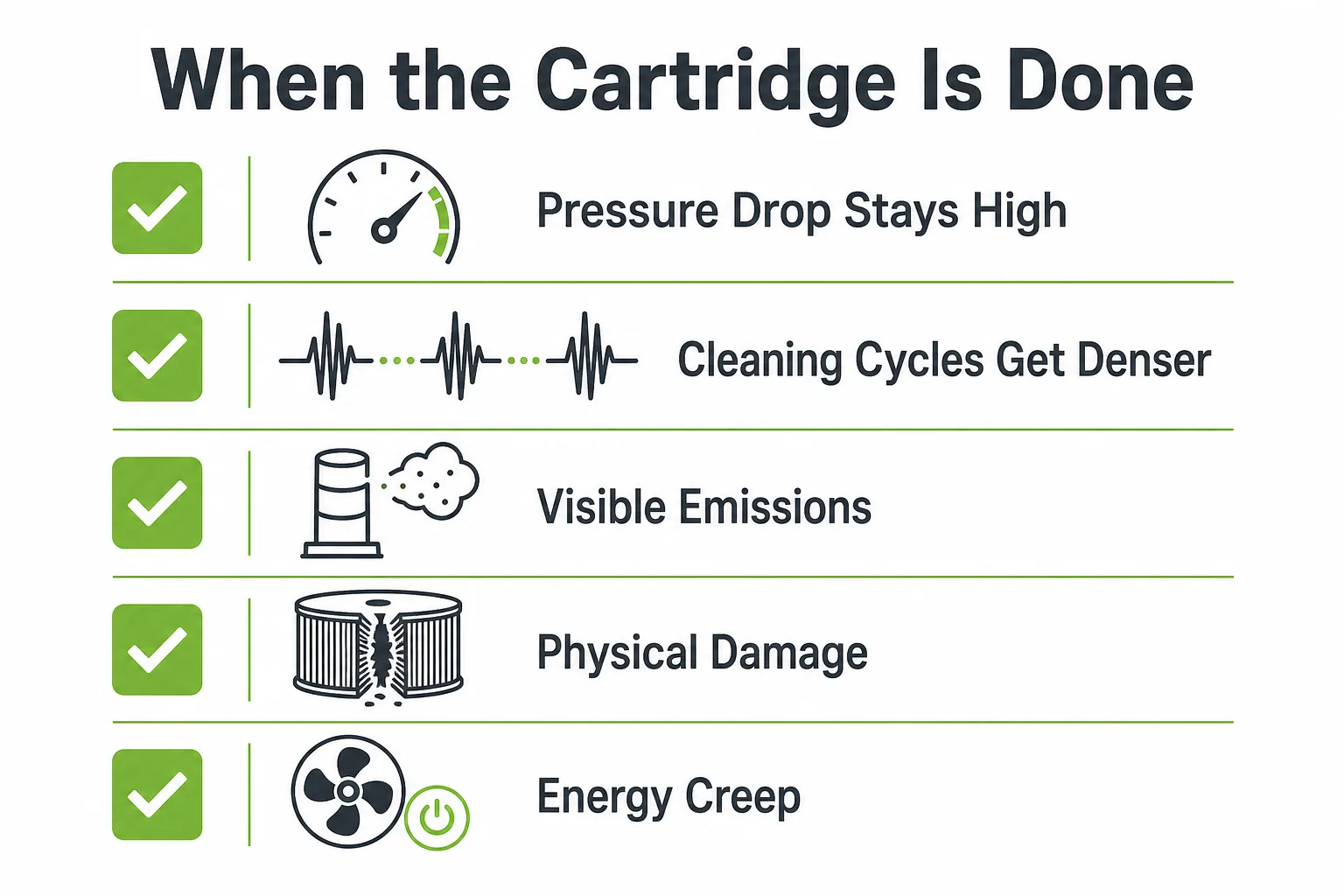
Pressure drop that cleaning no longer recovers, denser pulse cycles, visible emissions and physical element damage are the standard replacement signals.
- Pressure drop stays high after cleaning: when pulses no longer bring the differential pressure back to its familiar baseline, the media is loading permanently — the defining end-of-life signal.
- Cleaning cycles get denser: the system compensates for blinding media by pulsing more often, which spends compressed air and shortens the remaining life further.
- Visible or measured emissions: dust on the clean side means media damage or seal failure somewhere in the set — find it before replacing anything blindly.
- Physical damage: collapsed pleats, cracked end caps, opened glue seams or crushed cores end the discussion regardless of pressure drop.
- Energy creep: a fan working against a blinded filter set draws more power for the same airflow — the quiet cost that rarely gets attributed to the elements.
The monitoring routine behind these signals — differential pressure trending, cleaning system checks, inspection habits — is covered in our dust collector maintenance article; the pulse mechanics themselves are in the pulse jet cleaning explainer.
Cleaning vs Replacing: The Honest Answer
Every plant eventually asks whether cartridges can be cleaned and reused instead of replaced. The honest answer has three parts.
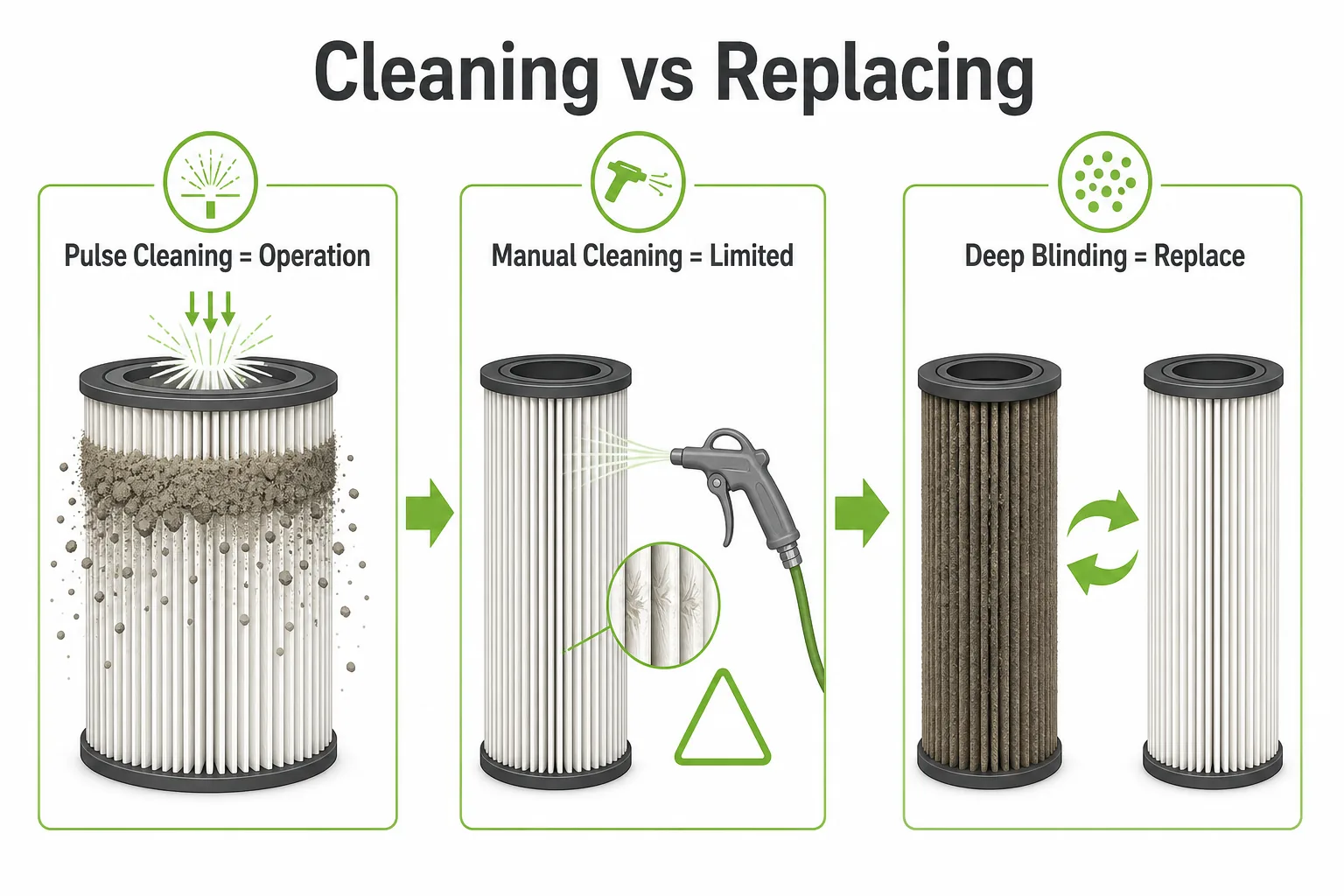
Pulse cleaning manages the daily cake; manual cleaning recovers surface dust at some risk; deep media blinding is irreversible — the pressure drop tells the truth.
First: pulse cleaning is operation, not renewal. The collector’s own compressed air pulses shed the daily dust cake and keep the element working — but they never return the media to new condition, and each cycle leaves a little more dust embedded in the depth of the media.
Second: manual cleaning has a narrow window. Careful low-pressure air blowdown from the clean side can recover surface-loaded dust and buy time on a lightly used set. It also carries real risks: driving dust deeper, tearing pleats, damaging membrane surfaces — a membrane cartridge cleaned aggressively is often a membrane cartridge destroyed. Washing is only even considered for specific washable media, and drying and re-verification make it rarely worth the downtime on standard elements.
Third: the pressure drop is the referee. If cleaning of any kind no longer restores the baseline differential pressure, the media is blinded in depth and no amount of external effort reverses it. At that point every week of delay is paid for in fan energy and cleaning air. Replace the set, record the service life, and use that record — dust type, conditions, months achieved — as the data for the next selection review.
Common Cartridge Buying Mistakes
The same avoidable mistakes appear across industries when cartridge sets are reordered.
- Buying by dimensions alone: a cartridge that fits the housing is not a cartridge that fits the dust — media selection is the decision, geometry is just the constraint.
- Downgrading media to save unit cost: a cheaper set that blinds in half the time costs more per year in elements, energy and downtime.
- Ignoring the gasket and seating: a perfect element sealed badly leaks like a damaged one; installation orientation and torque matter.
- Mixing old and new elements: airflow takes the path of least resistance — fresh cartridges next to blinded ones overload immediately and age unevenly.
- Treating manual cleaning as a strategy: it is a contingency measure, not a life-cycle plan.
- Keeping no replacement records: service life per dust and per media is the single most useful input for the next review — and most plants never write it down.
Information AIER Needs for a Cartridge Review
A cartridge selection or replacement review moves fastest when the inquiry carries the dust picture and the operating history together.
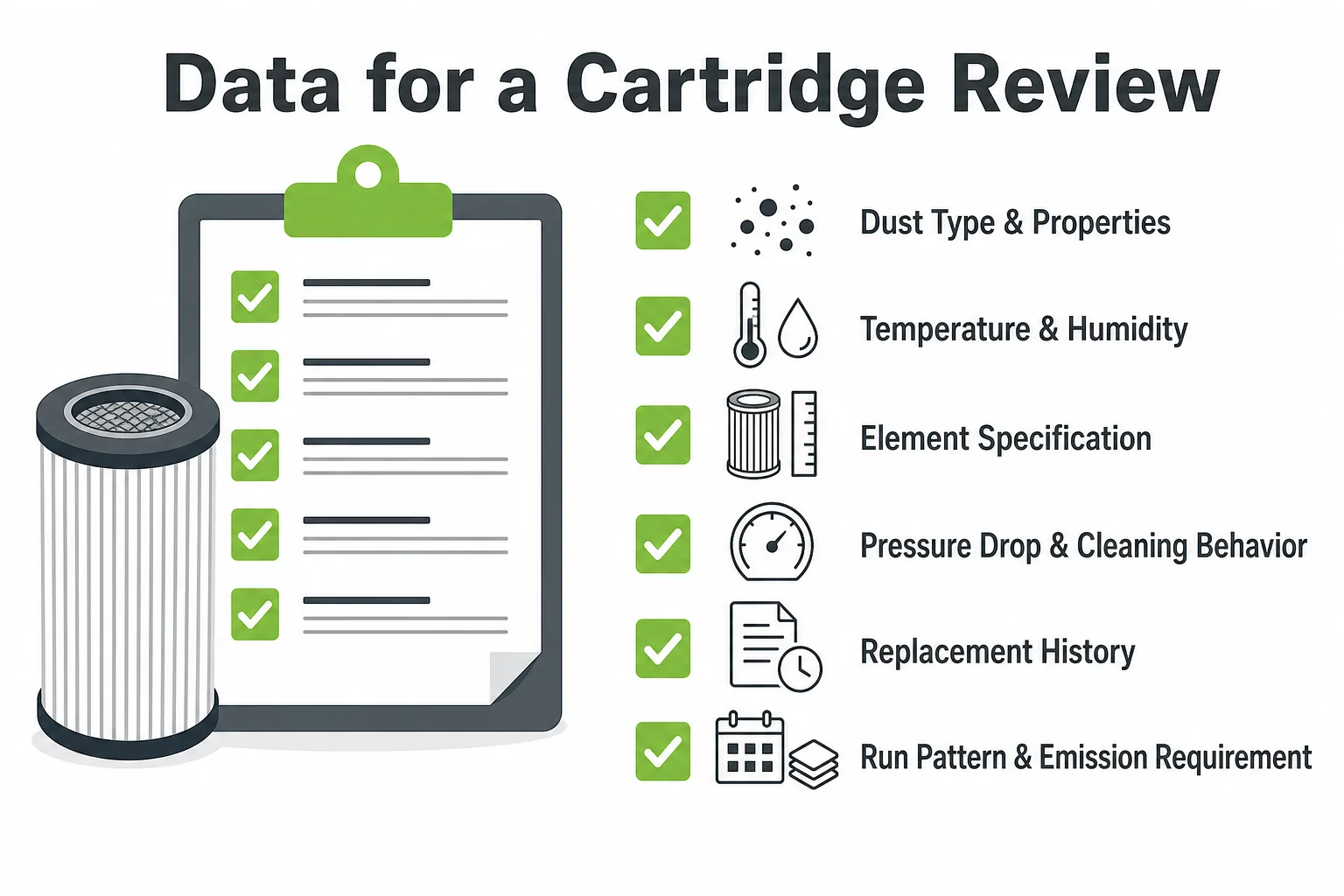
Dust properties, operating conditions, equipment and element details, pressure drop behavior and replacement history are the data AIER reviews before recommending cartridges.
| Data to Prepare | Why It Matters |
|---|---|
| Dust type and properties | Particle behavior, stickiness, abrasiveness and combustibility declaration drive media selection |
| Gas temperature and humidity | Decides whether cartridges fit at all, and which treatments are needed |
| Collector model and element specification | Dimensions, quantity and mounting geometry set the replacement envelope |
| Current pressure drop and cleaning behavior | Shows whether the problem is the elements, the cleaning system or the duty |
| Replacement history and service life achieved | The best predictor of what the next set needs to do differently |
| Run pattern and emission requirement | Continuous duty and strict limits justify higher-grade media |
| Installation country | Defines project and delivery requirements |
If your cartridge collector is due for elements — or its current set is not lasting the way it should — contact AIER with the dust type, operating conditions, element specification and replacement history. AIER will review the media selection against the actual duty, and say plainly if the dust points to a different filter element instead.
FAQ
What is a dust collector filter cartridge?
A dust collector filter cartridge is a cylindrical, replaceable filter element made of pleated media around a rigid support core, closed with end caps and sealed with a gasket. The pleated design packs several times more filter area into the same volume than a plain surface, which is what keeps cartridge collectors compact for their airflow.
How do I choose the right cartridge media?
Start from the dust, not the catalog: polyester base media covers general dry duty, PTFE membrane adds surface release for fine, agglomerating or moisture-sensitive dust, and nanofiber layers improve fine particle capture on duties like welding fume. Antistatic and flame-retardant treatments follow the process conditions. The declared dust properties decide which upgrade earns its cost.
How long do dust collector filter cartridges last?
There is no universal lifetime — service life depends on the dust load, its behavior, the operating hours and how well the cleaning system works. The reliable approach is to trend the signals: pressure drop baseline after cleaning, cleaning frequency and emissions. A replacement record per dust and media is the best predictor a plant can build for its own duty.
Can dust collector cartridge filters be cleaned and reused?
Within limits. Careful low-pressure blowdown can recover surface dust and buy time, but it risks driving dust deeper, tearing pleats and damaging membrane surfaces, and it never reverses deep media blinding. Washing applies only to specific washable media. If cleaning no longer restores the pressure drop baseline, the set is done and replacement is the economical choice.
When should filter cartridges be replaced?
When the signals say so: differential pressure that cleaning no longer recovers, pulse cycles growing denser, visible or measured emissions on the clean side, or physical damage such as collapsed pleats and cracked end caps. Replace the elements as a complete set, and record the achieved service life for the next selection review.
Does AIER supply replacement filter cartridges?
Yes. Cartridge collectors are a core AIER product line, with elements and media configured per the dust and operating conditions — and per its own catalog, AIER also states where cartridges are not suitable, such as high-temperature and high-concentration duty, where pleated bag and flat bag platforms take over. Element recommendations are handled as a review of the actual duty, not a one-size answer.