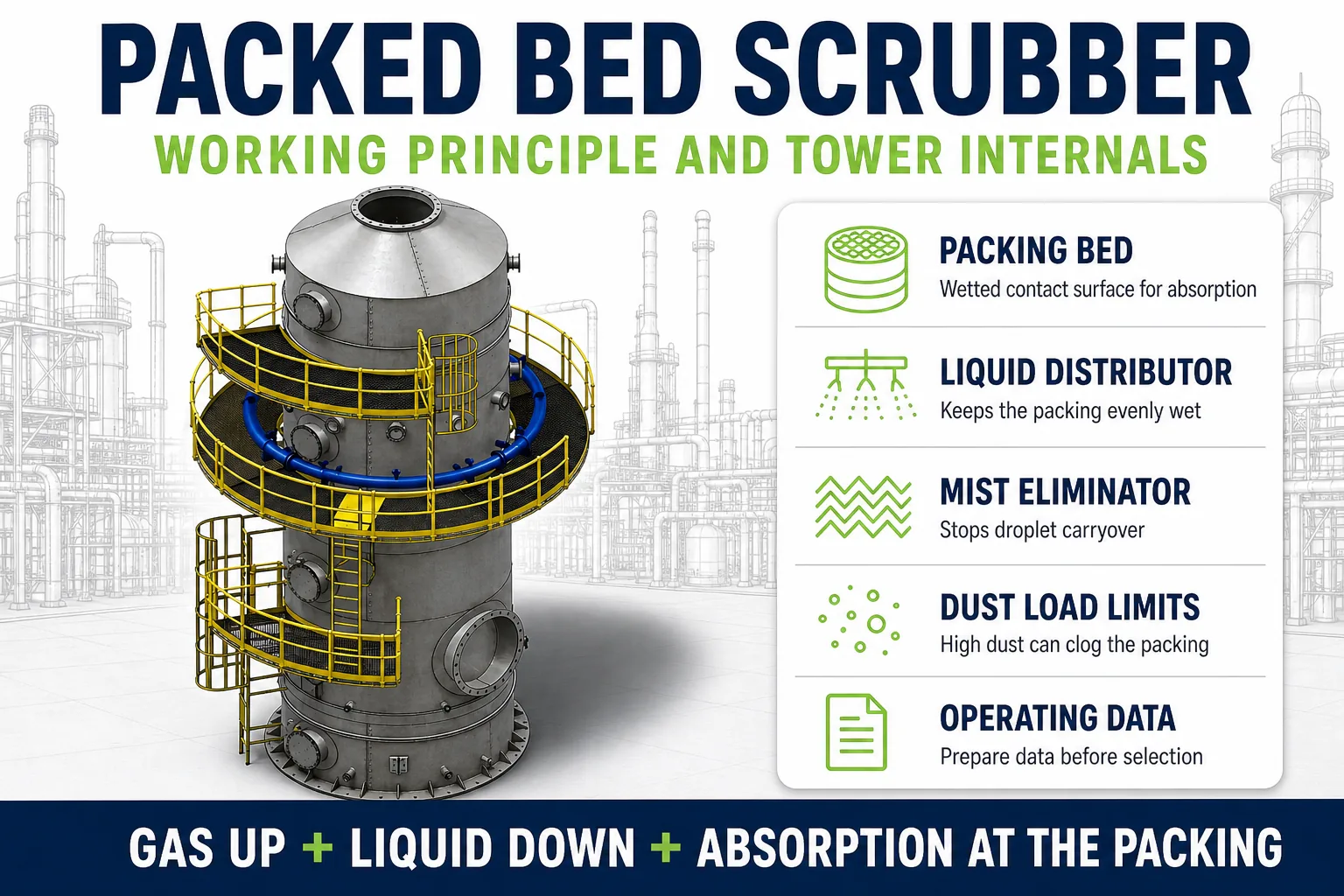
Packed bed scrubbers are the most common tower type behind the scrubber quotes industrial buyers receive, yet most product pages only show the outside of the vessel. What actually decides whether the scrubber works is inside: the packing bed, the liquid distributor, the support internals and the mist eliminator.
This article explains how a packed bed scrubber works, what each internal part does, how random and structured packing differ, when this tower type is the wrong choice, and what operating data AIER reviews before recommending one. It is written for plant engineers and project buyers comparing exhaust gas treatment systems. It does not replace process design or local emission requirements for a specific project.
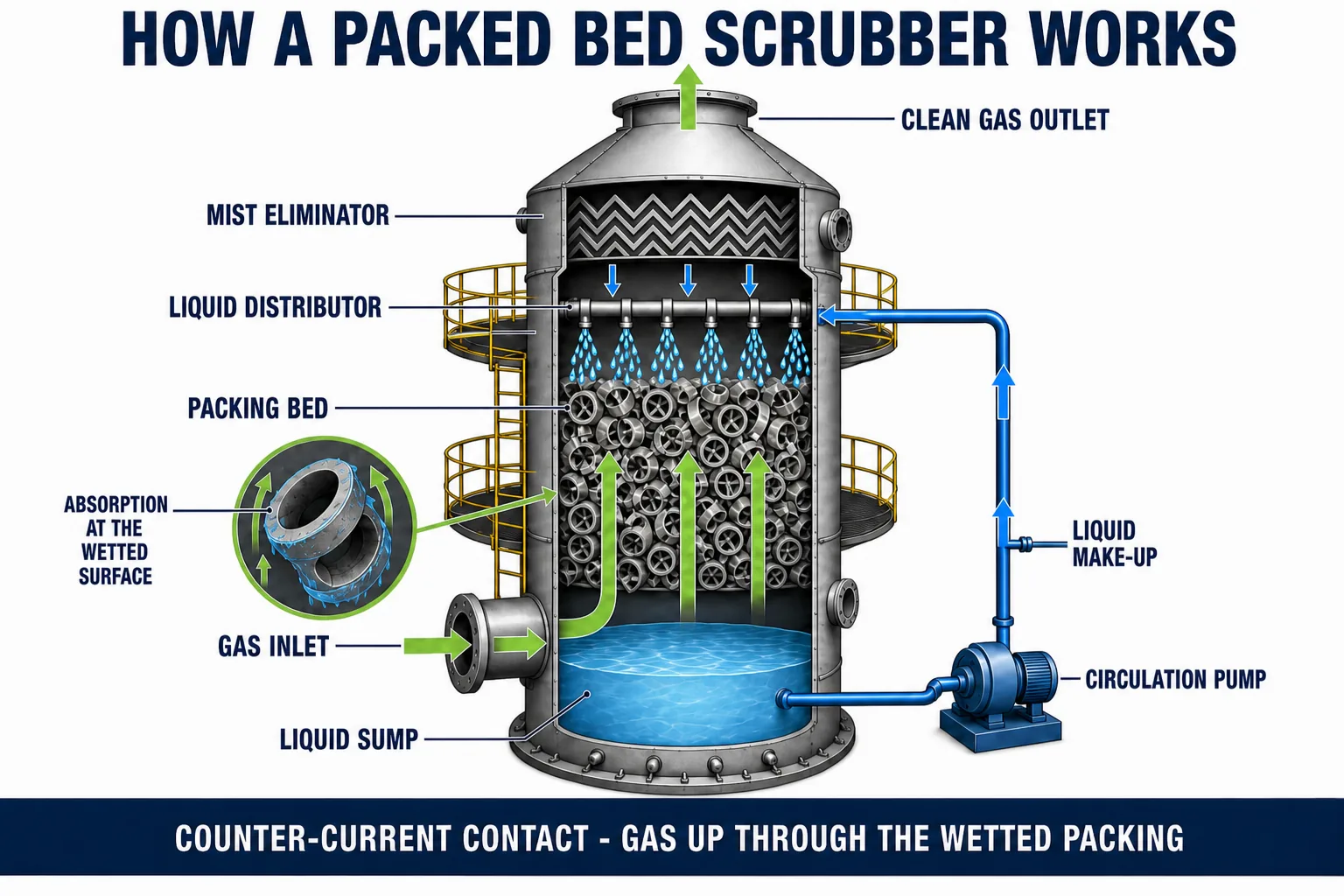
In a packed bed scrubber the gas flows up through the wetted packing while the washing liquid flows down, so pollutants are absorbed at the packing surface.
What Is a Packed Bed Scrubber?
A packed bed scrubber is a wet scrubbing tower that uses a bed of packing media to create a large gas-liquid contact surface, so gaseous pollutants in the exhaust stream are absorbed into the washing liquid as the gas passes through the wetted packing.
The same equipment appears under several names. A packed tower scrubber and a packed column scrubber are the same device family: a vertical vessel with one or more packing sections. When the emphasis is on the liquid circuit, the unit may also be called a packed bed wet scrubber. The names change; the working principle does not.
Packed bed contact is one of the two gas-liquid contact methods used in AIER industrial wet scrubber towers, alongside spray contact. The tower shell is typically FRP, PP or stainless steel, selected according to the gas and the washing chemistry. Where the packed tower sits among the other air pollution control equipment families is mapped in our overview article.
How a Packed Bed Scrubber Works
Most packed bed scrubbers run counter-current: the exhaust gas enters near the bottom of the tower and flows upward, while the washing liquid is distributed above the packing and flows downward over the media. The two streams meet across the packing surface, which is where absorption happens.
The sequence is simple to follow.
- Gas inlet: the exhaust stream enters above the liquid sump and turns upward into the packing section.
- Absorption in the packing: the packing media is coated with a thin liquid film; as the gas passes through the narrow wetted channels, soluble or reactive pollutants transfer into the liquid.
- Liquid return: the washing liquid collects in the sump and is circulated back to the top; the chemistry is refreshed as it is consumed.
- Droplet removal: the cleaned gas passes through a mist eliminator that reduces droplet carryover before the outlet.
Because absorption depends on contact between gas and liquid, anything that reduces wetted surface, such as fouled packing or poor liquid distribution, directly reduces removal performance. That is why the internals deserve more attention than the shell.
Main Parts Inside the Tower
From bottom to top, a packed bed scrubber contains a short list of internals. Each one has a job, and each one has a typical failure mode that shows up in operation.
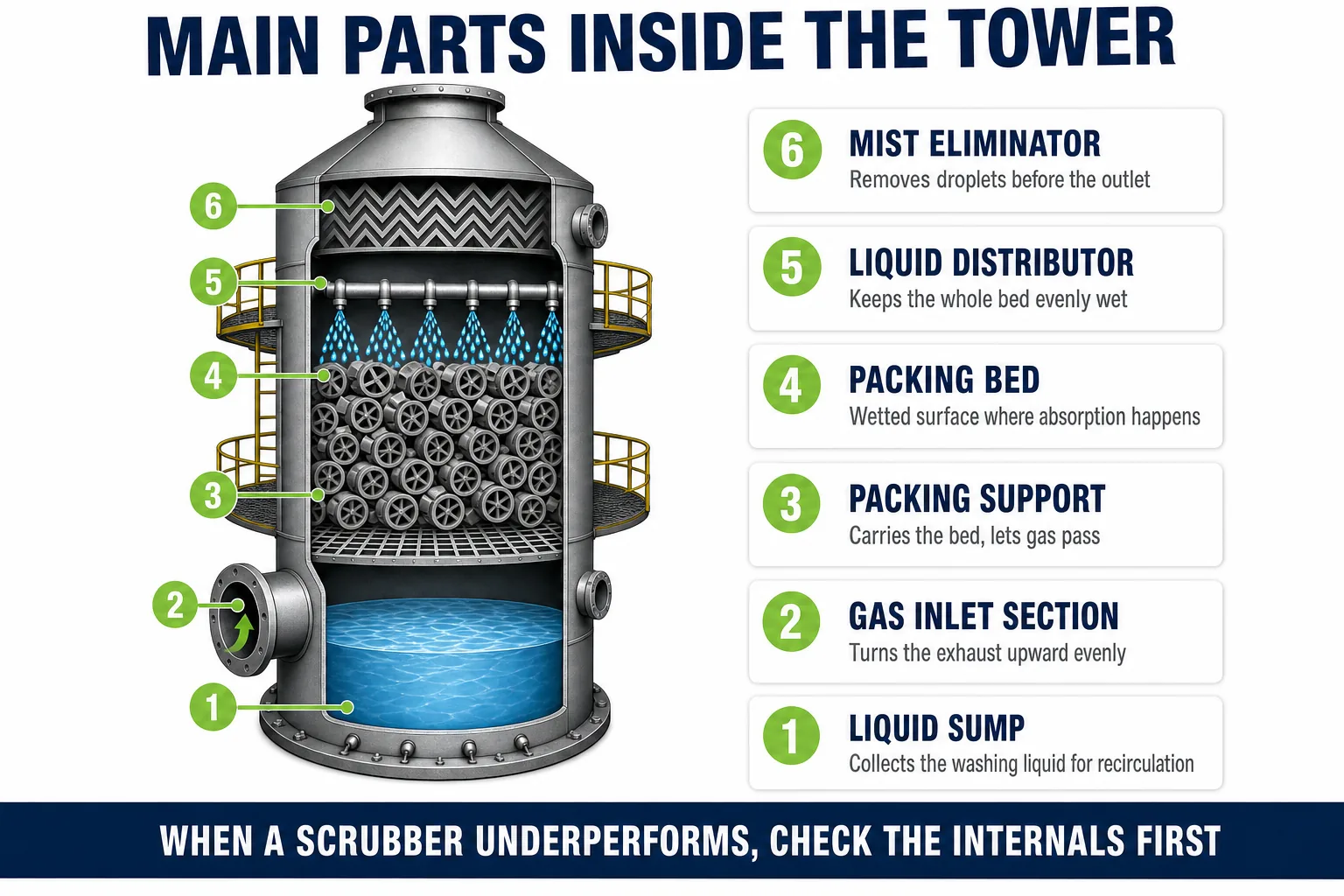
Packed bed scrubber internals from bottom to top: liquid sump, gas inlet, packing support, packing bed, liquid distributor and mist eliminator.
| Internal | What It Does | What Happens When It Fails |
|---|---|---|
| Liquid sump | Collects the washing liquid for recirculation | Sludge buildup changes liquid quality and pump behavior |
| Gas inlet section | Brings the exhaust in and turns it upward evenly | Poor gas distribution loads one side of the packing |
| Packing support | Carries the packing while letting gas pass through | Blocked support openings raise pressure drop |
| Packing bed | Creates the wetted contact surface for absorption | Fouling and channeling reduce removal performance |
| Liquid distributor | Spreads the washing liquid evenly over the packing | Blocked nozzles leave dry zones with no absorption |
| Mist eliminator | Removes entrained droplets before the outlet | Carryover wets downstream ducts and equipment |
When a packed bed scrubber underperforms, the cause is usually one of these internals rather than the tower size. A scrubber review should always ask how each internal can be inspected and maintained, not only what the vessel dimensions are.
Random Packing and Structured Packing
Scrubber packing comes in two families. Random packing is made of individual pieces, such as rings and saddles, dumped into the tower in bulk. Structured packing is made of ordered modules, usually corrugated sheets, stacked into the tower in defined layers.
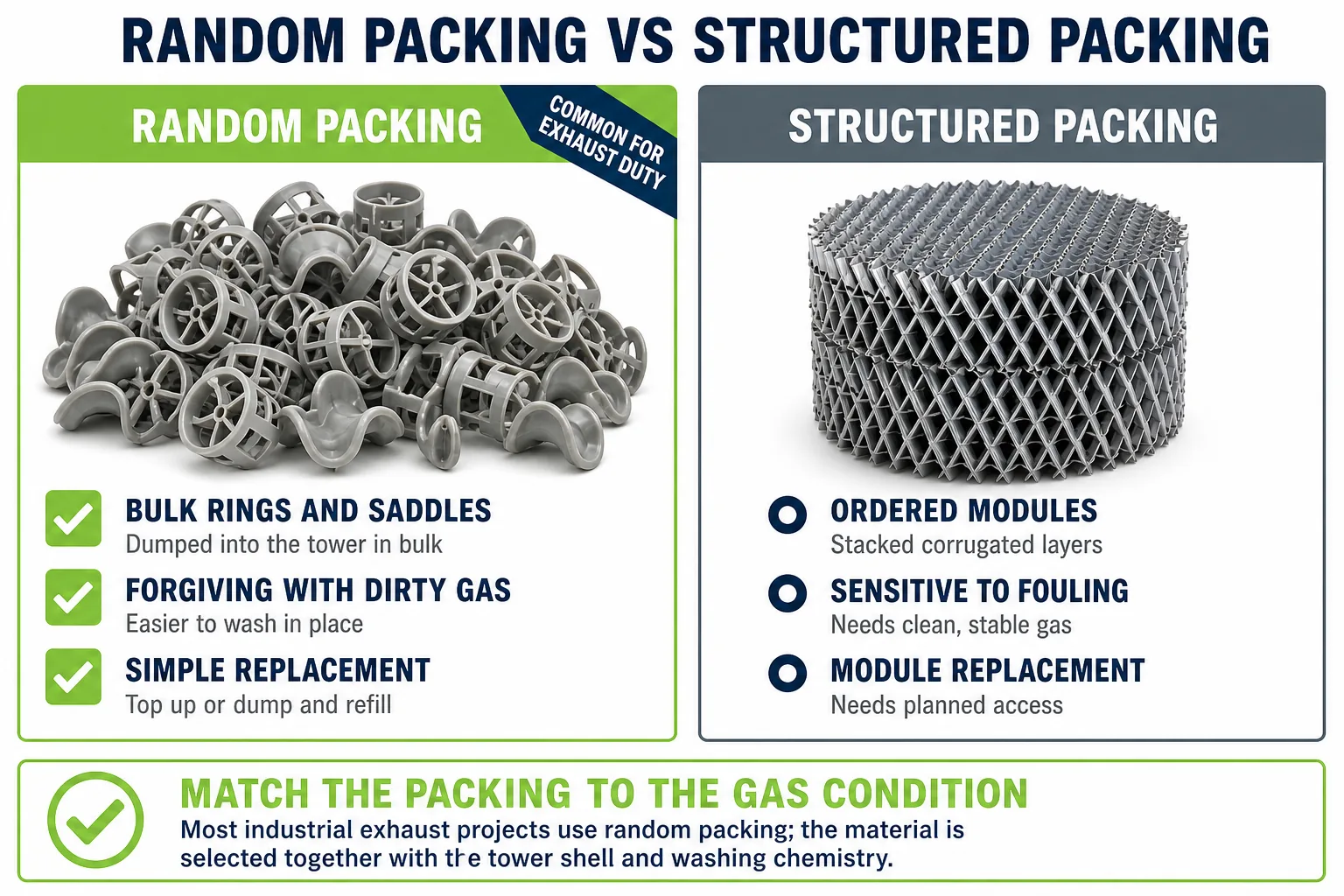
Random packing uses bulk-dumped rings and saddles while structured packing uses ordered modules; the choice depends on the gas condition.
| Aspect | Random Packing | Structured Packing |
|---|---|---|
| Form | Bulk pieces such as rings and saddles | Ordered modules stacked in layers |
| Contact surface | Good, created by random gaps between pieces | Organized channels with a defined surface |
| Dirty gas tolerance | More forgiving, easier to wash in place | More sensitive to fouling and plugging |
| Replacement | Simple to top up or dump and refill | Replaced as modules, needs planned access |
| Typical use in exhaust scrubbing | Most industrial exhaust applications | Selected cases where the gas is clean and stable |
For most industrial exhaust projects with some dust, oil or variability in the stream, random tower packing is the default choice because it tolerates real plant conditions better. The packing material itself, usually plastic in corrosive service, is selected together with the tower shell and the washing chemistry.
Packed Bed, Spray Tower and Venturi Compared
Packed bed contact is not the only scrubber design. The right type depends on what dominates the problem: gas absorption, dust load or droplet handling.
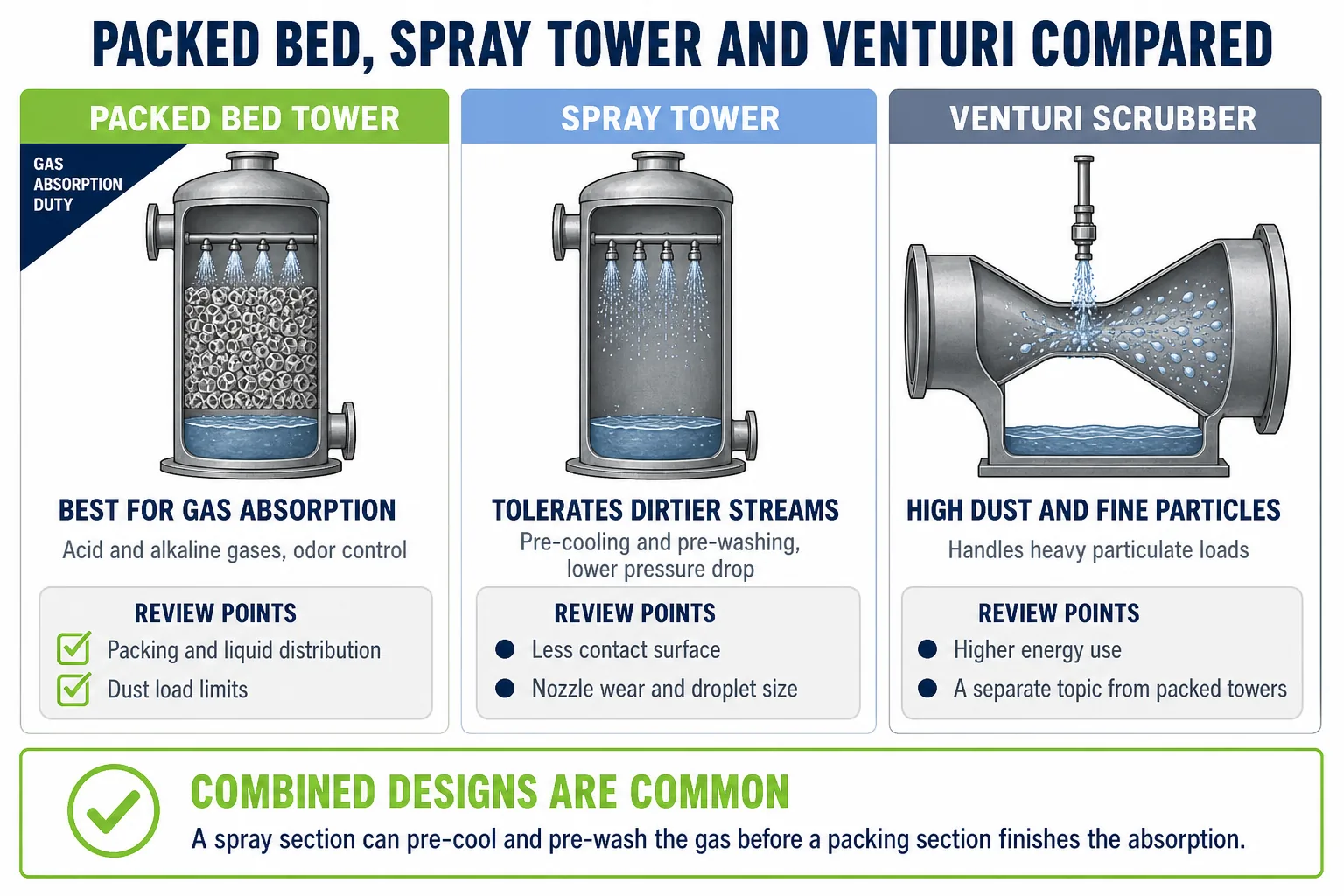
Packed bed towers lead on gas absorption, spray towers tolerate dirtier streams, and venturi designs target high dust loads.
| Type | Where It Fits | Review Points |
|---|---|---|
| Packed bed tower | Gas absorption duty, acid or alkaline gases and odor | Packing condition, liquid distribution, dust load limits |
| Spray tower | Dirtier streams and pre-cooling, lower pressure drop | Less contact surface, droplet size and nozzle wear |
| Venturi scrubber | High dust loads and fine particles | Higher energy use; a separate topic from packed towers |
Combined designs are common: a spray section can pre-cool and pre-wash the gas before a packing section finishes the absorption. This is one reason the gas condition, not the tower name, should drive the selection.
What a Packed Bed Scrubber Can Treat
Packed bed scrubbers are absorption equipment, so they target pollutants that can be dissolved or neutralized in a liquid. Typical duties in industrial plants include the following.
- Acid gases: streams containing gases such as hydrogen sulfide are treated with an alkaline washing route; the H2S scrubber application is covered in detail in a separate article.
- Alkaline gases: gases such as ammonia are handled with an acid washing route.
- Water-soluble components: components such as ethanol can be removed by water washing alone.
- Odor control: odor-driven projects in food, rendering and wastewater facilities often use packed towers, sometimes followed by an activated carbon adsorption polishing stage.
The washing route, water washing or chemical washing with an acid or alkaline liquid, is selected according to the gas composition. Sector pages such as chemical industry exhaust treatment show how packed towers are combined with other equipment in a full treatment line.
When a Packed Bed Scrubber Is Not the Right Choice
Packing creates a large contact surface, and that same geometry is its weakness: the narrow wetted channels can block. According to the EPA air pollution control technology fact sheet for packed-bed and packed-tower wet scrubbers, this tower type is best applied where the particulate loading in the gas is low, because dust can clog the packing.
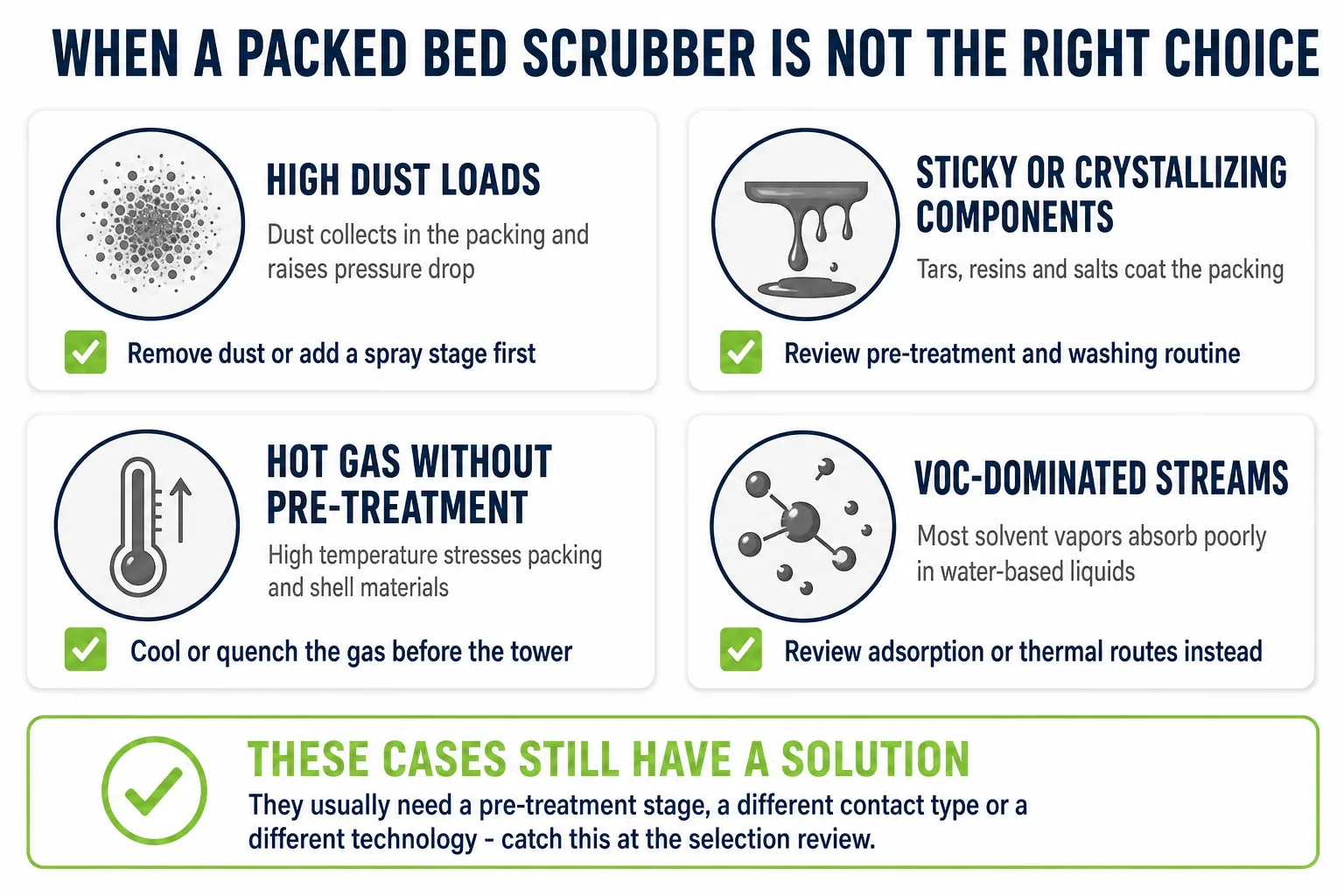
High dust loads, sticky or crystallizing components and hot untreated gas are the usual reasons a packed bed needs pre-treatment or a different design.
- High dust loads: dust collects in the packing and raises pressure drop; dusty streams usually need dust removal or a spray stage before the packing.
- Sticky or crystallizing components: tars, resins and salts that crystallize in the liquid can coat the packing faster than washing can clean it.
- Hot gas without pre-treatment: high inlet temperatures increase liquid loss and can exceed what the packing and shell materials tolerate; cooling or a quench section comes first.
- VOC-dominated streams: most solvent vapors absorb poorly in water-based liquids; these streams point to adsorption or thermal routes instead of a washing tower.
None of these situations means “no scrubber”. They mean the design needs a pre-treatment stage, a different contact type or a different technology, which is exactly what a selection review should catch before the order is placed.
What Affects Packed Bed Scrubber Performance
Two towers with the same diameter can deliver very different results. When AIER reviews a packed bed scrubber application, these are the factors that usually decide the outcome.
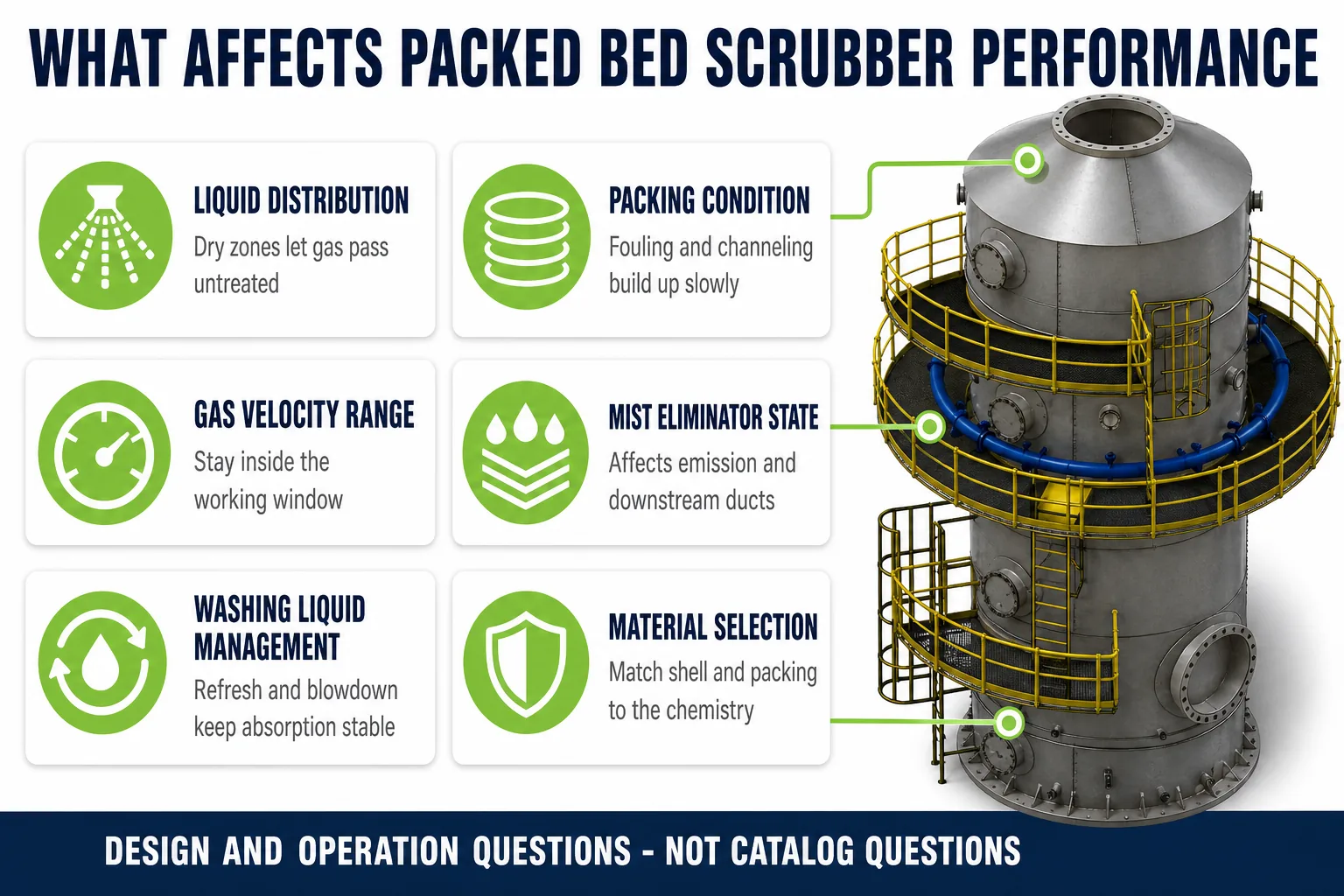
Liquid distribution, packing condition, gas velocity range, mist eliminator state and liquid management decide packed bed scrubber performance.
- Liquid distribution quality: the packing only works where it is wet; uneven distribution creates dry zones that gas passes through untreated.
- Packing condition: fouling and channeling develop gradually, so the review should cover how the packing can be inspected, washed and replaced.
- Gas velocity range: the tower has a working window; running far above or below design airflow hurts contact and can cause carryover.
- Mist eliminator state: a blocked or damaged mist eliminator affects both emission quality and everything downstream.
- Washing liquid management: liquid quality drifts as chemistry is consumed and solids accumulate; refresh and blowdown routines keep absorption stable.
- Material selection: shell, packing and internals must match the gas and the washing chemistry from the start, especially in corrosive service.
These are scrubber design and operation questions rather than catalog questions, and they come from the plant’s operating data. That leads directly to the data package.
Information AIER Needs for a Packed Bed Scrubber Review
A packed bed scrubber review moves quickly when the inquiry includes the operating data below instead of only a tower size request.
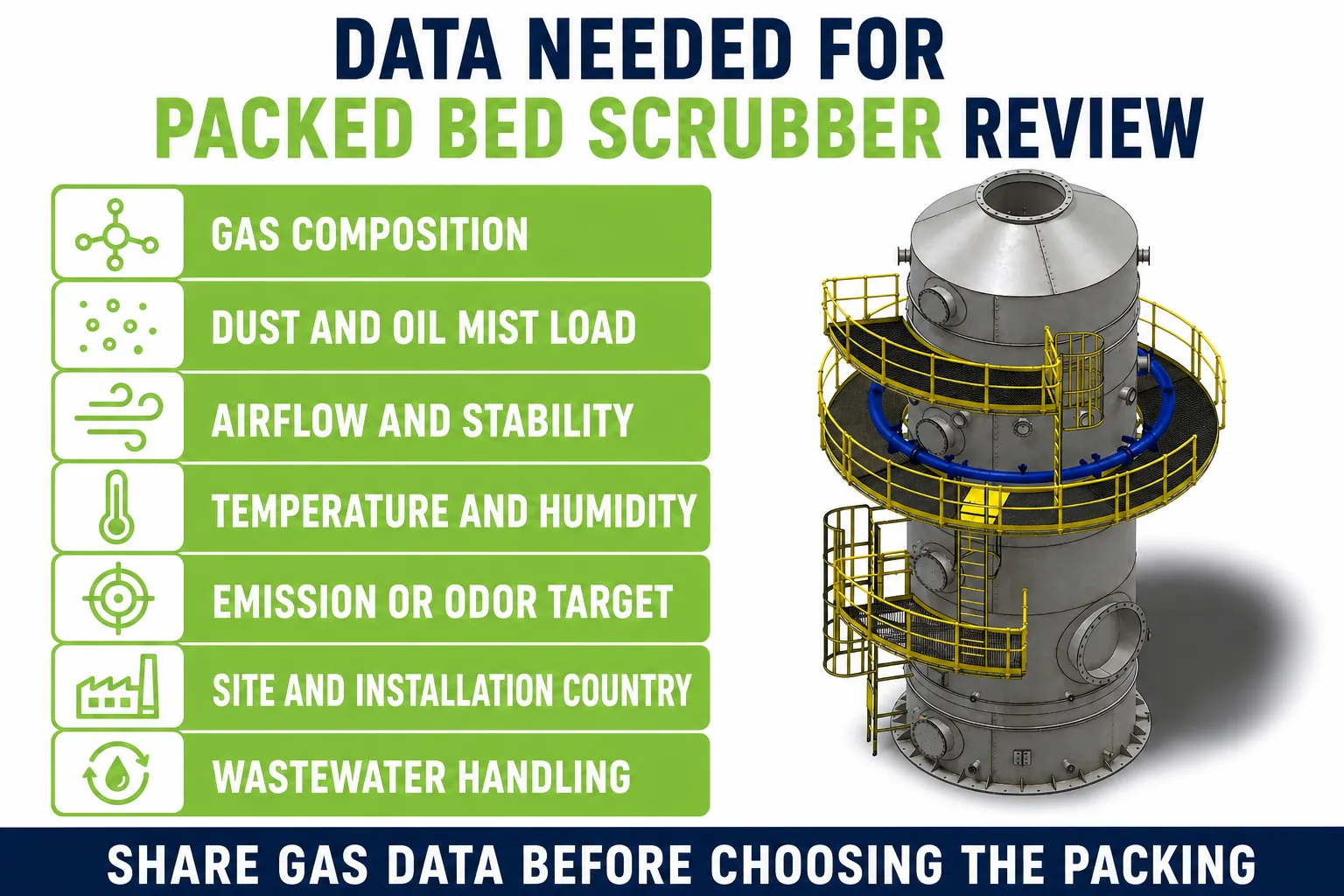
AIER reviews gas composition, dust and oil load, airflow, temperature, humidity and the emission target before recommending a packed bed scrubber.
| Data to Prepare | Why It Matters |
|---|---|
| Gas composition and concentration range | Decides the washing route and the packing material |
| Dust and oil mist load | Shows whether the packing needs pre-treatment protection |
| Airflow and how stable it is | Decides tower size and the working velocity window |
| Gas temperature and humidity | Affects absorption, liquid loss and material limits |
| Emission or odor target | Defines what the treated gas must achieve and whether polishing is needed |
| Site conditions and installation country | Affects layout, materials, utilities and project requirements |
| Wastewater handling capability | Confirms where the spent washing liquid can go |
If you are comparing scrubber offers or planning a new exhaust line, contact AIER with your gas composition, dust load, airflow, temperature, humidity and emission target. AIER will review whether a packed bed design, a spray stage, a combined tower or a different route fits your exhaust condition.
FAQ
What is a packed bed scrubber?
A packed bed scrubber is a wet scrubbing tower that uses a bed of packing media to create a large wetted contact surface. Exhaust gas passes up through the packing while washing liquid flows down over it, and gaseous pollutants are absorbed into the liquid.
How does a packed bed scrubber work?
The gas enters near the bottom of the tower and flows upward through the packing, counter-current to the washing liquid distributed from above. Pollutants transfer into the liquid film on the packing surface, the liquid collects in the sump for recirculation, and a mist eliminator removes droplets before the clean gas outlet.
Is a packed tower scrubber the same as a packed bed scrubber?
Yes. Packed tower scrubber, packed column scrubber and packed bed wet scrubber all describe the same equipment family: a wet scrubber whose gas-liquid contact happens in a packed section.
What packing is used in a scrubber?
Scrubber packing is either random packing, bulk pieces such as rings and saddles, or structured packing made of ordered modules. Most industrial exhaust applications use random packing because it tolerates dust and fouling better, with the material chosen to match the gas and washing chemistry.
When is a packed bed scrubber not suitable?
Packed beds suit streams with low particulate loading. High dust loads, sticky or crystallizing components and hot untreated gas can clog or damage the packing, so those streams need pre-treatment first or a different scrubber type such as a spray or venturi design.
What information is needed for a packed bed scrubber quote?
Provide gas composition, concentration range, dust and oil mist load, airflow, temperature, humidity, the emission or odor target and the installation country. AIER reviews the washing route, packing type, tower material and system design based on the exhaust gas condition.