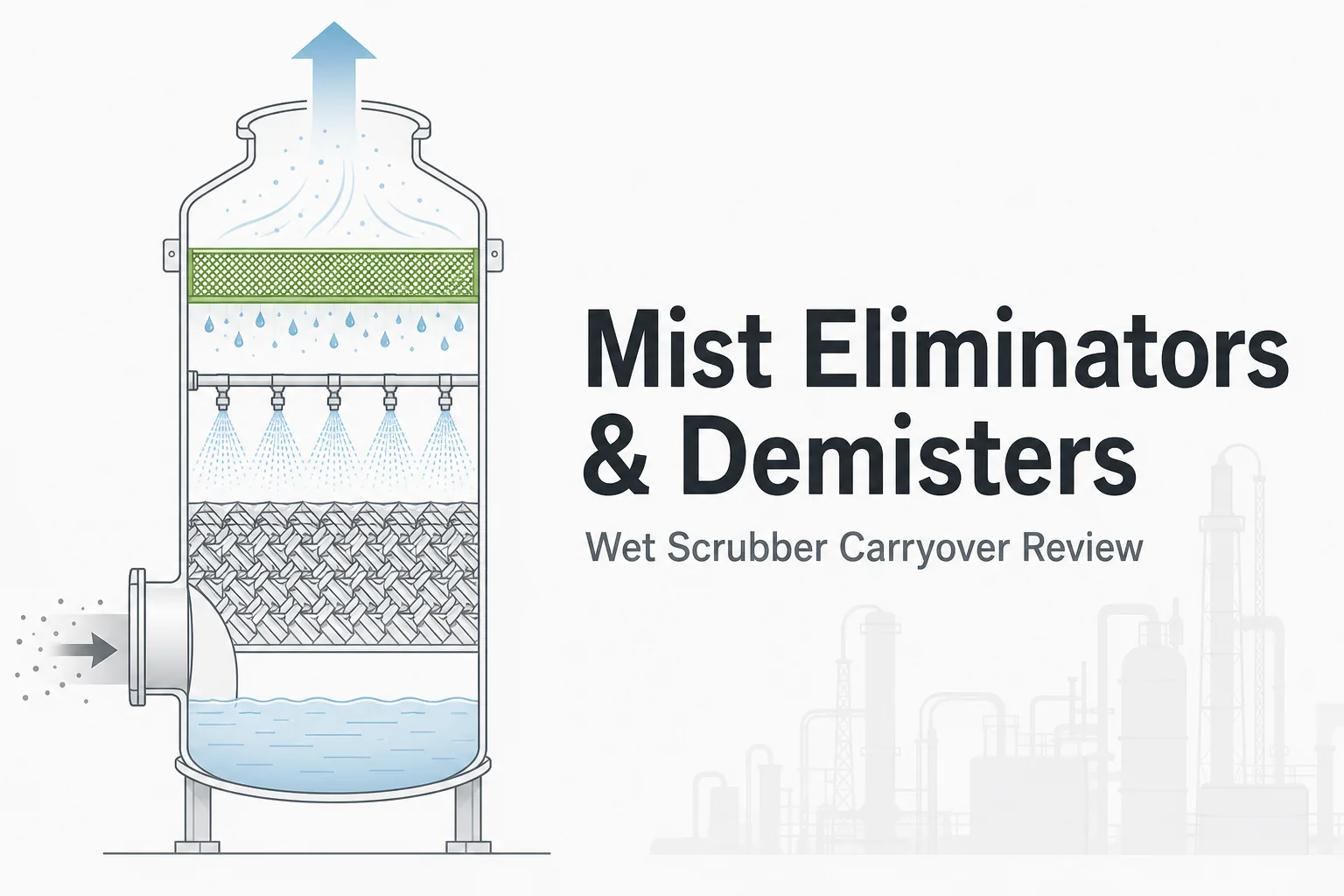
Every wet scrubber does its job by putting liquid into the gas path — spray droplets, wetted packing, agitated liquid surfaces. The unavoidable side effect is that some of that liquid tries to leave with the cleaned gas. Without a working mist eliminator, the result shows up downstream: fouled fans, corroded ductwork, stack rain over the parking lot and visible droplets at the outlet.
This article explains what a mist eliminator is, why wet scrubbers need one, how droplet capture works, how mesh pad, vane and chevron types compare, where the component sits in the system, which symptoms trigger a review, and what data AIER uses to review mist elimination duty. It is written for plant engineers, project buyers and EPC teams operating or specifying exhaust gas treatment systems. AIER’s scrubber documentation itself notes that tower exhaust reaches up to 100% relative humidity and recommends downstream moisture removal — this article explains the review logic behind that recommendation, and does not replace project engineering.
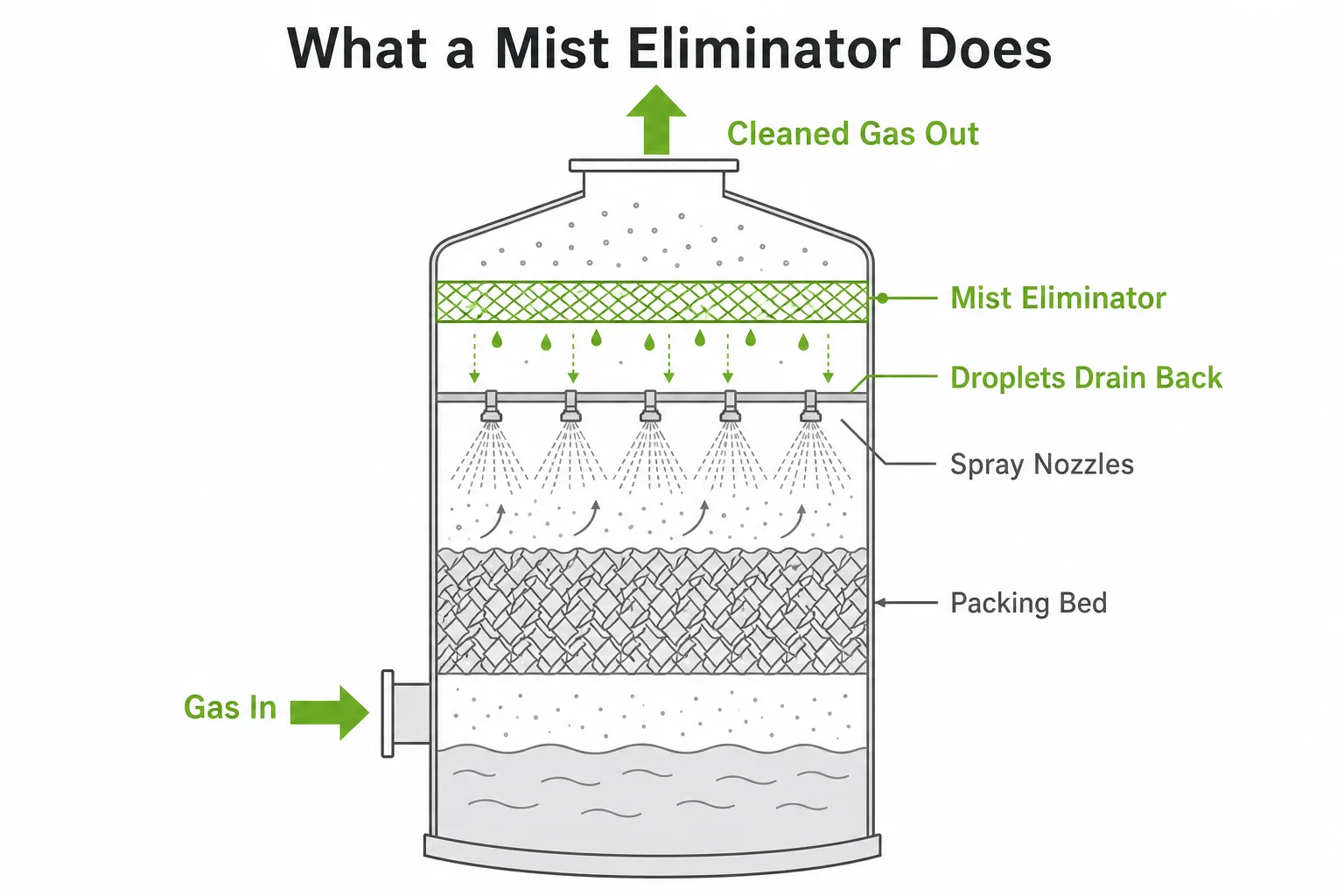
The mist eliminator sits at the scrubber outlet — the last internal the gas passes before the fan and stack, and the component that decides how much liquid leaves with it.
What Is a Mist Eliminator (Demister)?
A mist eliminator is a gas-liquid separation component installed at a scrubber outlet or in a duct that captures entrained liquid droplets from the gas stream and drains them back into the vessel.
The naming varies more than the equipment does. Mist eliminator and demister describe the same component family; a demister pad usually means the wire mesh version; droplet separator and mist separator are the same idea in other suppliers’ vocabularies. Whatever the label, the job is identical: let the gas through, stop the droplets.
The component earns its place because of how wet scrubbers behave. Per AIER’s scrubber documentation, tail gas leaves the tower at up to 100% relative humidity, and downstream moisture removal is recommended as standard configuration. A scrubber without mist elimination review is a scrubber that exports its washing liquid — along with whatever the liquid absorbed — into the fan, the duct and the stack.
Why Wet Scrubbers Need Mist Elimination
Droplet carryover is not a malfunction — it is built into how scrubbing works. The review question is never whether droplets form, but whether they leave.
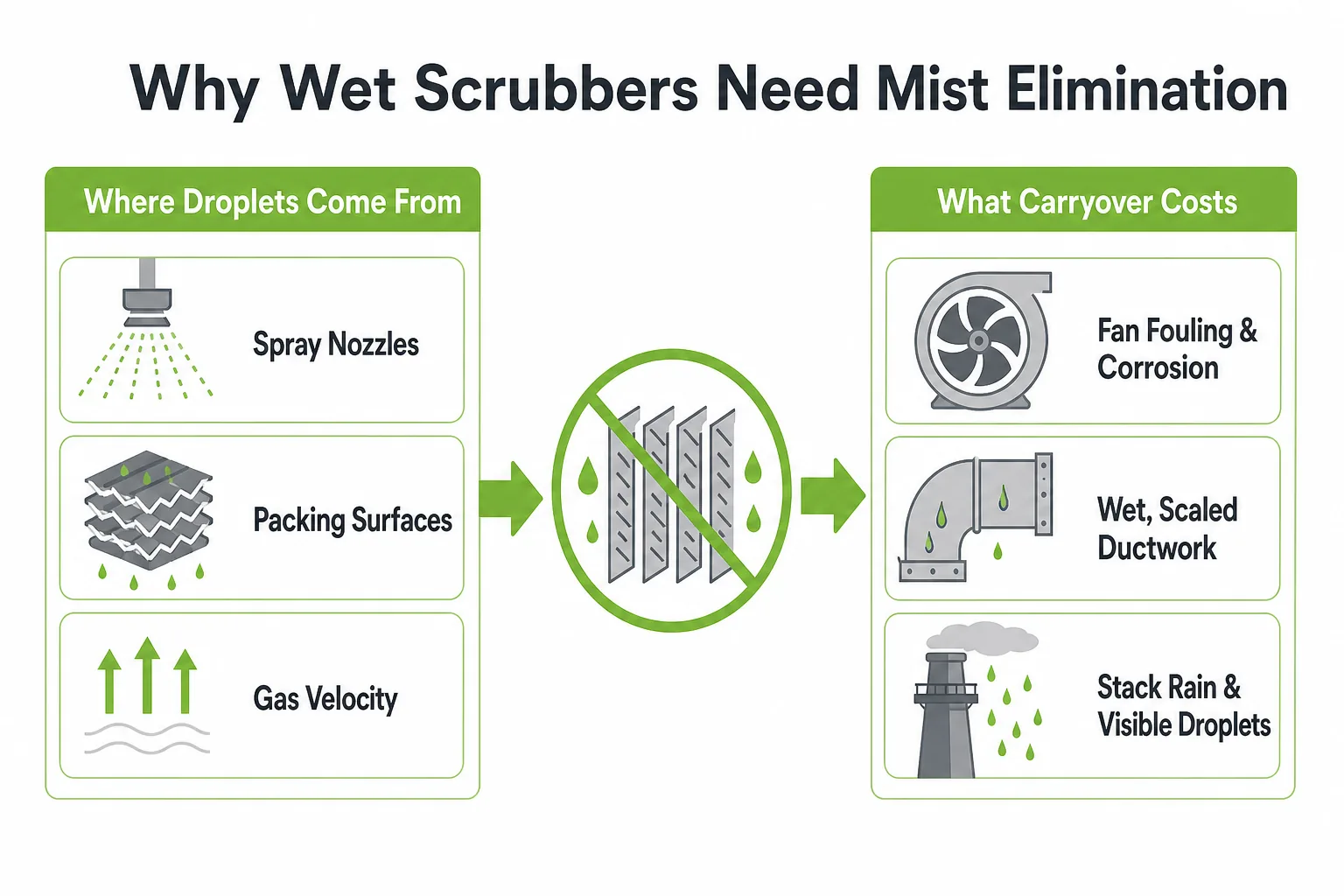
Spray nozzles, packing surfaces and gas velocity all generate entrained droplets; without capture, they become fan fouling, duct corrosion and stack rain.
- Where the droplets come from: spray nozzles atomize the washing liquid directly into the gas; liquid films strip off packing surfaces; and the upward gas flow carries whatever droplet sizes it can lift.
- What the droplets carry: scrubbing liquid is not clean water — it carries the absorbed pollutants, dissolved salts and washing chemistry. Carryover means partially treated liquid leaving the system.
- What it costs downstream: fan wheels foul and corrode, ductwork wets and scales, stack discharge turns into visible droplets or stack rain, and outlet measurements drift.
This applies to every wet tower AIER reviews — the same logic whether the duty is acid gas, alkaline gas or odor washing on an industrial wet scrubber, and it is one of the review differences between wet and dry routes covered in our wet scrubber vs dry scrubber comparison — and in the wider route map in our air pollution control equipment overview.
How a Mist Eliminator Works
Mist elimination runs on a simple physical asymmetry: gas changes direction easily, droplets do not.
As the gas weaves through a mesh pad or between vane plates, the flow path bends repeatedly. Droplets, carrying more inertia than the gas around them, fail to follow the turns and collide with the wire or plate surfaces. Captured droplets merge with their neighbors, grow heavy, and drain back down into the tower sump — the component separates liquid continuously without any moving parts.
Two practical consequences follow. First, droplet size matters: larger droplets are easy to capture, while the finest mist requires denser structures and more careful review. Second, the captured liquid must have somewhere to go — a mist eliminator that cannot drain floods, and a flooded pad re-entrains liquid instead of removing it.
One boundary should be stated honestly: a mist eliminator removes liquid droplets, not water vapor. Gas leaving a scrubber is close to saturation, and saturated vapor passes through every mesh and vane unchanged. The white plume sometimes visible at a stack in cold weather is condensing vapor, not failed mist elimination — managing plume visibility is a separate review with different tools.
Mesh Pad, Vane and Chevron Types Compared
Three structures cover most scrubber duty, and the choice follows the droplet spectrum and the dirt in the gas rather than a universal ranking.
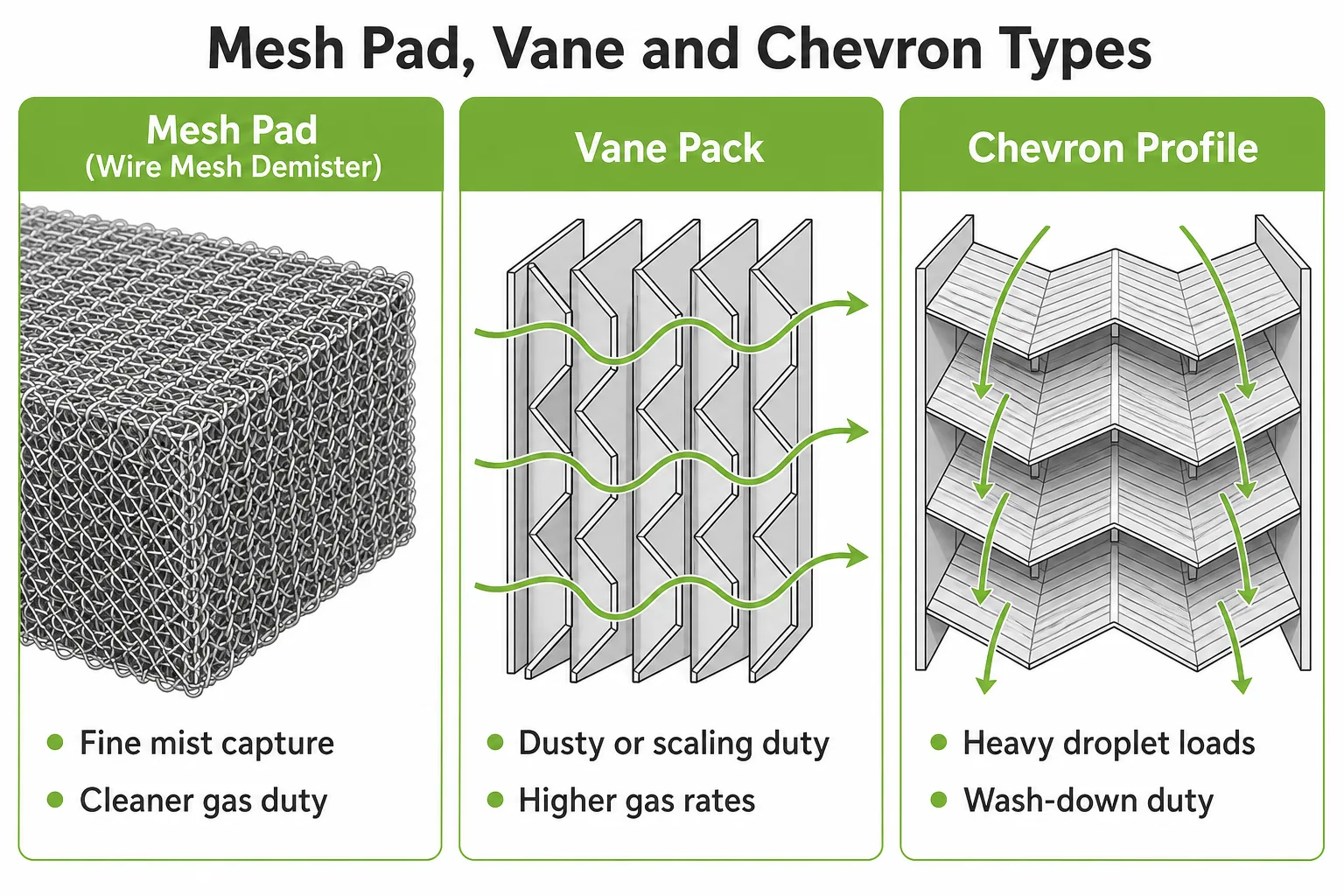
Mesh pads capture fine mist, vane packs tolerate dust and high gas rates, chevron profiles serve heavy droplet loads — the duty decides, not a ranking.
| Type | Structure | Where It Fits | Review Points |
|---|---|---|---|
| Mesh pad (wire mesh demister) | Knitted wire or plastic mesh layers | Fine mist capture on relatively clean gas | Plugging risk with dust or scaling liquids; drainage condition |
| Vane pack (vane mist eliminator) | Parallel zig-zag plates | Dusty or scaling duty, higher gas rates | Coarser capture than mesh; spacing and washability |
| Chevron profile | Angled baffle stages | Heavy droplet loads, wash-down duty | Stage count and orientation; often combined with sprays |
Materials follow the washing chemistry: polypropylene and FRP internals for most acid and alkaline duty, and a stainless steel demister pad where temperature or mechanical demands rule plastics out. Fiber-bed candle filters exist beyond these three for the very finest mist duty — a specialist review case rather than standard scrubber configuration.
Combinations are also normal practice: a vane stage catching the heavy load ahead of a mesh pad polishing the fine mist, or wash sprays keeping a pad clean on scaling duty. The arrangement is a design decision made from the droplet and dust data, not a catalog default.
Where Mist Eliminators Sit in the Scrubber System
The component appears in three places, and each placement answers a different carryover problem.
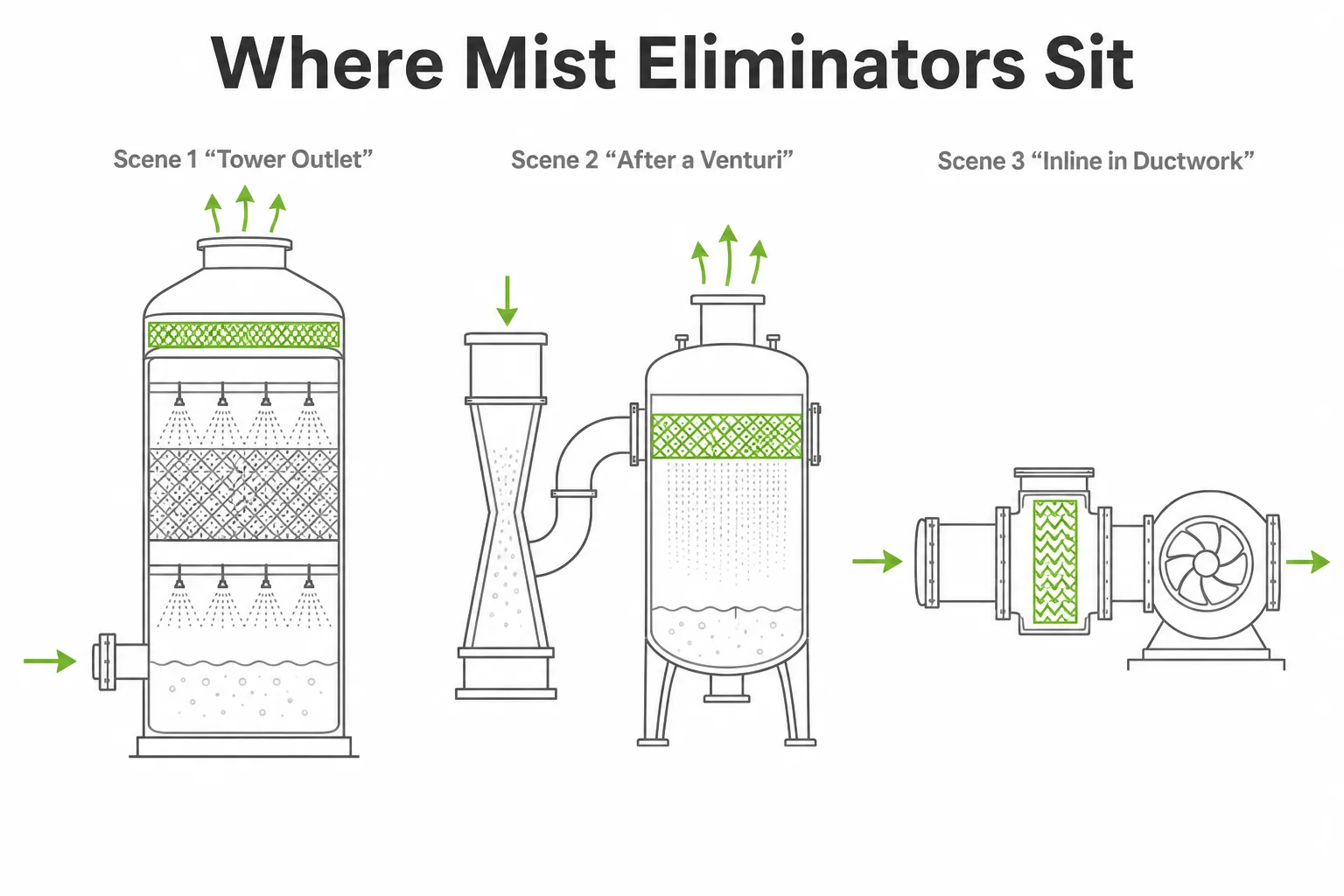
Tower-top installation is the standard case; venturi systems need a dedicated separation stage; inline units protect long duct runs and fans.
- Tower outlet: the standard case — the top internal above the spray and packing zones in a packed bed scrubber, catching carryover before the outlet flange.
- After a venturi: a venturi scrubber works by deliberately atomizing liquid into the gas, so its downstream separator is not an accessory but half the machine — the droplets carrying the captured dust must be removed in a dedicated separation vessel.
- Inline in ductwork: where a long duct run, a sensitive fan or a downstream device needs protection, an inline mist eliminator housing does the same job outside the tower.
Application context changes the liquid, not the principle: an acid washing stage, an ammonia scrubber circuit or a plain water wash all rely on the same droplet capture at the outlet.
Signs of Carryover: When to Review the Mist Eliminator
Carryover announces itself downstream before anyone opens the tower. These are the signals worth treating as review triggers rather than housekeeping problems.
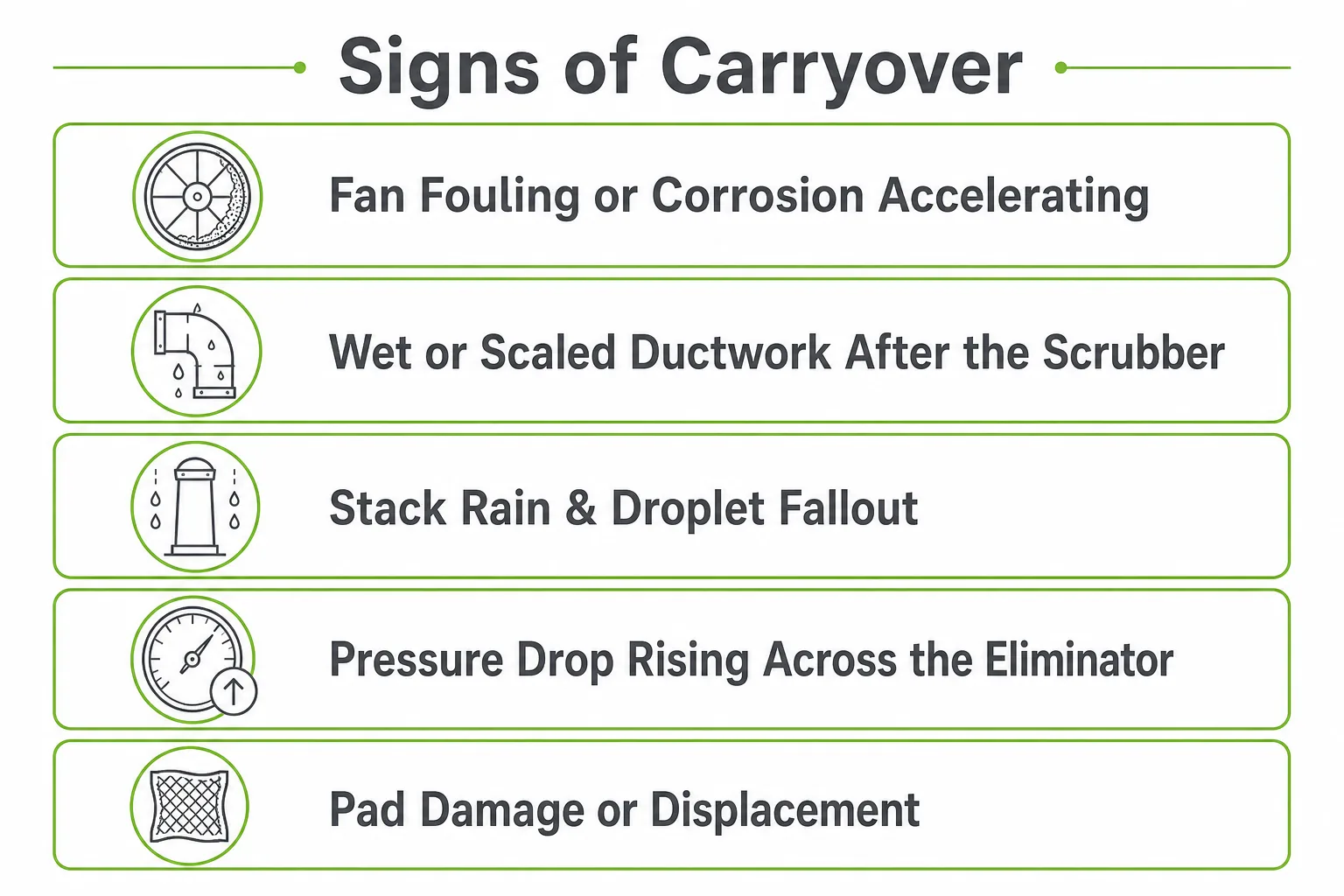
Fan fouling, duct corrosion, stack rain, rising pressure drop and visible outlet droplets are the standard carryover signals that trigger a mist eliminator review.
- Fan fouling or corrosion accelerating: deposits and attack on the fan wheel are usually the first place exported washing liquid shows up.
- Wet or scaled ductwork after the scrubber: the duct between tower and stack should stay dry; standing moisture means liquid is traveling.
- Stack rain and droplet fallout: droplets around the stack area point directly at outlet carryover.
- Pressure drop rising across the eliminator: a plugging pad chokes airflow — dust load, scaling or missing wash sprays are the usual causes.
- Pad damage or displacement: collapsed, deformed or shifted sections open bypass paths that no media density can compensate.
Each signal has the same review logic: confirm where the liquid is coming from, check the eliminator’s condition and drainage, and review whether the gas rate or the process has drifted from what the component was selected for.
Mist Eliminator vs Oil Mist Collector: Not the Same Equipment
One naming trap deserves its own section, because it produces wrong inquiries in both directions.
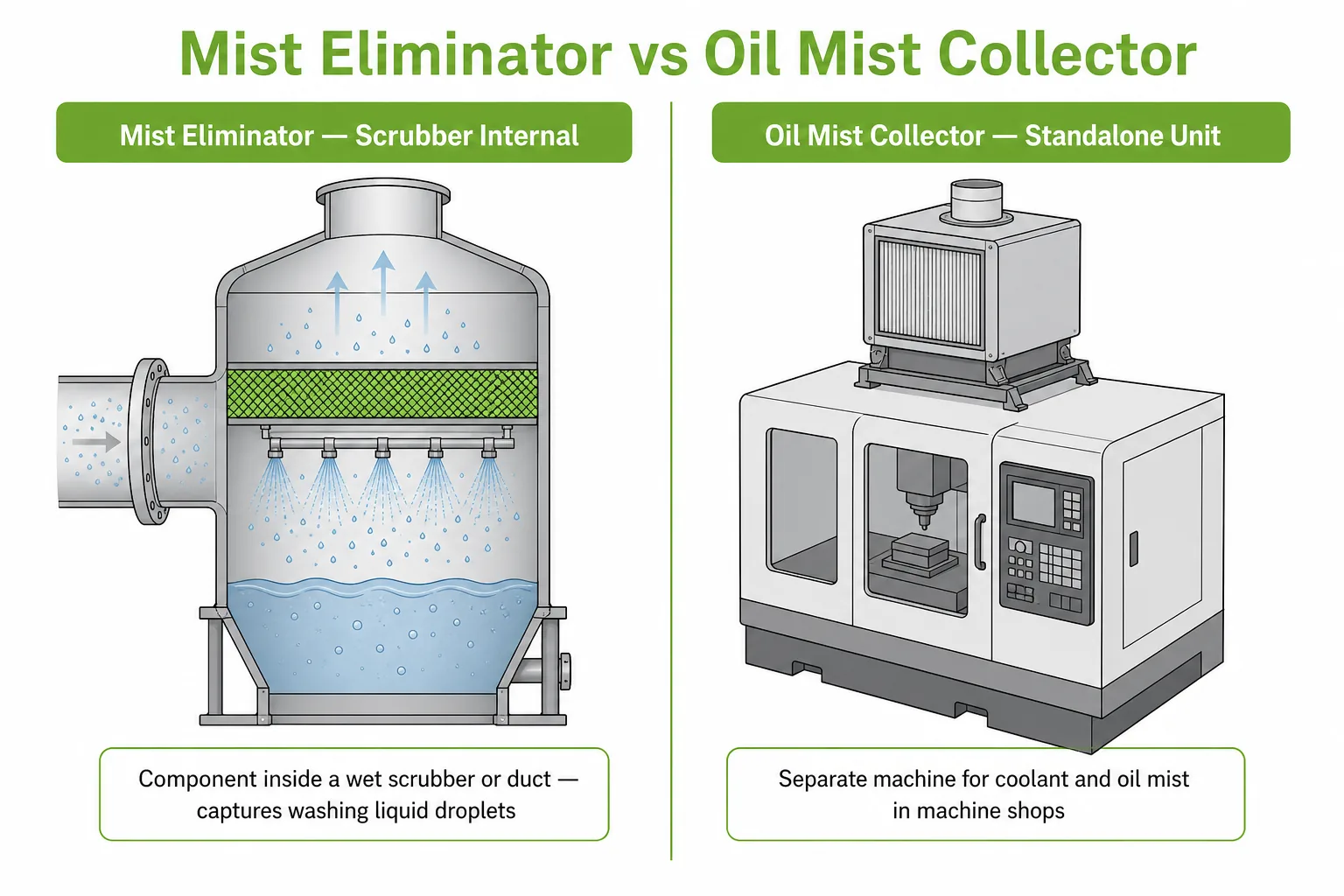
A mist eliminator is an internal component of a scrubber or duct system; an oil mist collector is a standalone filtration machine for machining coolant mist — different equipment for different problems.
- Mist eliminator / demister: an internal separation component in a scrubber tower or duct, handling water-based washing liquid droplets — the subject of this article and part of AIER’s wet scrubber system scope.
- Oil mist collector (mist collector): a standalone filtration unit mounted on or near CNC and machining equipment, capturing coolant and oil mist from machine enclosures. Different duty, different filtration design — and not part of AIER’s catalog scope, which is stated here so the right suppliers get the right inquiry.
If the problem is droplets leaving a scrubber, this article applies. If the problem is oil haze in a machine shop, the search term to use is oil mist collector — and the equipment review belongs with that product family.
Information AIER Needs for a Mist Elimination Review
Mist elimination is reviewed as part of the scrubber system, not as a loose part — and the review moves fastest when the inquiry describes the tower and the duty together.
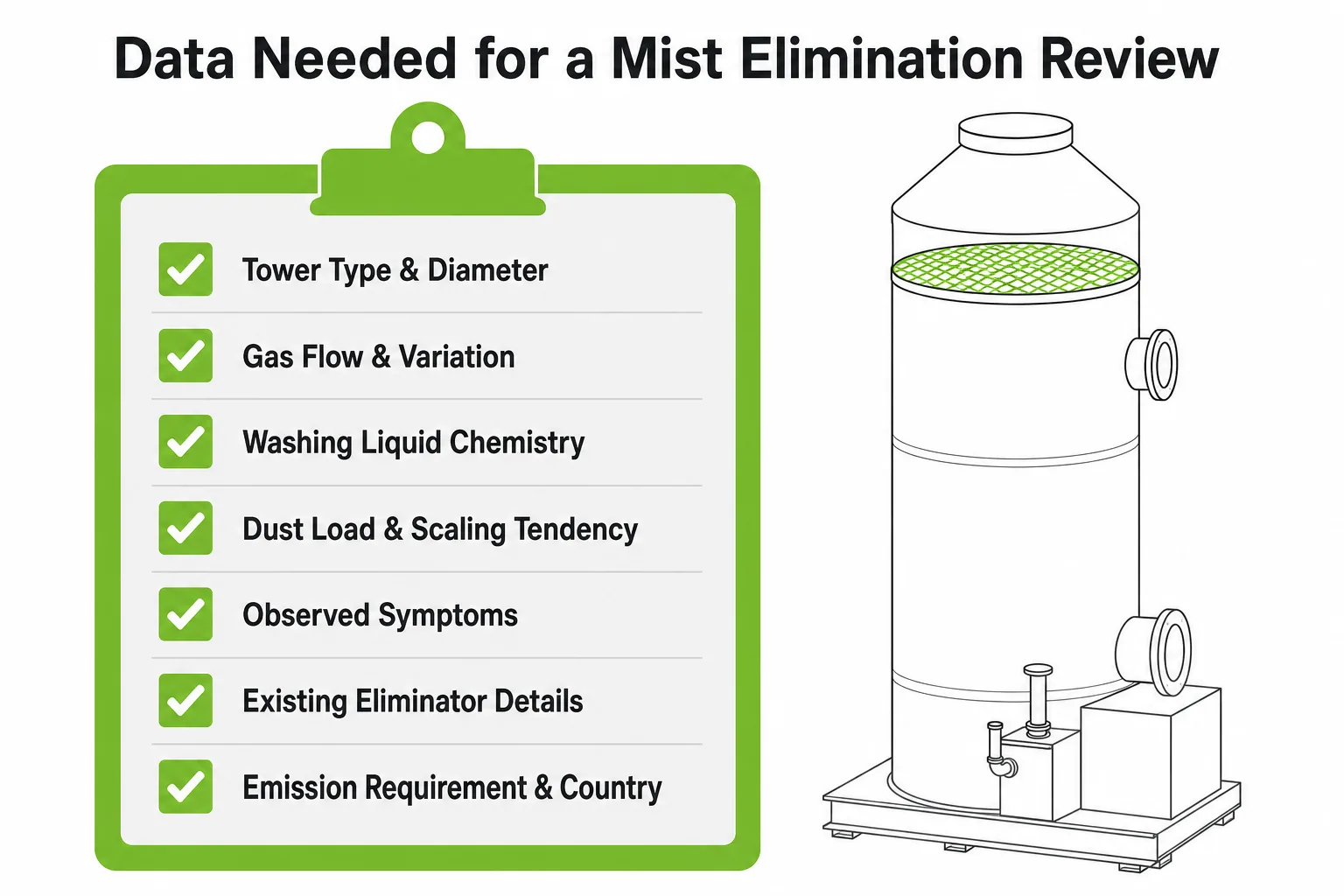
Tower type, gas flow, washing chemistry, dust load and observed symptoms are the data AIER reviews before recommending a mist elimination arrangement.
| Data to Prepare | Why It Matters |
|---|---|
| Tower type and diameter | Packed, spray or venturi duty sets the droplet load and mounting arrangement |
| Gas flow and its variation | Gas velocity through the eliminator decides capture and re-entrainment behavior |
| Washing liquid chemistry | Acid, alkaline or water duty drives material selection |
| Dust load and scaling tendency | Decides mesh vs vane selection and whether wash sprays are needed |
| Observed symptoms | Fan fouling, stack rain or pressure drop history focuses the review |
| Existing eliminator details, if any | Type, material and condition of the current internals |
| Emission requirement and country | Defines what the outlet must achieve |
If your scrubber shows carryover symptoms — or you are specifying a new wet system and want the outlet reviewed properly — contact AIER with your tower details, gas flow, washing chemistry and observed symptoms. AIER reviews mist elimination as part of the scrubber system configuration, with the reasoning shown.
FAQ
What is a mist eliminator?
A mist eliminator is a separation component installed at a wet scrubber outlet or in a duct that captures the liquid droplets entrained in the gas stream and drains them back into the vessel. It works by inertial impaction: the gas bends around the mesh or vane structure while the droplets collide with it, coalesce and drain away.
What is the difference between a mist eliminator and a demister?
They are the same component family under different names. Demister is common in European and process-industry usage, while mist eliminator dominates in air pollution control; a demister pad specifically refers to the knitted wire mesh version. Droplet separator and mist separator describe the same function in other suppliers’ terminology.
How does a demister pad work?
Gas passes through layers of knitted wire or plastic mesh, changing direction constantly around the filaments. Droplets cannot follow the turns, strike the wires, merge into larger drops and drain back down into the tower sump by gravity. The pad separates liquid continuously with no moving parts, as long as it stays clean and can drain freely.
Do mist eliminators remove water vapor and white stack plume?
No. A mist eliminator removes liquid droplets, not saturated water vapor — scrubber exhaust stays close to 100% relative humidity after the eliminator. A white plume in cold weather is vapor condensing in the atmosphere, which is a separate review topic with different measures. A mist eliminator stops droplet fallout and stack rain, not plume visibility.
Who manufactures mist eliminators for scrubber systems?
Mist eliminators are supplied both as loose internals by packing specialists and as part of complete scrubber systems by equipment manufacturers. AIER configures mist elimination as part of its wet scrubber systems — tower internals are reviewed together with the packing, spray system and washing chemistry rather than sold as an isolated part, because the eliminator selection depends on the tower duty around it.
What information is needed for a mist elimination review?
Provide the tower type and diameter, gas flow and its variation, washing liquid chemistry, dust load, any observed symptoms such as fan fouling or stack rain, details of the existing eliminator if one is installed, and the emission requirement with the installation country. AIER reviews the eliminator type, material and arrangement as part of the scrubber system configuration.