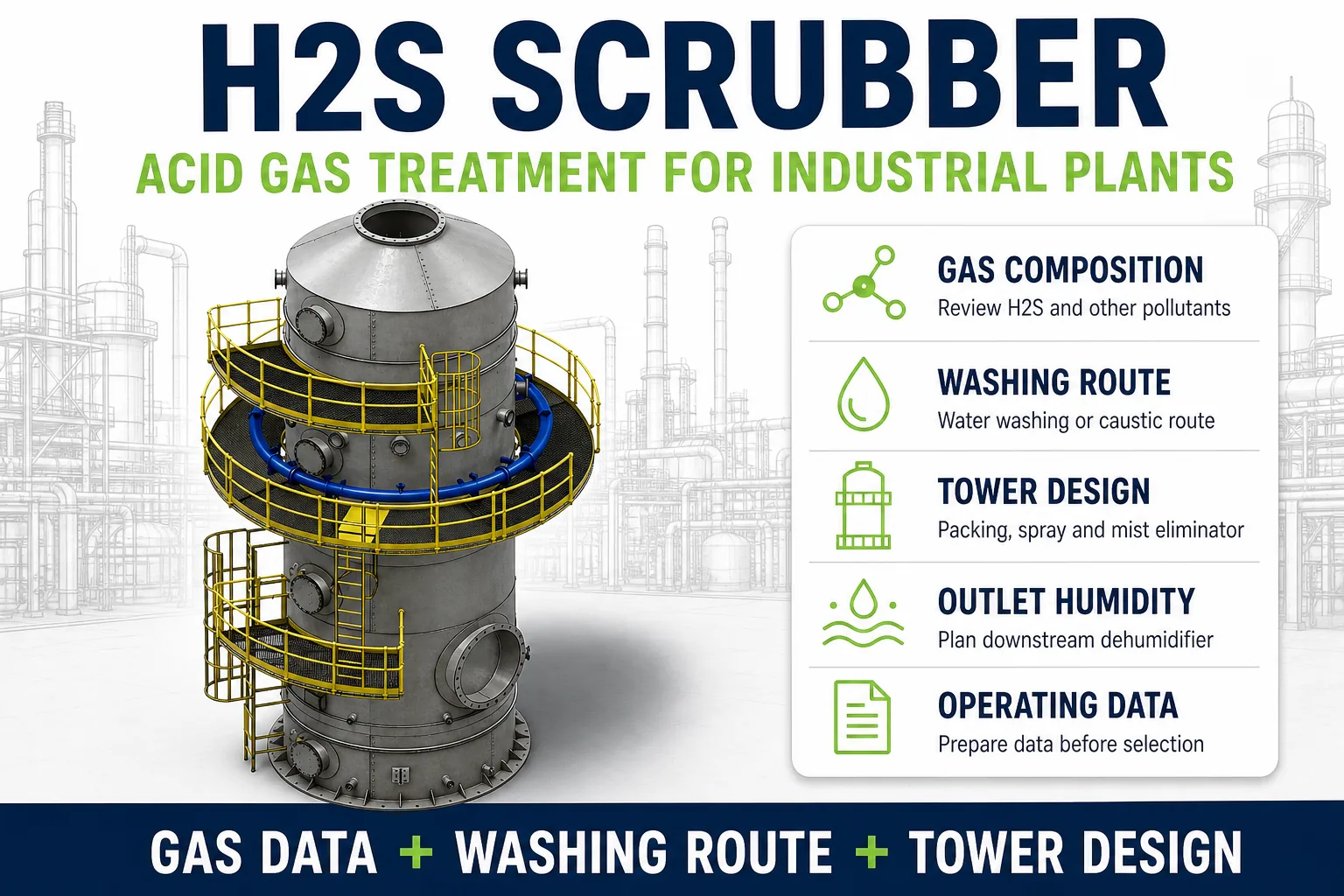
Hydrogen sulfide is one of the most common reasons industrial plants ask about exhaust scrubbing. It appears in wastewater treatment, sludge handling, chemical processing, food and rendering plants and other facilities that handle sulfur compounds. Even at low concentrations it creates strong odor complaints, and it is corrosive to equipment and piping.
This article explains how an H2S scrubber works, when water washing is not enough and a caustic route is used, where hydrogen sulfide scrubbers are applied, and what operating data AIER needs to review a scrubber selection. It is written for plant engineers, environmental managers and project buyers who operate or plan exhaust gas treatment systems. It does not replace process design, safety evaluation or local emission requirements for a specific project.
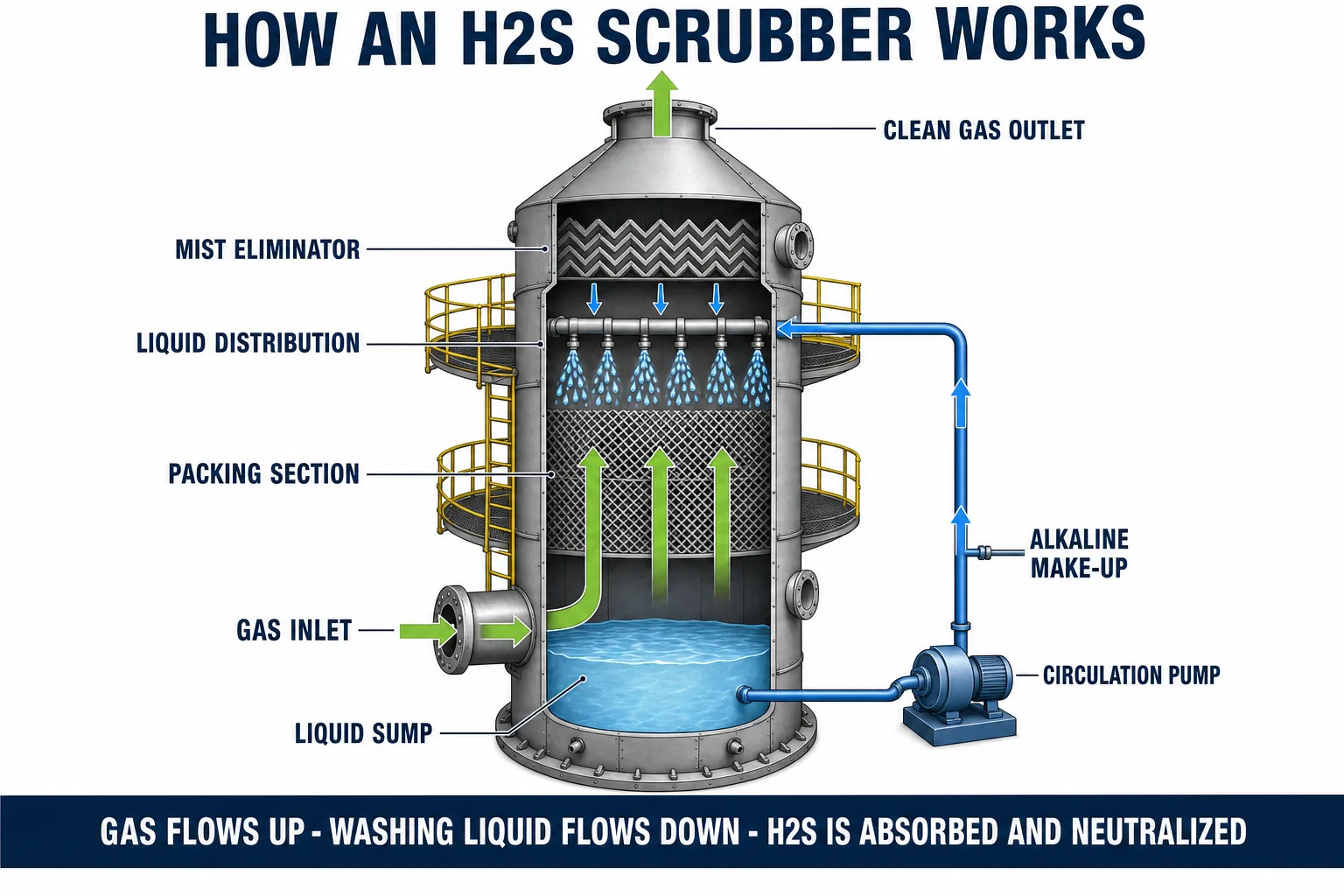
An H2S scrubber brings the exhaust gas into contact with a washing liquid so the hydrogen sulfide can be absorbed and neutralized before discharge.
What Is an H2S Scrubber?
An H2S scrubber is an exhaust gas treatment device that removes hydrogen sulfide from an air or gas stream through gas-liquid contact, usually in a washing tower where the gas passes through a circulating liquid that absorbs and neutralizes the H2S.
Most industrial H2S scrubbers are wet scrubbing towers. The exhaust gas enters the tower, flows through a contact section where it meets the washing liquid, and leaves through a mist eliminator at the top. Because hydrogen sulfide is an acid gas, the washing liquid is often alkaline, which is why an H2S scrubber is frequently designed as a caustic scrubber.
The same tower platform can be adapted to different pollutants by changing the washing liquid and internals. This is why H2S scrubbing is usually reviewed as one application of an industrial wet scrubber rather than a completely separate equipment type. Where scrubbing sits among the other treatment routes is mapped in our air pollution control equipment overview.
Why Hydrogen Sulfide Needs Treatment in Industrial Exhaust
Hydrogen sulfide is a colorless gas with a strong rotten-egg odor at low concentrations. According to OSHA, it is both toxic and flammable, and it occurs naturally in sewage, sludge and many industrial processes. For exhaust treatment projects, three practical problems usually drive the decision.
- Odor complaints: the human nose detects H2S at very low levels, so even small emissions can create neighborhood complaints long before any regulatory limit is reached.
- Corrosion: H2S and its oxidation products attack metal equipment, ductwork, instruments and concrete structures, increasing maintenance costs.
- Workplace and emission requirements: plants need to control H2S around work areas and meet local emission and odor requirements, which vary by country and project.
Because these drivers are different, the same H2S concentration can require different treatment targets in different plants. This is why gas data and the emission target should be confirmed before any scrubber model is selected.
How a Wet Scrubber Removes H2S
In a wet scrubbing tower, H2S removal happens in two steps that work together. First, the gas is absorbed into the washing liquid at the gas-liquid contact surface. Second, the absorbed H2S reacts with the washing chemistry so it stays in the liquid instead of escaping back into the gas.
The contact section is usually a packed bed, where packing media creates a large wetted surface between the rising gas and the circulating liquid. Spray sections can also be used depending on the gas condition. The washing liquid is collected at the bottom, circulated back to the top, and refreshed as the chemistry is consumed. A mist eliminator at the outlet reduces droplet carryover before the treated gas is discharged.
Because absorption depends on the washing liquid chemistry, the key design question for an H2S scrubber system is not only the tower size. It is whether the washing route matches the gas composition, which is where water washing and chemical washing are compared.
Water Washing, Chemical Washing and the Caustic Route
AIER scrubbers are designed around two washing families: water washing and chemical washing. Water washing dissolves water-soluble components, such as ethanol. Chemical washing is divided into acid washing and alkali washing, and the route is selected according to the gas composition and the application.
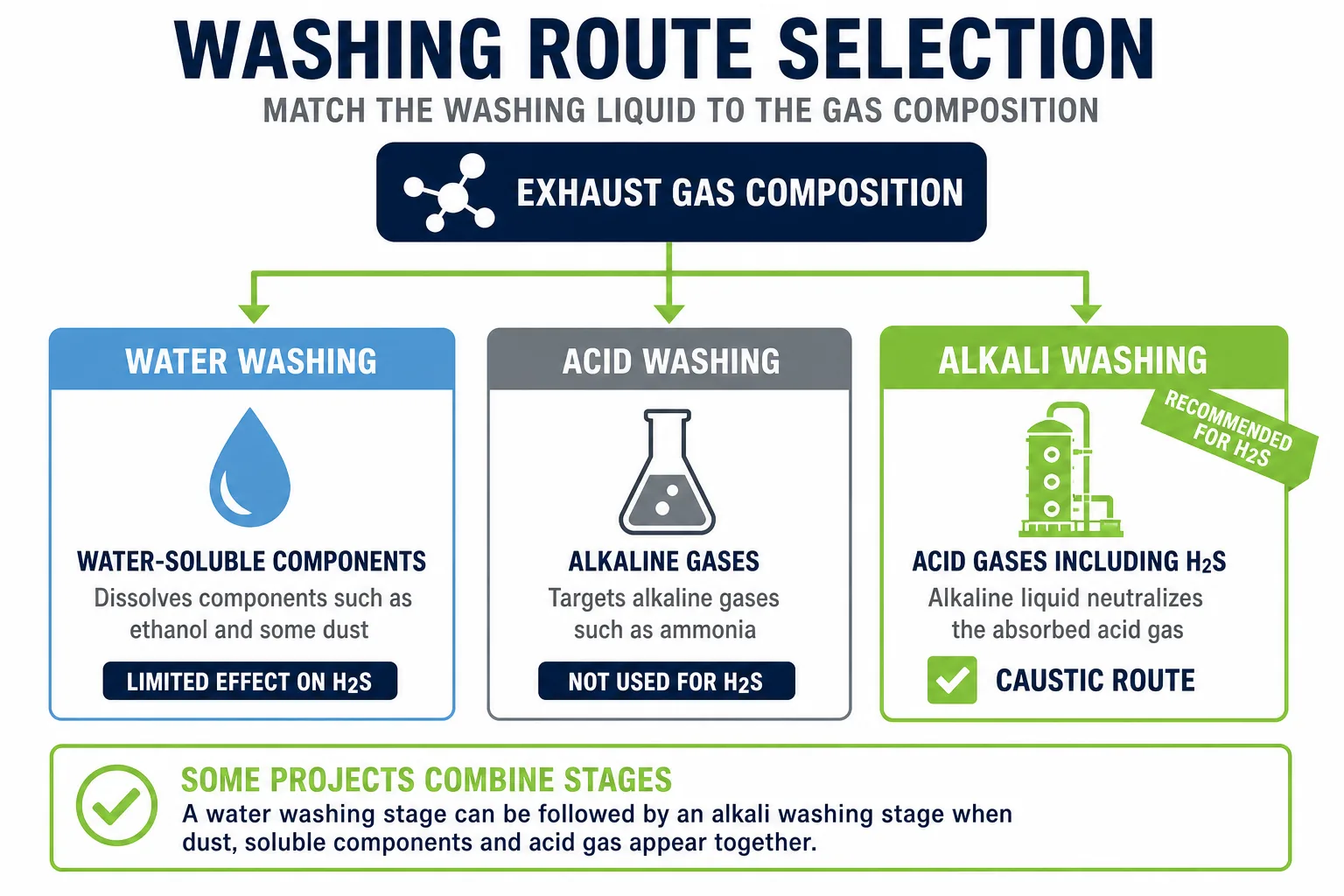
Washing route selection depends on the gas composition; H2S and other acid gases usually need an alkaline washing route instead of water alone.
| Washing Route | Typical Target | Relevance to H2S |
|---|---|---|
| Water washing | Water-soluble components such as ethanol and some dust | H2S has limited solubility in plain water, so water washing alone is usually not enough for meaningful H2S removal |
| Acid washing | Alkaline gases such as ammonia | Not used for H2S; it targets the opposite gas family. See the ammonia scrubber and acid route article for alkaline gas review points |
| Alkali washing (caustic route) | Acid gases, including H2S and many sulfur compounds | The main route for H2S; an alkaline solution neutralizes the absorbed gas and keeps it in the liquid |
A caustic scrubber is simply a wet scrubber operating on the alkali washing route. The alkaline washing liquid reacts with the absorbed hydrogen sulfide, which keeps the driving force for absorption and prevents the gas from being released again. The actual chemical dosing, liquid management and wastewater handling are project-specific and should be confirmed during engineering review, not copied from an article.
Some projects combine stages, for example a water washing stage for dust and soluble components followed by an alkali washing stage for the acid gas. Multi-stage designs are one reason the gas composition matters more than the tower model number.
Where H2S Scrubbers Are Used
H2S scrubbers appear wherever sulfur compounds are generated or handled. Whether the unit is called an odor control tower or an H2S gas scrubber, the most common industrial applications share one pattern: a continuous exhaust stream with odor or corrosion problems that water washing alone cannot solve.
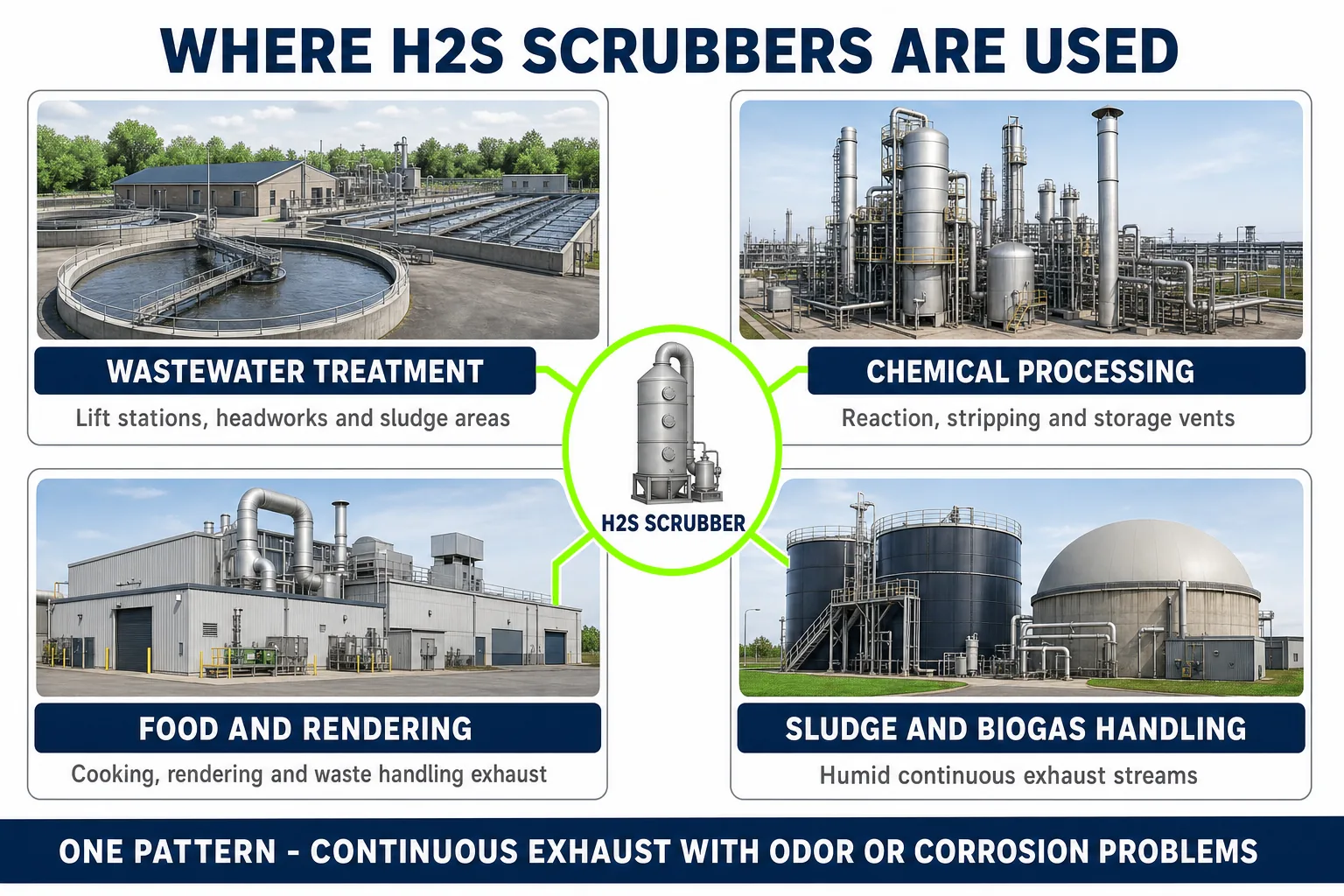
Typical H2S scrubber applications include wastewater treatment, chemical processing, food and rendering plants and sludge handling areas.
| Application | Typical H2S Source | Common Treatment Concern |
|---|---|---|
| Wastewater treatment plants | Lift stations, headworks, sludge tanks and dewatering areas | Odor control around the site and corrosion of equipment |
| Chemical processing | Reaction, stripping and storage vents containing sulfur compounds | Acid gas removal and material compatibility of the scrubber |
| Food and rendering plants | Cooking, rendering and waste handling exhaust | Odor complaints; often combined with other odor control steps |
| Sludge and biogas handling | Sludge storage and digester-related areas | H2S in humid, continuous exhaust streams |
Industry pages such as chemical industry exhaust treatment and the food, flavor and fragrance industry show how scrubbers are combined with other equipment in each sector. The scrubber itself is one unit inside a larger exhaust treatment route.
H2S Removal Routes Compared
Wet scrubbing is not the only way to remove hydrogen sulfide. The right route depends on concentration, airflow, humidity, other pollutants in the stream and how stable the load is. A short comparison helps position where a caustic scrubber fits.
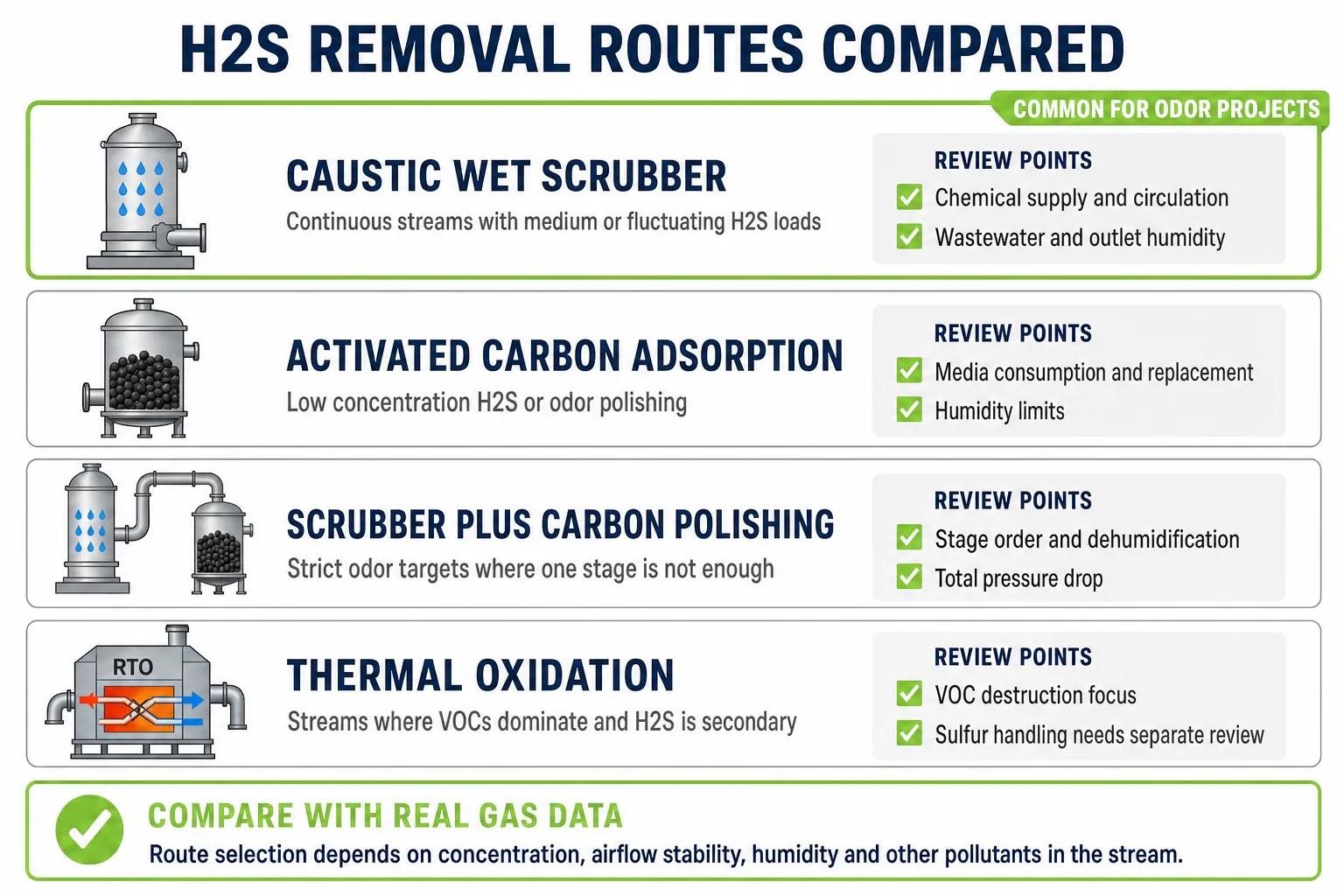
H2S removal route selection depends on concentration, airflow stability, humidity and other pollutants in the exhaust stream.
| Route | Where It Fits | Review Points |
|---|---|---|
| Caustic wet scrubber | Continuous streams, medium to higher or fluctuating H2S loads, humid gas | Chemical supply, liquid circulation, wastewater handling, outlet humidity |
| Activated carbon adsorption | Low-concentration H2S or odor polishing, intermittent sources | Media consumption and replacement, humidity limits, upstream protection |
| Scrubber plus carbon polishing | Strict odor targets where one stage is not enough | Stage order, dehumidification between stages, total pressure drop |
| Thermal oxidation | Streams where VOCs dominate and H2S is secondary | A regenerative thermal oxidizer targets VOC destruction; sulfur handling needs separate review |
For most odor-driven H2S problems with continuous airflow, the review starts with a wet scrubbing route and then checks whether a polishing stage is needed. For low, stable and dry streams, adsorption alone may be simpler. The comparison should be made with real gas data, not assumptions.
What Affects H2S Scrubber Performance
Two H2S scrubbers with the same nominal airflow can perform very differently. When AIER reviews an H2S application, these are the factors that usually decide whether the scrubber will work as expected.
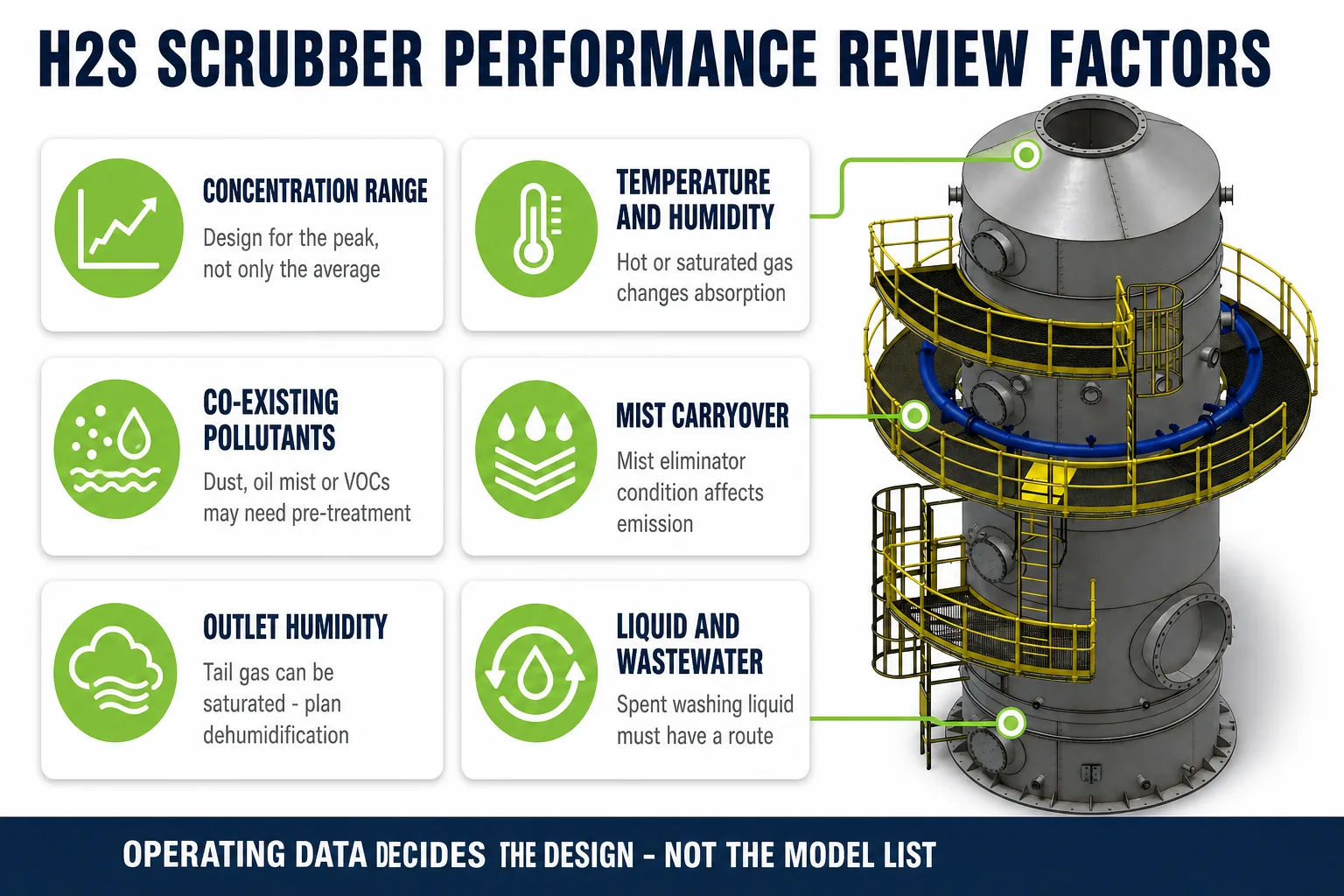
H2S scrubber review should cover concentration range, temperature, humidity, co-existing pollutants, mist carryover and downstream humidity handling.
- Concentration range, not one number: H2S loads often swing with production or season; the washing route and liquid management must handle the peak, not only the average.
- Gas temperature and humidity: hot or saturated gas changes absorption behavior and material selection for the tower and internals.
- Co-existing pollutants: dust, oil mist, VOCs or other acid gases can foul packing, consume washing chemistry or require a pre-treatment stage.
- Mist carryover: the mist eliminator condition affects both emission quality and downstream equipment.
- Outlet humidity: after wet scrubbing, the tail gas relative humidity can reach 100%, so a downstream dehumidifier is recommended when the following process or emission requirement needs drier gas.
- Liquid and wastewater management: spent washing liquid must go somewhere; the plant’s wastewater route should be confirmed at the selection stage.
None of these factors can be judged from a scrubber model list alone. They come from the plant’s operating data, which is why the data package matters more than the catalog page.
Common Mistakes When Selecting an H2S Scrubber
Most H2S scrubber problems reported after startup trace back to selection-stage gaps rather than equipment failure. These are the patterns AIER sees most often.
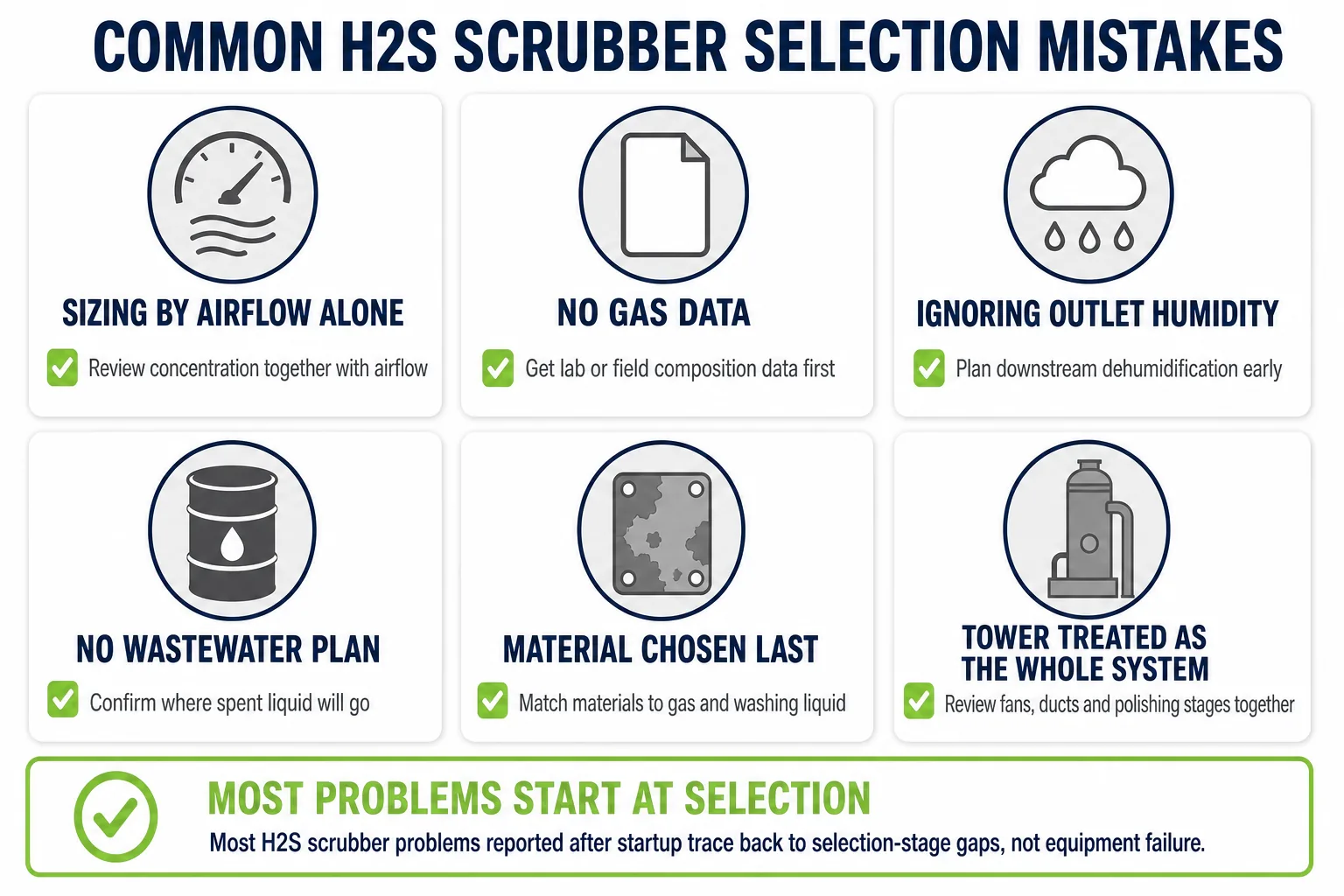
Common selection mistakes include sizing by airflow alone, ignoring outlet humidity and leaving washing liquid handling unplanned.
- Sizing by airflow alone: two streams with the same airflow but different H2S concentrations need different washing designs.
- No lab or field gas data: odor description is not gas composition; a selection without concentration data is a guess.
- Ignoring the outlet humidity: saturated tail gas surprises downstream equipment and can create visible plume concerns.
- Skipping wastewater planning: the washing liquid becomes a liquid stream that the plant must be able to handle.
- Choosing the material last: H2S service is corrosive; tower and internals material should match the gas and washing chemistry from the start.
- Treating the scrubber as the whole system: fans, ducts, pre-treatment and polishing stages decide the final result together with the tower.
Information AIER Needs for an H2S Scrubber Review
An H2S scrubber review moves much faster when the inquiry includes operating data instead of only a tower size request. This is the information AIER uses to judge the washing route, tower design and material selection.
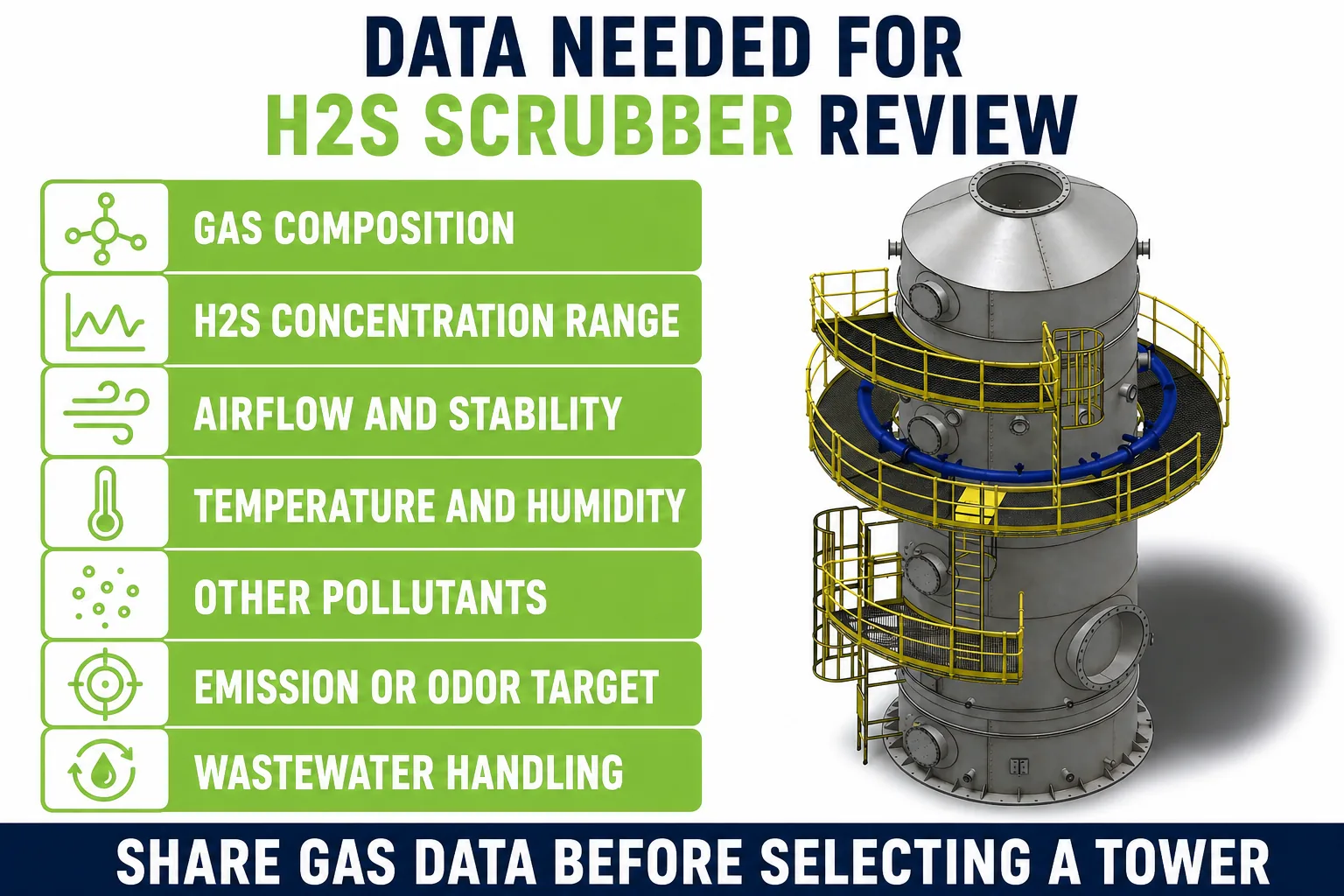
AIER reviews gas composition, H2S concentration, airflow, temperature, humidity and the emission target before recommending a scrubber route.
| Data to Prepare | Why It Matters |
|---|---|
| Gas composition and H2S concentration range | Decides the washing route and chemical consumption estimate |
| Airflow and how stable it is | Decides tower size and turndown behavior |
| Gas temperature and humidity | Affects absorption behavior and material selection |
| Other pollutants in the stream | Shows whether pre-treatment or a multi-stage design is needed |
| Emission or odor target | Defines what the treated gas must achieve and whether polishing is needed |
| Site conditions and installation country | Affects layout, materials, utilities and project requirements |
| Wastewater handling capability | Confirms where the spent washing liquid can go |
If your plant has an H2S odor or acid gas problem, contact AIER with your gas composition, concentration range, airflow, temperature, humidity and emission target. AIER will review whether a water washing stage, a caustic route, adsorption polishing or a combined design fits your exhaust condition.
FAQ
What is an H2S scrubber and how does it work?
An H2S scrubber is a gas washing tower that removes hydrogen sulfide from exhaust air through gas-liquid contact. The gas passes through a contact section where a circulating washing liquid absorbs the H2S, and an alkaline washing route neutralizes the absorbed gas so it stays in the liquid.
What is a caustic scrubber?
A caustic scrubber is a wet scrubber that uses an alkaline washing liquid to neutralize acid gases such as hydrogen sulfide. It is the most common washing route for H2S because plain water has limited capacity for the gas.
Where are H2S scrubbers used?
H2S scrubbers are used in wastewater treatment plants, chemical processing, food and rendering plants, sludge handling and other facilities where sulfur compounds create odor, corrosion or emission problems.
Can activated carbon remove H2S instead of a scrubber?
Activated carbon adsorption can handle low-concentration H2S or odor polishing, especially for intermittent sources. Higher or fluctuating loads usually suit wet scrubbing better, and some projects combine a scrubber with carbon polishing to reach strict odor targets.
Does the outlet gas need a dehumidifier after a wet scrubber?
The tail gas relative humidity after a wet scrubber can reach 100%, so a downstream dehumidifier is recommended when the following process or the emission requirement needs drier gas.
What information is needed for an H2S scrubber quote?
Provide gas composition, H2S concentration range, airflow, temperature, humidity, other pollutants, the emission or odor target and the installation country. AIER reviews the washing route, tower material and system design based on the exhaust gas condition.