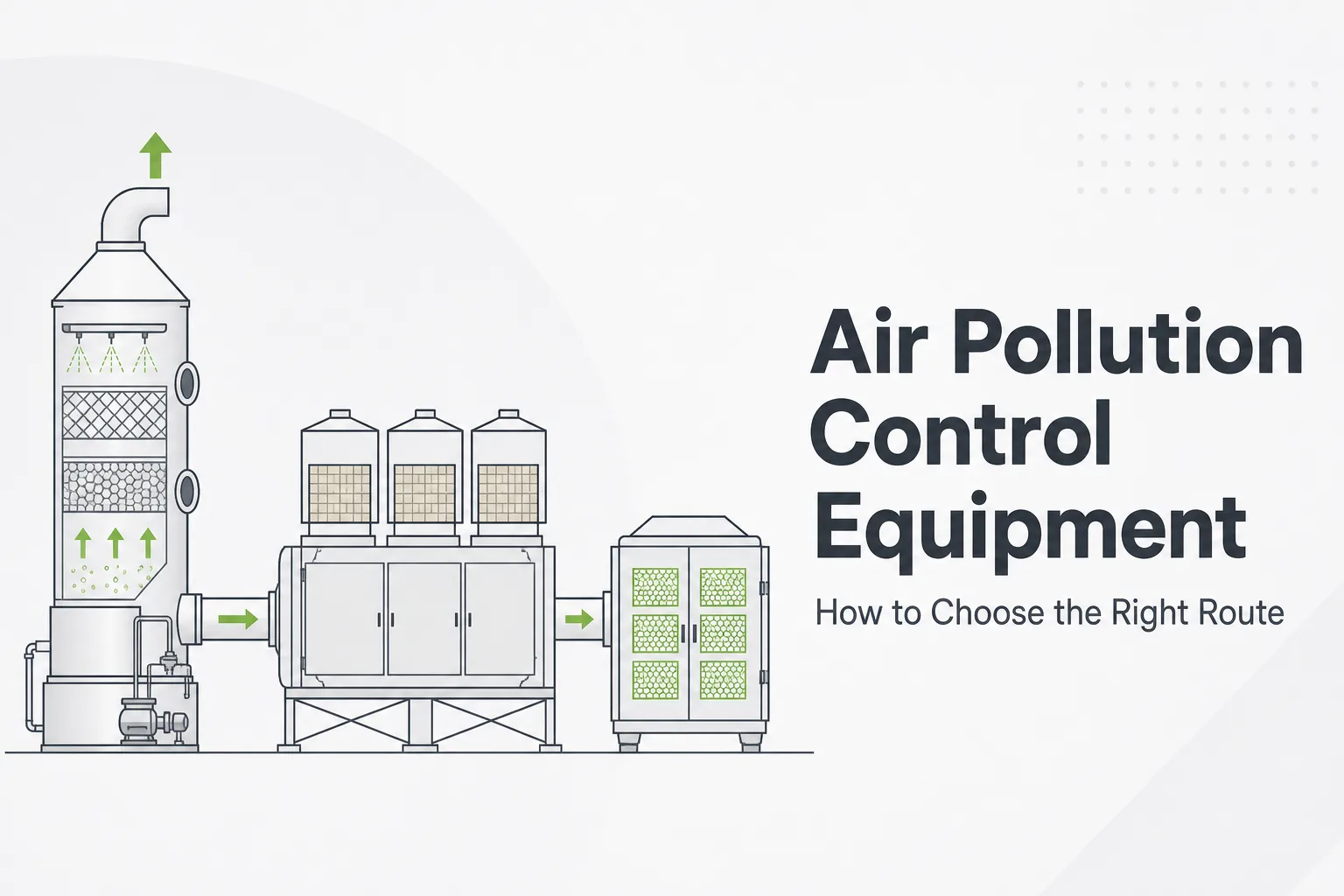
Most exhaust treatment projects do not start with an equipment name. They start with a pipe: solvent-laden air leaving a coating line, sour gas off a wastewater sump, ammonia from a fertilizer process, dust from a grinding hall. The market then answers with acronyms — RTO, CO, ESP, scrubber, concentrator — and leaves the buyer to work out which one actually fits the pipe.
This article is the map for that decision. It sorts air pollution control equipment into working families, explains what each family does well and badly, and shows how to move from the pollutant to a shortlist of routes. Every route covered here has a deeper article or product page on this site; this overview connects them. It is written for plant engineers, EHS owners and buyers comparing industrial air pollution control options for the first time, and it supports the review rather than replacing project engineering.
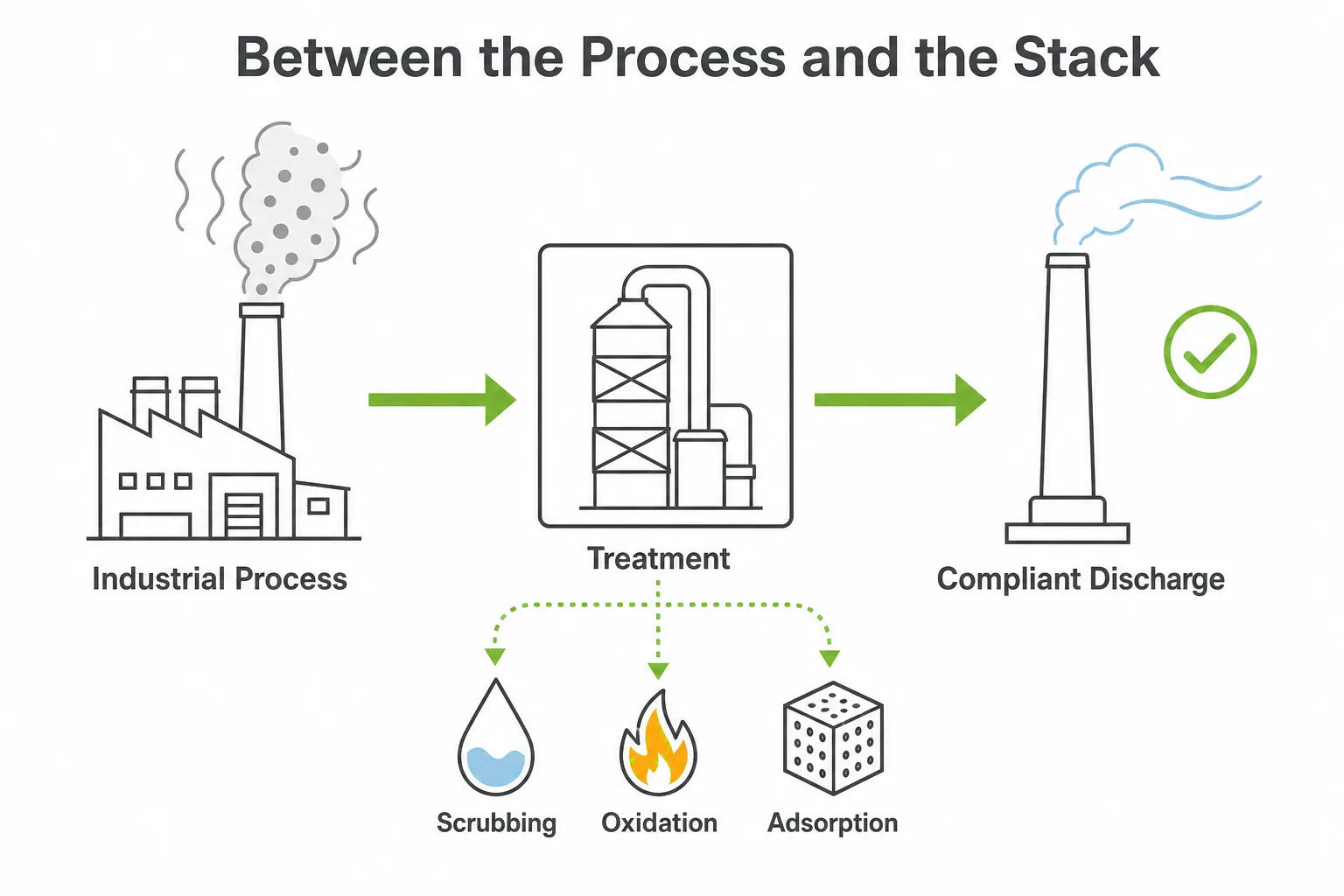
Air pollution control equipment sits between the process and the stack: it captures, destroys or recovers pollutants so the discharged air meets the emission requirement.
What Counts as Air Pollution Control Equipment?
Air pollution control equipment is the machinery that removes pollutants from an industrial exhaust stream before it is discharged — by scrubbing them into a liquid, destroying them at temperature, capturing them on a sorbent or filtering them out as particulate.
The scope matters, because the same words are used for very different problems. This article covers exhaust gas treatment at the industrial source: continuous process streams with defined pollutants, airflows and emission requirements. It does not cover indoor air purifiers, HVAC filtration or vehicle emission systems — a distinction worth making early, because consumer search results mix freely into this topic and the equipment classes have nothing in common.
Start From the Pollutant, Not the Equipment
Every misbought treatment system we review shares the same root cause: the equipment was chosen before the exhaust was characterized. The reliable order is the reverse, and it begins with one question — what is in the pipe?
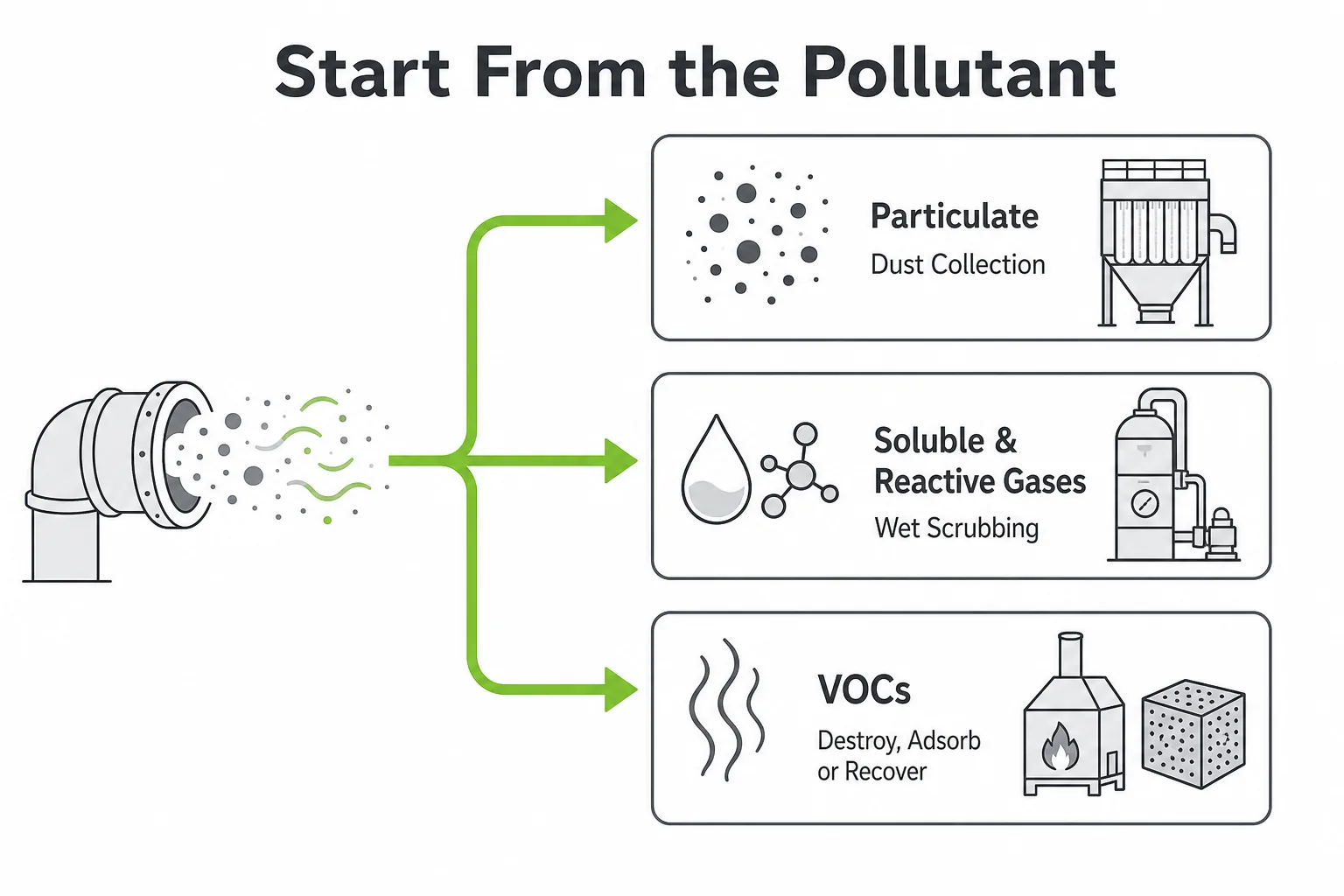
Three pollutant families, three route families: particulate goes to dust collection, soluble gases to scrubbing, VOCs to destruction, adsorption or recovery.
- Particulate — dust, fume and powder. Solid particles are a filtration duty, handled by baghouse, cartridge and related platforms. That family has its own map in our types of dust collectors overview, and this article leaves it there.
- Soluble and reactive gases — acids, alkalis, odor compounds. Gases like H2S, HCl, ammonia and many odor compounds dissolve or react in a washing liquid, which makes them scrubber territory.
- VOCs — solvents and organic vapors. Volatile organic compounds resist washing but can be destroyed by oxidation, captured by adsorption, concentrated for economical treatment, or recovered as product. Which of those four is right is a project decision, not a preference.
Real exhausts often carry more than one family at once — dust plus VOCs from coating, droplets plus acid gas from plating — and combined streams usually need staged equipment rather than one machine asked to do everything.
Scrubbers: The Wet Route for Acid, Alkaline and Odor Gases
A wet scrubber brings the exhaust into contact with a circulating washing liquid, usually in a vertical tower. The gas dissolves or reacts into the liquid, the liquid is refreshed as its chemistry is consumed, and a mist eliminator at the outlet keeps droplets from following the cleaned air out.
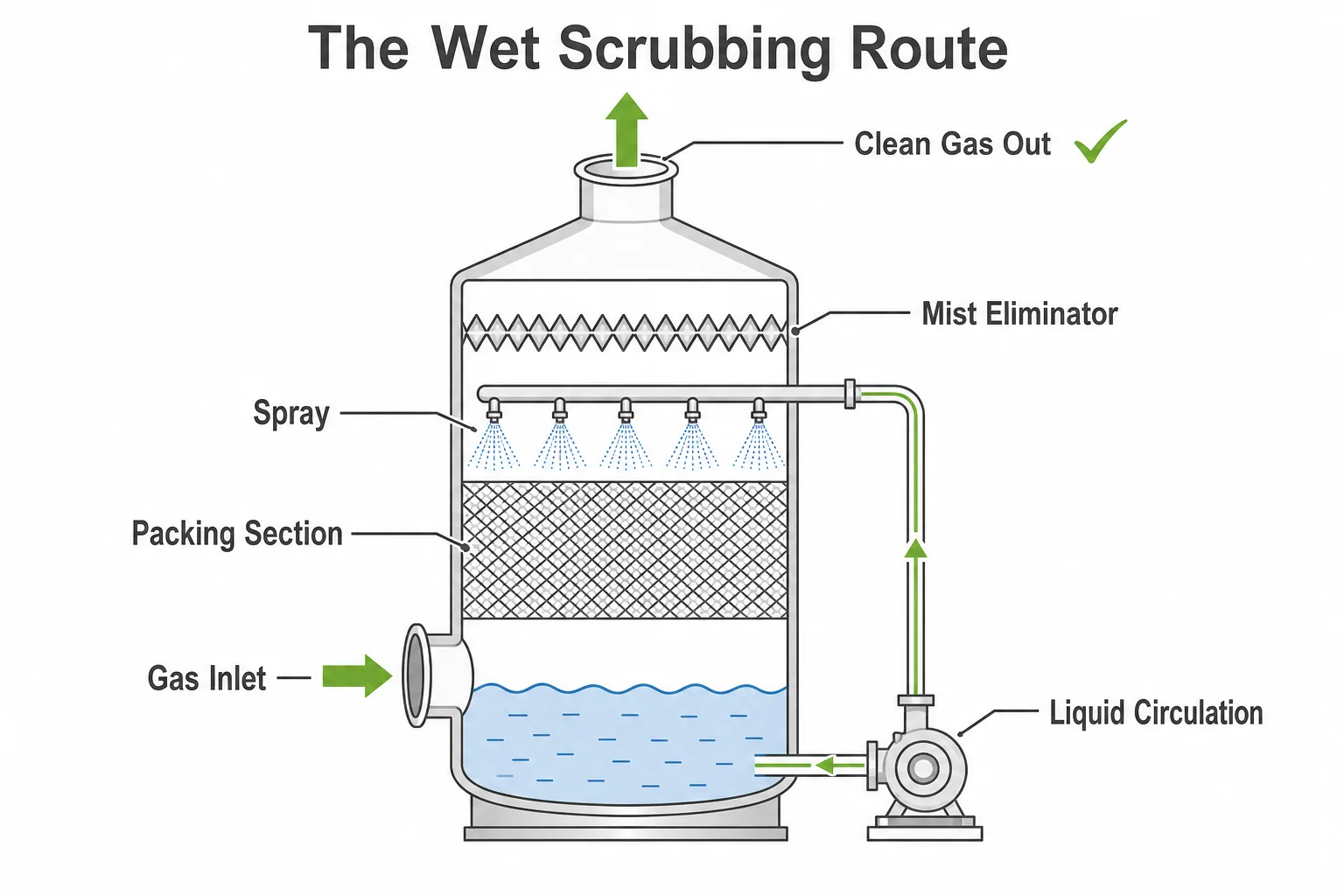
The scrubbing tower: gas-liquid contact in the packing, chemistry matched to the pollutant, droplet control at the outlet.
Inside the industrial wet scrubber family, the variations are about contact and chemistry rather than concept. Packed bed towers create large wetted surface for absorption duty; venturi scrubbers accelerate the gas through a throat where droplets capture particles and mist; the washing chemistry swings acid or alkaline depending on the pollutant — alkaline washing for acid gases like H2S, acid washing for alkaline gases like ammonia. The outlet detail that decides whether the plume looks clean — droplet carryover — has its own review in our mist eliminator article.
The honest limit: scrubbers trade an air problem for a water problem. Blowdown, chemical consumption and liquid treatment come with the route, and they belong in the cost comparison from the start — one of the review differences covered in our wet scrubber vs dry scrubber comparison.
Oxidizers: Destroying VOCs at Temperature
Oxidizers destroy VOCs by holding the exhaust at high temperature until the organic molecules break down — the route of choice when the VOC load is continuous and the emission requirement is strict.
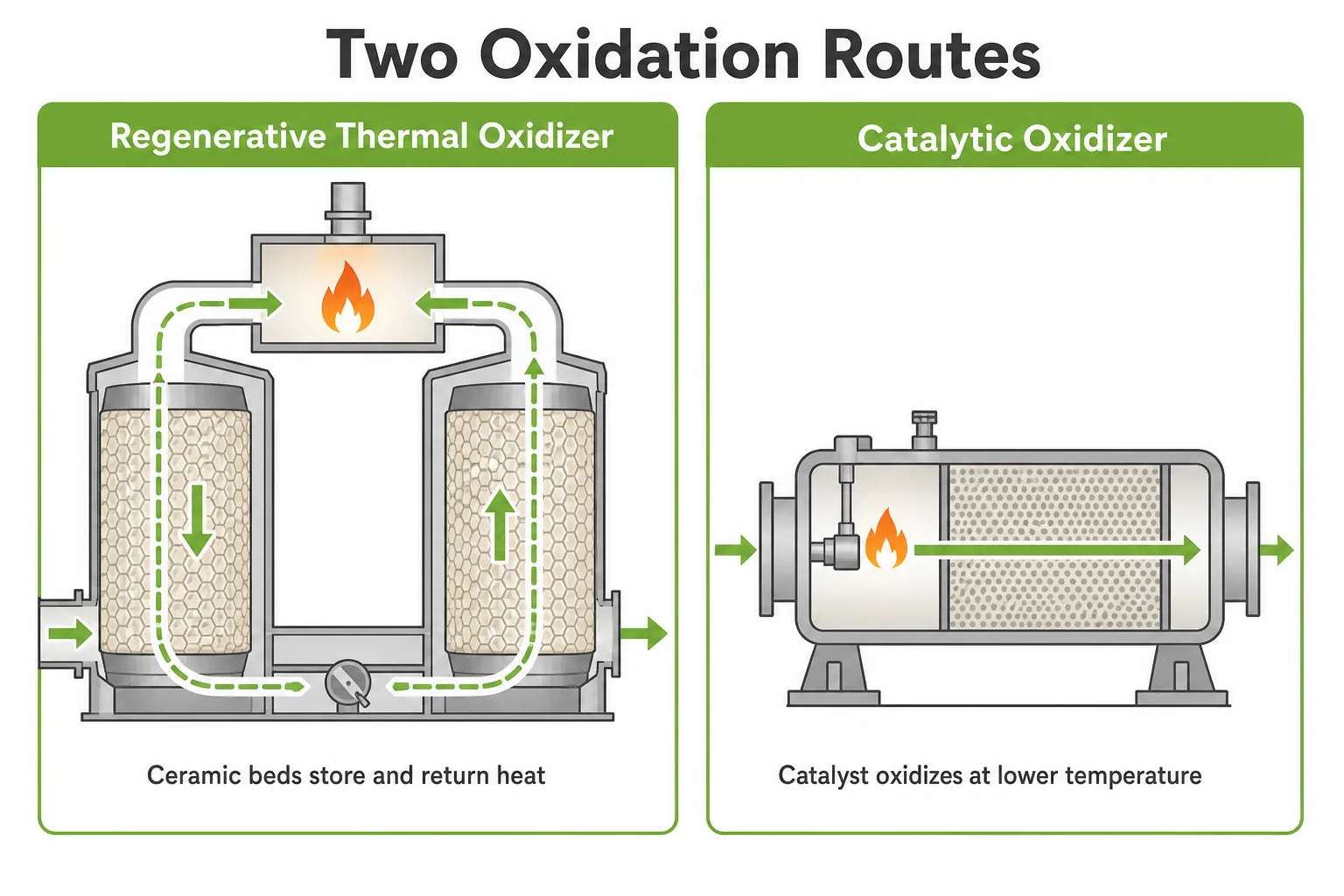
Two oxidation routes: the RTO stores and returns heat through ceramic beds; the catalytic oxidizer uses a catalyst to oxidize at lower temperature.
The workhorse is the regenerative thermal oxidizer (RTO), which stores heat in ceramic media beds and returns it to the incoming gas between flow reversals — the design feature that keeps fuel consumption workable on continuous duty. Its economics rise and fall with airflow, concentration and operating hours, a review mapped in our thermal oxidizer cost factors article; its upkeep — media beds, valves, burners — is covered in the RTO maintenance review.
The catalytic oxidizer runs the same destruction idea across a catalyst bed at lower temperature, which suits smaller airflows and specific exhaust chemistries — with catalyst poisoning as its particular risk. When to prefer which is a six-point comparison we walk through in catalytic oxidizer vs RTO.
Adsorption, Concentration and Recovery: The Other VOC Routes
Oxidation destroys the solvent along with the problem. Three other voc control technologies treat the same exhaust differently — and sometimes more economically.
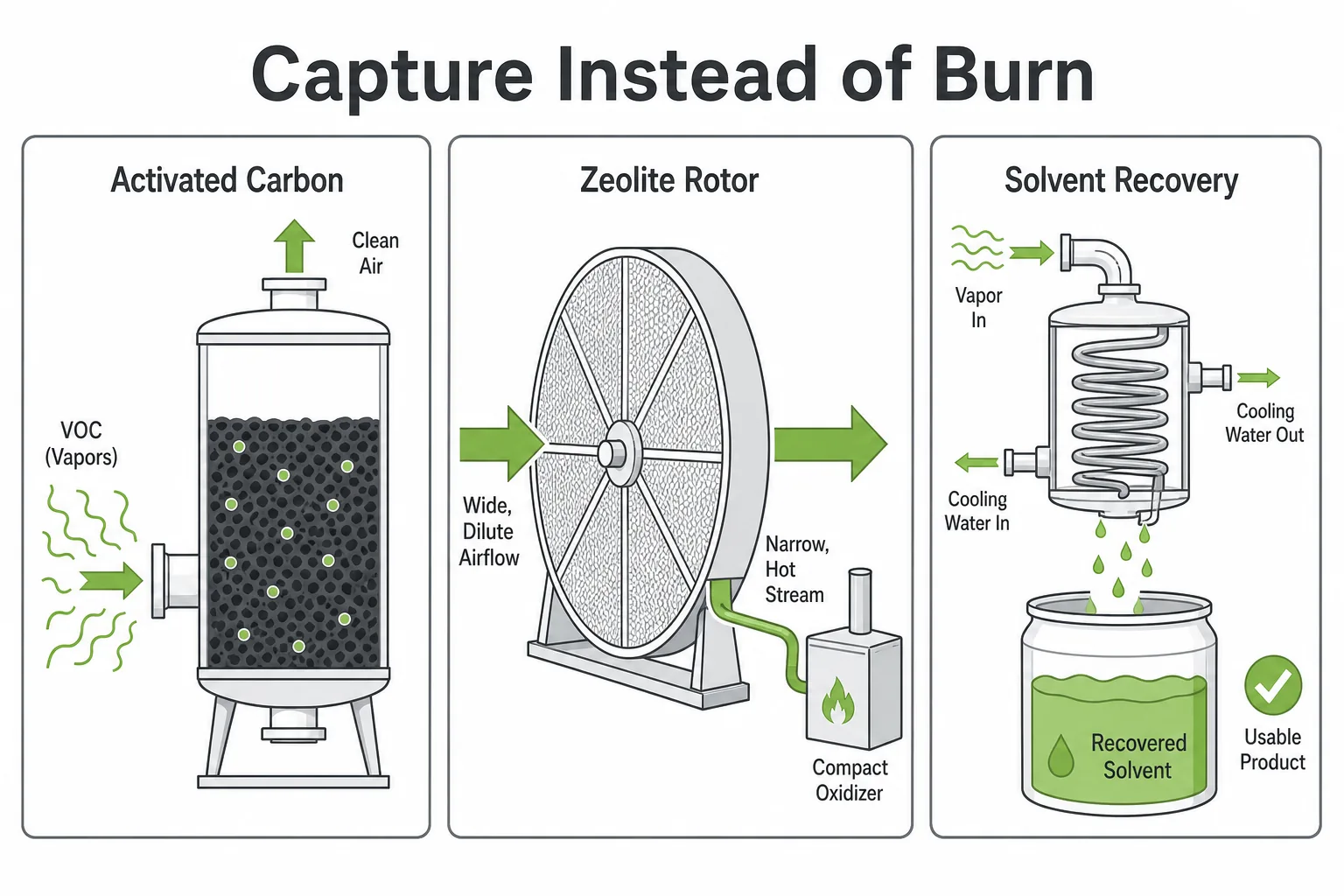
Capture instead of burn: activated carbon adsorbs, the zeolite rotor concentrates dilute exhaust, and recovery systems return solvent as product.
Activated carbon adsorption captures VOC molecules on a porous carbon bed — the practical route for lower concentrations, intermittent duty and odor polishing. The bed is a consumable whose real capacity depends on the compound and the conditions; that sizing logic is in our activated carbon adsorption capacity article, and the equipment side on the activated carbon adsorption product page.
Zeolite rotor concentration answers the hardest VOC case — huge airflow, thin concentration — by adsorbing continuously on a rotating wheel and desorbing into a small hot stream, so a compact RTO can treat what a full-size unit would burn fuel on. The combination is explained in our zeolite rotor concentrator article.
Solvent recovery treats the VOC as product rather than waste — worth reviewing whenever a single valuable solvent like NMP dominates the stream. Whether recovery, oxidation or carbon wins a given project is the three-way comparison in our solvent recovery vs RTO vs activated carbon review.
Other Technologies You Will Meet in the Market
Three more names appear in almost every equipment search, and a fair overview should place them honestly.
- Electrostatic precipitators (ESP) charge particles and collect them on plates — mostly utility-scale flue gas and some oil mist duties.
- Biofilters and biotrickling systems use microorganisms to digest odor compounds and some VOCs, at low operating cost but with large footprints and sensitivity to load swings.
- Plasma and UV-photolysis units target odor molecules with energized air; performance depends heavily on the specific compounds and residence time.
AIER does not supply these three routes; its range is the scrubber, oxidizer, carbon and rotor-concentration families described above, alongside the dust collection line. They are listed because if your exhaust genuinely points to one of them, that is worth knowing before any quote — not after.
Matching the Route to the Exhaust
Route selection is exhaust characterization wearing a different name. The same starting facts sort most projects onto a shortlist.
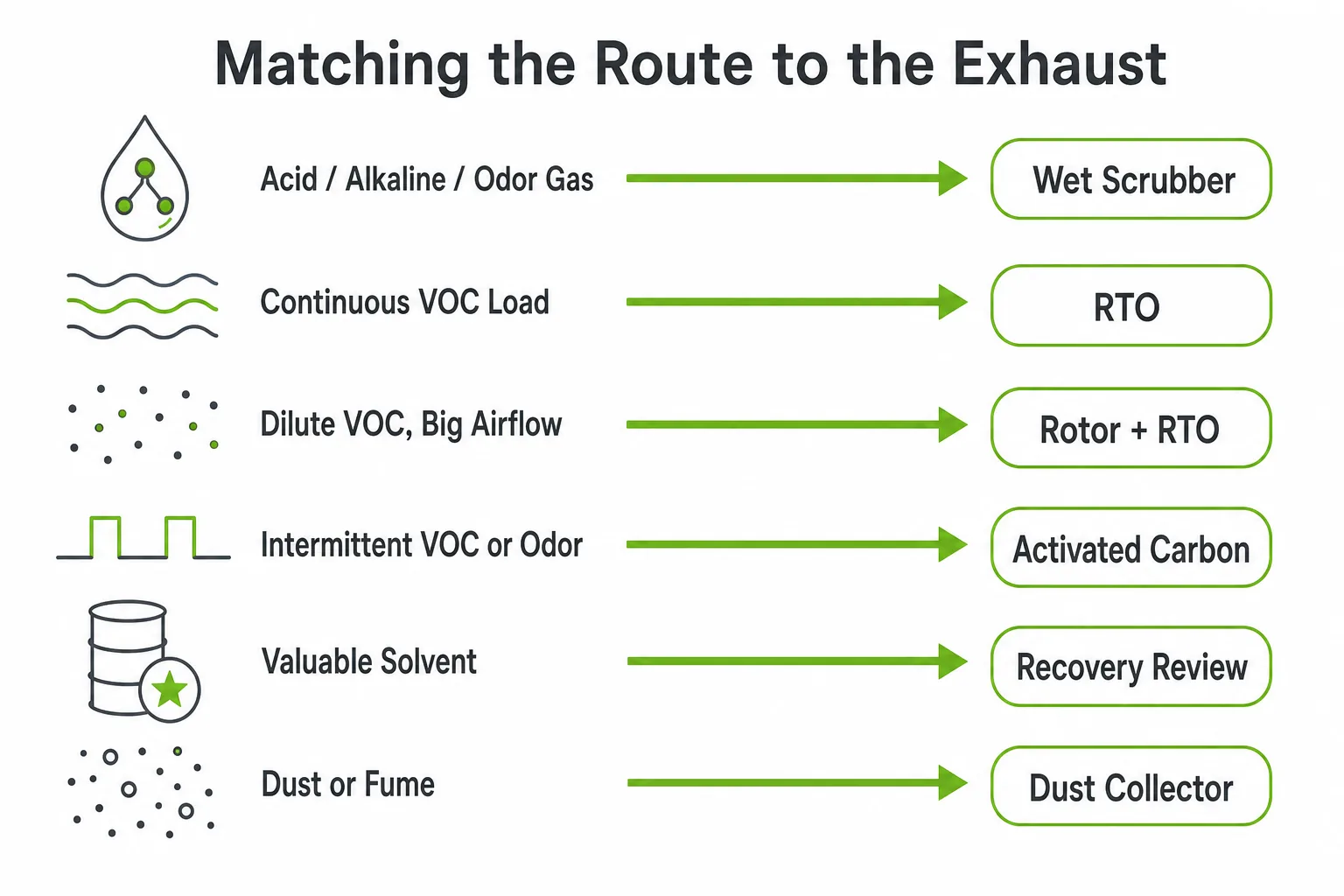
From exhaust facts to route shortlist: pollutant family, concentration, airflow and duty pattern decide the equipment before any brand does.
| If the Exhaust Looks Like | The Shortlist Starts With |
|---|---|
| Acid gas, alkaline gas or washable odor | Wet scrubber with chemistry matched to the pollutant |
| Continuous VOC load at workable concentration | Regenerative thermal oxidizer |
| Smaller airflow, suitable chemistry, no catalyst poisons | Catalytic oxidizer review alongside the RTO |
| Large airflow, dilute VOC | Zeolite rotor concentrator feeding a compact oxidizer |
| Low, intermittent VOC or odor polishing | Activated carbon adsorption |
| One valuable solvent dominating the stream | Recovery review before any destruction quote |
| Dust or fume, with or without gas pollutants | Dust collection stage first — see the dust collector overview |
| Mixed families in one pipe | Staged routes; no single machine covers chemistry and particulate well |
Two of these calls justify their own deeper comparisons: wet against dry treatment in our wet vs dry scrubber article, and destroy against recover in the solvent recovery comparison.
Common Mistakes When Buying Air Pollution Control Equipment
- Shopping by equipment name: asking for “an RTO quote” before the exhaust is characterized locks the project into a route that may not fit.
- Applying indoor-air thinking to industrial streams: air pollution control devices for process exhaust are a different equipment class from purifiers and HVAC filters, and the sizing logic does not transfer.
- Ignoring what the wet route brings along: a scrubber quote without blowdown, chemical and water treatment costs is not a complete number.
- Comparing purchase price instead of operating economics: fuel, media, chemicals and power decide the real cost ranking — the logic in our cost factors article.
- Forgetting the outlet details: droplet carryover and missing sampling ports are small line items that decide whether commissioning passes.
- Asking one machine to treat mixed pollutants: dust, droplets and VOCs in one pipe usually need stages, not a bigger single unit.
Information AIER Needs for a Route Review
A route recommendation is only as good as the exhaust data behind it. This is what the review starts from.
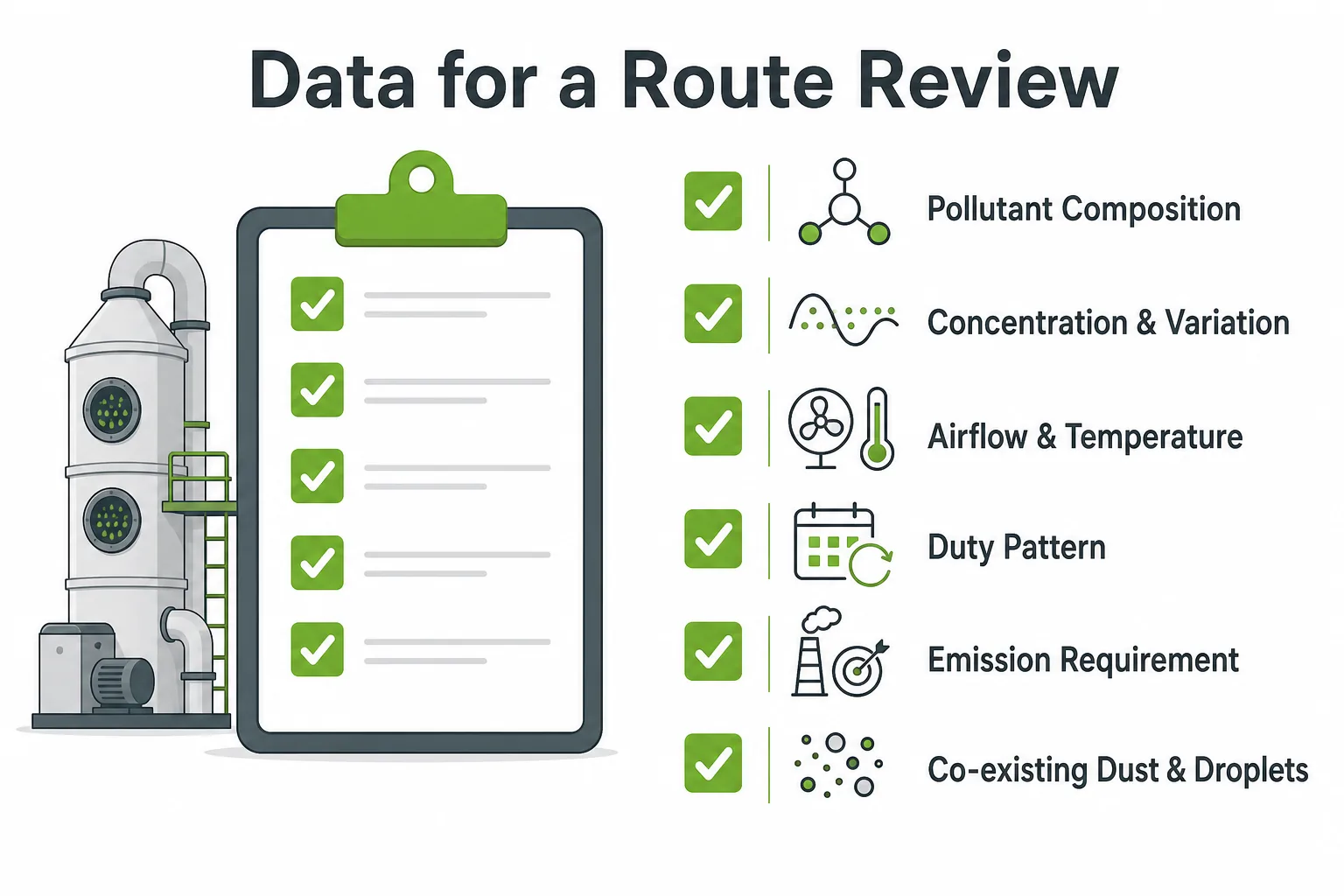
Pollutant composition, concentration, airflow, temperature, duty pattern and the emission requirement are the data AIER reviews before recommending a route.
| Data to Prepare | Why It Matters |
|---|---|
| Pollutant composition and source process | Decides the route family: scrubbing, oxidation, adsorption, recovery or filtration |
| Concentration and its variation | Separates RTO duty from rotor-concentration duty from carbon duty |
| Airflow and temperature | Sets equipment scale and heat recovery logic |
| Duty pattern — continuous, shift or intermittent | Continuous favors oxidation; intermittent favors adsorption |
| Emission requirement at the stack | Defines what the route must achieve, and how it will be verified |
| Co-existing dust, droplets or mixed pollutants | Decides pre-treatment stages and equipment order |
| Utilities and layout constraints | Fuel, power, water and footprint shape which routes are practical |
| Installation country | Defines project and delivery requirements |
If you are starting an exhaust treatment project — or re-quoting one that never quite fit — contact AIER with the pollutant data, airflow, duty pattern and emission requirement. AIER supplies scrubber, oxidizer, carbon and rotor-concentration platforms, so the route review can follow the exhaust instead of defending a single product.
FAQ
What is air pollution control equipment?
Air pollution control equipment is the machinery that removes pollutants from industrial exhaust before discharge — wet scrubbers that wash out acid, alkaline and odor gases, oxidizers that destroy VOCs at temperature, adsorption and recovery systems that capture organic vapors, and dust collectors that filter particulate. It is a different equipment class from indoor air purifiers and HVAC filtration.
What equipment removes VOCs from industrial exhaust?
Four routes cover most VOC duties: regenerative thermal oxidizers destroy VOCs on continuous loads, catalytic oxidizers do the same at lower temperature for suitable smaller streams, activated carbon adsorption captures lower or intermittent loads, and zeolite rotor concentrators condense large dilute airflows into a small stream an oxidizer can treat economically. Valuable solvents add a fifth option — recovery instead of destruction.
What is the difference between a scrubber and a thermal oxidizer?
A scrubber transfers pollutants into a washing liquid, which suits gases that dissolve or react — acids, alkalis and many odor compounds — and brings liquid handling along as a consequence. A thermal oxidizer destroys organic pollutants at high temperature, which suits VOC streams that washing cannot capture. They solve different pollutant families and are often staged together on mixed exhausts.
Which route fits low-concentration, high-airflow VOC exhaust?
That case is the classic zeolite rotor concentrator duty: the wheel adsorbs VOCs from the large dilute stream continuously and desorbs them into a much smaller hot stream, which a compact RTO then treats with workable fuel use. Running the full airflow directly through an oxidizer is usually the expensive answer, which is why the concentration step exists.
Does AIER supply electrostatic precipitators or biofilters?
No. AIER’s range covers the wet scrubber family, regenerative thermal and catalytic oxidation, activated carbon adsorption, zeolite rotor concentration and the industrial dust collection line. ESPs, biofilters and plasma units are noted in this overview so the route comparison stays honest — if the exhaust genuinely points there, that is worth knowing before procurement.
How do I choose between recovery and destruction?
Start from what the VOC is worth. When one valuable solvent such as NMP dominates the stream, a recovery review belongs before any destruction quote, because returned solvent offsets operating cost. Mixed cheap solvents usually point to oxidation, and low intermittent loads to carbon. The three-way comparison — recovery, RTO, activated carbon — is covered in its own article on this site.