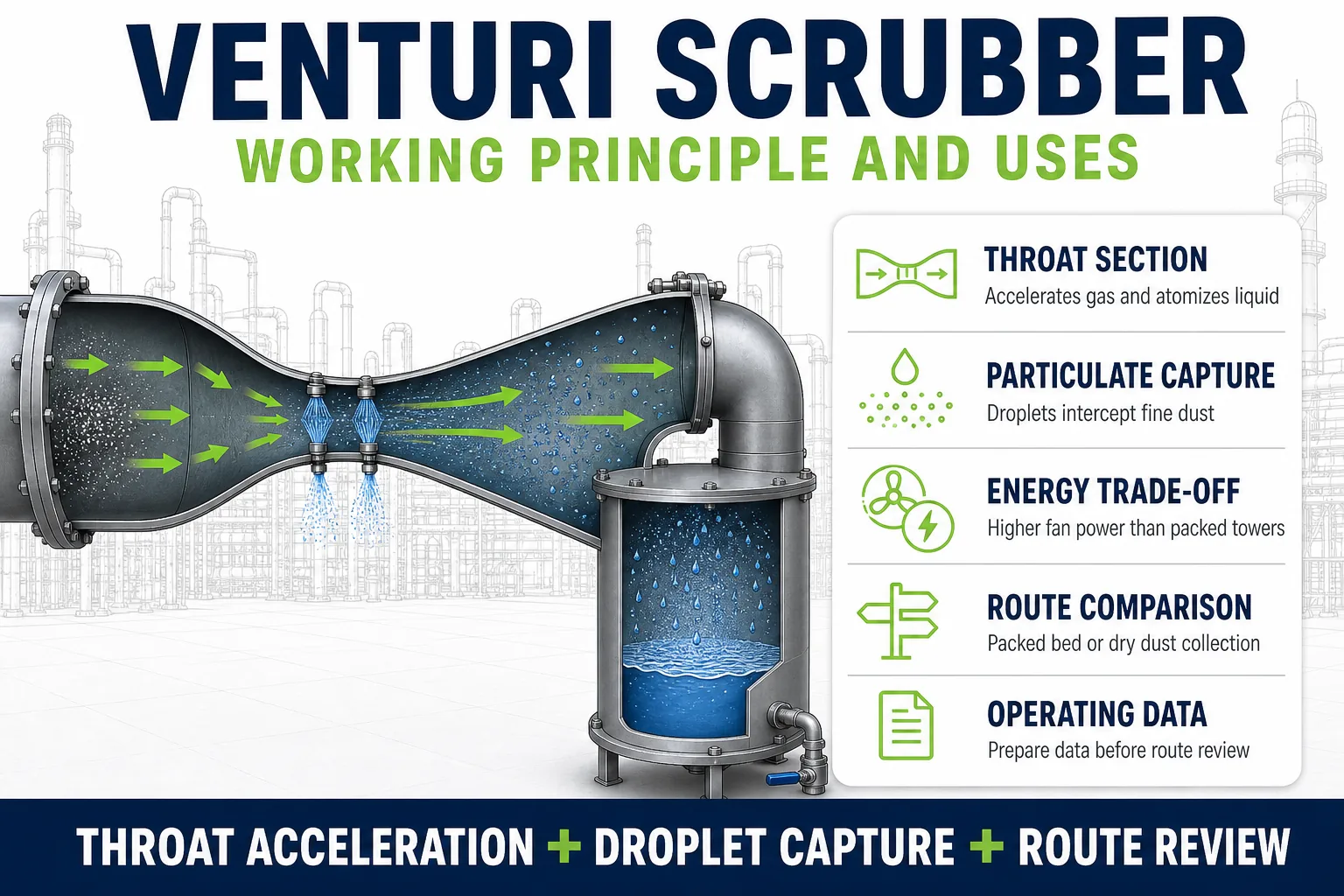
When a plant has a high dust load or fine particles that are hard to capture, the scrubber conversation often turns to a venturi design. The name comes from the throat shape, but what matters for a buyer is simpler: this is a wet scrubber built for particle capture, not the same job as a packed tower built for gas absorption.
This article explains how a venturi scrubber works, what it is used for, how it compares with a packed bed scrubber and with dry dust collection, and when this route makes sense. It is written for plant engineers and project buyers reviewing exhaust gas treatment systems or dust control options. AIER does not manufacture venturi scrubbers; AIER wet scrubbers use packed-bed and spray contact, and AIER also supplies industrial dust collection for dry routes. This article does not replace process design or local emission requirements for a specific project.
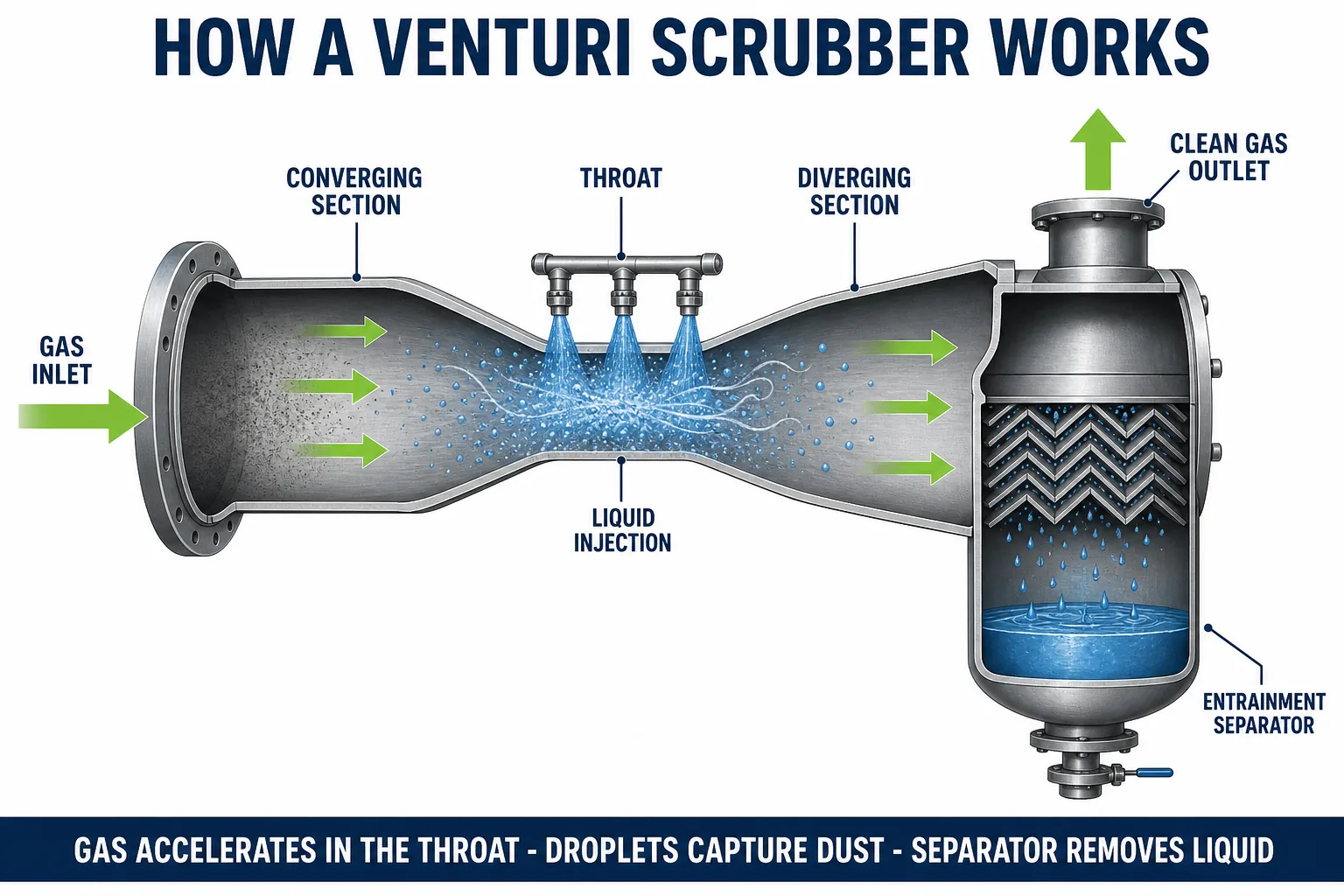
In a venturi scrubber the gas accelerates through a throat where liquid is atomized into droplets that capture dust before the stream slows and the droplets are separated.
What Is a Venturi Scrubber?
A venturi scrubber is a wet scrubber that removes particulate matter from an exhaust stream by forcing the gas through a constricted throat section, where high velocity and turbulence atomize the washing liquid into fine droplets that capture dust by inertial and diffusional interception.
The same equipment appears under several names. A venturi wet scrubber, venturi jet scrubber and gas-atomizing spray scrubber all describe the same family. Some buyers also call it a venturi dust collector when the project is framed as wet dust collection rather than gas scrubbing. The names change; the throat-and-droplet principle does not. Where venturi scrubbing sits among the other treatment routes is in our air pollution control equipment overview.
According to the EPA air pollution control technology fact sheet, venturi scrubbers belong to the wet scrubber group and are primarily used to control particulate matter, including fine particles, with some incidental removal of highly soluble gases. They are a different scrubber type from packed towers used for gas absorption.
How a Venturi Scrubber Works
The venturi scrubber working principle follows a short sequence through four zones. Gas enters a converging duct, passes through the throat, expands in a diverging section, and then enters a separation stage that removes the droplets carrying the captured dust.
- Converging section: the duct narrows and the gas accelerates toward the throat.
- Throat: washing liquid is injected into the high-velocity gas stream; turbulence breaks the liquid into fine droplets and increases contact between droplets and particles.
- Diverging section: the duct widens and the gas slows, which helps the droplets coalesce before separation.
- Entrainment separator: a cyclone, chevron mist eliminator or similar device separates the liquid droplets from the cleaned gas before discharge.
Particle capture happens in the throat, not in a packing bed. That is why a venturi scrubber design is judged on throat geometry, liquid injection and separation rather than on packing type or liquid distribution over media.
Main Parts of a Venturi Scrubber
A venturi scrubber has fewer internal zones than a packed tower, but each part has a clear role and a typical wear pattern in service.
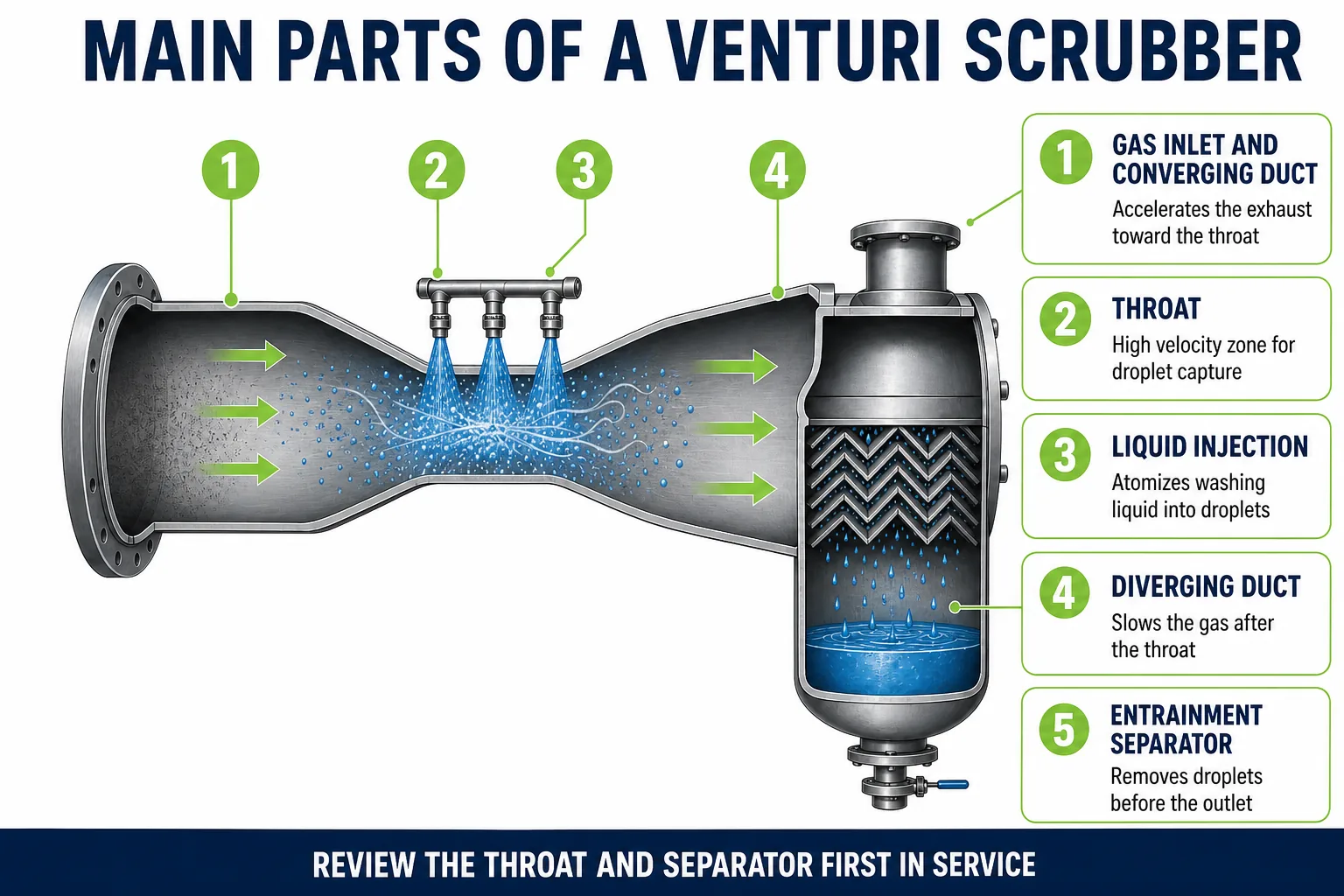
Main venturi scrubber parts from inlet to outlet: converging duct, throat with liquid injection, diverging duct and entrainment separator.
| Part | What It Does | What to Review in Service |
|---|---|---|
| Gas inlet and converging duct | Brings the exhaust in and accelerates it toward the throat | Wet-approach or flooded-wall entry reduces dust buildup at a wet-dry junction |
| Throat | Creates the high-velocity zone where liquid is atomized and particles are captured | Abrasive dust can erode the throat; adjustable throats need position checks |
| Liquid injection | Introduces washing liquid into the gas stream at or near the throat | Nozzle wear and uneven injection reduce capture across the duct |
| Diverging duct | Slows the gas after the throat | Layout affects droplet behavior before separation |
| Entrainment separator | Removes droplets from the gas before the outlet | Separator fouling increases carryover and wets downstream equipment |
When a venturi scrubber underperforms, the review usually starts at the throat and the liquid injection, then moves to the separator condition. These are operation questions, not catalog model numbers.
What a Venturi Scrubber Is Used For
Venturi scrubbers are particulate scrubbers first. Their main job is to capture dust, including fine particles, in streams where a wet route is acceptable and the dust load is high enough to justify the energy cost.
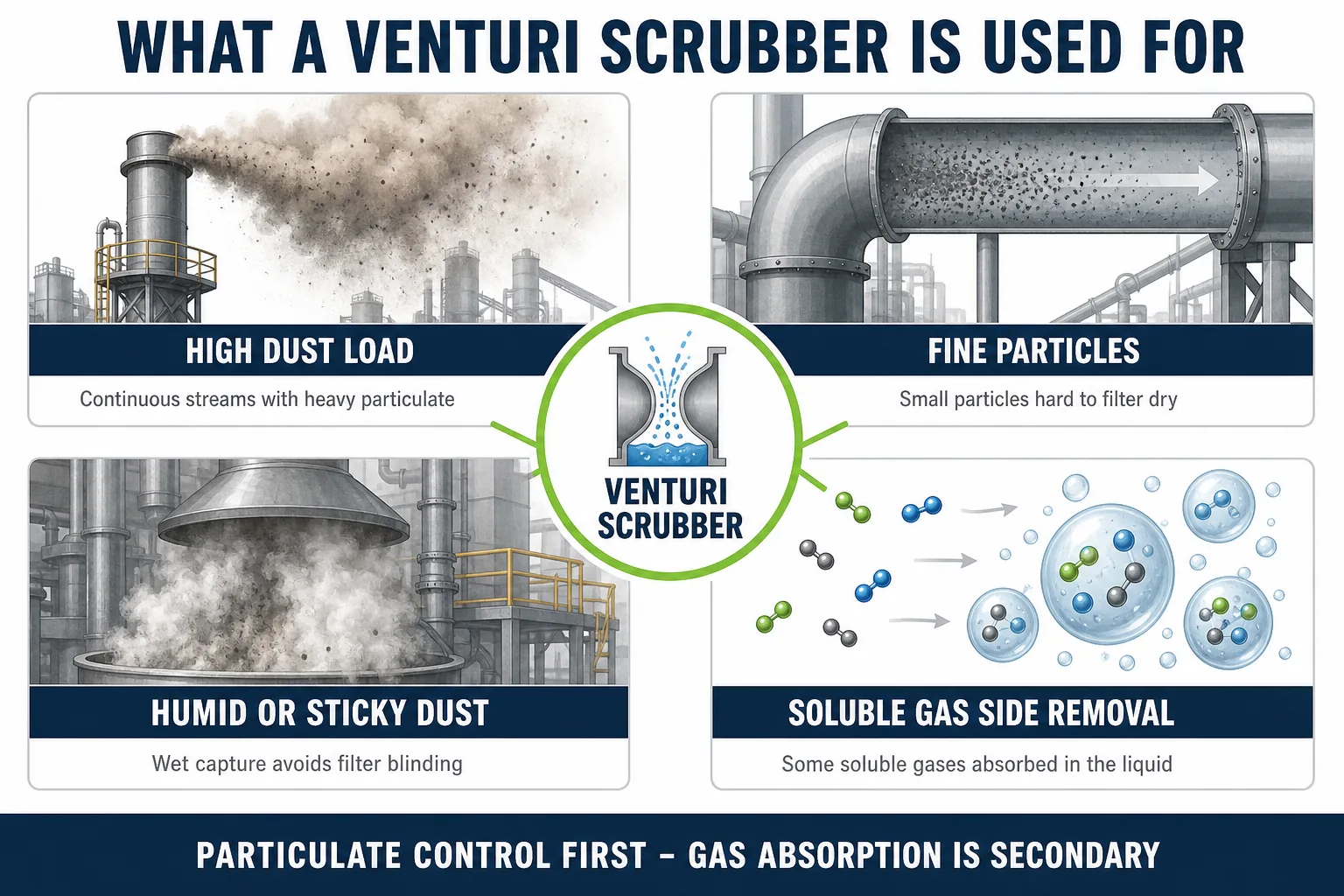
Typical venturi scrubber applications include high dust loads, fine particles, humid or sticky dust streams and projects that also need some soluble gas removal.
| Application Pattern | Why a Venturi Route Is Considered |
|---|---|
| High dust load in a continuous exhaust stream | Droplet capture tolerates heavy particulate better than a packing bed |
| Fine particles that are hard to filter dry | Throat turbulence improves contact with small particles |
| Humid, sticky or agglomerating dust | Wet capture avoids loading dry filter media with wet cake |
| Streams that also contain soluble gases | Some soluble components can be absorbed in the liquid as a side effect |
Industries that discuss venturi scrubbers include boiler and furnace exhaust with ash, chemical and mineral processing with abrasive dust, and some food or rendering lines where moisture and stickiness make dry filtration difficult. The right answer still depends on the dust properties and the emission target, not on the industry name alone.
Venturi Scrubber vs Packed Bed Scrubber
These two wet scrubber types solve different problems. A venturi scrubber targets particles; a packed bed scrubber targets gas absorption. Comparing them on the same metric usually leads to the wrong selection.
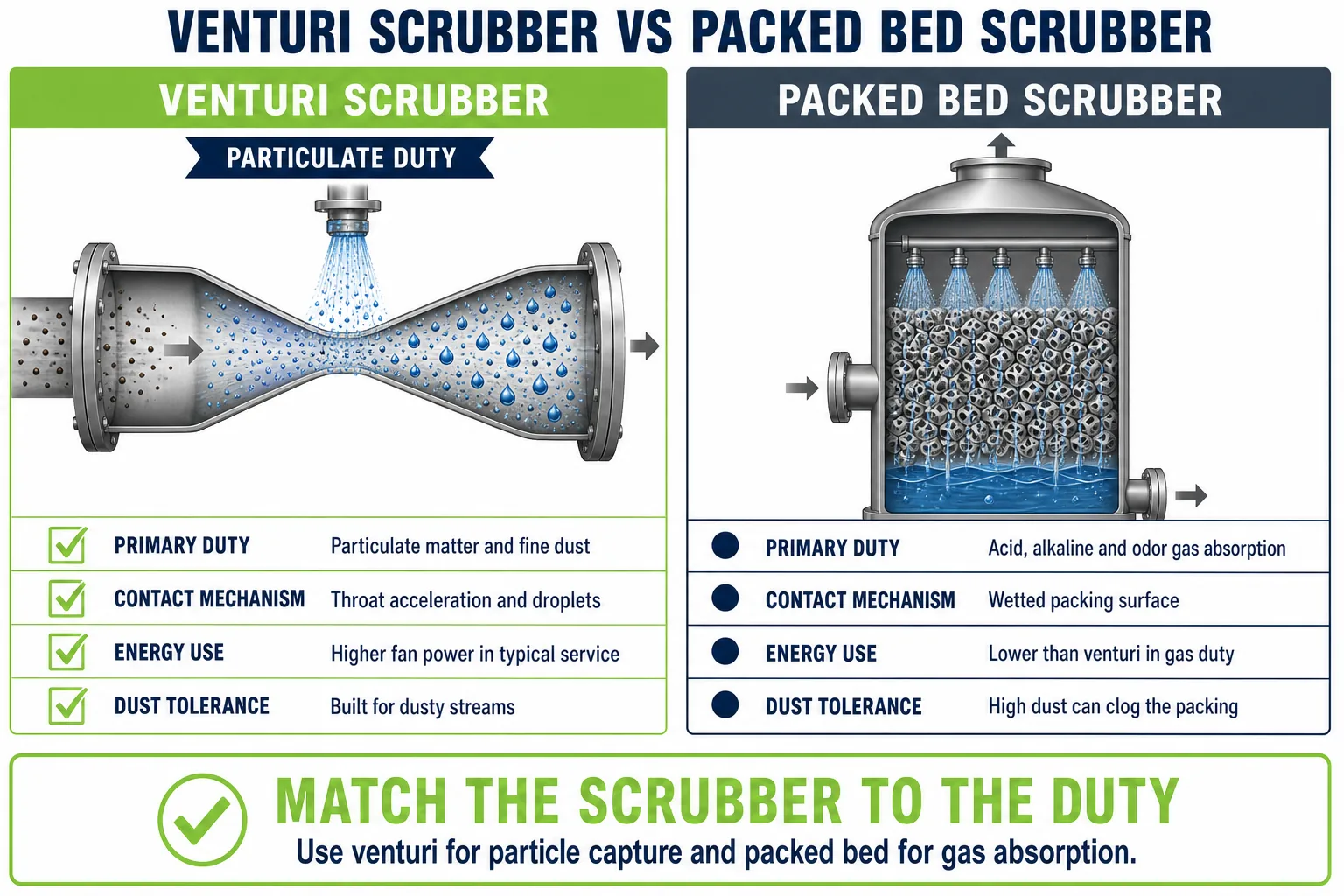
Venturi scrubbers lead on particulate capture; packed bed scrubbers lead on gas absorption with lower energy use in typical gas-duty service.
| Review Point | Venturi Scrubber | Packed Bed Scrubber |
|---|---|---|
| Primary duty | Particulate matter and fine dust | Acid, alkaline and soluble gas absorption |
| Contact mechanism | Throat acceleration and droplet interception | Wetted packing surface and counter-current flow |
| Typical energy use | Higher fan power because of throat velocity | Lower than venturi in typical gas absorption duty |
| Dust tolerance | Built for dusty streams | High dust loads can clog the packing |
| AIER route | Not an AIER product; review wet or dry alternatives | One of the contact types in AIER industrial wet scrubber towers |
If the main problem is hydrogen sulfide, ammonia or another gas that must be absorbed in a washing liquid, the review should start with a packed tower route, not a venturi. The packed bed scrubber article explains that contact type in detail.
The Energy Cost of Fine Particle Capture
Fine particle capture in a venturi scrubber depends on high gas velocity and turbulence in the throat. That mechanism works, but it costs fan energy. A venturi route usually needs more pressure drop than a packed bed tower or a simple spray tower doing gas absorption duty.
This is one reason many dust projects are reviewed on two tracks at the same time: a wet venturi or wet dust collection route, and a dry dust collection route with a cartridge or baghouse collector. The question is not only whether the venturi can capture the dust, but whether the plant can accept the ongoing energy, water and wastewater burden that comes with it.
None of this means venturi scrubbers are wrong. It means the selection should compare total operating burden, not only the capture mechanism on a datasheet.
Venturi Scrubber or Dry Dust Collection
A venturi scrubber is one form of wet dust collection. Many buyers searching for a wet dust collector are really asking whether the plant should stay dry or go wet. Both routes appear in industrial projects, and the better choice depends on the dust, not on the name on the quote.
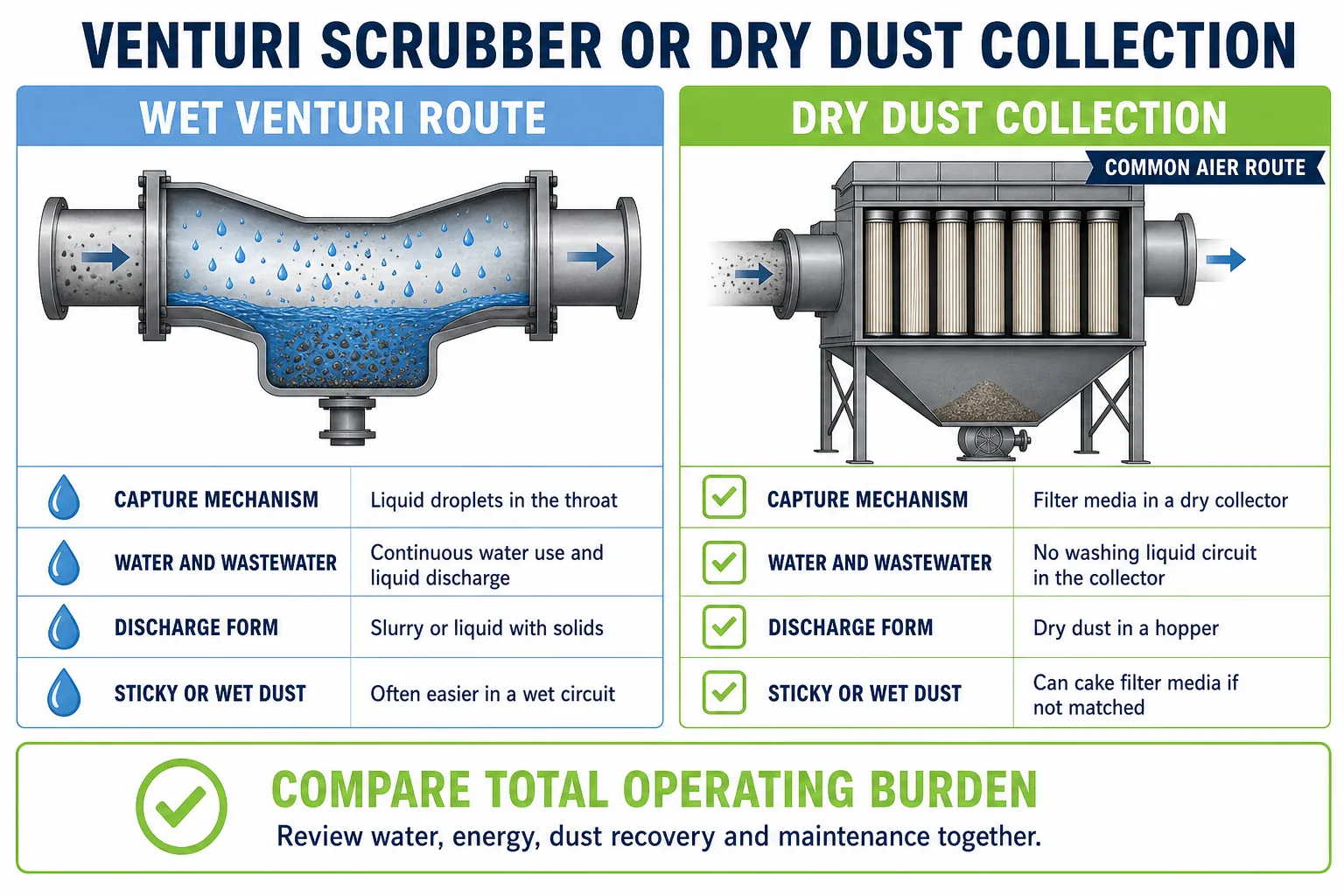
Wet venturi routes use water and produce a slurry; dry routes use filter media and produce a dry dust discharge.
| Review Point | Wet Venturi Route | Dry Dust Collection |
|---|---|---|
| Capture mechanism | Liquid droplets in the throat | Filter media in a cartridge or baghouse collector |
| Water and wastewater | Continuous water use and a liquid discharge stream | No washing liquid circuit in the collector itself |
| Dust discharge form | Slurry or liquid with solids | Dry dust in a hopper for disposal or recovery |
| Sticky or wet dust | Often easier to handle in a wet circuit | Can blind or cake filter media if not matched to the dust |
| Typical AIER route | Not a venturi supplier; review other wet or dry options | Cartridge dust collector and other dry collectors in the AIER line |
For combustible dust, the review also needs a safety assessment of the chosen route. That assessment is project-specific and should be handled with the plant’s hazard data, not assumed from an article.
When a Venturi Scrubber Makes Sense and When It Does Not
Selection mistakes on venturi scrubbers usually come from using a particulate scrubber for a gas absorption problem, or from choosing a high-energy wet route when a dry collector would be simpler.
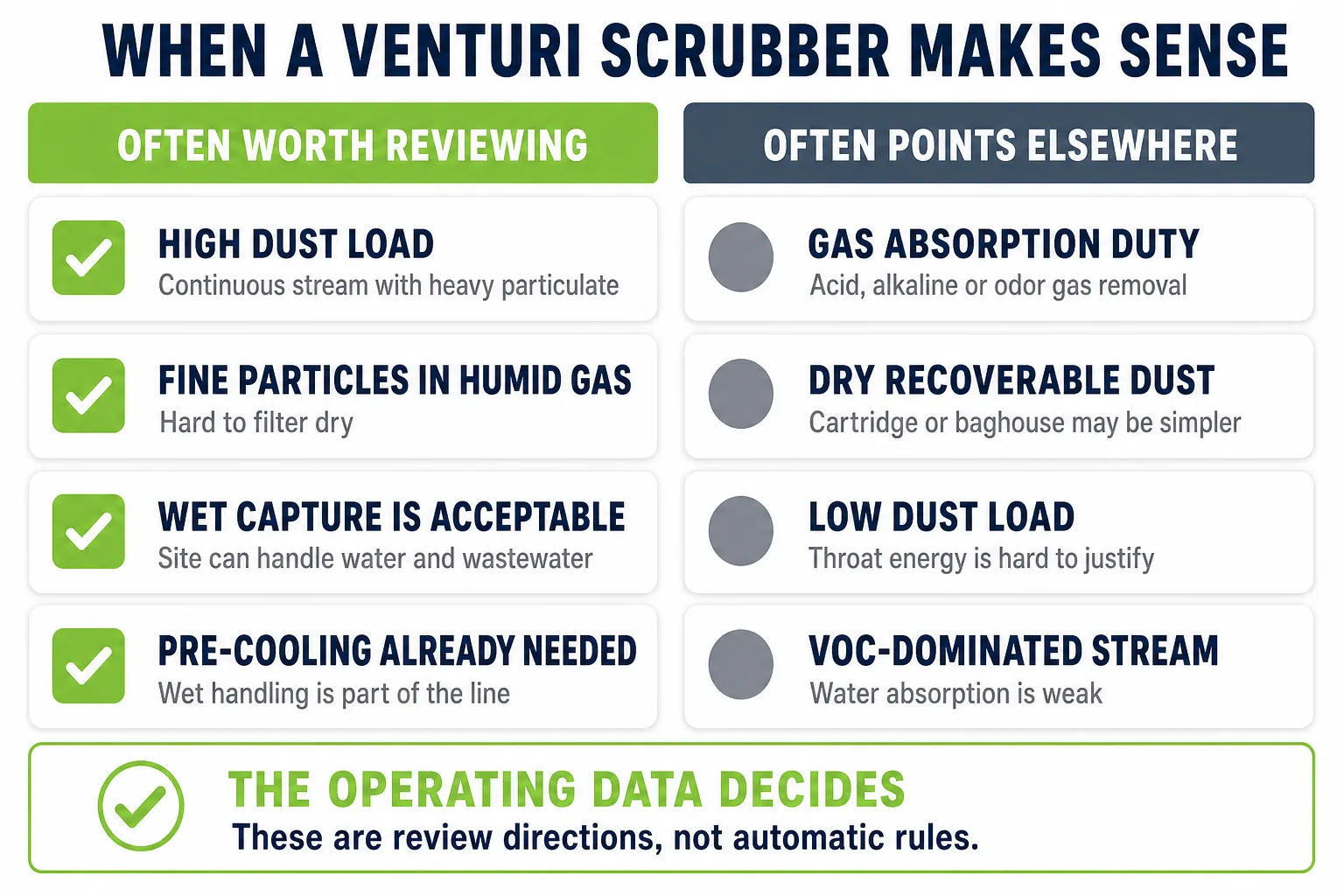
A venturi route fits high dust and fine particle wet capture; gas absorption and many dry recoverable dust streams usually point elsewhere.
| Often worth reviewing a venturi route | Often points to another route |
|---|---|
| High dust load in a continuous exhaust stream | Main problem is acid, alkaline or odor gas absorption |
| Fine particles in a humid or sticky stream | Dry, recoverable dust that suits a cartridge or baghouse collector |
| Wet capture is acceptable and wastewater can be handled | Low dust load where throat energy is hard to justify |
| Pre-cooling or wet handling is already part of the line | VOC-dominated stream where absorption in water is weak |
These are review directions, not automatic rules. The operating data still decides which route fits a specific plant.
Information AIER Needs to Review a Dust or Gas Scrubbing Route
Because AIER does not supply venturi scrubbers, an inquiry is most useful when it describes the exhaust condition and asks which route should be reviewed: dry dust collection, an AIER packed or spray wet scrubber, or a combination.
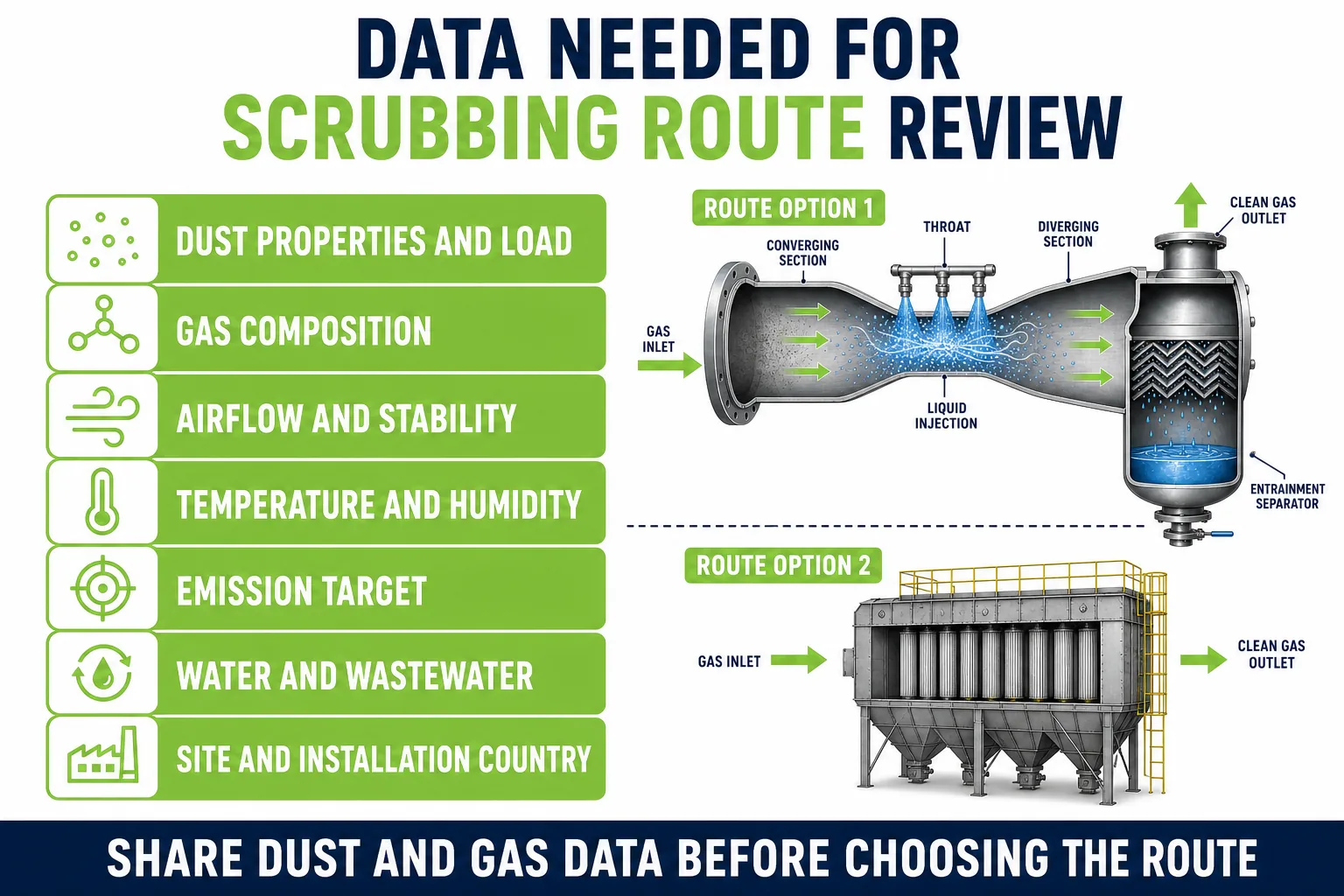
AIER reviews dust properties, gas composition, airflow, temperature, humidity and the emission target before recommending a wet or dry treatment route.
| Data to Prepare | Why It Matters |
|---|---|
| Dust properties and load | Size range, stickiness, abrasiveness and whether the dust is combustible |
| Gas composition | Shows whether the main duty is dust, gas absorption or both |
| Airflow and stability | Decides collector or tower size and turndown behavior |
| Temperature and humidity | Affects wet versus dry route selection and material choice |
| Emission target | Defines what the treated gas or dust discharge must achieve |
| Water and wastewater capability | Confirms whether a wet venturi-style route is practical on site |
| Site conditions and installation country | Affects layout, utilities and project requirements |
If you are comparing venturi scrubbers with other dust or gas treatment options, contact AIER with your dust properties, gas composition, airflow, temperature, humidity and emission target. AIER will review whether dry dust collection, a packed or spray wet scrubber, or another combination fits your exhaust condition.
FAQ
What is a venturi scrubber?
A venturi scrubber is a wet scrubber that removes dust from exhaust gas by accelerating the stream through a narrow throat, where washing liquid is atomized into fine droplets that capture particles before the droplets are separated from the cleaned gas.
How does a venturi scrubber work?
The gas enters a converging duct and accelerates through the throat, where liquid is injected and broken into droplets that capture dust. The gas then slows in a diverging section and passes through an entrainment separator that removes the droplets before discharge.
What is a venturi scrubber used for?
Venturi scrubbers are mainly used for particulate control, including fine particles, in high dust or humid exhaust streams. They can also remove some highly soluble gases as a side effect, but they are not the usual choice for gas absorption duty.
What is the difference between a venturi scrubber and a packed bed scrubber?
A venturi scrubber captures dust with throat acceleration and liquid droplets. A packed bed scrubber absorbs gases on a wetted packing surface. Venturi designs tolerate higher dust loads; packed towers suit acid, alkaline and odor gas absorption with lower energy use in typical gas-duty service.
Is a venturi scrubber the same as a wet dust collector?
Often yes in practice. A venturi scrubber is a type of wet dust collector because it uses liquid droplets to capture dust. The term wet dust collector can also describe other wet particulate devices, but venturi designs are a common example.
What are the alternatives to a venturi scrubber for dust control?
Alternatives include dry dust collection with a cartridge or baghouse collector, spray towers for some wet pre-treatment duty, and packed bed wet scrubbers when the main problem is gas absorption rather than dust. The right route depends on dust properties, gas composition and the emission target.