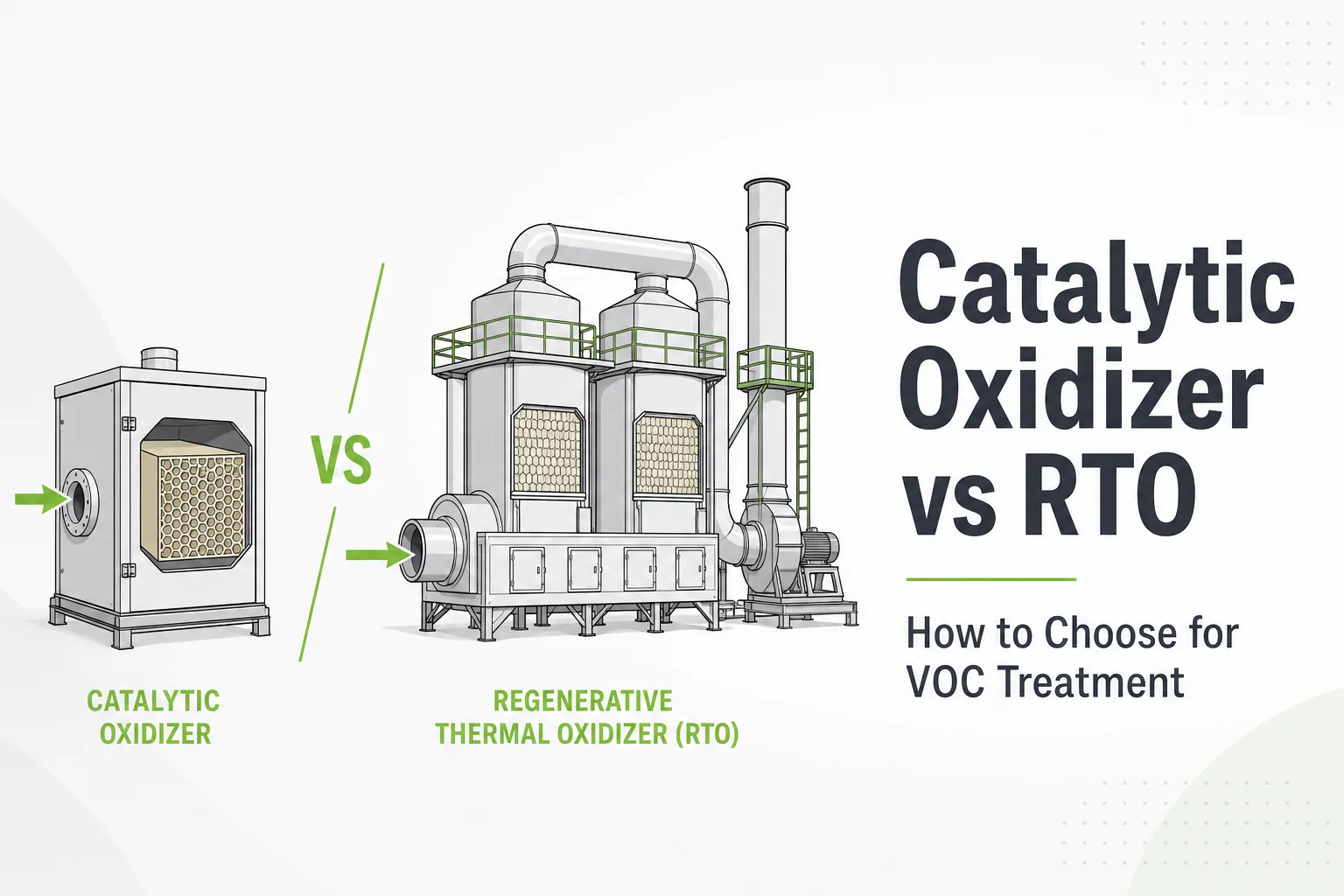
Most VOC destruction projects end up comparing two oxidation routes: a catalytic oxidizer or a regenerative thermal oxidizer. Both destroy organic compounds by oxidation, both recover heat, and supplier documents often present them side by side — which leaves buyers with the real question of what actually separates them in operation.
This article explains what a catalytic oxidizer is, how catalytic oxidation works, where it fits, where an RTO is the safer review direction, what can poison a catalyst, and what project data settles the choice. It is written for plant engineers, project buyers and EPC teams comparing exhaust gas treatment systems. AIER’s catalog describes CO catalytic oxidation technology alongside its RTO product line; the comparison here is a route review framework, not a substitute for project engineering or local emission requirements.
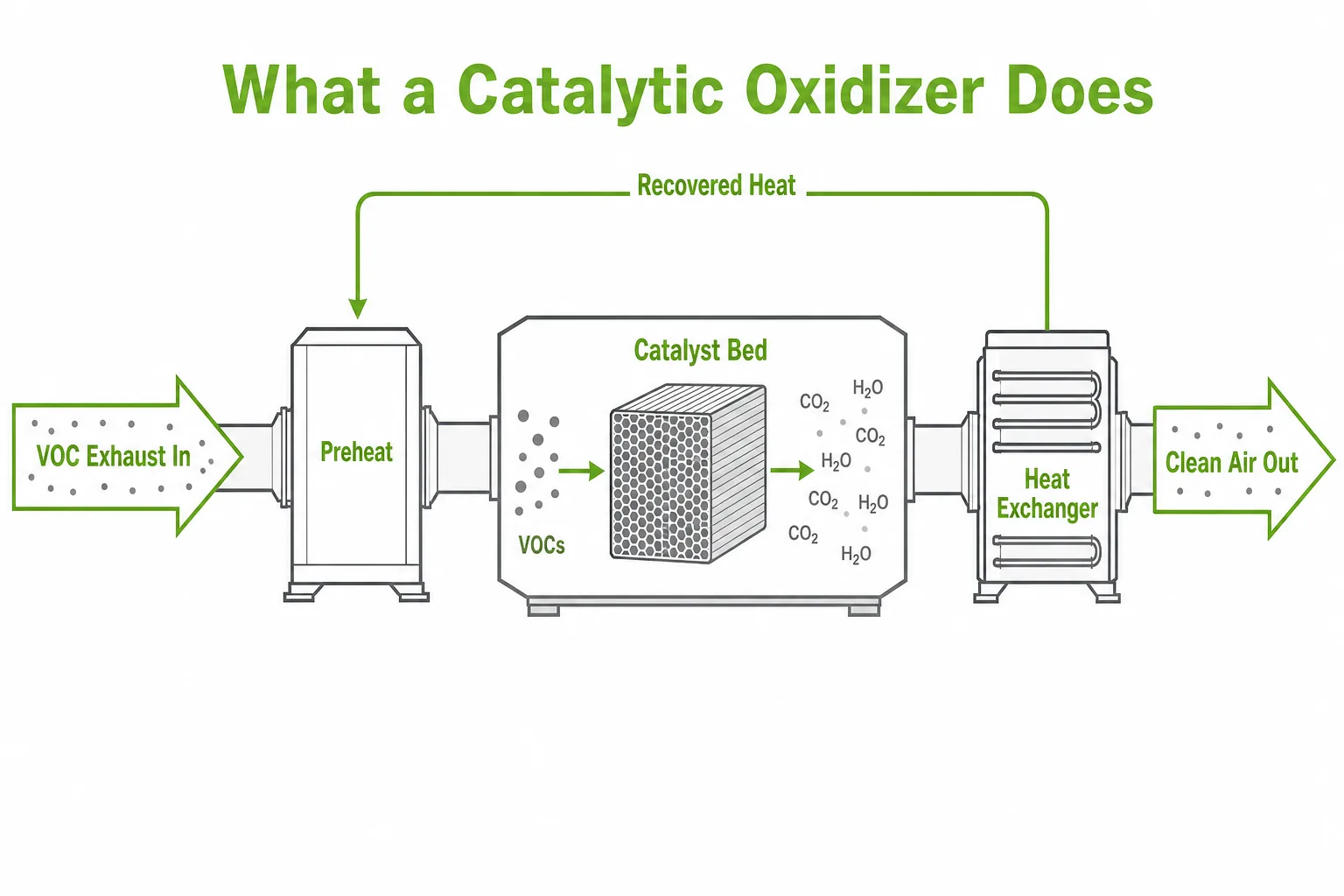
A catalytic oxidizer preheats the exhaust, oxidizes VOCs on a precious metal catalyst bed and recovers the reaction heat — at temperatures far below flame-based oxidation.
What Is a Catalytic Oxidizer?
A catalytic oxidizer is a VOC treatment unit that oxidizes organic compounds on a precious metal catalyst bed at temperatures far below those needed for flame-based thermal oxidation.
The equipment appears under several names: catalytic oxidizers, CatOx units, the older term catalytic incinerator, and — when the catalyst bed is combined with ceramic heat-storage media — regenerative catalytic oxidizer, abbreviated RCO. Some supplier documents also use catalytic thermal oxidizer for the same equipment family. The EPA’s control technique overview treats them as one category: oxidation assisted by a catalyst.
Per the AIER catalog description, the CO catalytic oxidation route uses platinum and palladium precious metal catalysts, offers good low-temperature activity with high treatment performance, occupies a small footprint and runs safely and reliably. The catalyst is the defining component: it is what allows the oxidation reaction to proceed at lower temperature, and it is also what sets the limits on where this route can be applied.
How Catalytic Oxidation Works
The process chain is short: the exhaust is preheated, passes through the catalyst bed where VOCs oxidize to CO2 and water vapor, and the reaction heat is recovered to preheat the incoming stream.
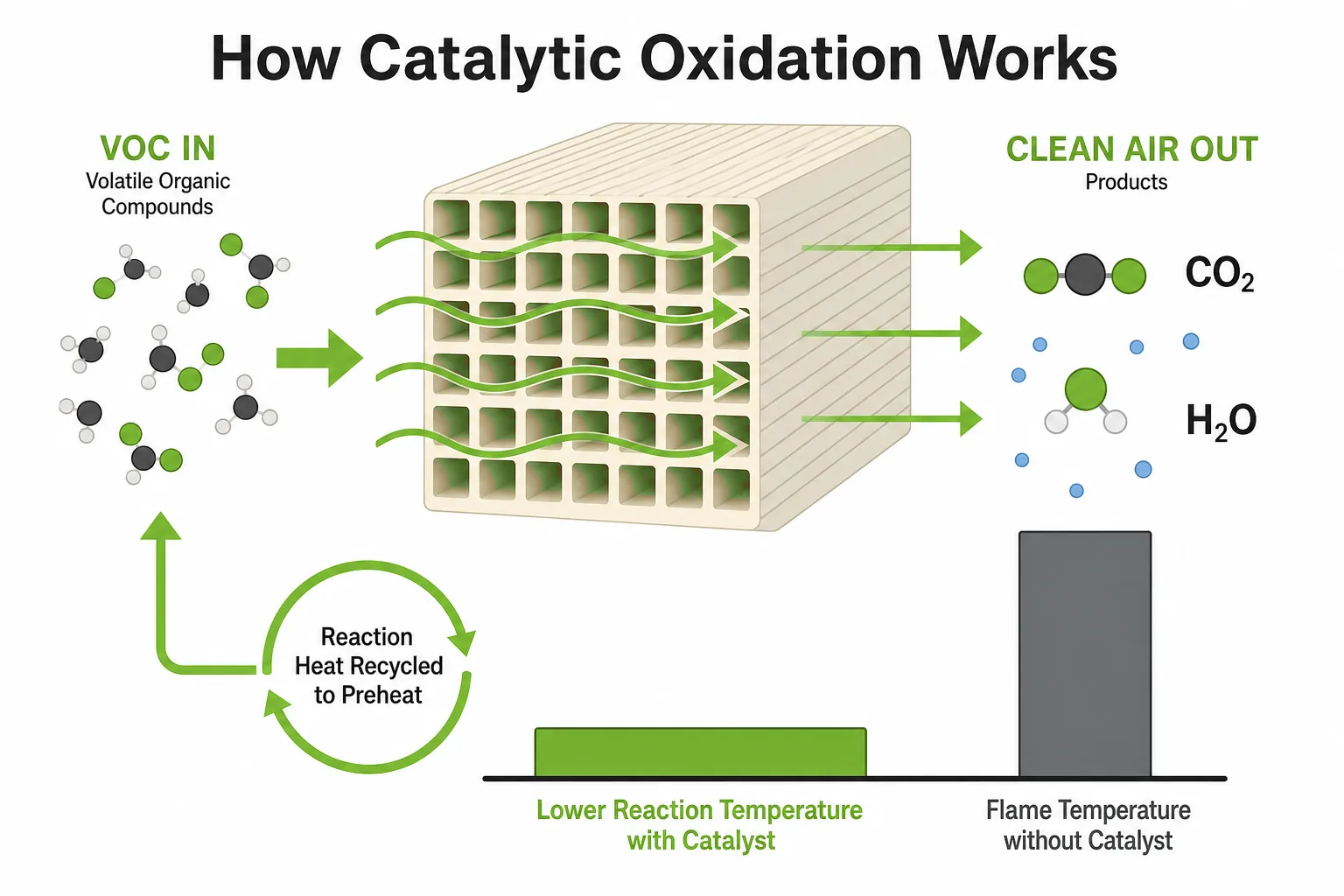
The catalyst lowers the energy needed to start oxidation, so the same destruction reaction runs at a fraction of flame temperature, with the reaction heat recycled to preheat incoming exhaust.
The catalyst does not get consumed by the reaction itself — it lowers the activation energy so oxidation proceeds at roughly 300–400°C per the AIER catalog, instead of the flame-range temperatures a thermal oxidizer needs. Less temperature lift means less fuel, which is the core economic argument for the catalytic route.
In a regenerative catalytic oxidizer, the catalyst bed sits together with ceramic heat-storage media, combining the low reaction temperature of catalysis with the high heat recovery of a regenerative design. The operating logic stays the same; the heat economics improve further.
What the short process chain hides is a dependency: everything relies on the catalyst staying active. That dependency drives most of the comparison that follows.
Catalytic Oxidizer vs RTO: The Core Differences
A regenerative thermal oxidizer destroys VOCs at or above 760°C, storing and returning heat through ceramic media beds instead of relying on a catalyst. Setting the two side by side, the differences group into six review points.
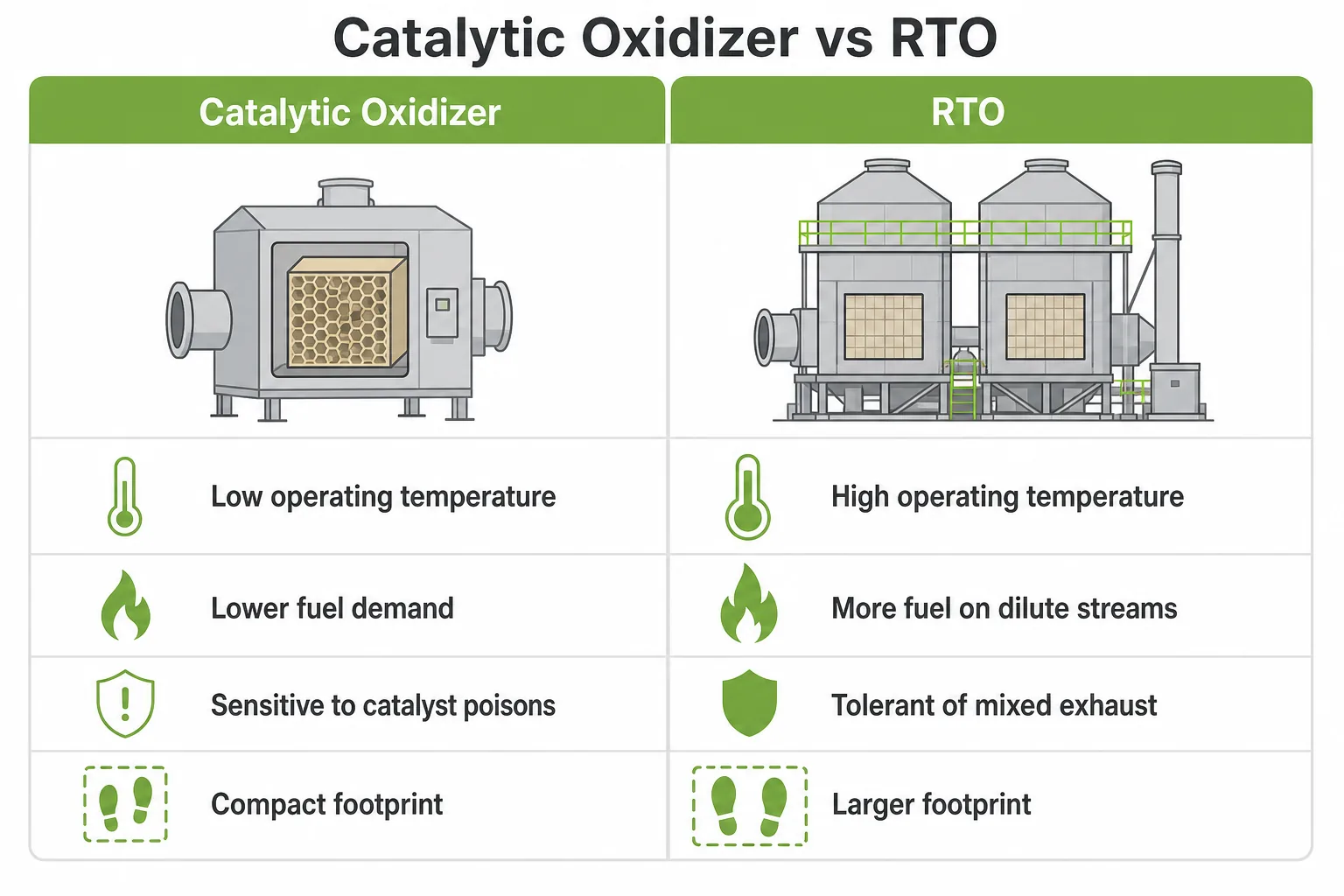
The catalytic route trades lower operating temperature against catalyst sensitivity; the RTO route trades higher temperature against broad tolerance of exhaust composition.
| Review Point | Catalytic Oxidizer | RTO |
|---|---|---|
| Operating temperature | Low — catalyst drives the reaction | High — heat alone drives the reaction |
| Heat recovery | Heat exchanger; ceramic beds in regenerative catalytic oxidizer designs | Ceramic heat-storage beds, high recovery |
| Fuel logic | Lower temperature lift, lower fuel demand | More fuel at low concentrations; less at higher loads |
| Sensitivity to exhaust composition | High — poisons and masking agents degrade the catalyst | Low — no catalyst to protect |
| Footprint | Compact | Larger, driven by media beds and airflow |
| Main consumable focus | Catalyst condition and replacement | Ceramic media, valves and burners |
Neither column wins by itself. The table turns into a decision only when it meets the actual exhaust data — which is why the next two sections describe the conditions, not preferences.
Where a Catalytic Oxidizer Fits
The catalytic route earns its case when the exhaust is clean, well-defined and stable — conditions where the catalyst can do its work without being degraded.
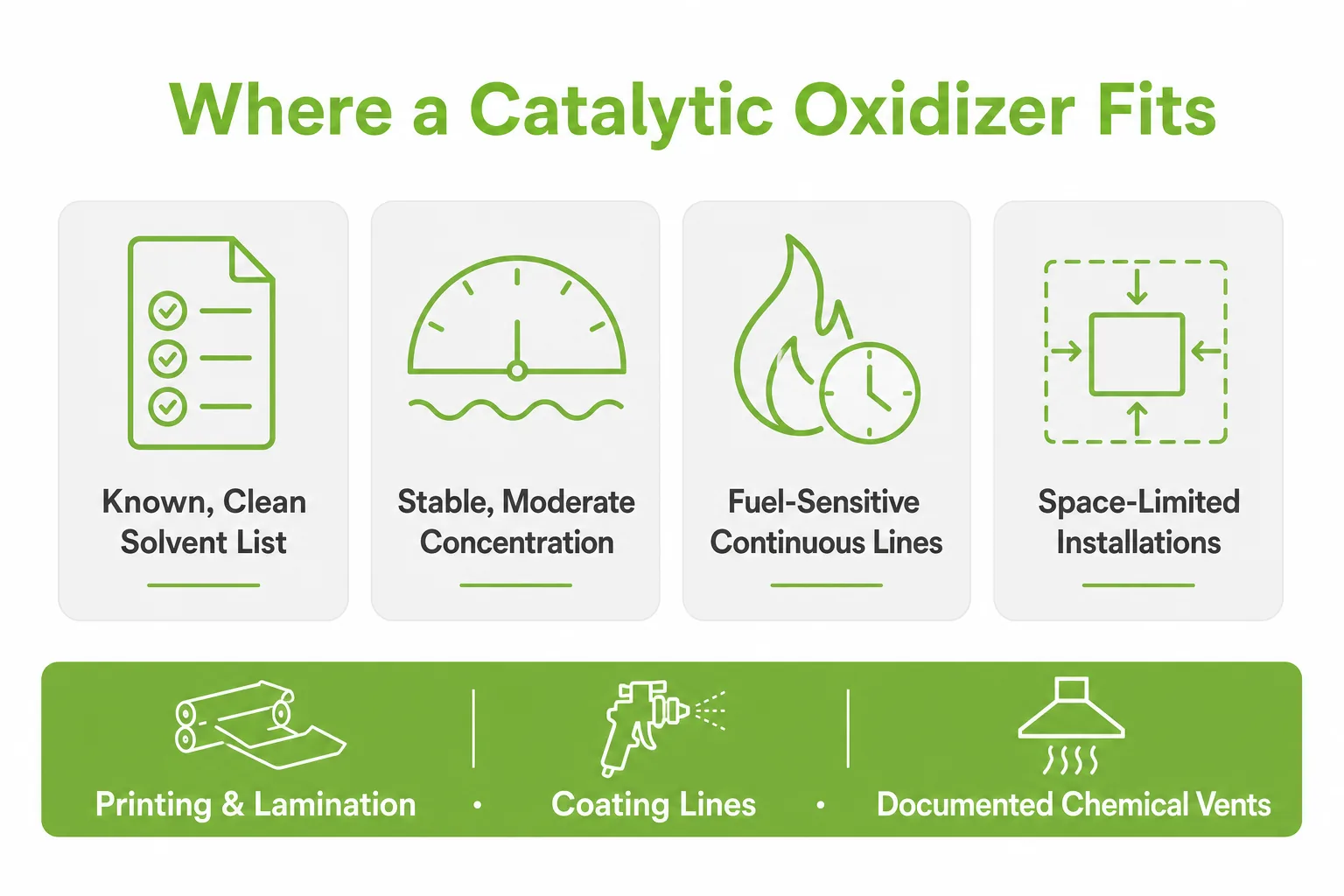
Clean, well-characterized solvent exhaust with stable concentration is the natural territory of the catalytic route.
- Known, clean solvent list: streams built from well-characterized solvents with no silicone, sulfur or halogen load — the catalyst’s chemistry is respected.
- Stable, moderate concentrations: steady loads let the unit run near its design point instead of chasing swings.
- Fuel-sensitive continuous operation: long running hours multiply the value of the lower temperature lift.
- Space-limited installations: the compact footprint suits rooftop and mezzanine placements where a media-bed oxidizer will not fit.
Typical applications include printing and lamination lines, coating and painting exhaust with disciplined solvent management — the same duty family covered by VOC emission control in coating plants — and chemical vents with a fixed, documented composition.
Where an RTO Is the Safer Review Direction
The RTO route wins where the exhaust refuses to stay clean or predictable — its tolerance is the feature being purchased.
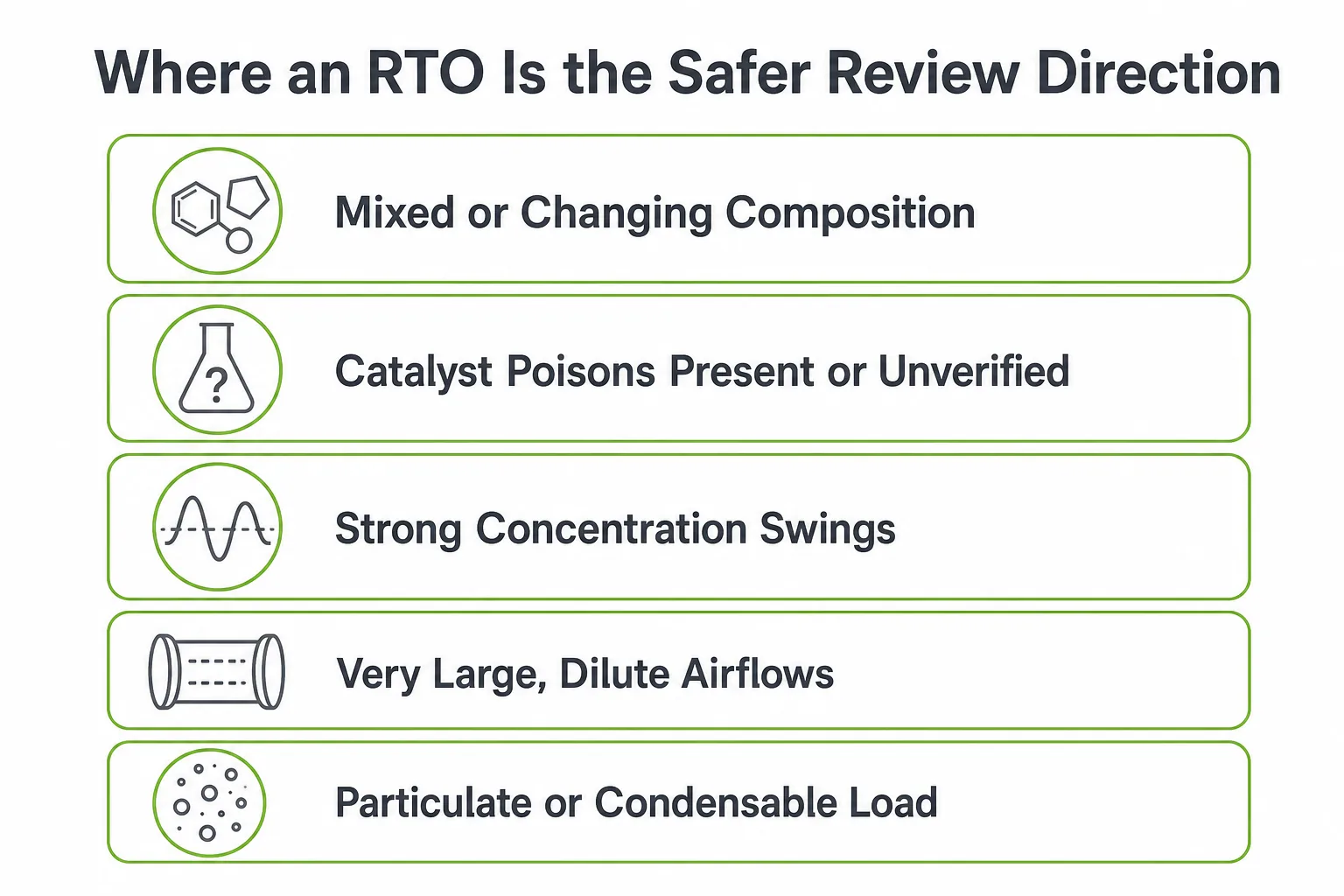
Mixed or changing composition, potential catalyst poisons, strong concentration swings and very large airflows all point the review toward the RTO route.
- Mixed or changing composition: multi-product lines, recipe changes and campaign operation make catalyst exposure impossible to control.
- Catalyst poisons present or unverified: if silicone, sulfur, phosphorus, halogens or heavy metals cannot be ruled out, the catalytic route starts with an open risk.
- Strong concentration swings: the thermal route absorbs load changes without a catalyst bed to overheat or starve.
- Very large, dilute airflows: high-volume low-concentration streams are usually reviewed as a zeolite rotor concentrator feeding a smaller RTO rather than as a catalytic unit on the full flow.
- Particulate or condensable load: dust and aerosols that would blind a catalyst face are a routine pre-treatment question for an RTO.
And when the exhaust data points away from oxidation entirely — low intermittent loads or a solvent worth recovering — adsorption on an activated carbon adsorption system or a recovery arrangement enters the review instead, a comparison covered in our solvent recovery system vs RTO vs activated carbon article. The full route map is in our air pollution control equipment overview.
Catalyst Poisoning and Deactivation: Buyer Review Points
Catalyst poisoning is the single most common reason catalytic oxidizer projects disappoint, and it is almost always visible in the exhaust data before purchase — if anyone asks for that data.
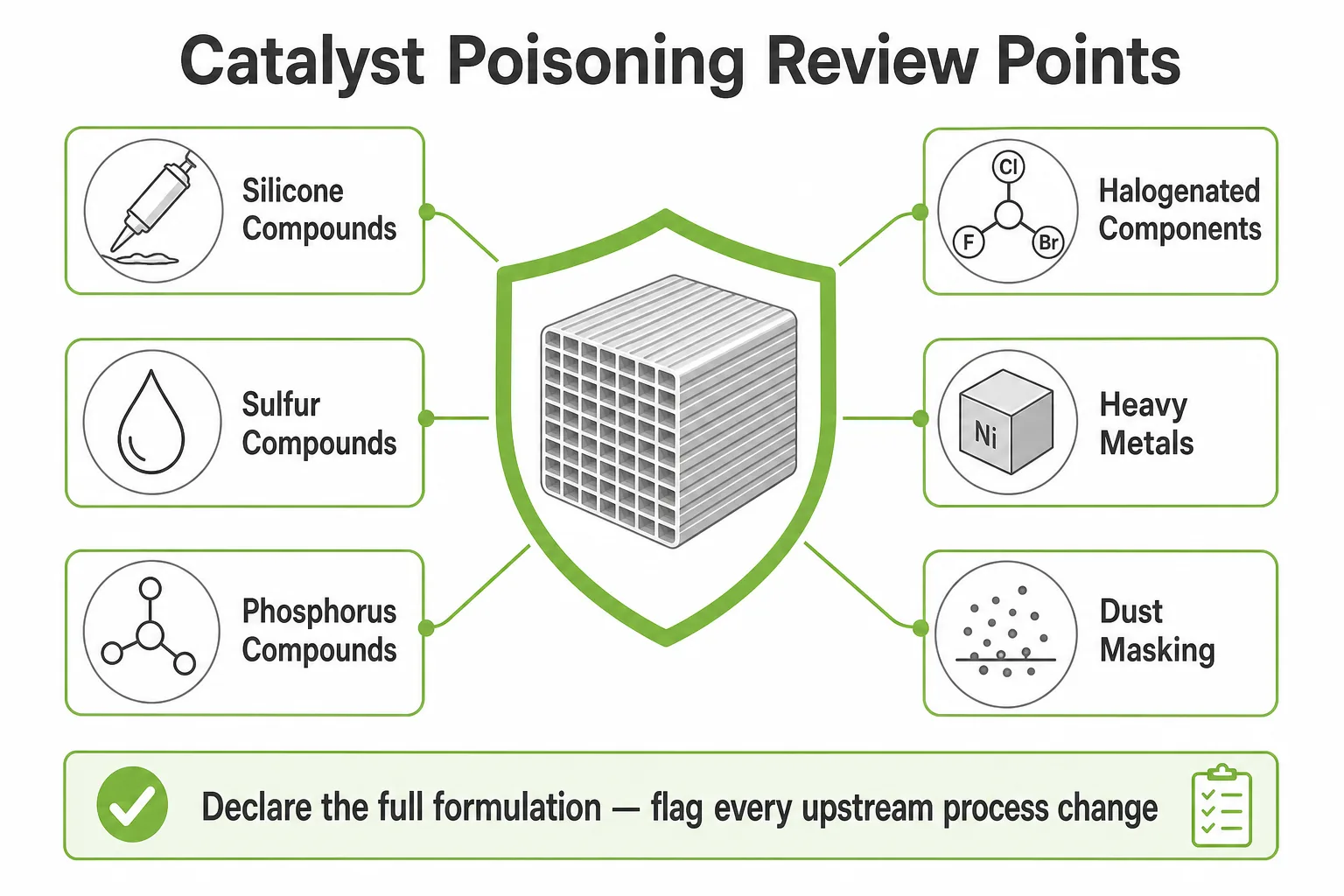
Silicone compounds, sulfur, phosphorus, halogens, heavy metals and dust masking are the declaration points every catalytic oxidizer review should cover.
- Silicone compounds: release agents, sealants, defoamers and silicone-containing coatings deposit silica on the catalyst — a frequent and often undeclared poison source.
- Sulfur and phosphorus compounds: present in some solvents, additives and lubricants; both degrade precious metal activity.
- Halogenated components: chlorinated and fluorinated compounds attack standard catalysts and change the reaction products.
- Heavy metals: traces from upstream processes permanently deactivate catalyst sites.
- Dust and aerosol masking: particles do not react with the catalyst — they simply cover it, which ends with the same lost performance.
The review habit that prevents most of this is simple: declare the full formulation environment, not just the main solvents, and flag every upstream process change — a new adhesive, a new mold release, a new additive package — as a catalyst exposure question before it reaches the oxidizer.
Running Cost Logic: Catalyst Replacement vs Fuel
The running cost comparison is a trade between two different spending patterns rather than a single number.
The catalytic route spends less on fuel every operating hour because of the lower temperature lift, but the catalyst is a consumable: its activity declines with exposure, and replacement is a planned cost event whose timing depends heavily on how clean the exhaust actually stays. The thermal route spends more on fuel at low concentrations — the dilution economics covered in our thermal oxidizer cost factors article — but carries no catalyst line item, and at higher VOC loads the pollutants themselves supply most of the oxidation heat.
In review terms: the more confident you are in the solvent list staying clean and stable, the stronger the catalytic case; the more the composition drifts, the more the catalyst replacement risk erodes the fuel savings. Total cost follows concentration, running hours and composition risk together — not the equipment label.
Information AIER Needs for an Oxidizer Route Review
An oxidizer route review moves fastest when the inquiry describes the exhaust honestly — including the trace components that decide whether a catalyst can survive.
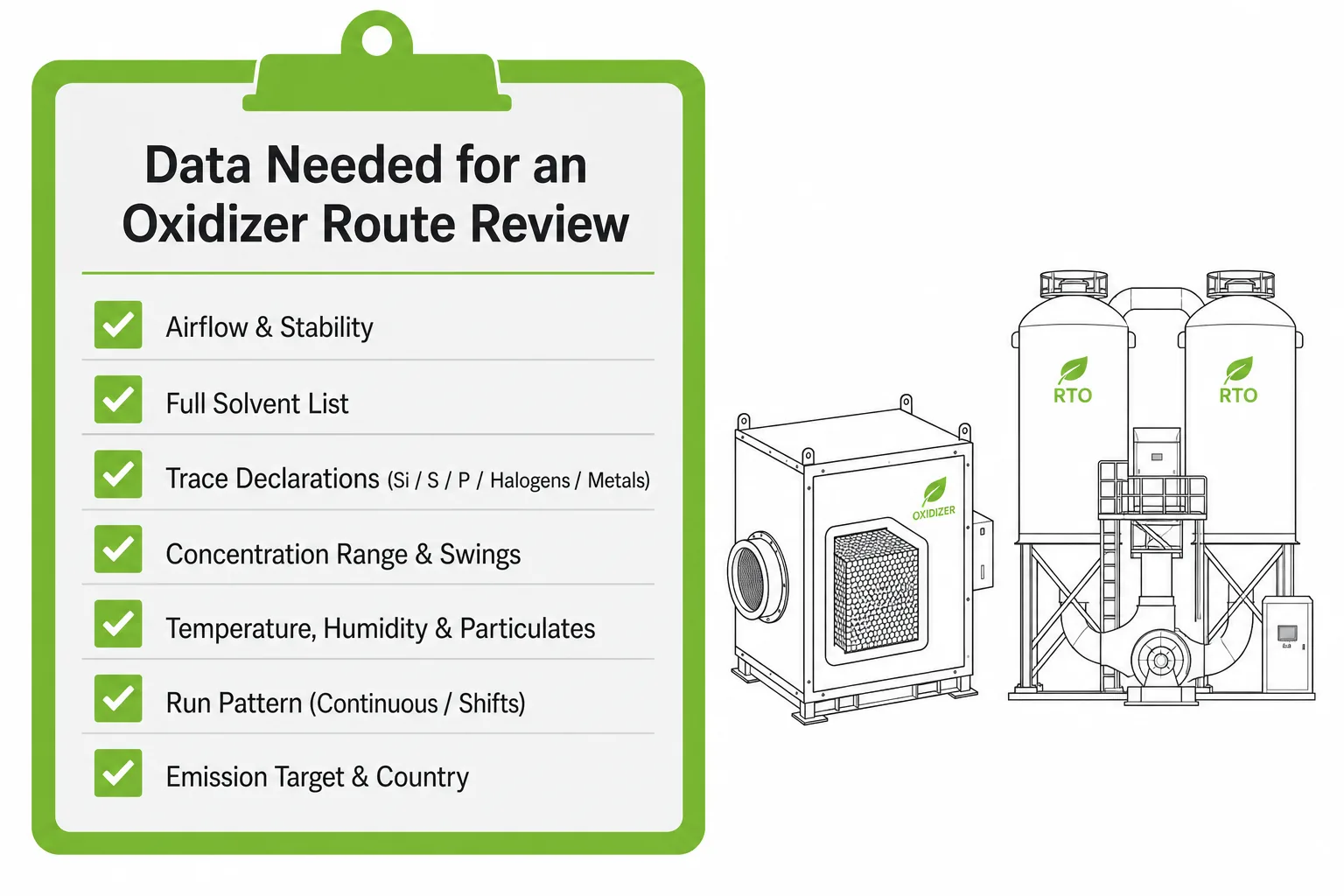
AIER reviews airflow, the full solvent list with trace declarations, concentration behavior, run pattern and the emission target before recommending an oxidation route.
| Data to Prepare | Why It Matters |
|---|---|
| Airflow and how stable it is | Sets equipment scale and turndown behavior |
| Full solvent list, not just main components | Decides destruction behavior for both routes |
| Trace declaration: silicone, sulfur, phosphorus, halogens, metals | Decides whether a catalyst is viable at all |
| Concentration range and swing pattern | Drives the fuel comparison and design point |
| Gas temperature, humidity and particulate load | Defines pre-treatment and heat balance |
| Run pattern (continuous, shifts, batch) | Multiplies or shrinks the fuel-saving argument |
| Emission target and installation country | Defines what the treated stream must achieve |
If you are comparing a catalytic oxidizer against an RTO for a VOC project, contact AIER with your airflow, full solvent list, trace declarations, concentration range and emission target. AIER will review both oxidation routes — and the adsorption or concentration alternatives where they fit better — against your actual exhaust data, with the reasoning shown.
FAQ
What is a catalytic oxidizer?
A catalytic oxidizer is a VOC treatment unit that oxidizes organic compounds into CO2 and water vapor on a precious metal catalyst bed. Because the catalyst lowers the energy needed to start the reaction, destruction happens at much lower temperatures than flame-based thermal oxidation, which reduces fuel demand on suitable exhaust streams.
How does a catalytic oxidizer work?
The exhaust is preheated, passes through a platinum or palladium catalyst bed where the VOCs oxidize, and the reaction heat is recovered to preheat the incoming stream. In a regenerative catalytic oxidizer, the catalyst works together with ceramic heat-storage media, combining low reaction temperature with high heat recovery.
What is the difference between a catalytic oxidizer and an RTO?
A catalytic oxidizer runs at low temperature using a catalyst, saving fuel but demanding a clean, stable exhaust because poisons and dust degrade the catalyst. An RTO oxidizes at high temperature without a catalyst, using ceramic beds for heat recovery, which makes it tolerant of mixed, changing and harder exhaust conditions. The choice follows the solvent list, concentration behavior and composition risk.
What can poison an oxidation catalyst?
The common poisons are silicone compounds, sulfur, phosphorus, halogenated components and heavy metals; dust and aerosols additionally mask the catalyst surface without reacting. Most poisoning problems trace back to undeclared trace components or upstream process changes, which is why a full formulation declaration belongs in every catalytic oxidizer review.
Does AIER supply catalytic oxidizer systems?
AIER’s exhaust gas catalog describes CO catalytic oxidation technology with precious metal catalysts alongside its RTO, scrubber and activated carbon lines. Project configuration is handled as a route review: AIER evaluates the exhaust data first and recommends the oxidation or adsorption arrangement that fits, rather than defaulting to one equipment type.
What information is needed for an oxidizer route review?
Provide the airflow and its stability, the full solvent list with trace declarations for silicone, sulfur, phosphorus, halogens and metals, the concentration range, gas temperature and humidity, particulate load, the run pattern, the emission target and the installation country. AIER reviews the catalytic and thermal routes on the same data before recommending a configuration.