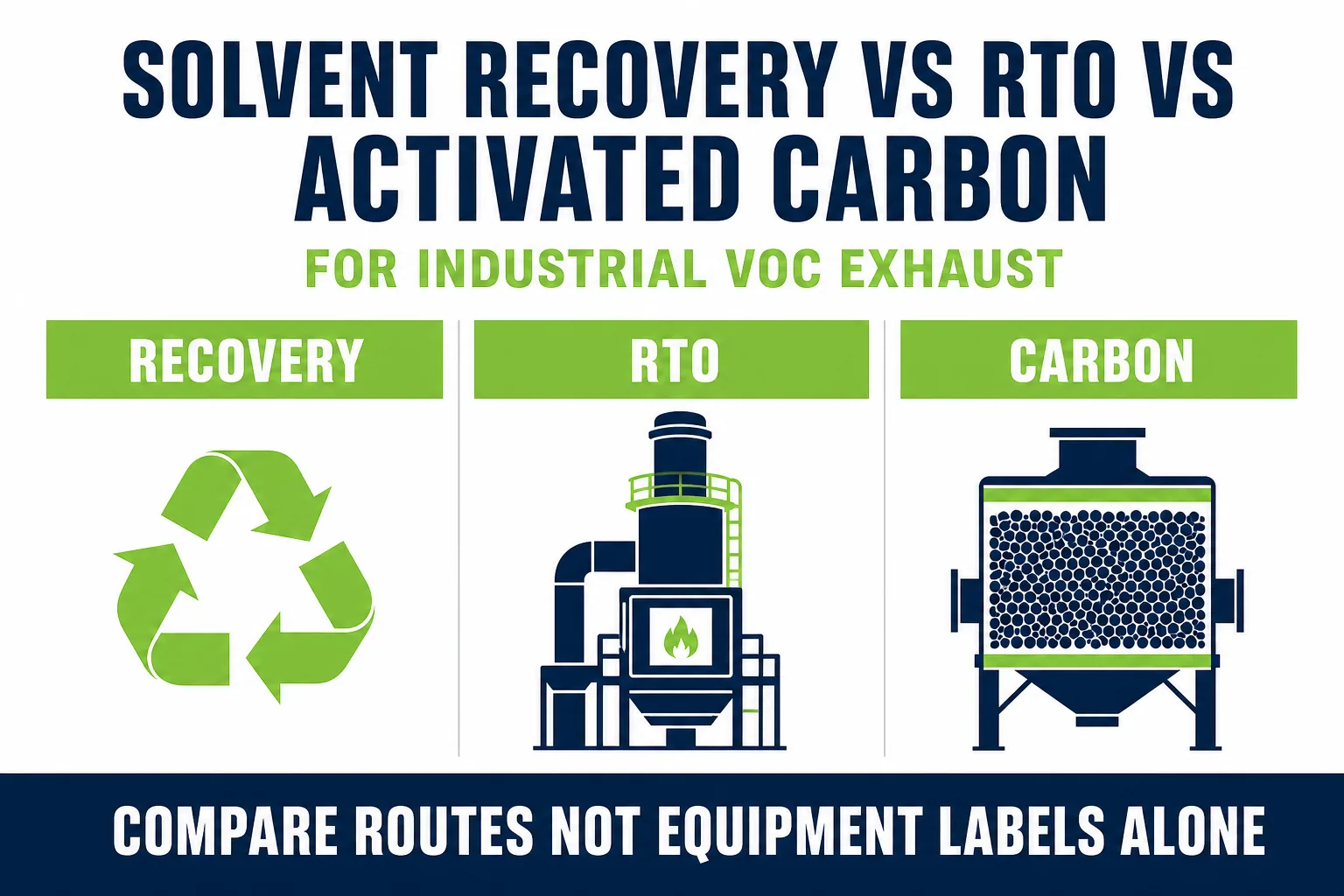
Project teams comparing solvent recovery system, RTO and activated carbon routes often receive equipment quotes without a clear explanation of when recovery, destruction or adsorption is the better fit. The labels sound interchangeable, but the operating logic, review data and long-term burden are different.
This article compares solvent recovery, thermal oxidation and activated carbon adsorption for industrial VOC and NMP exhaust. It is written for plant engineers, project buyers and EPC teams reviewing exhaust gas treatment systems. AIER supplies regenerative thermal oxidizer and activated carbon adsorption systems with published product scope, and its catalog also describes NMP recovery approaches and zeolite rotor concentration technology. AIER does not publish a standalone solvent recovery product page or fixed public recovery performance numbers. A broader map of the treatment families is in our air pollution control equipment overview. This article does not replace project quotation, local codes or site-specific engineering review.
What Is a Solvent Recovery System in Industrial Exhaust Treatment?
A solvent recovery system is an exhaust treatment route that captures and returns usable solvent from a process exhaust stream instead of destroying the VOC or discharging it as waste.
In coating, chemical, pharmaceutical and battery manufacturing, solvent recovery systems are reviewed when the solvent has reuse value and the exhaust conditions support solvent vapor recovery rather than only end-of-pipe destruction. This industrial route should not be confused with oil and gas vapor recovery unit systems used for tank venting or hydrocarbon loading operations. The review question here is whether a process solvent such as NMP or another coating solvent should be recovered, oxidized in an RTO, or adsorbed on activated carbon.
| Route | Main Function | Typical Review Question |
|---|---|---|
| Solvent recovery system | Return usable solvent to the process or storage | Is the solvent worth recovering under this concentration and run pattern? |
| RTO / thermal oxidation | Destroy VOCs through high-temperature oxidation | Is destruction required and is thermal oxidation the better operating route? |
| Activated carbon adsorption | Retain VOCs or odor on carbon media | Is the stream low enough in concentration for adsorption or polishing duty? |
Many projects also need voc abatement review across more than one stage, especially when concentration, operating hours or emission targets do not fit one technology alone.
When Does Solvent Recovery Fit Better Than Thermal Oxidation?
Solvent recovery usually leads the review when the solvent has reuse value, the exhaust stream is compatible with recovery equipment, and the plant wants to return solvent rather than consume it as fuel support for oxidation.
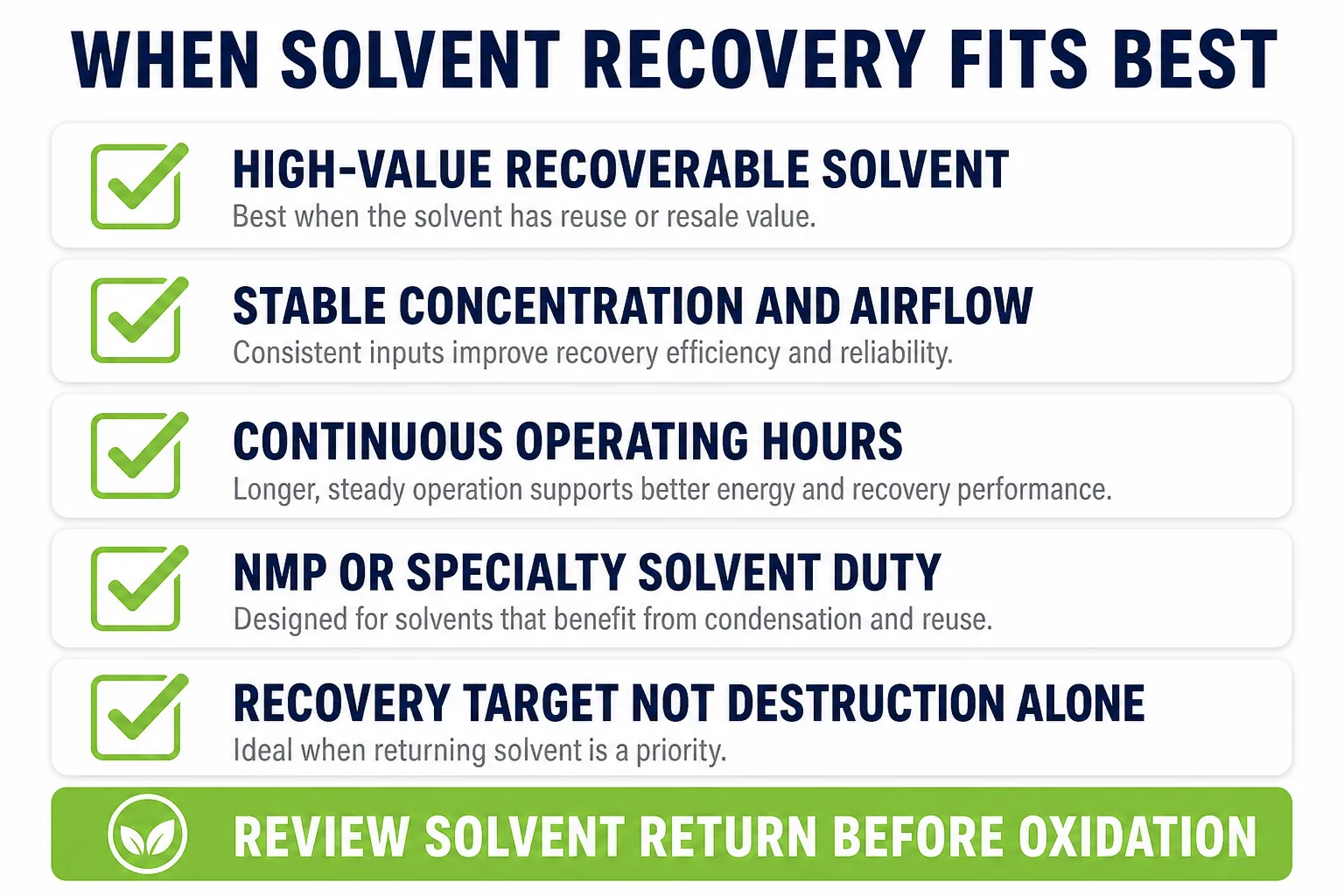
Solvent recovery is often reviewed when the solvent has reuse value and the exhaust conditions support recovery rather than only destruction.
| Review Factor | Why Recovery May Fit |
|---|---|
| High-value recoverable solvent | The process benefits from returning solvent instead of paying only to destroy it |
| Stable concentration and airflow | Recovery equipment sizing and operation depend on predictable loading |
| Continuous or long operating hours | Recovery routes are often reviewed on cumulative operating burden, not one peak event |
| NMP or specialty coating solvent duty | Battery coating and drying exhaust is a common recovery review case |
| Recovery target instead of destruction target | The buyer needs solvent return, not only VOC destruction |
When Does an RTO Fit Better Than Solvent Recovery?
An RTO usually leads the review when VOC destruction is the primary goal, the exhaust conditions are better suited to thermal oxidation, or recovery is not practical for the solvent and operating pattern involved.
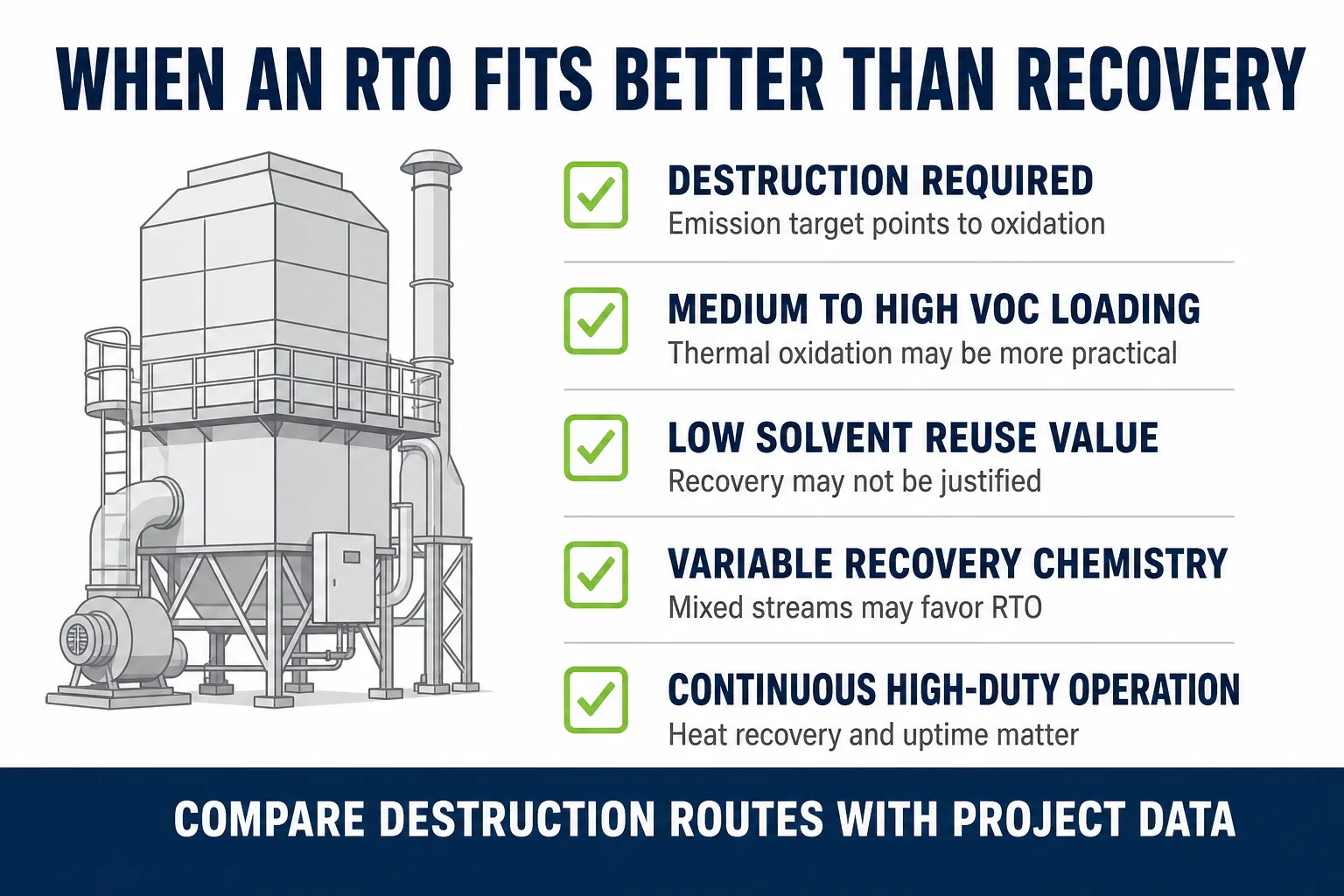
An RTO often fits when destruction is required and the exhaust supports thermal oxidation better than solvent return.
| Review Factor | Why an RTO May Fit |
|---|---|
| Destruction required | Emission or process requirements point to oxidation rather than solvent return |
| Medium to high VOC loading | Thermal oxidation may be more practical than recovery for some mixed streams |
| Low solvent reuse value | Recovery hardware may not be justified when solvent value is limited |
| Variable or difficult recovery chemistry | Mixed or unstable streams may favor a destruction route |
| Continuous high-duty operation | Heat recovery and long-run operating review matter; see thermal oxidizer cost factors and regenerative thermal oxidizer maintenance |
AIER publishes RTO product scope on its regenerative incineration technology page. Recovery and oxidation should be compared as routes, not as interchangeable labels on the same quote sheet.
When Does Activated Carbon Fit Instead of Recovery or an RTO?
Activated carbon usually leads the review when VOC concentration is relatively low, odor control or polishing duty is the main need, or carbon adsorption is the final stage after another treatment route.
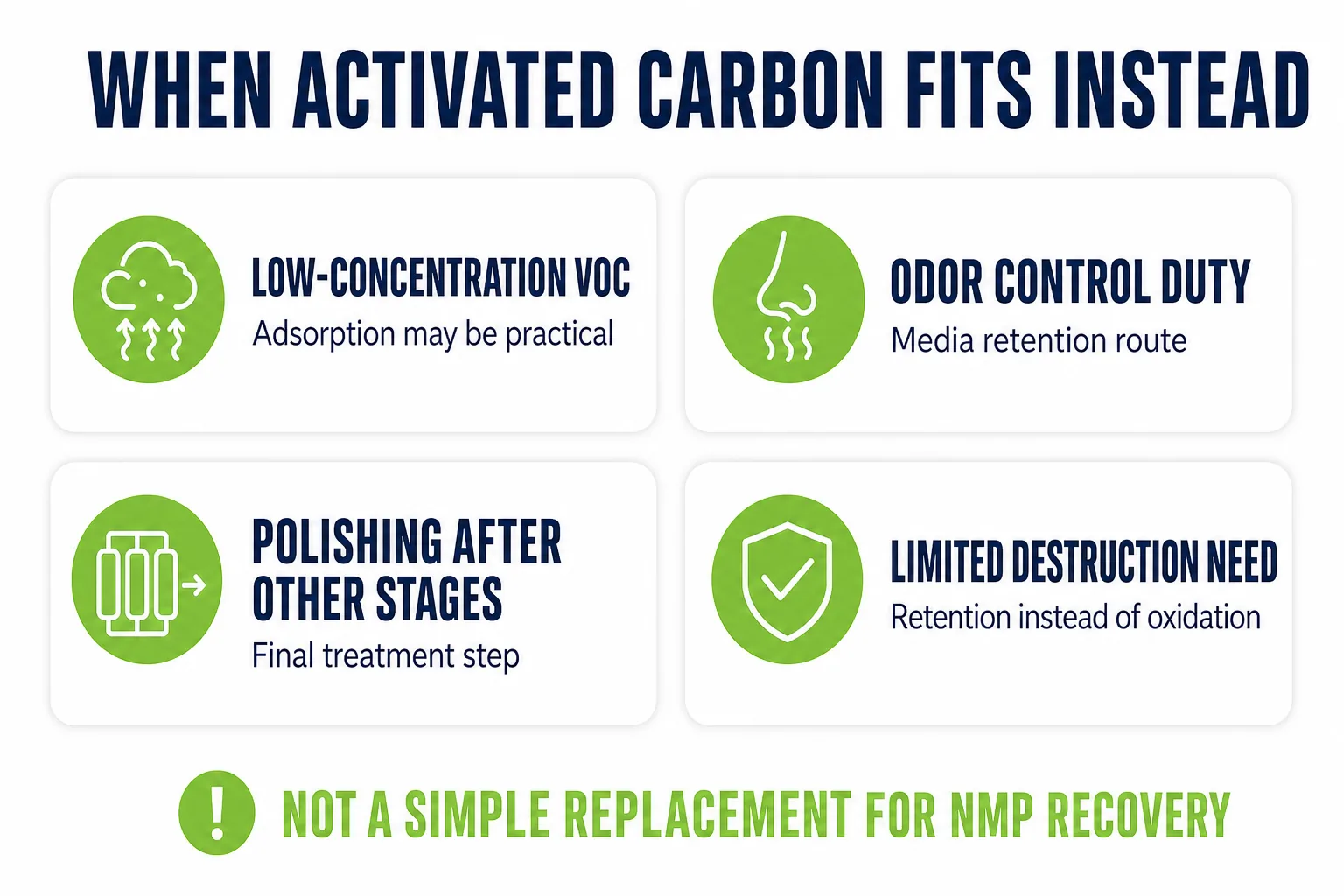
Activated carbon often fits low-concentration VOC, odor control or polishing duty rather than primary solvent recovery or high-duty oxidation.
- Low-concentration VOC or odor: adsorption may be more practical than building a full recovery or RTO route for every low-load stream.
- Polishing after another stage: carbon can serve as the final treatment step after concentration, recovery or oxidation.
- Limited destruction need: when the stream is better handled by media retention than by thermal oxidation.
- Bed design and replacement review: route selection should also consider capacity, breakthrough and changeout factors discussed in the article on activated carbon adsorption capacity and bed design.
Activated carbon is often the wrong primary route for high-value NMP recovery review, even though it remains useful for low-load or polishing applications.
NMP Recovery in Battery Coating and Drying Exhaust
An nmp recovery system review is one of the most common industrial solvent recovery reviews in lithium battery coating and drying exhaust, where N-methylpyrrolidone vapor leaves the process at elevated temperature and relatively consistent concentration during production.
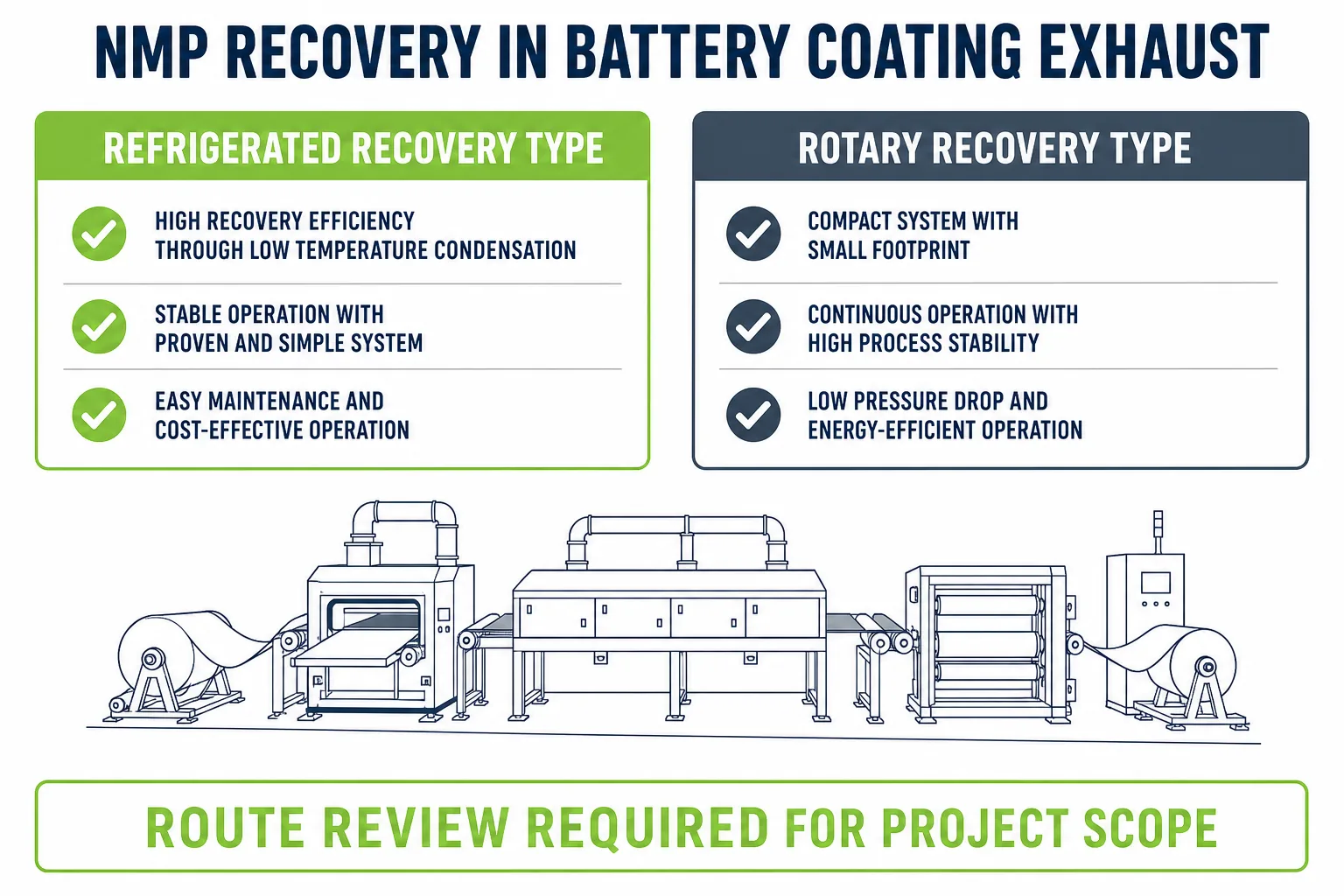
NMP recovery in battery coating and drying exhaust is commonly reviewed as a solvent recovery route rather than as a generic VOC destruction project alone.
AIER’s exhaust gas catalog describes NMP recycling approaches including refrigerated recovery type and rotary recovery type, mainly for lithium-ion battery manufacturing exhaust with recoverable NMP solvent. AIER does not currently publish a standalone NMP recovery product page or a public AR model table equivalent to its RTO or activated carbon product listings. That means buyers should treat NMP recovery as a route review topic supported by catalog capability, not as an off-the-shelf online quotation item.
For broader battery process context, review the lithium battery manufacturing solution page for electrode coating, NMP vapor and combined dust and exhaust control scope. For coating and painting exhaust outside battery lines, review VOC emission control application conditions as well.
Solvent Recovery vs RTO vs Activated Carbon Comparison
The three routes solve overlapping but not identical VOC problems. A side-by-side review is more useful than treating recovery, oxidation and adsorption as interchangeable exhaust treatment labels.
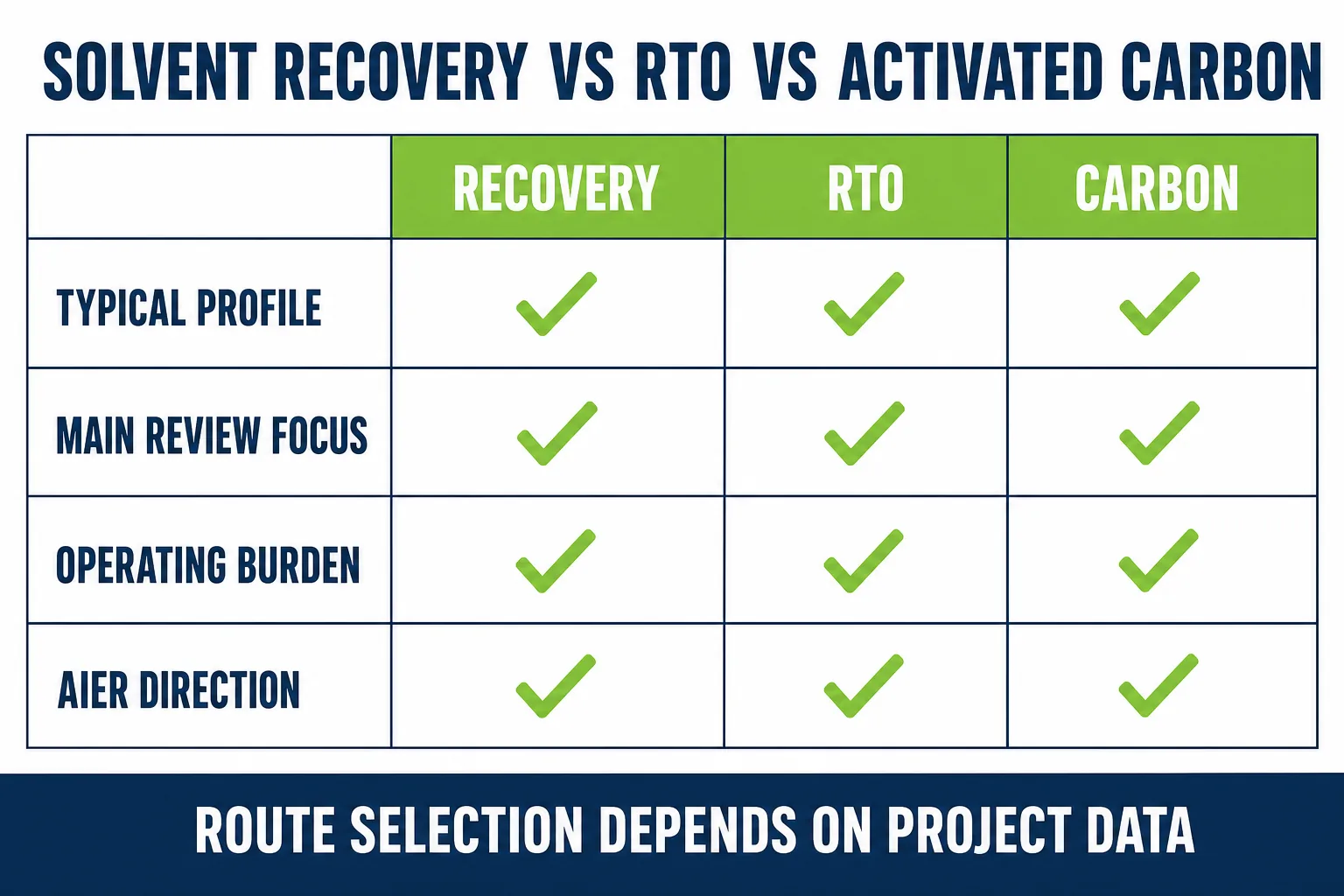
Route selection depends on solvent value, concentration, operating hours and the emission target—not on one default technology choice.
| Route | Typical Exhaust Profile | Main Review Focus | AIER Direction |
|---|---|---|---|
| Solvent recovery system | High-value recoverable solvent, stable NMP or solvent vapor | Recovery feasibility, concentration, operating pattern | Route review; NMP recovery described in catalog |
| RTO / thermal oxidation | Medium to high VOC, destruction required | Fuel, heat recovery, operating cost, uptime | Regenerative thermal oxidizer product page |
| Activated carbon adsorption | Low VOC, odor, polishing stage | Bed design, capacity, breakthrough, replacement | Activated carbon adsorption product page |
| Wet scrubber when gas chemistry differs | Acid, soluble or wet-compatible gas | Chemistry, packing, wastewater | Industrial wet scrubber; see wet scrubber vs dry scrubber |
Final route selection depends on solvent value, concentration, operating hours, emission target and confirmed project scope—not on one default technology choice.
Combined Routes: Concentration, Recovery and Polishing
Many industrial VOC projects use more than one stage because a single route does not fit the full airflow, concentration range and emission target at the same time.
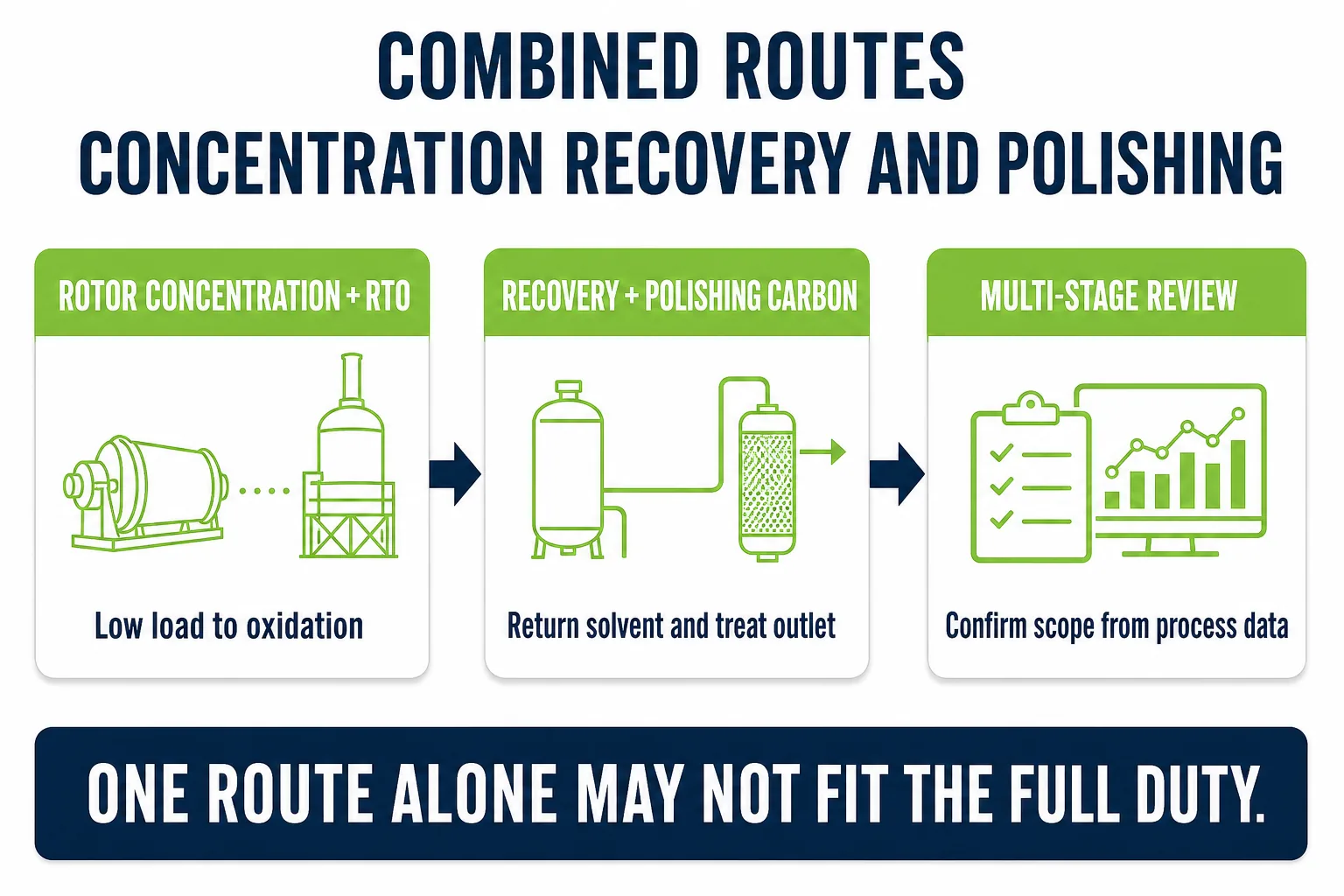
Concentration, recovery, oxidation and polishing stages are often combined when one route alone does not fit the full project duty.
| Combined Route | What It Does | When It Is Reviewed |
|---|---|---|
| Zeolite rotor concentration + RTO | Concentrates low-load exhaust before thermal oxidation | Large airflow with low VOC concentration that still requires destruction |
| Solvent recovery + polishing carbon | Recovers main solvent and treats remaining low-level exhaust | Recovery is primary but outlet polishing is still required |
| Recovery or RTO + downstream monitoring | Main treatment plus performance verification | Projects with strict emission or odor review points |
AIER’s catalog includes zeolite rotor concentration technology for concentrating large-volume, low-concentration exhaust before downstream treatment. Combined route scope should be confirmed during project review rather than assumed from one equipment name alone.
Common VOC Treatment Route Selection Mistakes
Common route selection mistakes usually come from comparing equipment labels instead of comparing solvent value, concentration behavior and operating duty.
- Choosing by equipment price alone: the lowest first cost may miss recovery value or long-run operating burden.
- Using activated carbon as a substitute for NMP recovery: carbon may polish low-load exhaust but does not replace a recovery route review for high-value NMP duty.
- Ignoring concentration variability: peak and average loading can change whether recovery, oxidation or adsorption is practical.
- Confusing industrial solvent recovery with oil and gas VRU systems: tank vent and hydrocarbon loading systems follow a different review logic.
- Assuming one published route fits every plant: coating, chemical, battery and food exhaust all need project-specific review data.
- Skipping combined-route review: concentration plus oxidation or recovery plus polishing may fit better than a single box solution.
Economics and Operating Review Points Without Fixed Numbers
Route economics should be reviewed qualitatively before any quotation comparison, especially when recovery value, energy use and media replacement all affect the long-term picture.
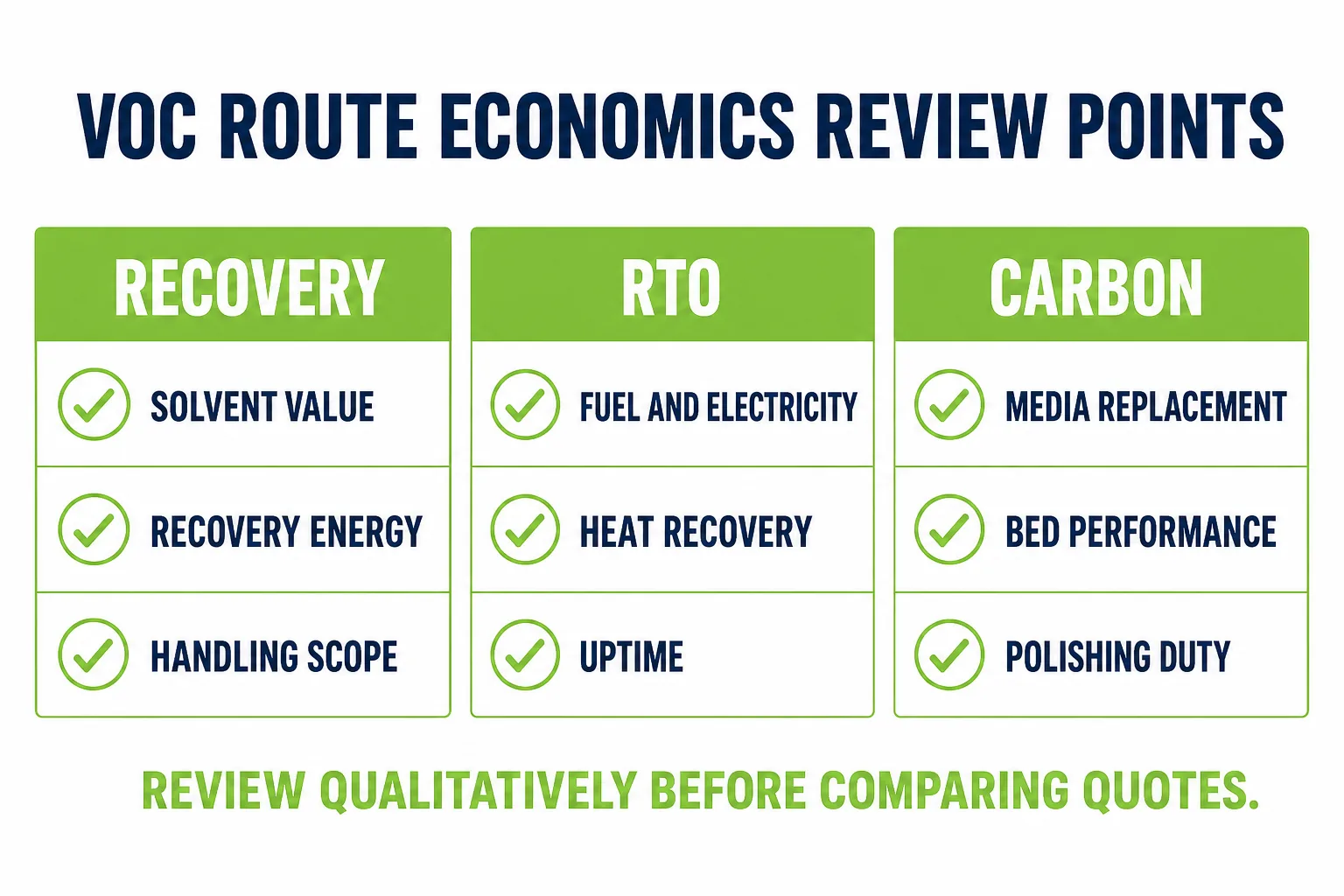
Recovery value, energy use, media replacement and operating hours all affect route economics and should be reviewed before comparing quotes.
| Review Area | Solvent Recovery | RTO | Activated Carbon |
|---|---|---|---|
| Primary operating burden | Recovery equipment energy, maintenance and solvent handling | Fuel, electricity and long-run heat recovery performance | Media replacement and bed performance over time |
| Project scope sensitivity | Strongly tied to solvent value and stream stability | Strongly tied to concentration, run hours and configuration | Strongly tied to loading, humidity and bed design |
| Useful cross-reference | Route review with NMP or solvent data | Thermal oxidizer cost factors | Activated carbon adsorption capacity and bed design |
This article does not publish recovery rates, payback periods or solvent price assumptions. Those values depend on project data and should be reviewed case by case.
Data Needed for a VOC or NMP Treatment Route Review
Before asking AIER to review a solvent recovery system, RTO or activated carbon route, collect process and project data instead of requesting a generic technology recommendation.
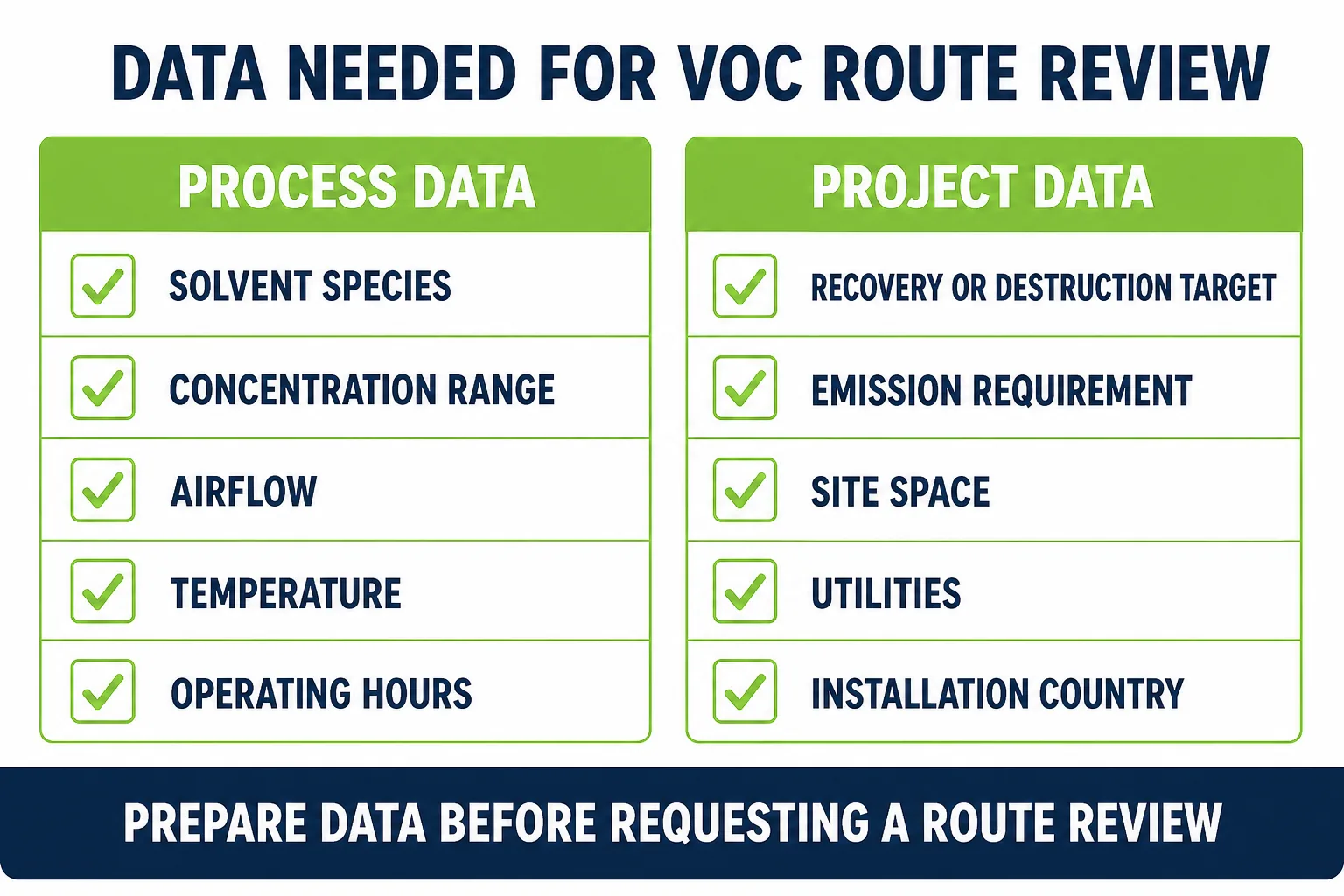
AIER reviews VOC and NMP treatment routes more accurately when solvent species, concentration range, airflow, temperature, operating hours and emission targets are provided.
| Data to Prepare | Why AIER Needs It |
|---|---|
| Solvent species and concentration range | Determines whether recovery, oxidation or adsorption is feasible |
| Treated airflow and temperature | Sets equipment class and operating range review |
| Operating hours and production pattern | Affects recovery, fuel and media replacement review |
| Recovery target vs destruction target | Clarifies whether solvent return or VOC destruction is primary |
| Emission or odor requirement | Confirms whether polishing or combined routes are needed |
| Site space and utility availability | Affects route layout and combined-system review |
| Installation country and project scope | Helps confirm what AIER can review and supply |
If you are comparing solvent recovery system, RTO and activated carbon routes for industrial VOC or NMP exhaust, contact AIER with solvent type, concentration range, airflow, temperature, operating hours and the target emission requirement. AIER can review whether recovery, oxidation, adsorption or a combined route fits the application and what data still needs clarification before quotation. This is a treatment route review invitation, not a published recovery performance guarantee.
FAQ
What is a solvent recovery system in industrial exhaust treatment?
A solvent recovery system captures and returns usable solvent from process exhaust instead of destroying the VOC or releasing it as waste. It is reviewed when the solvent has reuse value and the exhaust conditions support recovery rather than only end-of-pipe oxidation or adsorption.
When should a plant use solvent recovery instead of an RTO?
A plant should review solvent recovery instead of an RTO when solvent reuse is valuable, the stream is stable enough for recovery equipment, and the project target emphasizes solvent return rather than VOC destruction alone. Destruction-heavy or highly variable streams may still favor an RTO.
Can activated carbon replace solvent recovery for NMP exhaust?
Activated carbon can fit low-concentration adsorption or polishing duty, but it does not simply replace high-value NMP solvent recovery logic. For battery coating and drying exhaust, buyers should review recovery, oxidation and adsorption routes with project data rather than assuming one media route replaces recovery.
What is NMP recovery in lithium battery coating exhaust?
NMP recovery refers to recovering N-methylpyrrolidone solvent from coating and drying exhaust in battery manufacturing. AIER’s catalog describes refrigerated and rotary recovery approaches for this application, but specific project scope and equipment configuration require a data-based route review rather than one generic online recommendation.
Can solvent recovery, concentration and RTO be used together?
Yes. Many projects combine concentration, recovery, oxidation or polishing stages when one route alone does not fit the full airflow, concentration range and emission target. Combined scope should be reviewed from process data and confirmed project requirements.
What data is needed for a VOC or NMP treatment route review?
Prepare solvent species, concentration range, airflow, temperature, operating hours, recovery or destruction target, emission requirement, site space and installation country. These details help AIER review whether recovery, an RTO, activated carbon or a combined route fits the exhaust condition.