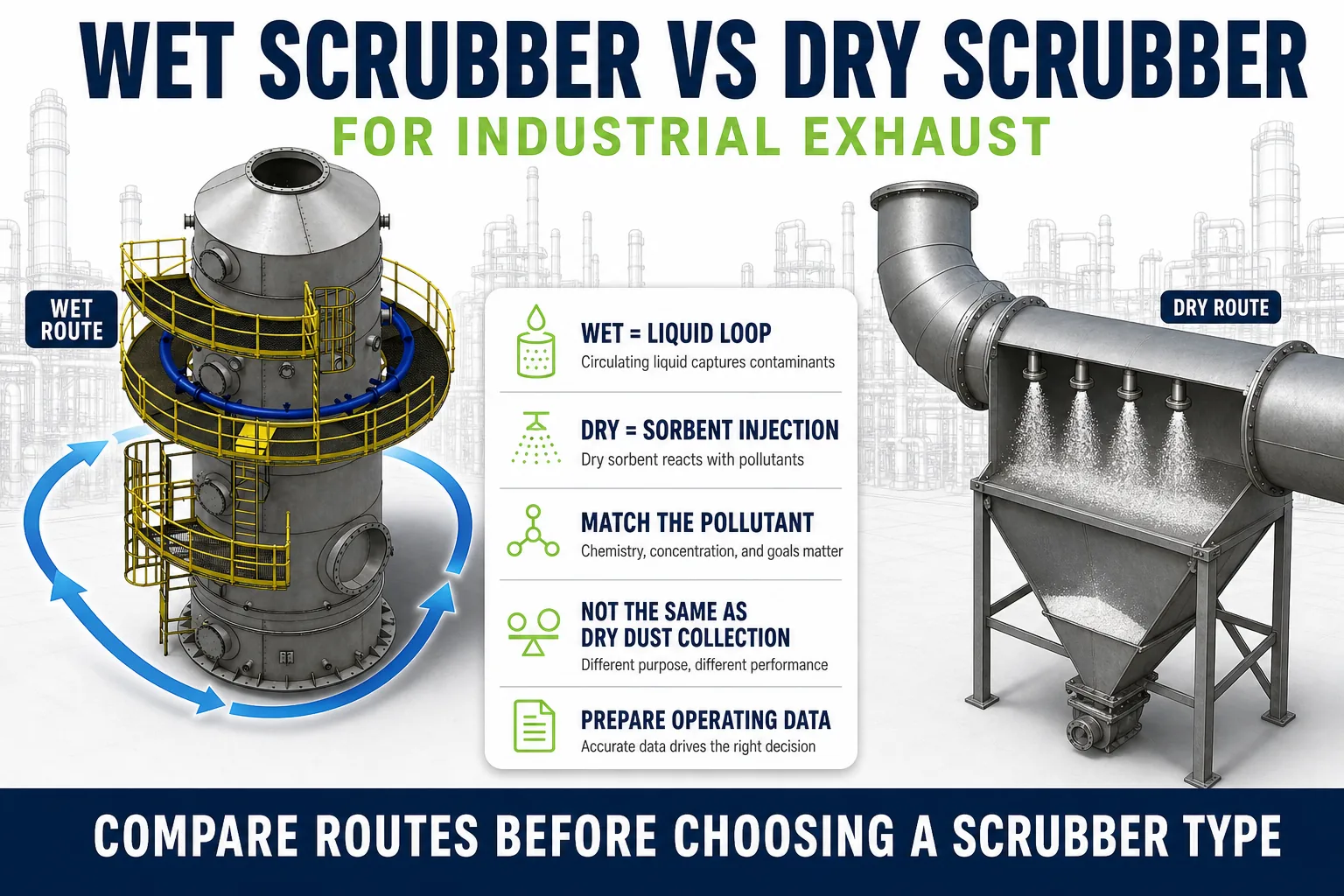
Industrial buyers often receive quotes for both wet and dry scrubbing routes without a clear explanation of what each one actually does. The labels sound simple, but the equipment, operating burden and target pollutants are different.
This article compares wet scrubber and dry scrubber routes for industrial exhaust, explains how each works, when each fits, and how dry scrubbing differs from dry dust collection. It is written for plant engineers and project buyers reviewing exhaust gas treatment systems. AIER supplies industrial wet scrubber towers with packed-bed and spray contact plus water washing and chemical washing routes, but does not manufacture dry scrubber systems based on sorbent injection. A broader map of all the treatment routes is in our air pollution control equipment overview. This article does not replace process design or local emission requirements for a specific project.
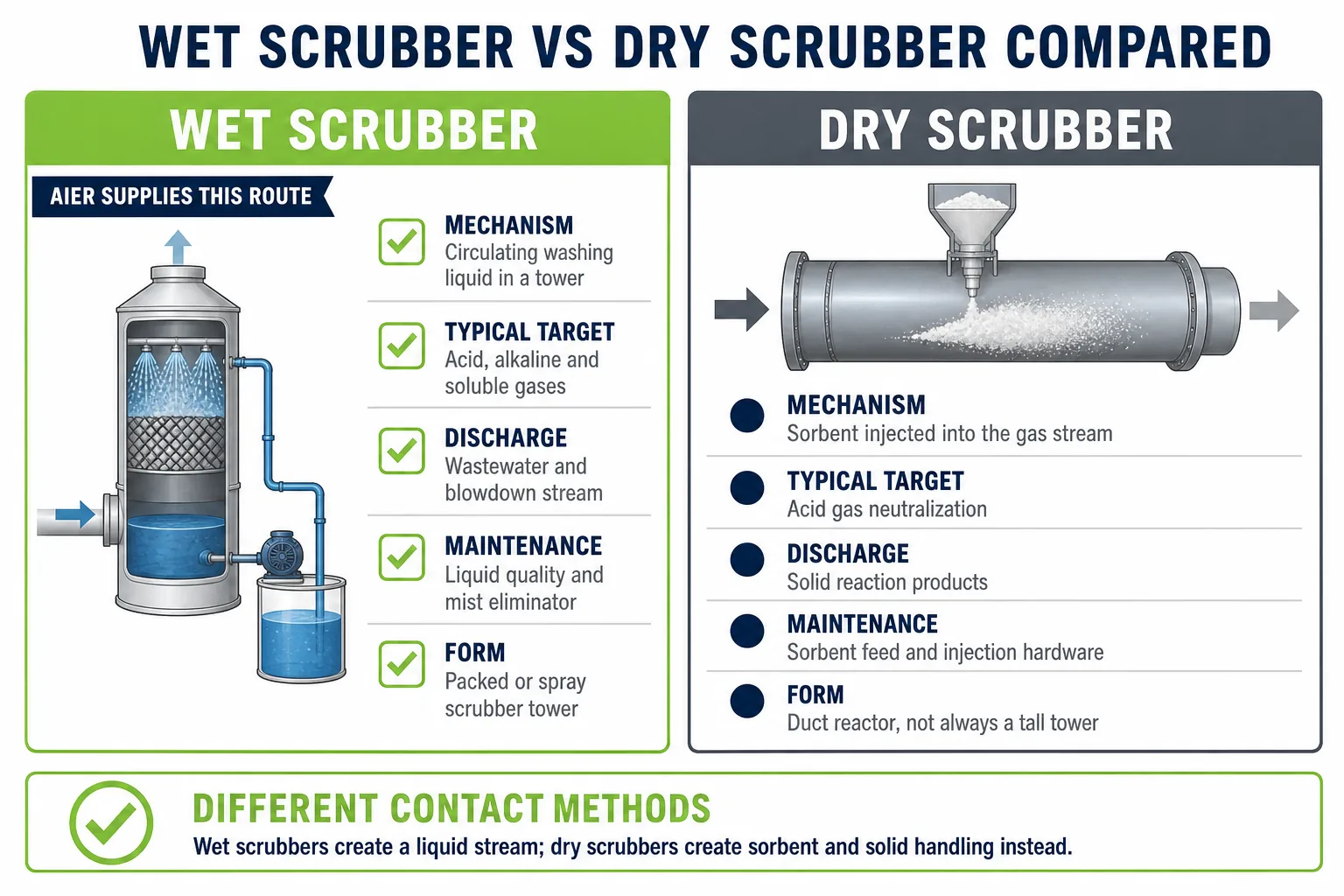
Wet scrubbers use a circulating washing liquid in a tower; dry scrubbers inject sorbent into the gas stream and produce solid reaction products instead of a liquid loop.
What Is a Wet Scrubber?
A wet scrubber is an exhaust gas treatment device that brings the gas into contact with a washing liquid, usually in a tower where the liquid is circulated, refreshed and discharged as the chemistry is consumed.
Wet scrubbing routes include water washing for water-soluble components and chemical washing for acid or alkaline gases. Contact can happen in a packed bed, through spray sections, or in a combination of both. AIER wet scrubber towers use packed-bed and spray gas-liquid contact in FRP, PP or stainless steel shells, with washing routes selected according to the gas composition.
What Is a Dry Scrubber?
A dry scrubber is an exhaust gas treatment device that injects a dry or semi-dry sorbent into the gas stream so acid gases react with the sorbent and form solid reaction products, without a circulating washing liquid loop in a tower.
Common sorbents include lime and sodium bicarbonate, introduced through sorbent injection systems in the duct or reactor section. The gas does not pass through a packed tower with liquid recirculation the way a wet scrubber does. Instead, the plant handles sorbent supply and solid by-product disposal or collection.
Dry scrubbers and dry gas scrubber are names used for this sorbent-based route. They target acid gas neutralization rather than general dust capture with filter media, which is a separate equipment family discussed later in this article.
Semi-Dry Scrubbing and Other Labels
Some projects use semi-dry scrubber or semi-dry scrubbing labels. In practice this usually means the sorbent is introduced as a slurry or fine spray so the reaction happens in a relatively dry product form, sitting between classic wet tower scrubbing and fully dry sorbent injection.
Equipment names vary by vendor and region, but the review question is the same: does the route rely mainly on a liquid circulation loop, mainly on sorbent injection, or on a hybrid semi-dry contact step? Once that is clear, wet scrubber vs dry scrubber comparison becomes much easier.
Wet Scrubber vs Dry Scrubber Compared
The two routes solve overlapping but not identical problems. A side-by-side review is more useful than treating them as interchangeable scrubber types.
| Review Point | Wet Scrubber | Dry Scrubber |
|---|---|---|
| Main mechanism | Gas contacts a circulating washing liquid in a tower | Dry or semi-dry sorbent is injected into the gas stream |
| Typical target | Acid gases, alkaline gases, soluble components, odor in wet duty | Acid gas neutralization with sorbent reaction products |
| Liquid handling | Continuous washing liquid and a wastewater stream | No liquid circulation tower; sorbent and solid by-products instead |
| Operating burden | Liquid quality, circulation, blowdown and mist carryover | Sorbent consumption, injection hardware and solid handling |
| Typical tower form | Vertical packed or spray scrubber | Duct reactor or compact injection section, not always a tall tower |
| AIER supply | Yes, through AIER wet scrubber towers | No, AIER does not manufacture dry sorbent injection scrubbers |
According to EPA guidance on wet and dry scrubbers, both belong to the broader scrubber family but use different contact methods and create different operating streams. That difference drives route selection more than the label on the quote sheet.
When a Wet Scrubber Is the Better Choice
Wet scrubbers usually lead the review when the main problem is gas absorption in a liquid rather than avoidance of any liquid circuit altogether.
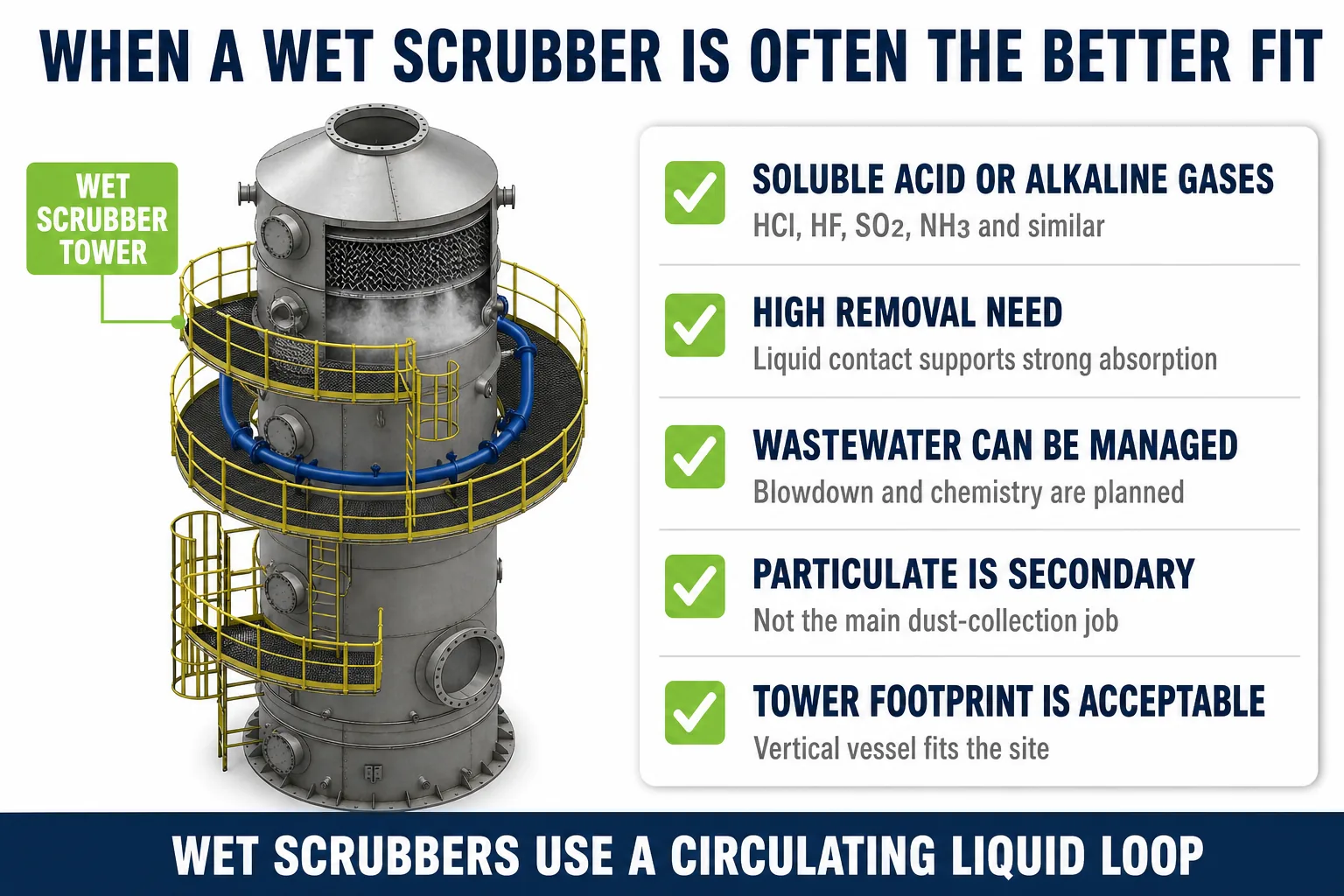
Wet scrubbers fit acid and alkaline gas absorption, soluble components and projects that can handle a washing liquid circuit.
- Acid or alkaline gas absorption: hydrogen sulfide, ammonia and similar gases are commonly reviewed on a wet chemical washing route, such as the H2S scrubber application.
- Stable liquid circulation: the plant can support pumps, liquid quality control and wastewater handling.
- Packed or spray tower duty: the pollutant is absorbed on a wetted surface or spray contact section, as explained in the packed bed scrubber article.
- Combined water-soluble and reactive components: water washing and chemical washing can be staged in one wet system when the gas composition requires it.
If the emission target depends on gas-liquid absorption rather than sorbent injection, the review should start with a wet scrubber route and the washing chemistry that matches the gas.
When a Dry Scrubber Is the Better Choice
Dry scrubbers appear in projects where a liquid circulation tower is undesirable and acid gas neutralization with sorbent injection is acceptable.
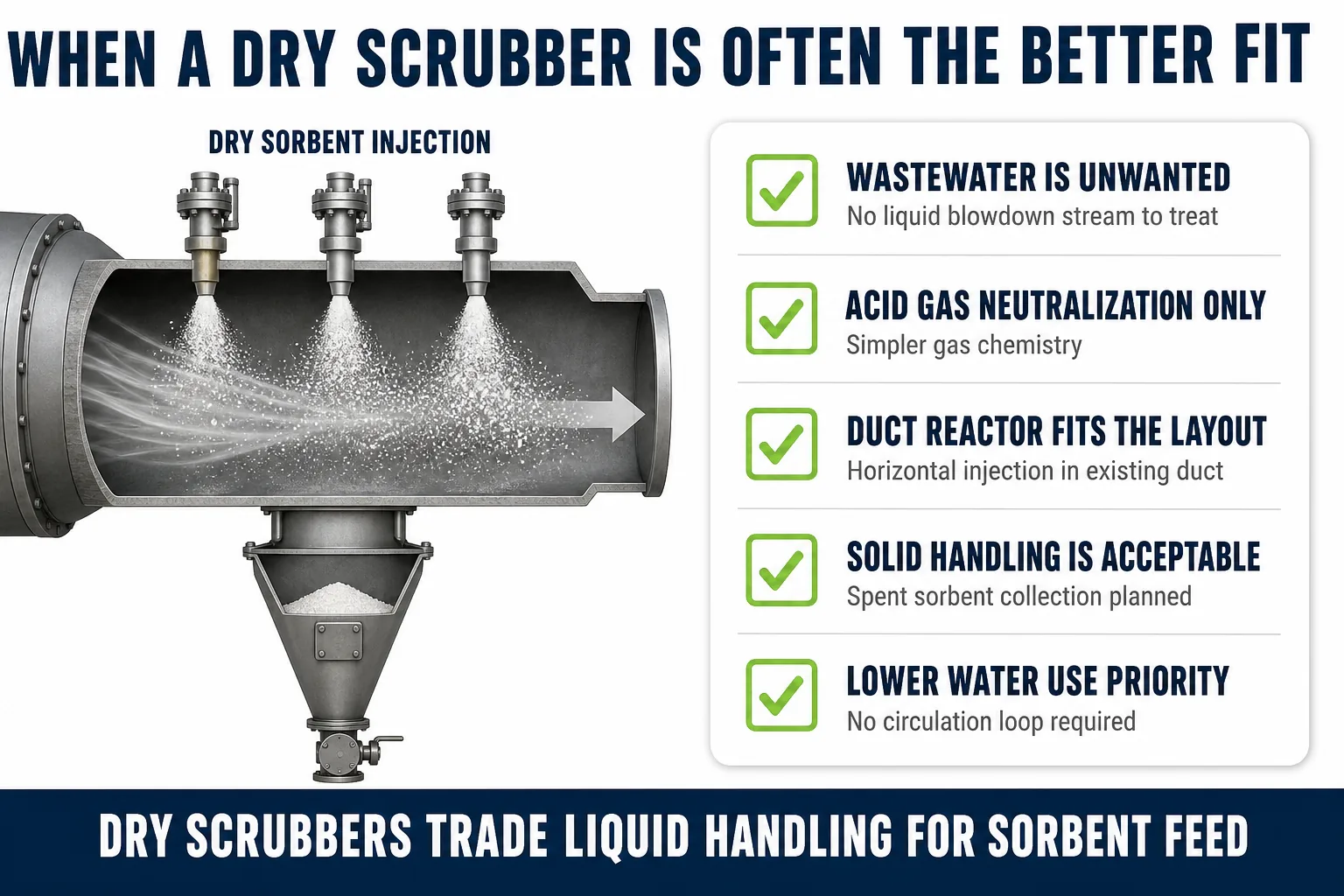
Dry scrubbers are often reviewed when the site wants to avoid a washing liquid loop and can handle sorbent supply and solid reaction products.
- Limited wastewater capability: the site cannot easily accept the liquid discharge from a wet tower.
- Compact duct-based layout: some projects prefer injection in the duct rather than a full wet tower footprint.
- Acid gas neutralization with sorbent: certain acid gas loads are reviewed on lime or sodium bicarbonate injection routes.
- Semi-dry hybrid preference: some owners choose a semi-dry scrubber route when they want less liquid inventory than a full wet tower.
These are review directions, not automatic rules. AIER does not supply dry scrubber systems, so when a project appears to need sorbent injection rather than a wet tower, the buyer should compare vendor options separately and still review whether a wet route, dry dust collection, RTO or carbon polishing might fit better.
Dry Scrubber Is Not the Same as Dry Dust Collection
One of the most common selection mistakes is treating a dry scrubber quote as the same thing as a dry dust collector quote. They are not the same equipment family.
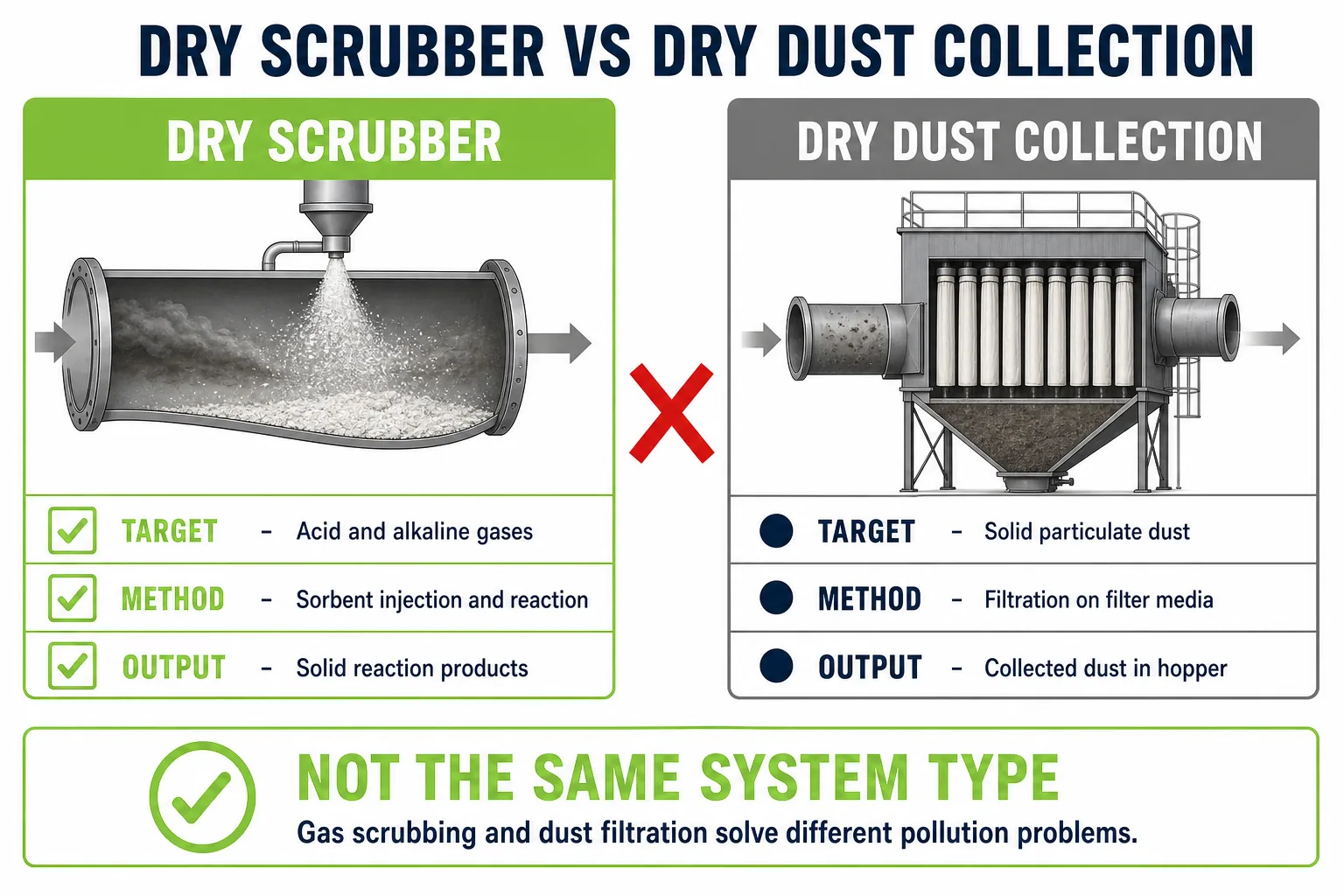
A dry scrubber neutralizes acid gases with sorbent injection; dry dust collection captures particulate matter with filter media.
| Term | What It Means | Typical Equipment |
|---|---|---|
| Dry scrubber | Acid gas treatment by sorbent injection | Duct reactor, sorbent feed system, solid by-product handling |
| Dry dust collection | Particulate capture with filter media | Cartridge collector, baghouse, sintered plate collector |
If the problem is dust rather than acid gas neutralization, the review usually moves to industrial dust collection or to wet particulate routes such as the venturi scrubber application, not to a dry scrubber label alone.
Other Routes When Neither Wet nor Dry Scrubbing Fits
Not every exhaust problem is solved by choosing between wet scrubber and dry scrubber. Some streams point to a different technology altogether.
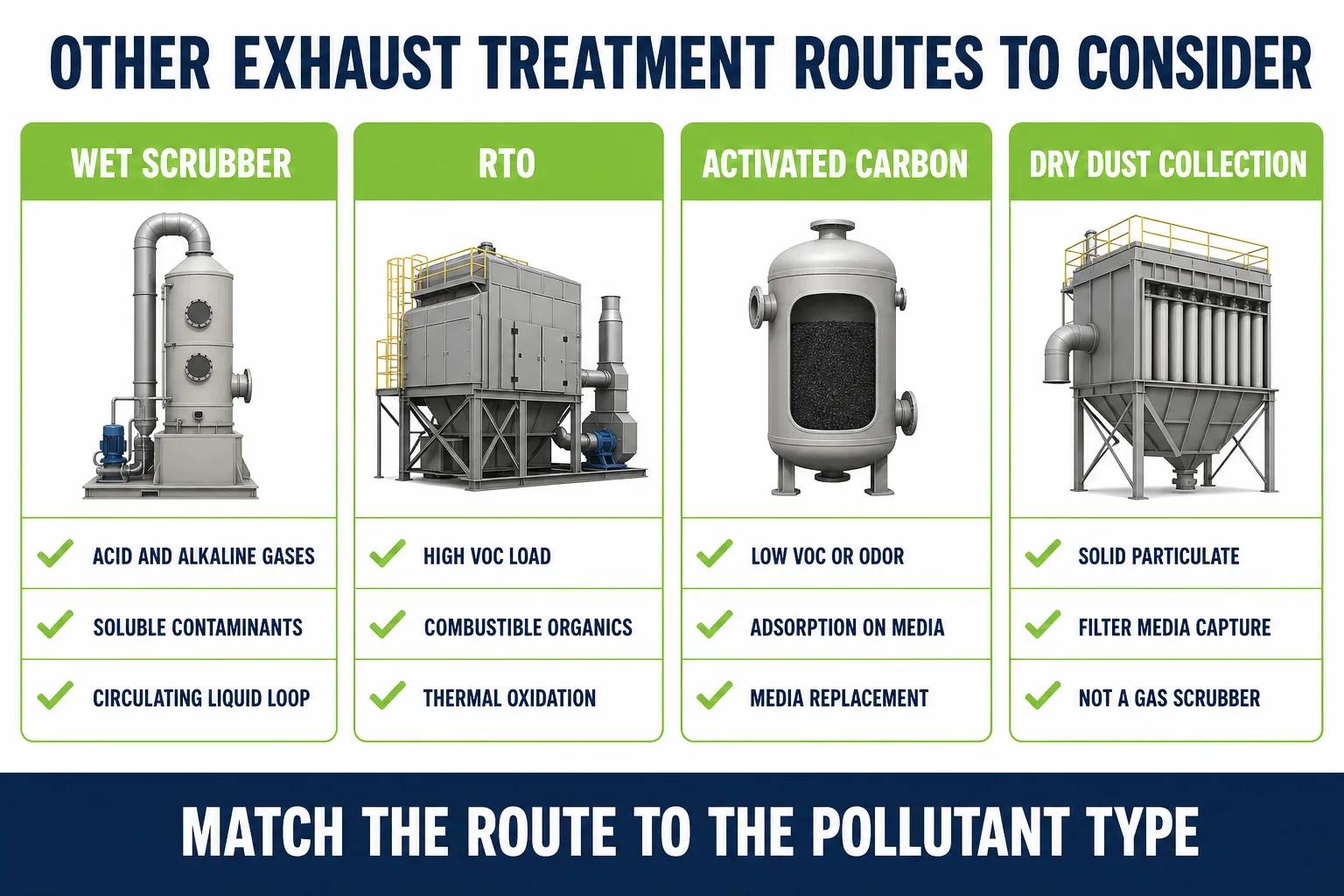
VOC-dominated streams often point to thermal oxidation or activated carbon, while dust-dominated streams may point to dry dust collection instead.
| Problem Pattern | Route Often Reviewed |
|---|---|
| VOC destruction at sufficient concentration | Regenerative thermal oxidizer |
| Low-concentration VOC or odor polishing | Activated carbon adsorption |
| High dust load with dry recoverable discharge | Industrial dust collection |
| High dust load where wet capture is acceptable | Wet particulate route such as a venturi scrubber design |
A wet versus dry scrubber comparison is most useful when the pollutants are mainly acid, alkaline or soluble gases. Once VOCs or dust dominate the stream, the review should widen beyond scrubber type alone.
Common Mistakes When Comparing Wet and Dry Scrubbers
Most route errors happen before any tower size is discussed. These are the patterns that most often send a project down the wrong path.
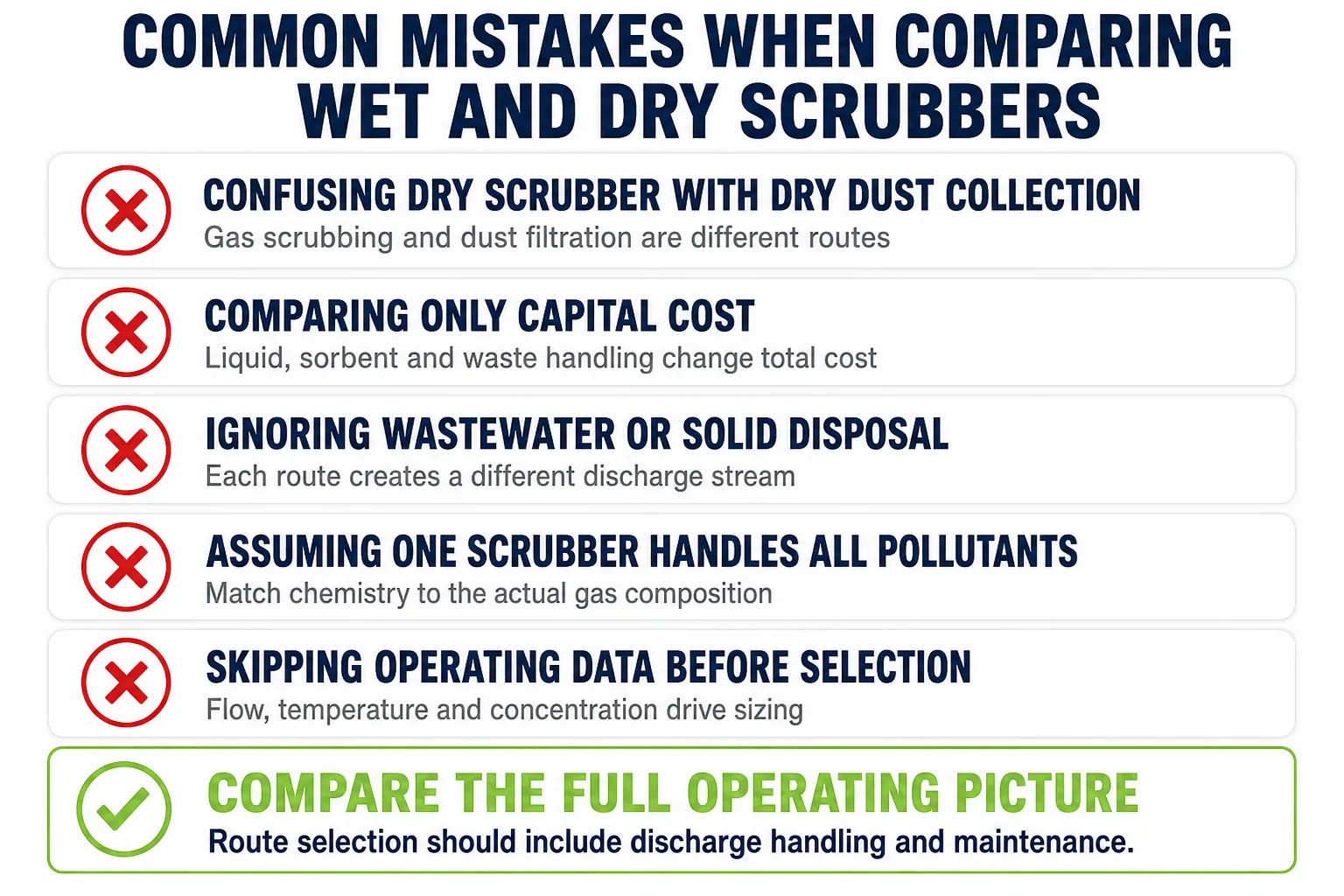
Common mistakes include treating dry scrubber and dry dust collection as the same thing and choosing a scrubber type before defining the pollutant.
- Choosing the label before the pollutant: wet vs dry should follow the gas and dust composition, not the other way around.
- Confusing dry scrubber with dry dust collection: sorbent injection and filter media capture are different duties.
- Ignoring wastewater or sorbent handling: wet routes need a liquid discharge plan; dry routes need sorbent and solid by-product handling.
- Using a scrubber route for VOC-dominated exhaust: thermal oxidation or adsorption may fit better than either wet or dry scrubbing.
- Assuming AIER supplies both routes: AIER wet scrubbers are available; dry sorbent injection systems are not part of the AIER line.
Information AIER Needs for a Scrubbing Route Review
An inquiry is most useful when it describes the exhaust condition and asks which route should be reviewed, rather than requesting a scrubber type by name alone.
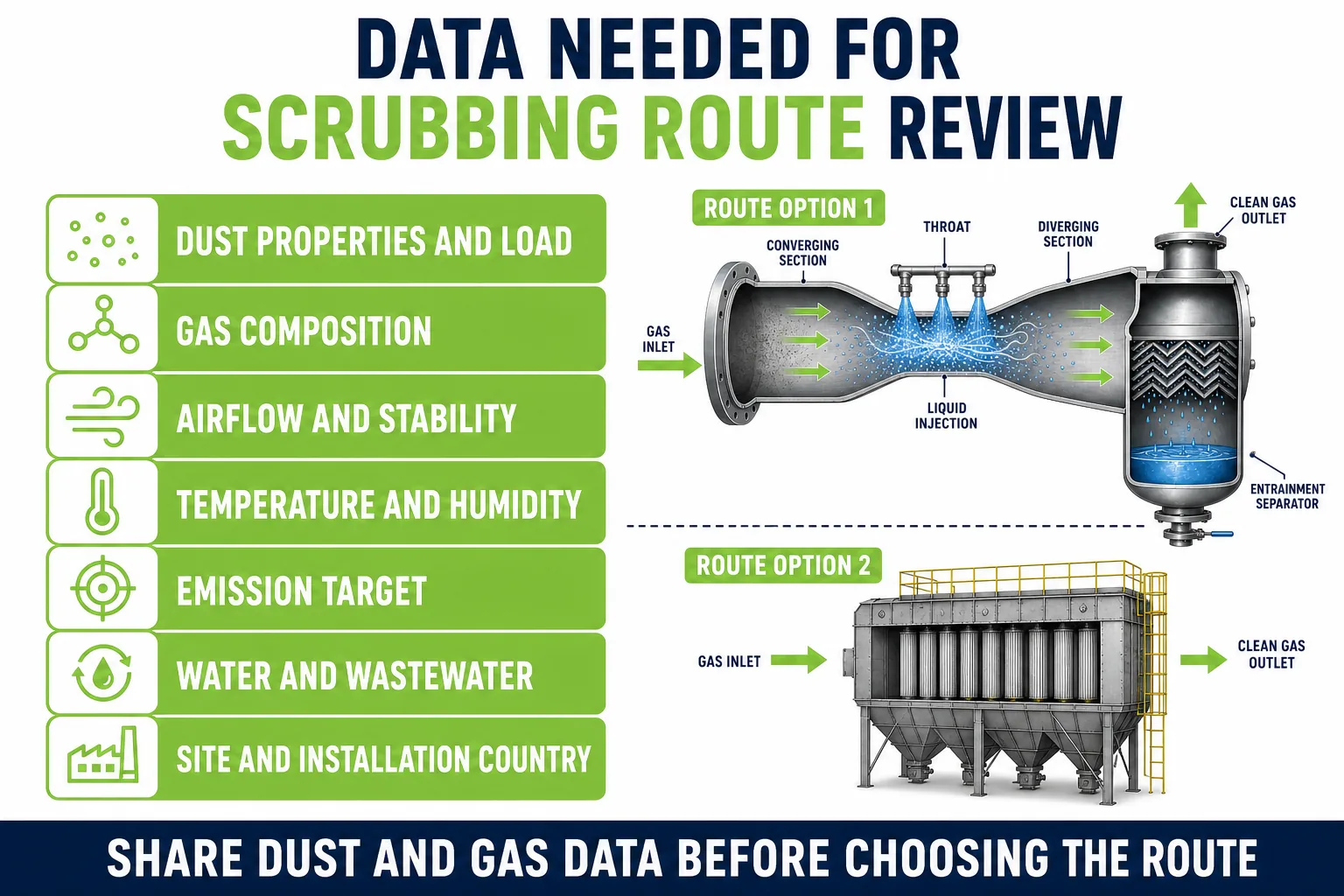
AIER reviews gas composition, dust load, airflow, temperature, humidity and the emission target before recommending a wet scrubber, dry dust collection, RTO or carbon route.
| Data to Prepare | Why It Matters |
|---|---|
| Gas composition and concentration range | Decides whether the duty is absorption, sorbent reaction, oxidation or adsorption |
| Dust properties and load | Shows whether the problem is gas scrubbing, dust collection or both |
| Airflow and stability | Decides equipment size and turndown behavior |
| Temperature and humidity | Affects washing chemistry, sorbent behavior and material selection |
| Water and wastewater capability | Confirms whether a wet scrubber route is practical on site |
| Emission or odor target | Defines what the treated gas must achieve |
| Site conditions and installation country | Affects layout, utilities and project requirements |
If you are comparing wet scrubber and dry scrubber options for an industrial exhaust line, contact AIER with your gas composition, dust load, airflow, temperature, humidity and emission target. AIER will review whether an AIER wet scrubber, dry dust collection, RTO, activated carbon or a combined route fits your operating condition.
FAQ
What is the difference between a wet scrubber and a dry scrubber?
A wet scrubber contacts the gas with a circulating washing liquid in a tower, while a dry scrubber injects a dry or semi-dry sorbent into the gas stream to neutralize acid gases and form solid reaction products. Wet scrubbers create a liquid discharge stream; dry scrubbers create sorbent consumption and solid handling instead.
What is a dry scrubber and how does it work?
A dry scrubber works by injecting sorbent such as lime or sodium bicarbonate into the exhaust gas, where acid gases react with the sorbent and form solids that are collected downstream. There is no liquid circulation loop in a tower as there is in a wet scrubber.
When is a wet scrubber the better choice?
A wet scrubber is usually the better choice when the main problem is acid or alkaline gas absorption, water-soluble components or odor control that needs a stable washing liquid circuit and the site can handle wastewater. AIER wet scrubber towers fit this type of duty.
When is a dry scrubber the better choice?
A dry scrubber is often reviewed when the site wants to avoid a washing liquid loop and can handle sorbent supply and solid reaction products for acid gas neutralization. It is a vendor-specific route and not part of the AIER product line.
Is a dry scrubber the same as dry dust collection?
No. A dry scrubber treats acid gases with sorbent injection, while dry dust collection captures particulate matter with filter media in equipment such as a cartridge or baghouse collector. The names both contain dry, but the duty and equipment are different.
What information is needed to choose between wet and dry scrubbing routes?
Provide gas composition, dust load, airflow, temperature, humidity, water or wastewater capability, the emission target and the installation country. AIER reviews whether a wet scrubber, dry dust collection, RTO, activated carbon or a combined route fits the exhaust condition.