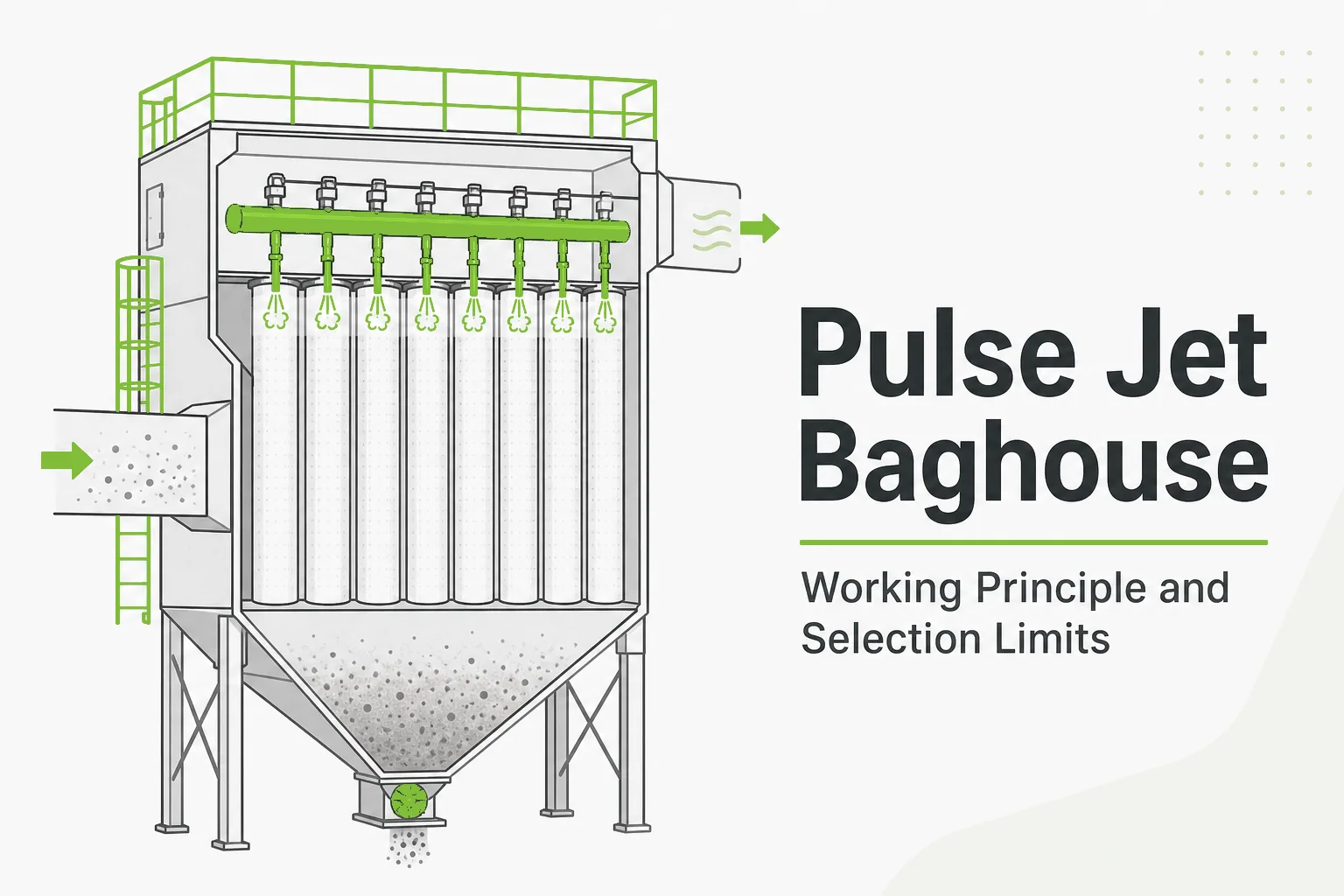
Most industrial fabric filter dust collectors sold today clean themselves with compressed air pulses. The design is compact, cleans without stopping the airflow and adapts to a wide range of dusts, which is why bag, flat bag and cartridge collectors all use the same cleaning idea. It is not automatic that a pulse jet design fits every project, though, and the cases where it struggles are usually visible in the dust data before the order is placed.
This article explains how a pulse jet baghouse works, the difference between online and offline cleaning, how pulse jet compares with reverse air and shaker designs, where the design fits best, what limits it, and what project data AIER needs to review a baghouse selection. It is written for plant engineers, project buyers and EPC teams planning industrial dust collection systems. It does not replace engineering design or local emission requirements for a specific project.
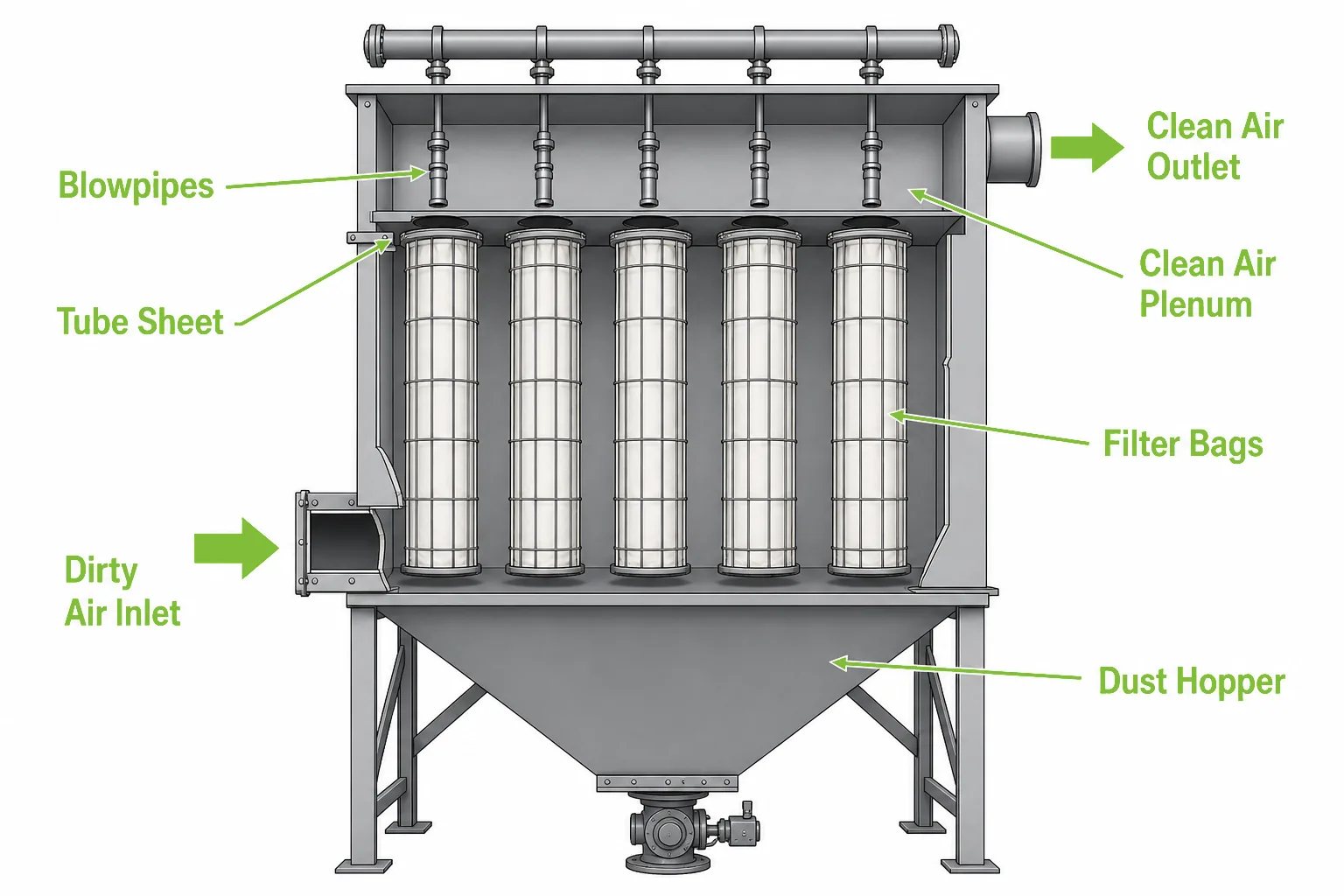
A pulse jet baghouse filters dusty air through fabric bags and cleans the bags with compressed air pulses fired from blowpipes above the bag openings.
What Is a Pulse Jet Baghouse?
A pulse jet baghouse is a fabric filter dust collector that cleans its filter bags with short bursts of compressed air, fired from blowpipes above the bags, so the dust cake falls into the hopper while the collector keeps running.
A baghouse itself is simply a dust collector that filters dusty air through fabric bags. The bags hang from a tube sheet that separates the dirty air side from the clean air plenum, and each bag is supported by an internal cage so it keeps its shape under suction. Dusty air flows from the outside of the bag to the inside; the dust stays on the outer surface as a cake, and the cleaned air leaves through the top.
What makes it a pulse jet design is the cleaning system: a compressed air header, pulse valves and blowpipes with nozzles positioned over each bag row. The same platform appears across the AIER dust collection range — the bag dust collector uses round bags, the flat bag dust collector uses flat bags with pulse jet cleaning, and cartridge dust collectors apply the same pulse principle to pleated cartridges.
How Pulse Jet Cleaning Works
A pulse jet dust collector alternates between two states that share the same housing: filtration and cleaning. Filtration is continuous; cleaning happens row by row in short bursts.
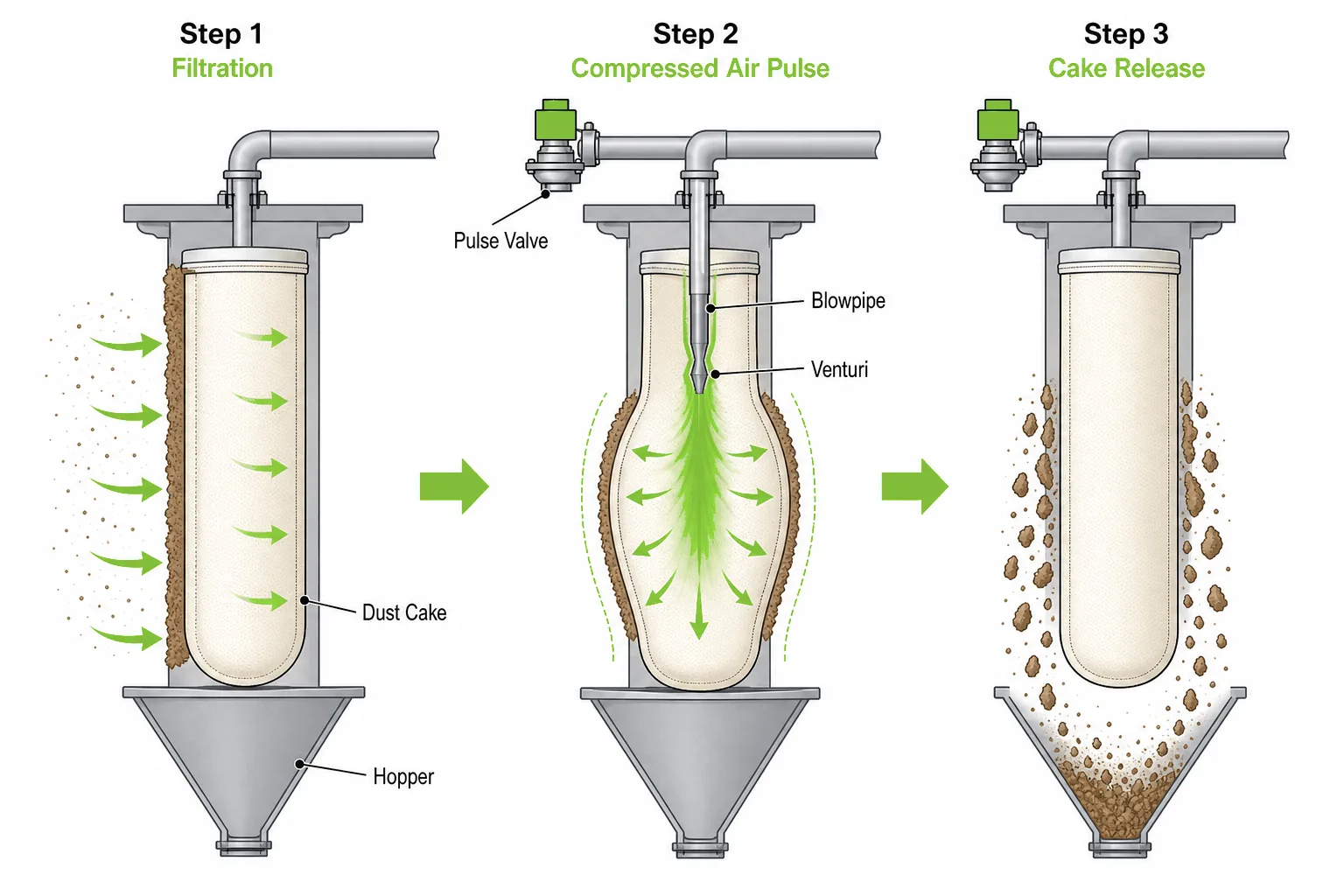
During a cleaning pulse, the valve fires compressed air through the blowpipe into the bag, the bag flexes outward and the dust cake breaks off into the hopper.
- Filtration: dusty air enters the housing, dust collects as a cake on the outside of the bags, and clean air passes through the fabric into the clean air plenum. The cake itself does part of the filtering work, which is why a lightly used bag often filters better after the first few days of operation.
- The pulse: a pulse valve opens for a fraction of a second and releases a burst of compressed air from the header through the blowpipe nozzle into the open top of the bag. Many designs use a venturi at the bag opening to pull in extra air and amplify the pulse.
- Cake release: the pulse briefly interrupts the airflow through that bag and flexes the fabric outward, breaking the dust cake off the surface so it falls toward the hopper below.
- Sequencing: a controller fires the rows in sequence, either on a fixed timer or triggered by the pressure drop across the bags, so only a small share of the bags is being cleaned at any moment.
- Dust discharge: released dust settles into the hopper and leaves through the discharge device; if it is left to pile up, the next pulse just re-entrains it back onto the bags.
The actual pulse pressure, pulse duration and cleaning interval are set during engineering and commissioning for the specific dust and filter media — they are operating decisions, not numbers to copy from an article.
Online vs Offline Cleaning
Pulse jet designs clean in one of two modes, and the difference matters for how the collector behaves at full load.
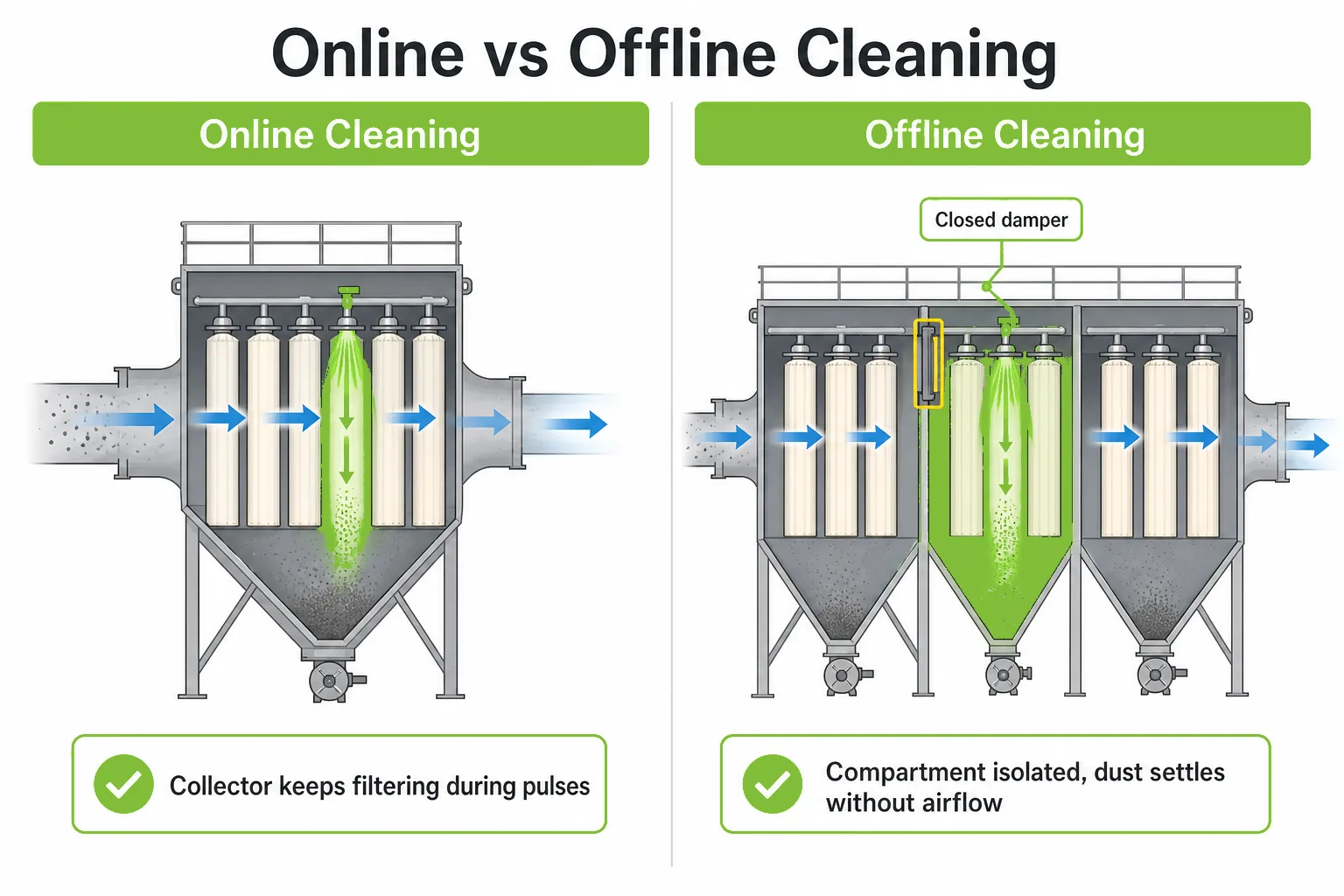
Online cleaning pulses bag rows while the collector keeps filtering; offline cleaning isolates a compartment first so the bags are cleaned without through-flow.
Online cleaning is the standard mode: the collector keeps filtering while individual rows are pulsed. It is simple and compact, and it works well for most dusts. Its weakness is that the released dust must fall against the rising airflow, so with very fine or light dust, part of the cake can be pulled straight back onto neighboring bags.
Offline cleaning divides the collector into compartments; a damper isolates one compartment at a time, the rows in that compartment are pulsed with no through-flow, and the compartment then returns to service. This gives the released dust a quiet window to settle, which helps with fine, light or high-load dusts, at the cost of extra dampers, controls and footprint.
Most single-unit industrial collectors use online cleaning; offline arrangements appear on larger multi-compartment systems or difficult dusts. Which mode a project needs is a review question that depends on the dust behavior, not a catalog default.
Pulse Jet vs Reverse Air vs Shaker Baghouse
Pulse jet is the youngest of the three classic fabric filter cleaning methods, and in most new industrial projects it is the default. The older methods still exist and still have their place, so a short comparison helps position the choice. The classification below follows the fabric filter categories described by the EPA.
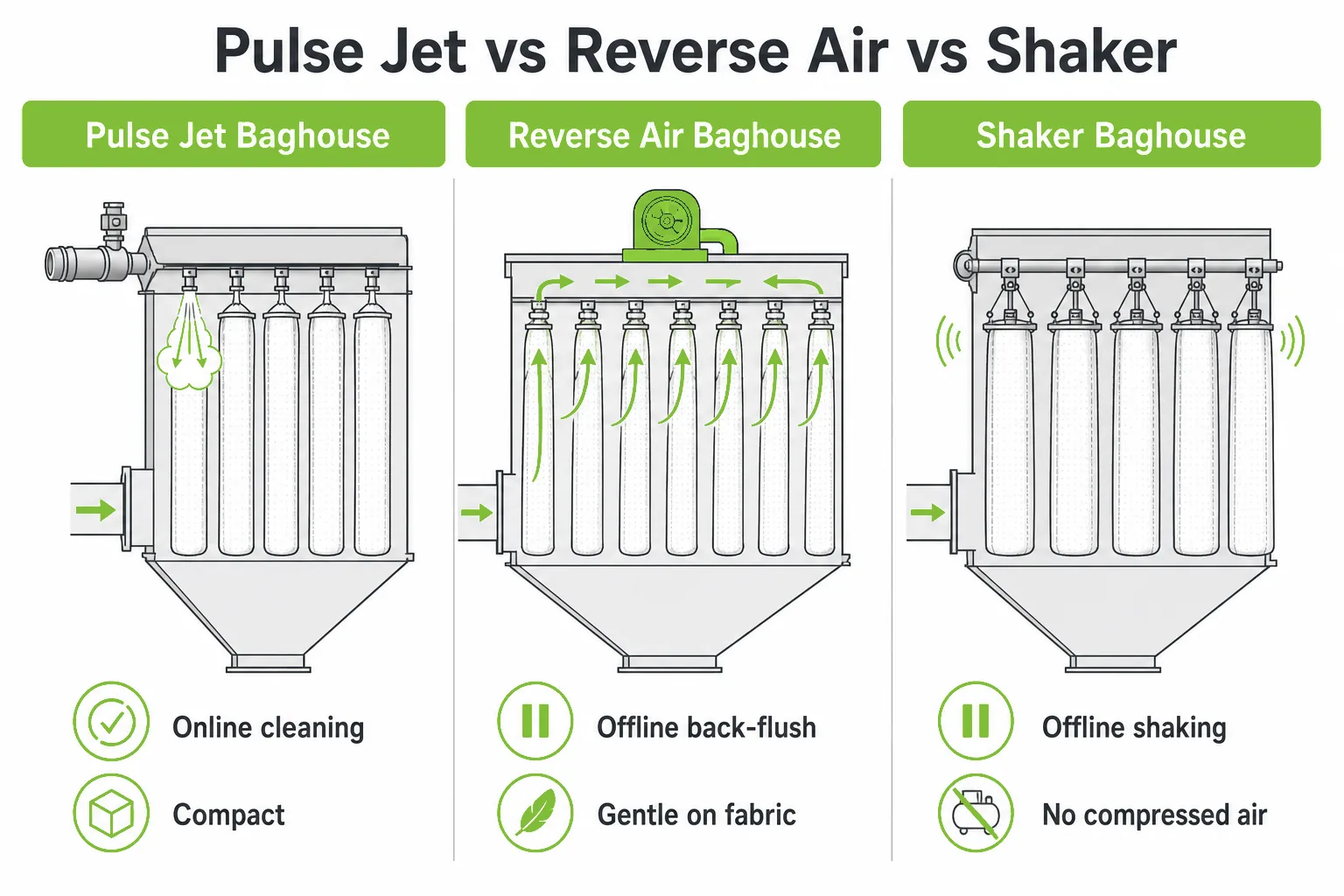
Pulse jet, reverse air and shaker designs clean the bags in different ways, which changes bag stress, footprint and where each design fits.
| Cleaning Design | How It Cleans | Where It Fits | Review Points |
|---|---|---|---|
| Pulse jet baghouse | Compressed air pulses fired into the bags while the unit stays online | Most modern industrial applications; compact units next to production | Compressed air supply and quality, cleaning intensity versus bag life |
| Reverse air baghouse | A compartment is taken offline and gently back-flushed with reverse airflow | Large, older or utility-scale installations with fragile bags such as fiberglass | Multi-compartment layout, larger footprint, gentler on fabric |
| Shaker baghouse | Bags are mechanically shaken while the compartment is offline | Smaller or intermittent-duty units without compressed air | Moving parts wear, cleaning only offline, lower cleaning intensity |
The practical consequence: a pulse jet bag filter cleans harder and packs more filter area into a smaller housing, but it makes the bags work harder too — every pulse flexes the fabric. Reverse air and shaker designs are gentler and slower, which is why they survive in duties where fabric stress or the absence of compressed air dominates the decision.
Where Pulse Jet Designs Fit Best
Pulse jet collectors carry most of the industrial dust duties AIER reviews. The design suits continuous production, dry dusts and plants that want the collector close to the process.
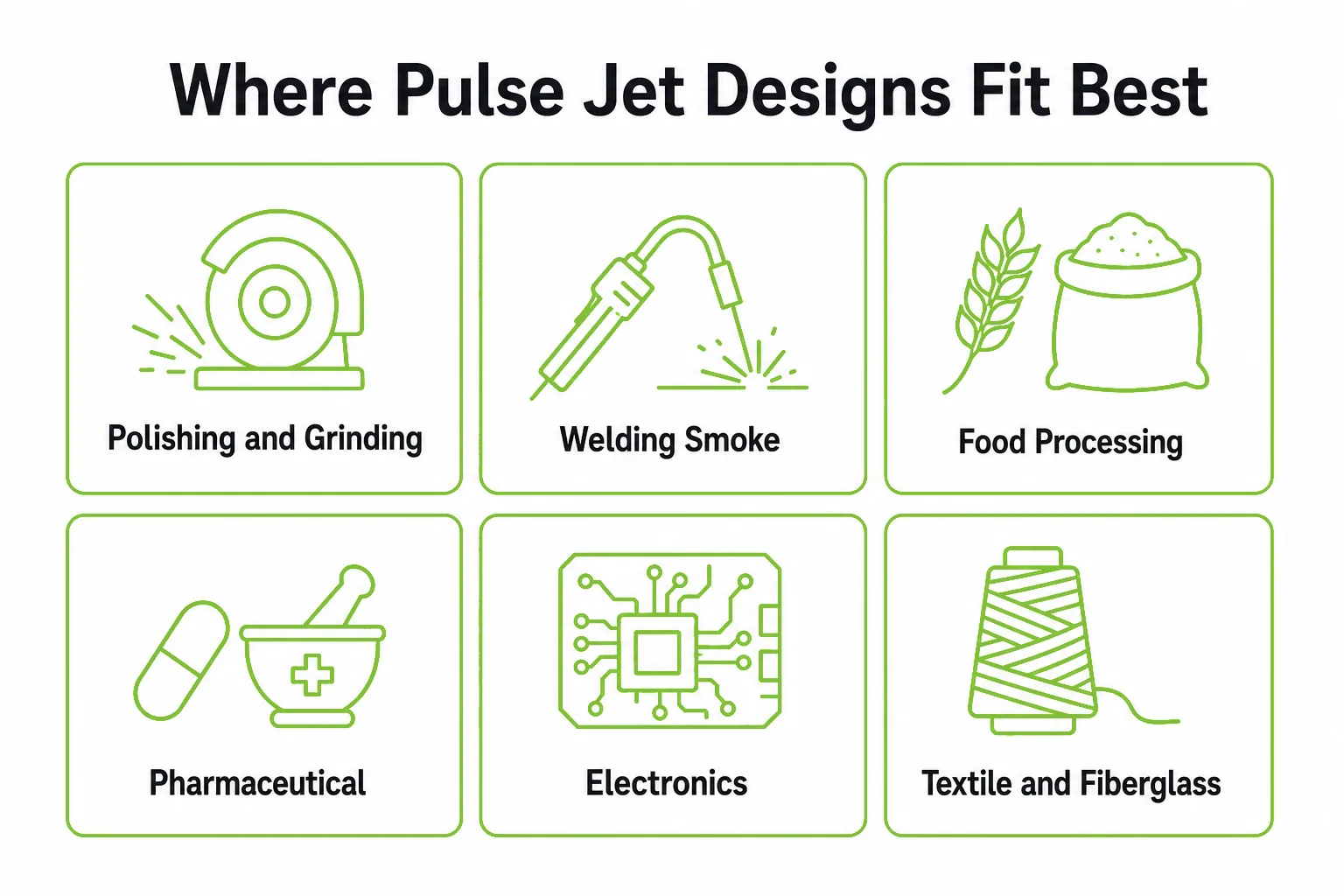
Typical pulse jet applications include polishing and grinding dust, welding smoke, food and pharmaceutical processing, textiles and other dry industrial dusts.
The AIER catalog lists pulse jet cleaned collectors for dust from polishing and grinding, welding smoke and robot welding, chemical processing, food processing, pharmaceutical production, electronics, smelting, textile and fiberglass operations, among others. Two selection patterns cover most of these cases — and the full platform family is mapped in our types of dust collectors overview.
- Bag platforms for heavier or coarser dust: round bag and flat bag collectors handle higher dust loads and are easier to fit with high-temperature or specialty fabrics when the gas condition demands it.
- Cartridge platforms for fine, dry dust: pleated cartridges pack more filter area into a compact housing, which suits fine dusts such as welding fume and light powders in space-limited layouts.
The same pulse jet principle also works in a compact roof-mounted form on storage silos and hoppers — the bin vent dust collector, which vents displaced air during filling and returns the dust to the vessel.
How to choose between the two platforms is a project decision of its own — our baghouse vs cartridge dust collector comparison walks through that selection in detail.
In a full system, the collector is one unit inside a designed airflow: capture points, ducting and fan sizing decide whether the baghouse ever sees the dust it was bought for. That system-level logic is covered in our dust collection system design article.
Limits of a Pulse Jet Baghouse
Most pulse jet problems reported in operation trace back to a project condition that was visible before the purchase. These are the limits AIER checks when reviewing whether a pulse jet design fits.
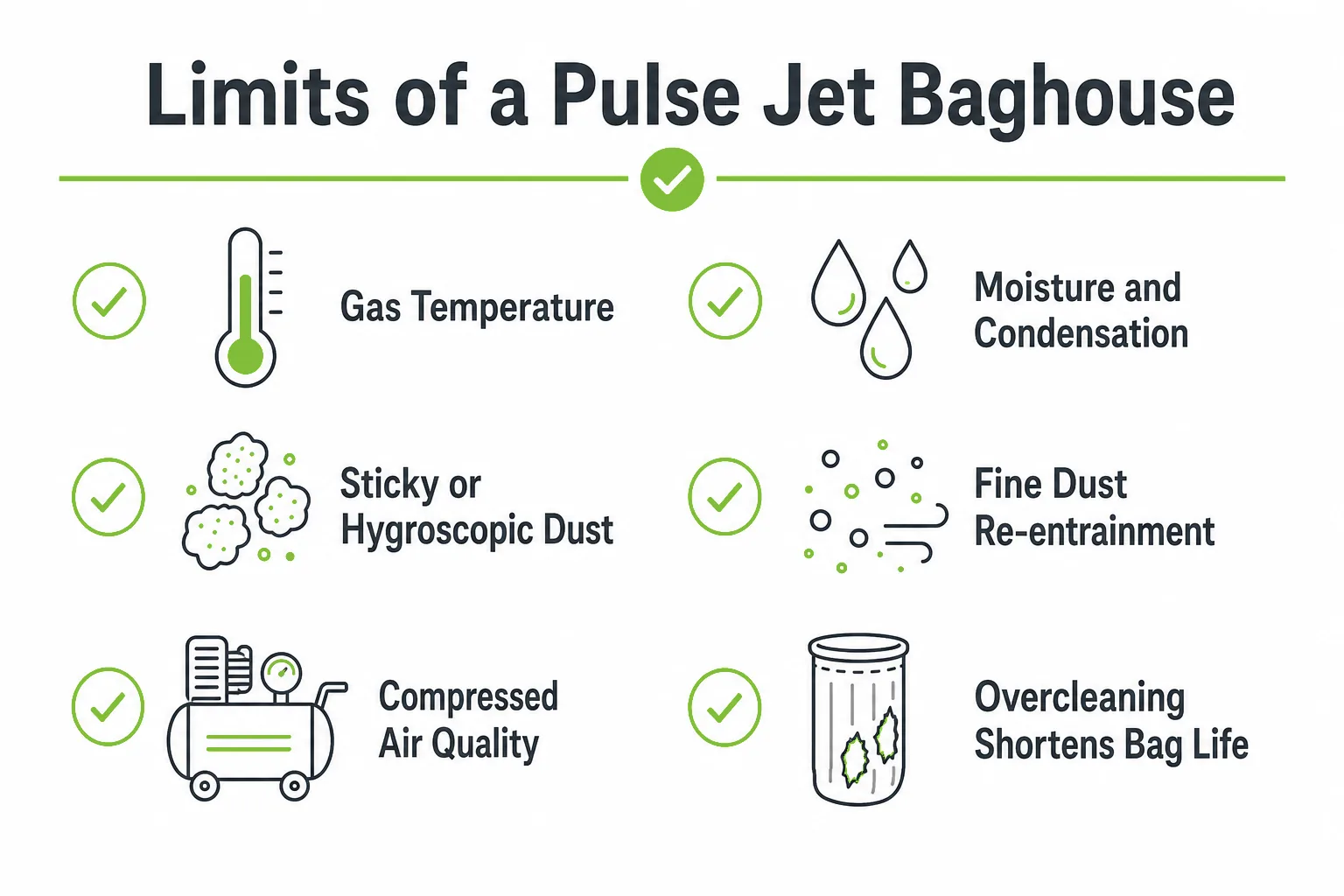
Pulse jet limits include gas temperature, moisture and sticky dust behavior, very fine dust re-entrainment and compressed air quality.
- Gas temperature: the fabric sets the ceiling. Standard media handle everyday duties; hot gas needs high-temperature fabrics and sometimes cooling upstream. Media selection is covered in our dust collector filter bags article.
- Moisture and condensation: humid gas or temperature swings below the dew point make dust sticky and blind the fabric; a cake that will not release cannot be pulsed off harder without damaging the bags.
- Sticky or hygroscopic dust: some dusts cling regardless of moisture; they may need pre-treatment, additives or a different collector type entirely.
- Very fine, light dust: online pulsing can re-entrain fine dust back onto neighboring bags; offline cleaning, lower filtration velocity or cartridge media are the usual review directions.
- Compressed air quality and supply: the cleaning system needs dry, oil-free air at stable pressure; wet or oily air coats the bags from the inside and undermines the cleaning it is supposed to perform.
- Overcleaning: pulsing more often than the dust requires shortens bag life and can worsen emissions, because a thin cake filters better than bare fabric. Cleaning settings belong to commissioning, and their drift over time belongs to maintenance review.
Common Mistakes When Selecting a Pulse Jet Baghouse
These are the selection-stage gaps AIER sees most often in underperforming pulse jet installations.
- Sizing by airflow alone: two projects with the same airflow but different dust properties need different filter areas, media and cleaning arrangements.
- Ignoring the compressed air system: the collector is bought, but the plant’s compressed air is wet, oily or undersized — the cleaning system then fails quietly from day one.
- Treating cleaning as a maintenance substitute: pulsing removes the daily cake; it does not fix worn bags, leaking seals or hopper bridging. That review logic is in our dust collector maintenance article.
- Copying another plant’s collector: a design that works on one dust can blind on another; the dust data, not the reference install, decides.
- Forgetting the discharge path: dust that reaches the hopper still has to leave it; a blocked discharge turns the hopper into a dust reservoir that the pulses keep stirring up.
- Choosing the bag material last: temperature, chemistry and moisture should drive media selection from the start, not after the housing is fixed.
Information AIER Needs for a Baghouse Review
A pulse jet baghouse review moves fastest when the inquiry includes dust and process data instead of only an airflow number. This is the information AIER uses to judge the platform, filter media, cleaning arrangement and system fit.
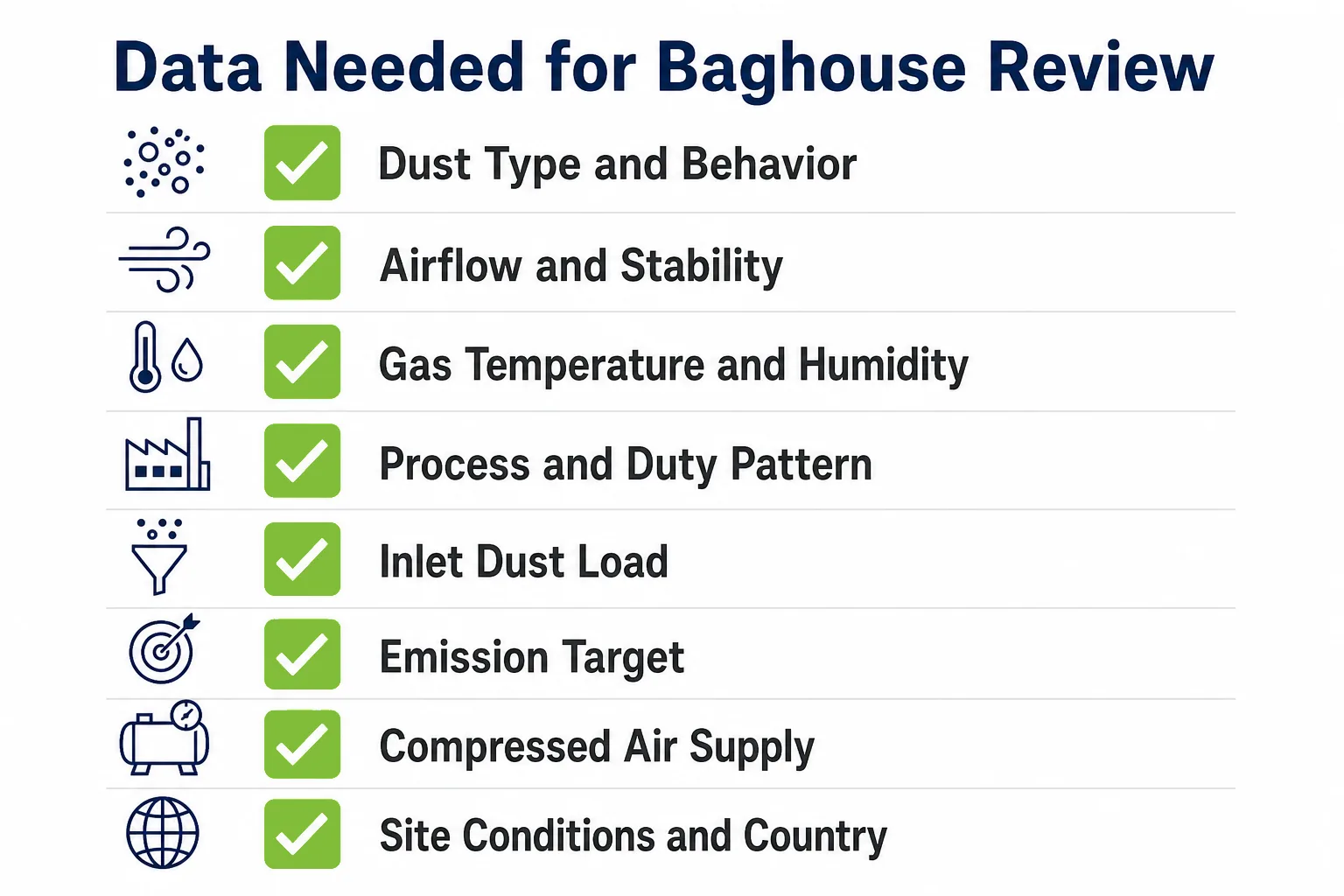
AIER reviews dust properties, airflow, temperature, humidity, inlet load and the emission target before recommending a baghouse platform and cleaning arrangement.
| Data to Prepare | Why It Matters |
|---|---|
| Dust type and behavior (sticky, hygroscopic, abrasive, combustible) | Decides the collector platform, media and whether pulse jet cleaning fits at all |
| Airflow and how stable it is | Decides filter area and turndown behavior |
| Gas temperature and humidity | Drives fabric selection and condensation risk |
| Process description and duty pattern | Continuous or intermittent duty changes the cleaning arrangement |
| Inlet dust load | High loads may need pre-separation or offline cleaning |
| Emission target | Defines media efficiency and whether a membrane or cartridge route is needed |
| Compressed air availability and quality | The cleaning system depends on dry, oil-free air at stable supply |
| Site conditions and installation country | Affects layout, materials, utilities and project requirements |
If your plant is planning a new collector or questioning an existing one, contact AIER with your dust type, airflow, temperature, humidity, inlet load and emission target. AIER will review whether a pulse jet bag, flat bag or cartridge platform fits your condition, and whether online or offline cleaning suits the dust.
FAQ
What is a pulse jet baghouse?
A pulse jet baghouse is a fabric filter dust collector that cleans its filter bags with short bursts of compressed air fired from blowpipes above the bags. The dust cake breaks off the bag surface and falls into the hopper while the collector keeps filtering, which is why it is the most common cleaning design in modern industrial dust collection.
How does pulse jet cleaning work?
A pulse valve releases a burst of compressed air through a blowpipe nozzle into the open top of the bag, often amplified by a venturi. The pulse briefly reverses the airflow and flexes the bag outward, breaking the dust cake off the outer surface so it falls toward the hopper. A controller fires bag rows in sequence on a timer or based on pressure drop.
What is the difference between pulse jet and reverse air baghouses?
A pulse jet baghouse cleans online with high-intensity compressed air pulses and packs more filter area into a compact housing. A reverse air baghouse takes a compartment offline and back-flushes it gently with reverse airflow, which is easier on fragile fabrics and appears mostly in large or utility-scale installations.
Can a pulse jet baghouse clean while running?
Yes. Online cleaning is the standard pulse jet mode: bag rows are pulsed in sequence while the rest of the collector keeps filtering. For very fine or light dusts that re-entrain easily, an offline arrangement can isolate a compartment first so the released dust settles without through-flow.
What dust types are difficult for pulse jet cleaning?
Sticky and hygroscopic dusts, humid gas near the dew point and very fine light dusts are the usual problem cases. A cake that will not release cannot be fixed by pulsing harder, so these conditions need media, pre-treatment or cleaning-arrangement review before purchase rather than stronger pulses after startup.
What information is needed for a pulse jet baghouse quote?
Provide the dust type and behavior, airflow, gas temperature and humidity, process description, inlet dust load, emission target, compressed air availability and the installation country. AIER reviews the collector platform, filter media and cleaning arrangement based on the actual operating condition.