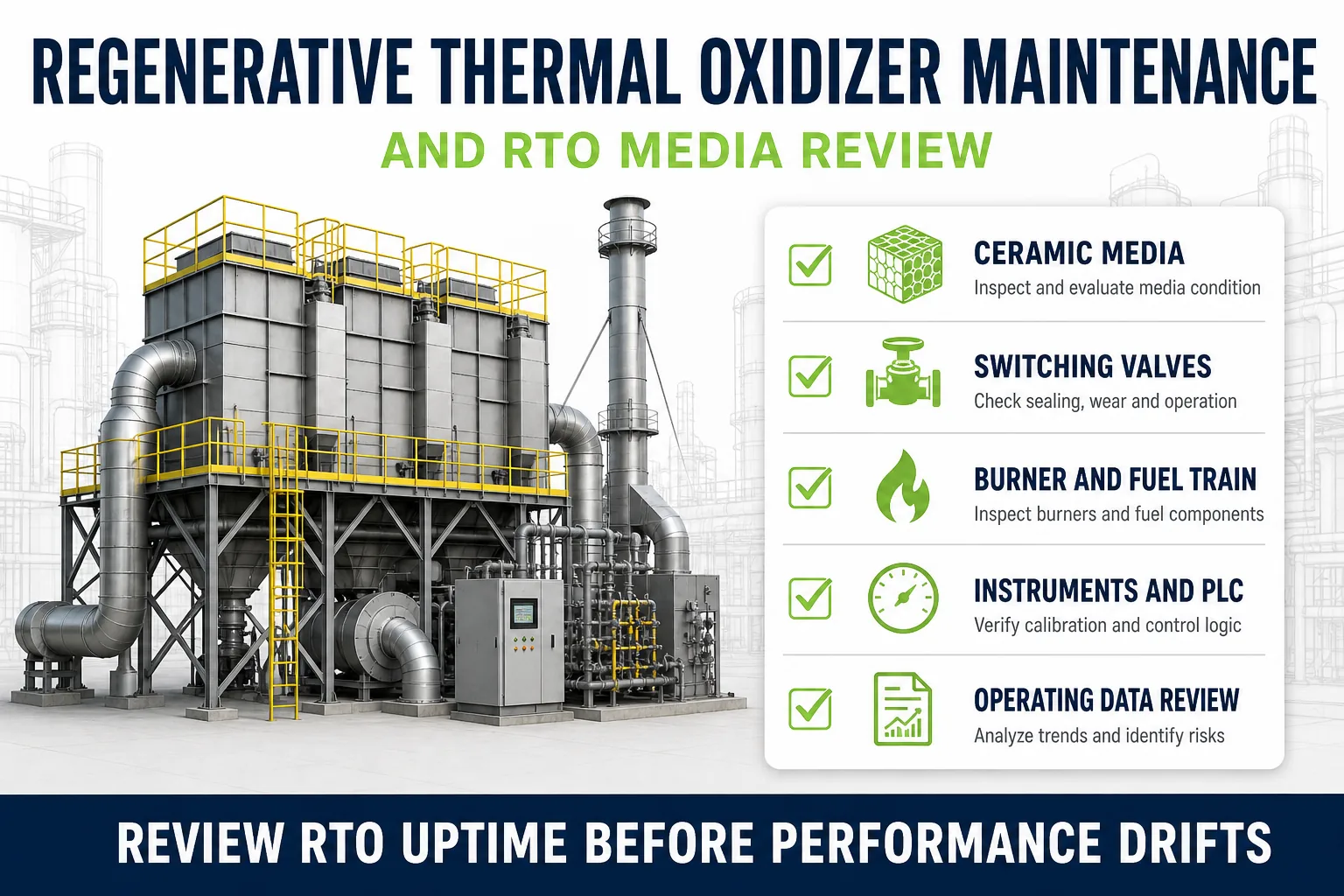
Regenerative thermal oxidizer maintenance is not only burner tuning after an alarm. In an industrial VOC treatment line, maintenance should keep switching valves reliable, protect ceramic heat exchange media, confirm safety interlocks, track operating trends and make planned inspections practical before performance drift becomes a permit or production problem.
This article explains regenerative thermal oxidizer maintenance and RTO media review for plant engineers, maintenance teams and project buyers who operate exhaust gas treatment systems. AIER supplies regenerative thermal oxidizer systems with PLC control, variable frequency drives and integrated VPN access for remote troubleshooting and operating data review. This article does not replace the equipment O&M manual, site inspection or local emission requirements for a specific installed RTO.
What Regenerative Thermal Oxidizer Maintenance Covers
Regenerative thermal oxidizer maintenance is the routine inspection, cleaning, adjustment and planned repair of ceramic media, switching valves, burners, instrumentation and safety systems so an RTO can keep destroying VOCs reliably over long run hours.
A regenerative thermal oxidizer oxidizes VOCs at high temperature and uses ceramic beds to store and release heat between flow reversals, which reduces auxiliary fuel use in many industrial applications. This article focuses on rto maintenance and thermal oxidizer maintenance review points, not a full working-principle explanation. For equipment selection and system parameters, use the RTO product page and process data review instead.
| Maintenance Area | What to Check | Why It Matters |
|---|---|---|
| Ceramic media | Fouling, cracking, channeling, support condition, pressure drop and heat recovery trends | Media condition drives fuel use, pressure drop and stable VOC destruction |
| Switching valves and actuators | Sealing, stroke, limits, leakage and switching sequence | Valve performance affects flow direction, bypass leakage and uptime |
| Burner and fuel train | Flame stability, ignition, interlocks, visible burner condition | Combustion support and safety systems protect stable operation |
| Instrumentation and controls | Temperature readings, alarms, data logs, PLC and VFD status | Trends show problems earlier than a single trip event |
| Fans, ductwork and stack | Vibration, leaks, damper position, abnormal noise | System issues can look like an RTO fault when the root cause is elsewhere |
VOC-dominated exhaust usually points to thermal oxidation routes such as an RTO, while acid or soluble gas streams often need a wet treatment route instead. For scrubbing comparisons, see the article on wet scrubber vs dry scrubber and the industrial wet scrubber product page. Low-concentration odor or polishing duties may also involve activated carbon adsorption. The full route map is in our air pollution control equipment overview.
Daily and Weekly RTO Inspection Points
Inspection frequency should follow the plant schedule and equipment manual, but many RTO systems can use structured shift-level and weekly checks to catch small changes before fuel use, pressure drop or trips escalate.
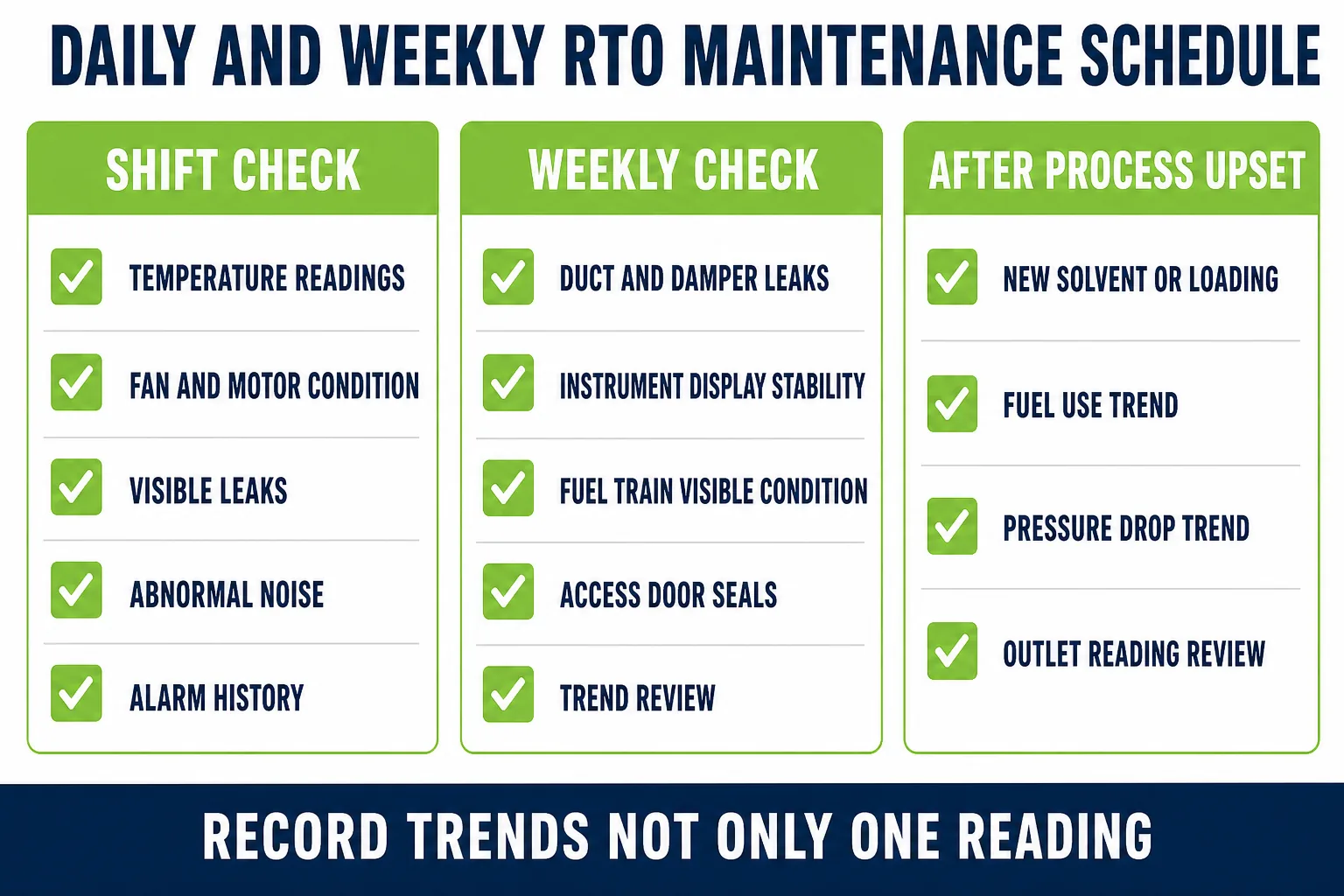
Shift and weekly RTO checks should record trends, not only one reading, because production loading and ambient conditions also affect operating data.
| Inspection Level | Typical Checkpoints | Action if Abnormal |
|---|---|---|
| Shift or daily check | Outlet and chamber temperature readings, fan and motor condition, visible leaks, abnormal vibration or noise, alarm history | Record the change and compare it with recent production conditions |
| Weekly check | External duct leaks, damper position, instrument display stability, fuel train visible condition, access door seals | Schedule cleaning, seal repair or deeper inspection if the trend continues |
| After process upset | New solvent mix, higher loading, added branch, changed operating hours | Recheck fuel use, pressure drop and outlet readings against prior baseline data |
Monthly and Planned-Stop Maintenance Tasks
Monthly checks and planned shutdown windows are where many RTO teams review valves, burners and internal components that cannot be judged reliably from outside the unit alone.
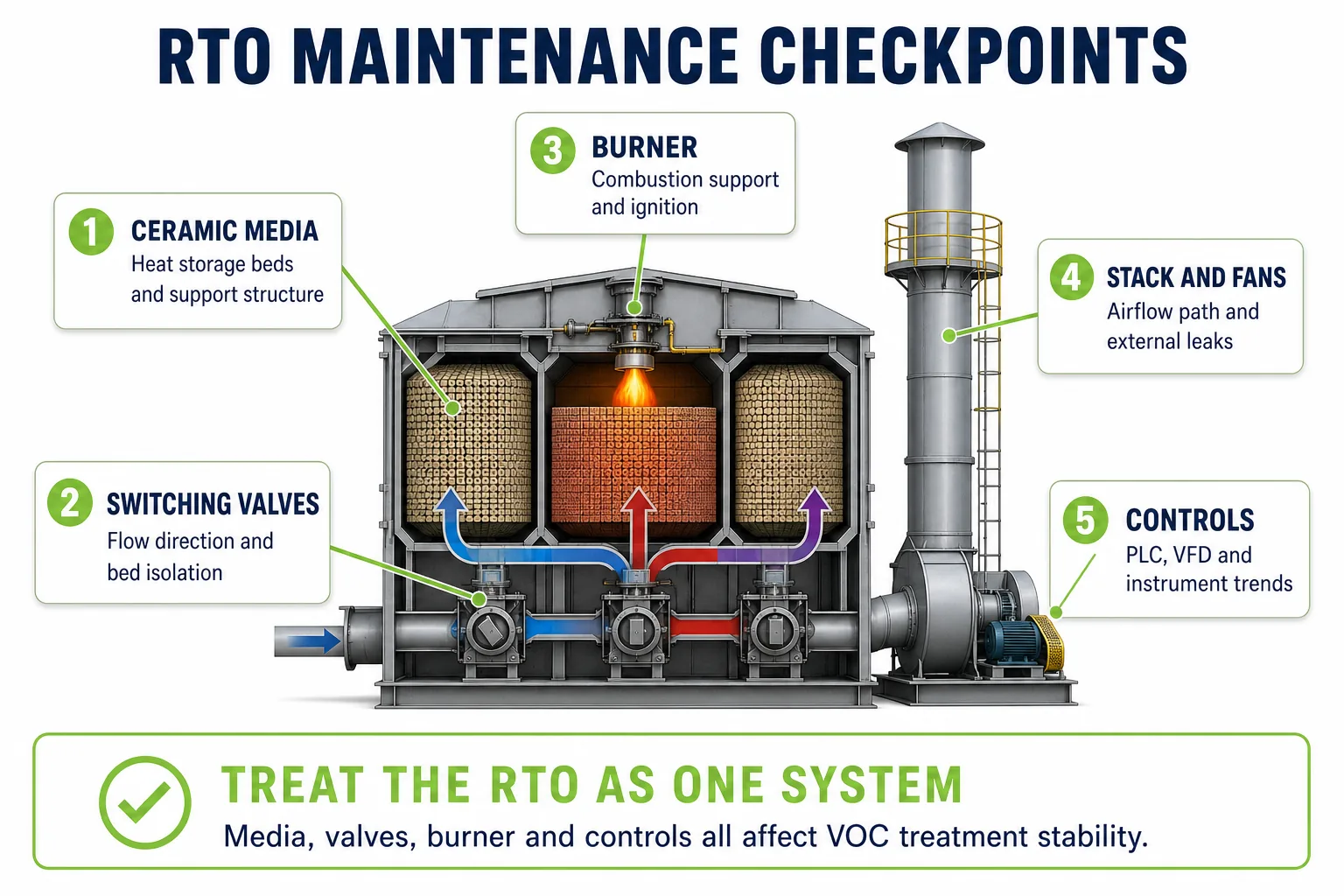
RTO maintenance should treat ceramic media, valves, burner, stack and controls as one system rather than isolated components.
| Planned Task | What to Review | Typical Follow-Up |
|---|---|---|
| Valve and actuator review | Limit switches, stroke, seat condition, actuator response | Adjust, reseal or plan replacement before leakage affects performance |
| Instrument trend review | Temperature profiles, pressure drop history, fuel use, fan load | Identify drift before repeated trips or rising operating cost |
| Burner visible inspection | Flame appearance, ignition components, fuel train fittings | Clean, service or schedule burner support review |
| Insulation and access seals | Hot spots, door gaskets, insulation gaps, external shell condition | Repair seals and insulation openings during the planned stop |
| Internal media inspection window | Media surface condition, support integrity, debris or buildup where accessible | Plan bake-out, wash-down or media replacement review if damage is confirmed |
RTO Ceramic Media Review: What to Check
RTO ceramic media and broader rto media condition are often the most important part of a long-term maintenance program. Media stores and releases heat during flow reversals, so fouling, breakage or channeling can raise pressure drop, increase fuel demand and reduce effective heat recovery.
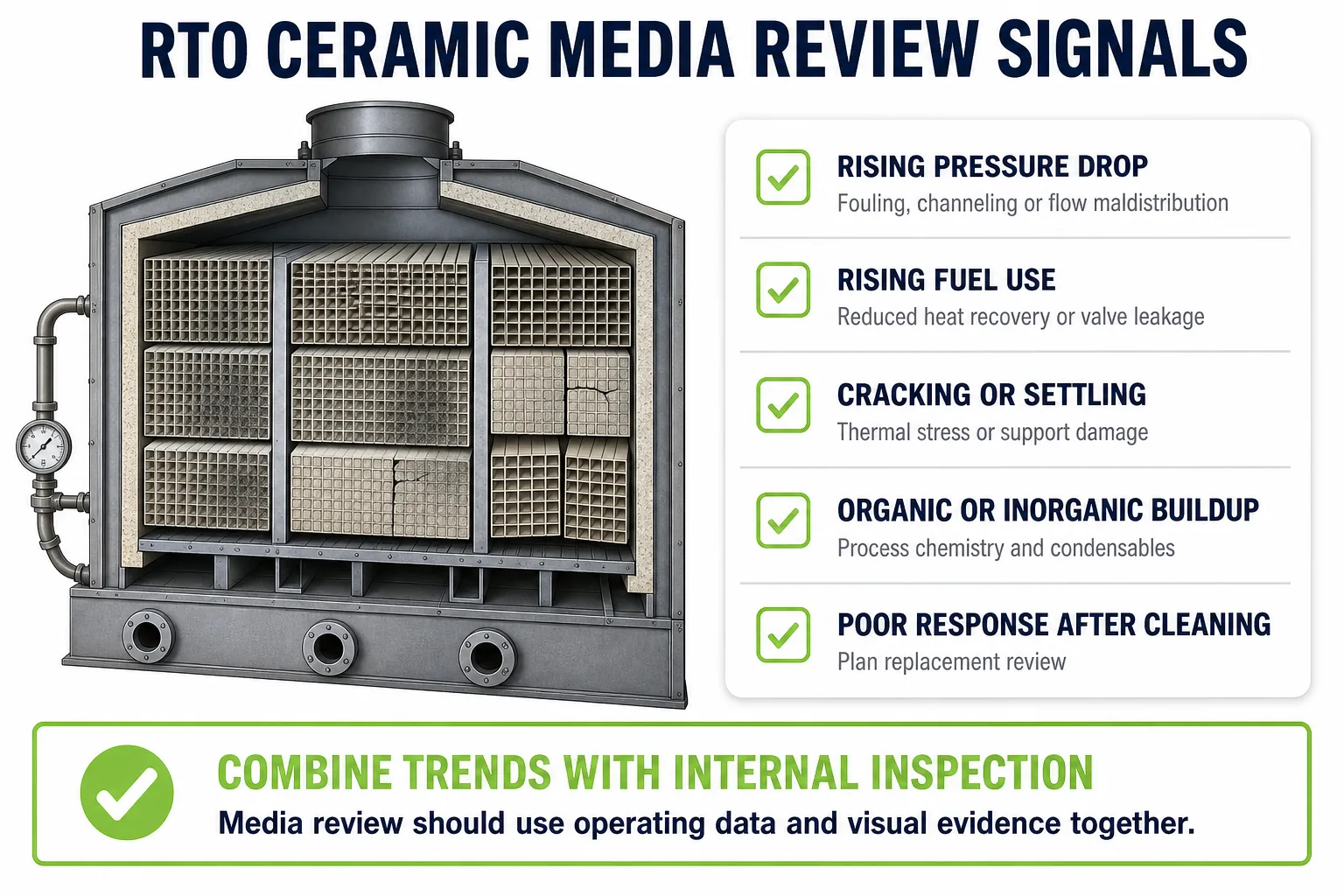
Ceramic media review should combine operating trends with internal inspection evidence rather than age alone.
| Review Signal | What It May Indicate | Next Step |
|---|---|---|
| Rising pressure drop trend | Fouling, particulate buildup, channeling or flow maldistribution | Review upstream particulate loading, bake-out or wash-down options, then internal inspection |
| Rising fuel use at similar load | Reduced heat recovery, media damage or valve leakage | Compare valve sealing, temperature profile and media condition |
| Visible cracking or settling | Thermal stress, support issue or mechanical damage | Plan internal inspection and engineering review for replacement scope |
| Organic residue or inorganic scale | Process chemistry, condensables, silicon or salt-forming components | Review upstream protection, cleaning method and media suitability |
| Repeated performance drift after cleaning | Media may no longer match current exhaust chemistry or loading | Prepare operating history and consider media replacement review |
Common maintenance paths include bake-out, wash-down and planned media replacement, but the right path depends on media type, exhaust chemistry and the OEM manual. This article does not recommend fixed replacement thresholds; those decisions should use site trend data and internal inspection results. The media logic also depends on the oxidizer design itself — catalytic units run catalyst beds instead of plain ceramic media, a difference covered in our catalytic oxidizer vs RTO comparison.
Valve, Damper and Actuator Maintenance
Switching valve reliability is central to regenerative thermal oxidizer maintenance because flow direction, bed isolation and leakage control depend on repeatable valve action. AIER RTO designs emphasize reliable valve arrangements for VOC removal duty, but every installed system still needs periodic inspection.
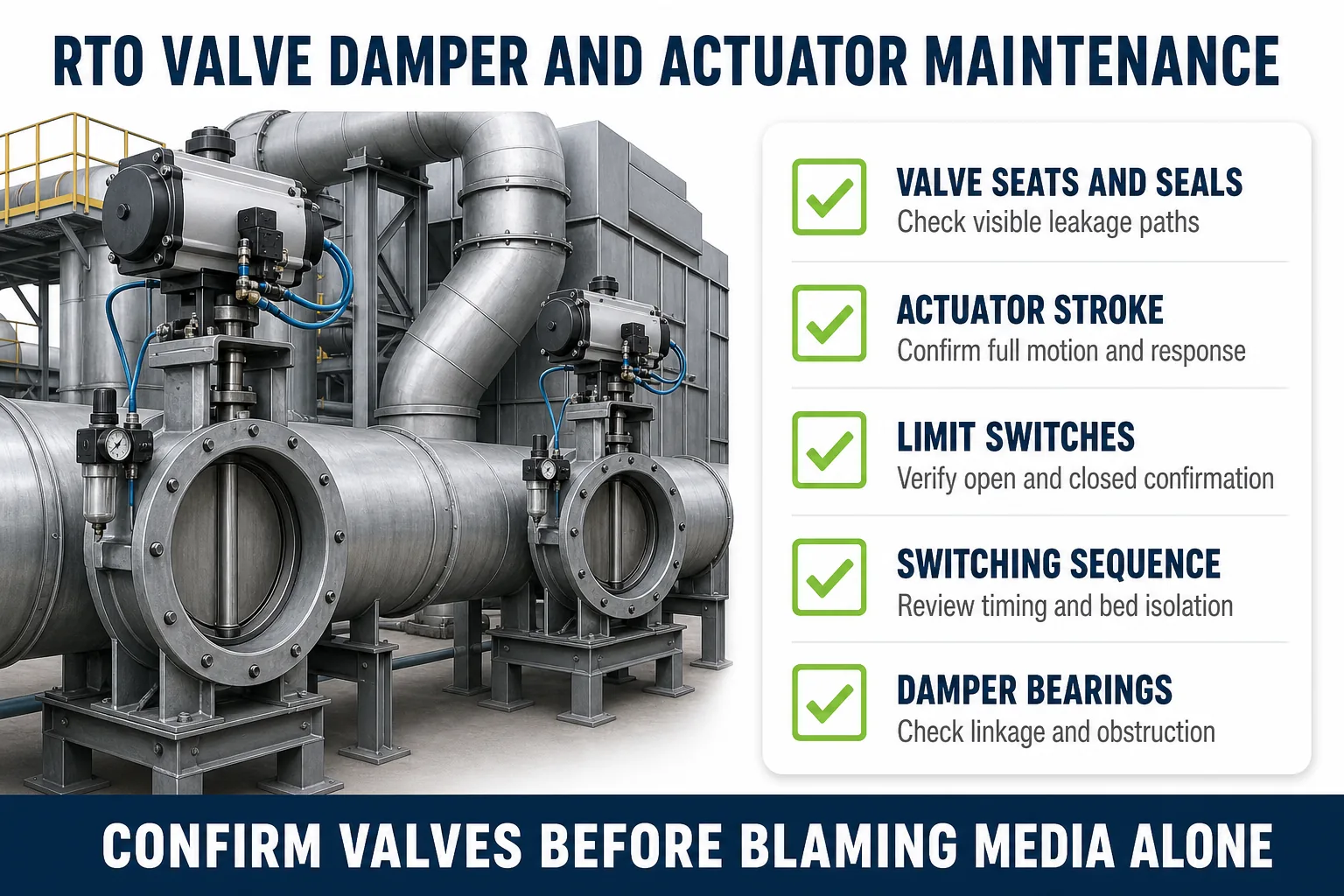
Valve maintenance should confirm sealing, stroke, limits and switching sequence before performance drift is blamed on media alone.
- Check valve seats, seals and visible leakage paths during planned access.
- Verify actuator stroke, limit switches and response time against the expected sequence.
- Review switching timing and bypass leakage symptoms in operating data.
- Inspect damper bearings, linkages and external obstruction that can affect motion.
- Record any repeated valve-related alarms before requesting regenerative thermal oxidizer repair support.
Burner, Fuel Train and Safety System Checks
Burner and fuel train checks belong in both thermal oxidizer maintenance routines and regenerative thermal oxidizer preventative maintenance plans. The goal is stable combustion support, safe ignition and reliable interlocks rather than unsupervised adjustment of combustion settings.
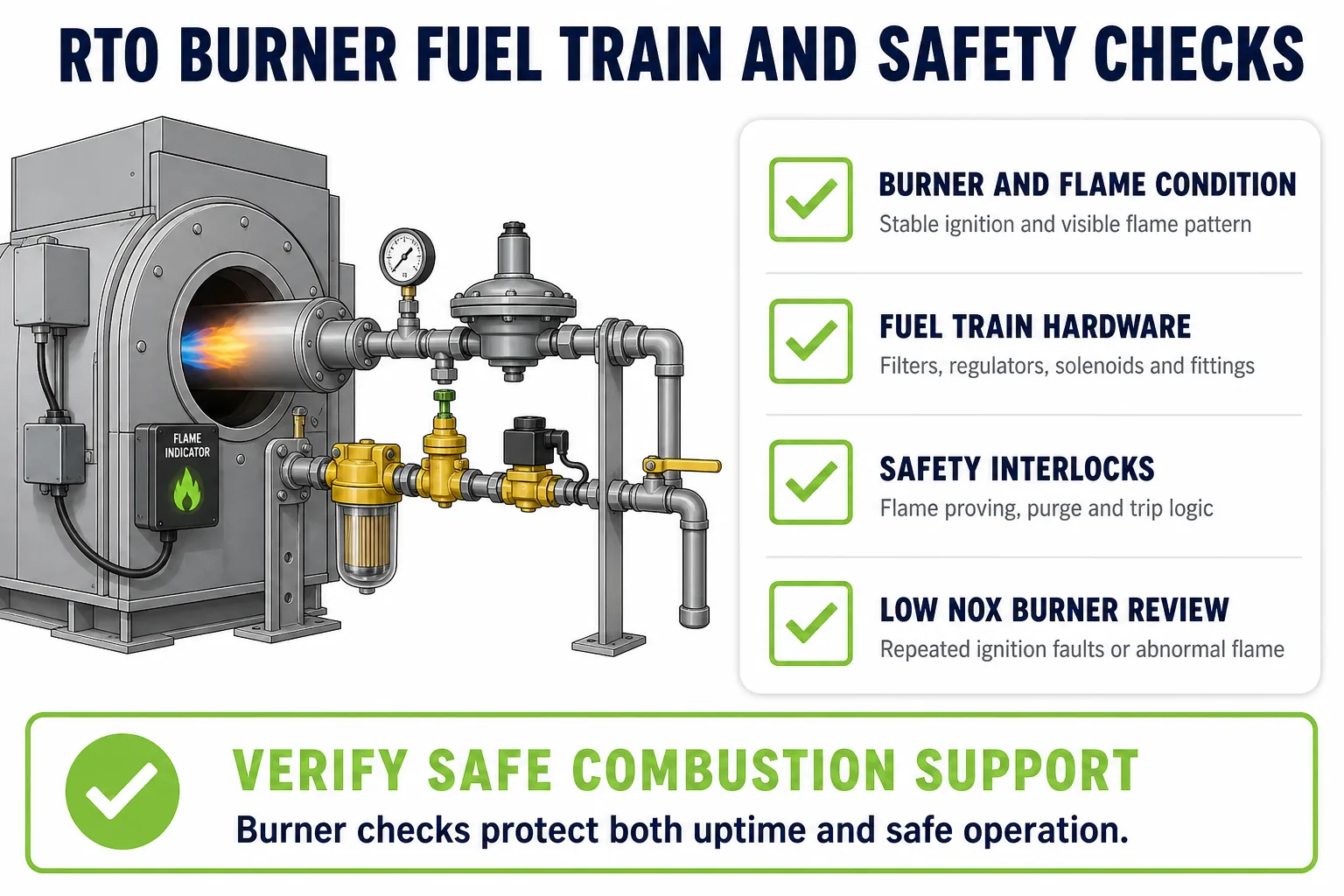
Burner maintenance should prioritize safe ignition, stable flame indication and intact fuel train hardware.
| Check Area | What to Inspect | Why It Matters |
|---|---|---|
| Burner assembly | Visible flame pattern, ignition components, nozzle condition | Unstable combustion support can increase fuel use and trip frequency |
| Fuel train hardware | Filters, regulators, solenoids, fittings, leak points | Fuel delivery problems can appear as temperature or outlet instability |
| Safety interlocks | Flame proving, purge sequence, trip history, limit devices | Safety systems must be verified before changing operating assumptions |
| Low NOx burner condition | Visible damage, abnormal flame behavior, repeated ignition faults | Burner condition affects both compliance margin and operating stability |
Instrumentation, PLC and Remote Monitoring
Instrumentation turns maintenance from reactive repair into trend-based review. According to the EPA monitoring guidance for thermal oxidizers, outlet VOC concentration and combustion temperature are primary performance indicators, while fuel pressure, fan load, outlet CO and other readings also help show whether the system is operating as expected.
AIER RTO systems use PLC automatic control, variable frequency drives and integrated VPN access for remote troubleshooting and review of real-time operating data. Maintenance teams should use those records to compare recent trips, fuel use and temperature profiles before opening the unit.
- Review temperature profile stability across beds and control zones.
- Compare pressure drop, fan current and fuel use trends over time.
- Check alarm history, bypass events and repeated interlock causes.
- Confirm critical instruments are reading consistently and not drifting without explanation.
- Export recent operating logs before requesting an engineering maintenance review.
Common RTO Performance Problems During Operation
Many RTO problems repeat across industries, but the right response depends on whether the root cause is media, valves, burner support, instrumentation or upstream process change.
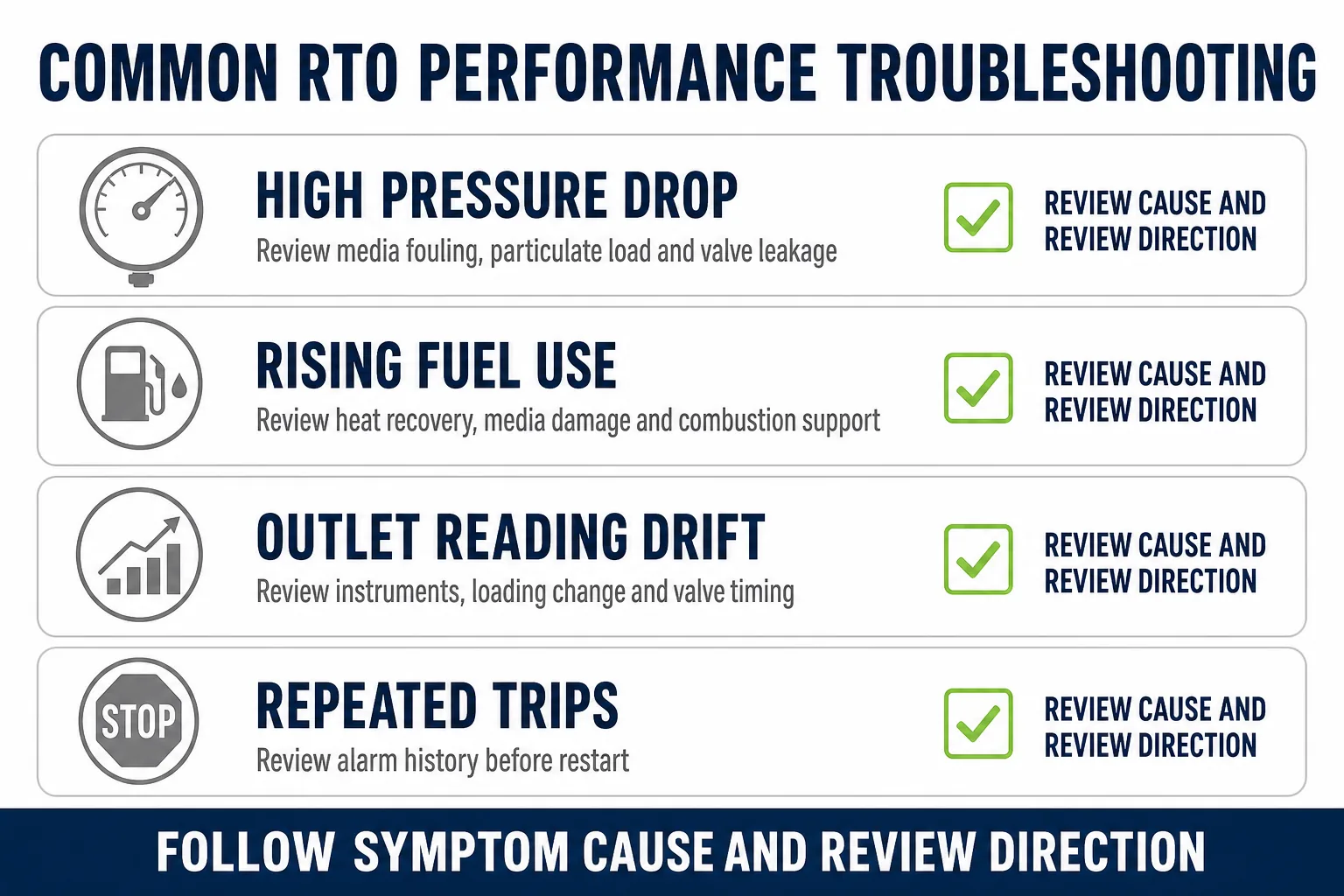
Troubleshooting should follow symptom, likely cause and review direction instead of replacing major components without trend data.
| Symptom | Possible Cause | First Review Direction |
|---|---|---|
| High or rising pressure drop | Media fouling, particulate loading, channeling, valve leakage or flow imbalance | Review trends, upstream particulate protection and internal media condition |
| Rising fuel use | Reduced heat recovery, media damage, valve bypass or unstable combustion support | Compare temperature profile, valve sealing and burner condition |
| Outlet reading drift | Combustion support issue, valve timing, loading change or instrument drift | Verify instrument calibration and recent process changes first |
| Repeated trips or shutdowns | Interlock fault, fuel train issue, control fault or unresolved media restriction | Review alarm history and recent maintenance actions before restart |
| Problem returns after service | Root cause not corrected, wrong component changed or process no longer matches design | Prepare operating history for engineering review rather than repeating the same part swap |
Some issues require thermal oxidizer repair or vendor support, while others are resolved by cleaning, valve service or corrected operating data. This article does not describe on-site thermal oxidizer maintenance services contracts; it focuses on what plant teams should inspect and what data AIER needs for a maintenance review discussion.
Data Needed for an RTO Maintenance Review
Before asking AIER to review an RTO maintenance issue, collect operating and service data instead of only describing the alarm. This helps distinguish media fouling, valve leakage, burner support problems and upstream process changes.
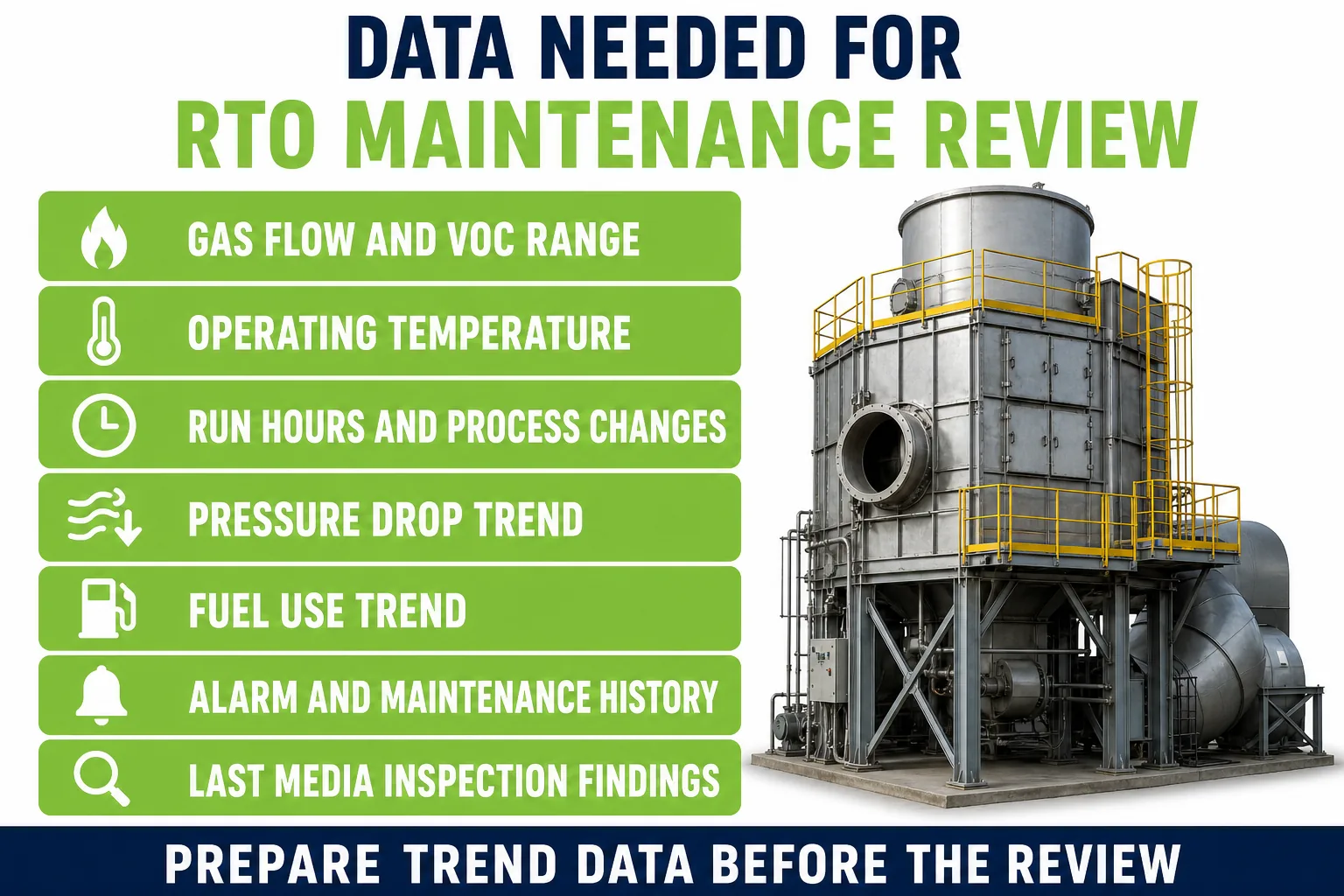
AIER can review RTO maintenance questions more efficiently when flow, concentration, temperature, run hours and trend data are prepared.
| Data to Prepare | Why AIER Needs It |
|---|---|
| RTO model, chamber configuration and installation year | Shows which system and media arrangement is being reviewed |
| Gas flow, VOC concentration range and temperature | Helps judge whether current loading still matches the original application |
| Operating hours and recent production changes | Explains whether the issue started gradually or after a process upset |
| Pressure drop, fuel use and temperature trends | Helps separate media, valve, burner and instrument causes |
| Alarm history and recent maintenance actions | Shows whether the same fault repeats after service |
| Last internal media inspection date and findings | Supports bake-out, wash-down or replacement review decisions |
| Photos of external condition, access points and available interior views | Helps locate obvious leaks, damage or installation issues |
If your RTO shows rising pressure drop, increasing fuel use, unstable outlet readings, repeated valve alarms or performance drift after cleaning, contact AIER with operating data, maintenance history and trend records. AIER can review whether the issue likely relates to ceramic media, switching valves, burner systems, controls or a broader VOC emission control application change. This is a maintenance and performance review invitation, not a substitute for the installed system manual or local permit requirements.
FAQ
How often should a regenerative thermal oxidizer be maintained?
A regenerative thermal oxidizer should be maintained according to operating hours, VOC loading, fuel and media trends and the equipment O&M manual. Many plants use shift, weekly and planned-stop checks, then increase frequency when pressure drop, fuel use or outlet readings change.
When should RTO ceramic media be inspected or replaced?
RTO ceramic media should be inspected when pressure drop, fuel use or heat recovery trends change, after repeated cleaning fails to restore performance, or when internal inspection shows fouling, cracking, channeling or support damage. Replacement timing should use site data and OEM guidance rather than age alone.
What causes high pressure drop or rising fuel use in an RTO?
High pressure drop or rising fuel use can be caused by fouled or damaged ceramic media, particulate loading, valve leakage, flow maldistribution, unstable combustion support or upstream process changes. Review operating trends before replacing major components.
What is included in regenerative thermal oxidizer preventative maintenance?
Regenerative thermal oxidizer preventative maintenance usually includes external inspections, instrument and alarm review, valve and actuator checks, burner and fuel train inspection, insulation and seal review, and planned internal checks of ceramic media where access allows.
What valve and burner checks matter most for RTO uptime?
Valve sealing, actuator stroke, limit confirmation and switching sequence matter because bypass leakage and poor bed isolation affect fuel use and stability. Burner ignition, flame proving, fuel train condition and safety interlocks matter because combustion support and trip logic protect reliable operation.
What operating data should be shared before an RTO maintenance review?
Share gas flow, VOC concentration range, operating temperature, run hours, pressure drop and fuel use trends, alarm history, recent maintenance actions, last media inspection findings and photos of accessible conditions. These details help AIER review the likely cause more accurately.