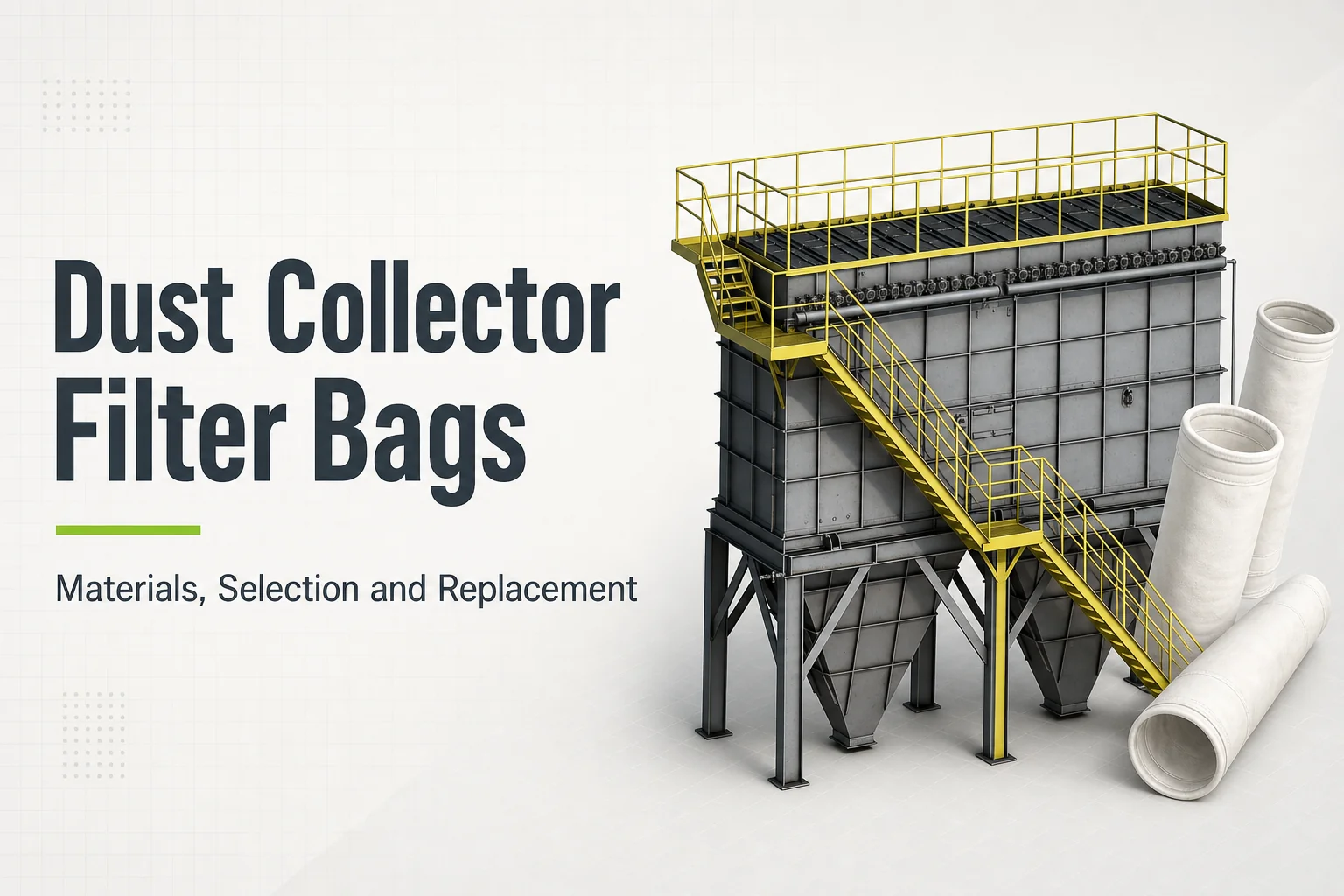
Dust collector filter bags are the working core of every baghouse dust collector. The housing, hopper and pulse system can stay in service for decades, but the bags decide the real filtration efficiency, the pressure drop and a large part of the operating cost. Choosing the wrong bag material is one of the most common reasons an industrial dust collection system underperforms.
This article explains how filter bag materials are matched to dust and gas conditions, when PTFE and membrane finishes are worth the cost, how pulse jet cleaning affects bag life, and which signals show that dust collector bags need replacement. It is written for plant engineers and project buyers who run industrial bag collectors, not for woodshop or home dust collection.
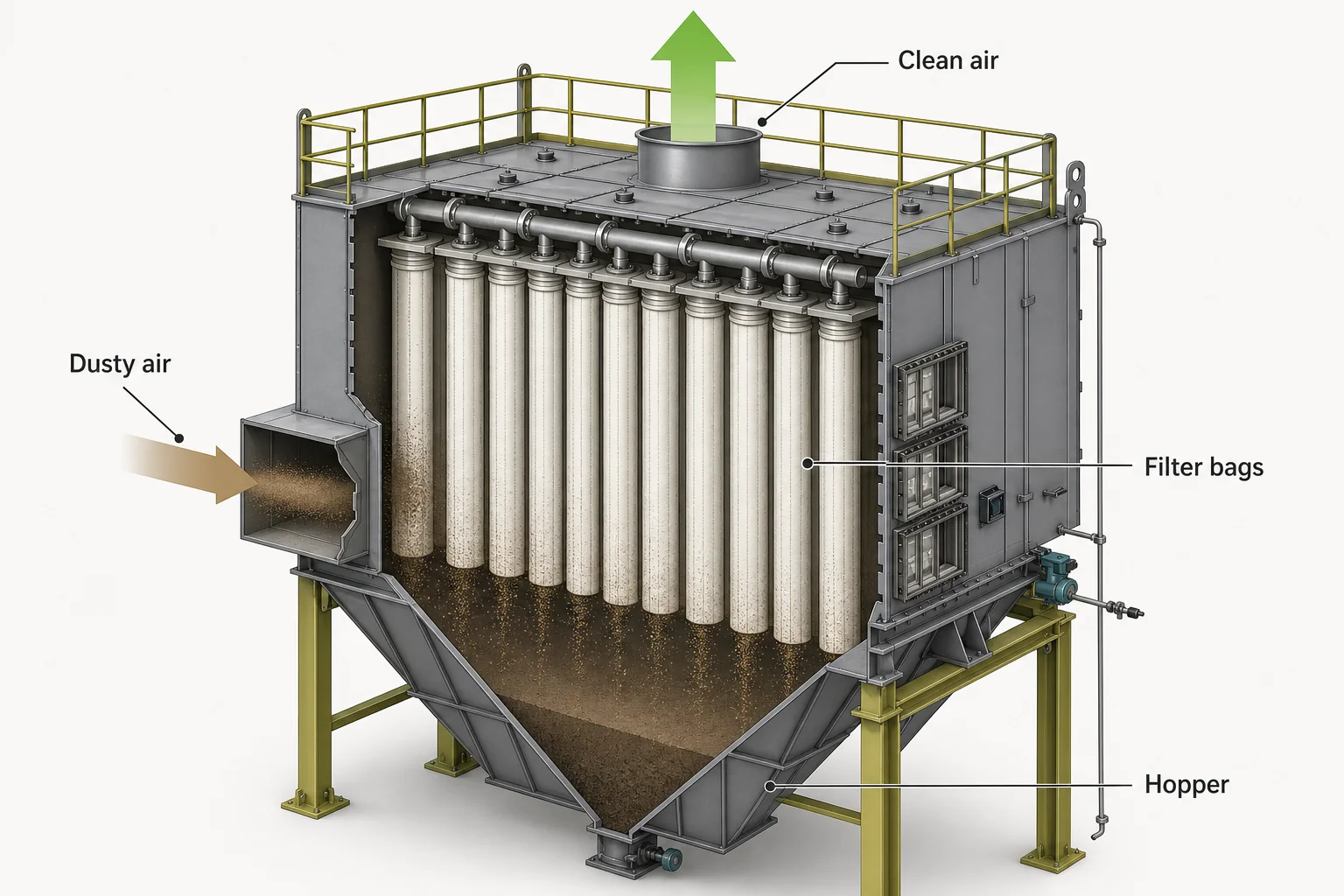
Filter bags hang on cages inside the clean air plenum of a baghouse. Dust collects on the outer bag surface and compressed air pulses knock it into the hopper.
What Are Dust Collector Filter Bags?
A dust collector filter bag is a tube of needle felt or woven filter fabric, typically 120 to 160 mm in diameter and 2 to 6 meters long, supported by a steel filter bag cage. Dusty air flows from the outside of the bag to the inside: particles stay on the fabric surface and build a dust cake, while cleaned air passes through the tube sheet into the clean air plenum. In a pulse jet baghouse, short bursts of compressed air expand each bag and throw the dust cake into the hopper below.
The bag itself does the filtering, so most performance questions come back to three properties:
- Fiber material: decides temperature limit, chemical resistance and cost.
- Fabric construction and finish: needle felt weight, surface treatments such as singeing, calendering or a PTFE membrane, and options like antistatic fibers.
- Bag and cage condition: correct sizing, tensioning and installation keep the bag sealed at the tube sheet and prevent early abrasion damage.
Main Filter Bag Materials and When They Are Used
Filter bag material selection starts with continuous operating temperature, then checks moisture, chemical attack and abrasion. The table below shows the most common materials used in industrial baghouse filter bags. Temperature figures are typical continuous ratings; the final choice should always be confirmed against the real gas condition of the project.
| Bag Material | Typical Continuous Temperature | Strengths | Watch Out For |
|---|---|---|---|
| Polyester (PET) | Up to ~135°C | Low cost, good all-round performance, wide availability | Hydrolysis in hot humid gas, acid attack |
| Polypropylene (PP) | Up to ~90°C | Very good acid and alkali resistance at low temperature | Low temperature limit |
| Aramid (m-aramid, often called Nomex) | Up to ~200°C | High temperature strength, good abrasion resistance | Hydrolysis with moisture plus heat, acid gas |
| PPS (polyphenylene sulfide) | Up to ~190°C | Excellent acid and hydrolysis resistance, good for coal boilers | Oxygen content above ~15% at high temperature, strong oxidizers |
| P84 (polyimide) | Up to ~240°C | Fine particle capture thanks to multilobal fiber shape | Hydrolysis in humid gas, higher cost |
| Fiberglass | Up to ~260°C | Highest temperature range of common fabrics, dimensional stability | Flex and abrasion damage, needs gentle cleaning |
| PTFE | Up to ~250°C | Near-universal chemical resistance, long service life | Highest material cost |
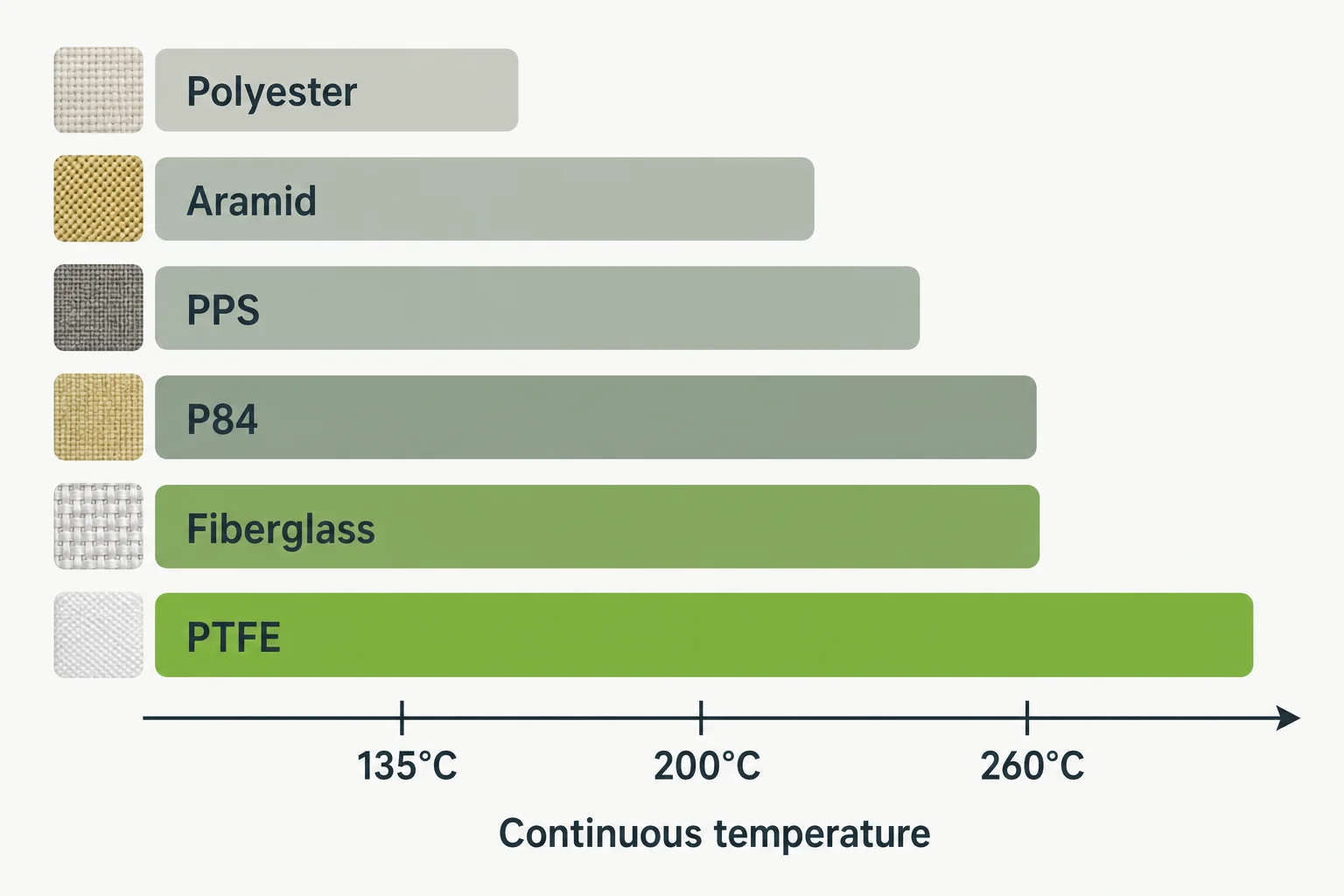
Material selection moves from polyester for ambient air toward PPS, P84, fiberglass and PTFE as temperature, moisture and chemical exposure increase.
In practice, polyester filter bags cover the majority of ambient dust collection tasks such as material handling, blending, cutting and general ventilation. Aramid and PPS filter bags appear where hot gas comes from dryers, kilns, boilers or thermal processes. Fiberglass filter bags and P84 handle the hottest baghouse applications. If more than one material fits, the decision usually comes down to expected bag life against price.
PTFE Filter Bags and PTFE Membrane Finishes
PTFE appears in two different roles, and mixing them up causes confusion in quotations.
PTFE filter bags are sewn from 100% PTFE felt. They are chosen when the gas itself is aggressive: chemically corrosive exhaust, acid dew point risk, or high temperature combined with moisture where polyester, aramid or even PPS would degrade. A PTFE filter bag is the most expensive common option, but in severe conditions it often outlasts cheaper bags several times over.
PTFE membrane filter bags are standard bags, in polyester, aramid, PPS, fiberglass or PTFE felt, laminated with a thin expanded PTFE membrane on the dust side. The membrane works as a surface filter: dust stays on the smooth membrane instead of penetrating the felt, so the dust cake releases cleanly with every pulse. PTFE membrane filter bags are used for:
- Fine or sticky dust that blinds normal felt quickly.
- Strict outlet emission requirements on fine particles.
- Applications where stable, low pressure drop matters more than bag price.
- Hygroscopic dust that absorbs moisture and cakes on plain fabric.
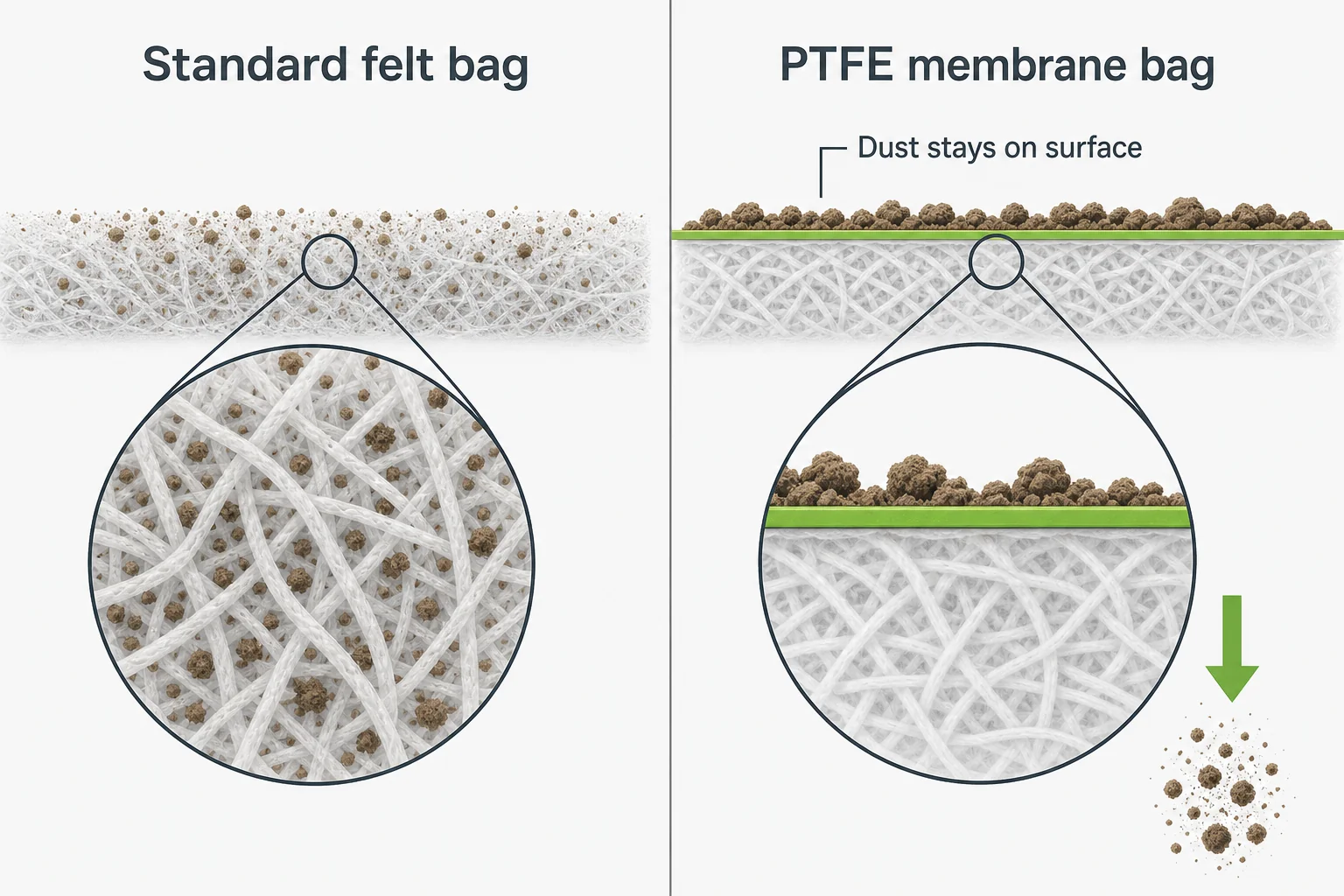
A PTFE membrane keeps dust on the bag surface for clean cake release, while plain needle felt lets fine dust work into the fabric over time.
How Dust Type and Operating Conditions Affect Selection
The collector model tells you bag dimensions and quantity. It does not tell you which fabric will survive. Before confirming dust collector filter bags, review these conditions:
- Particle size and abrasiveness: fine dust below a few microns pushes the choice toward membrane finishes; sharp abrasive dust such as shot blasting or mineral dust needs heavier felt and careful inlet design.
- Moisture and humidity: hot humid gas causes hydrolysis in polyester, aramid and P84. Hygroscopic dust such as sugar, salts or some chemical powders cakes on plain fabric and favors membrane bags.
- Chemical exposure: acid gas, alkaline dust or solvent vapors each attack specific fibers. PPS and PTFE handle most acid conditions; polypropylene works for low-temperature chemical duty.
- Temperature spikes: rate the bag for the real peak, not the average. A dryer upset or bypass event can destroy a full bag set in hours.
- Static and combustible dust: where the dust is ignitable, antistatic filter bags with conductive fibers, properly grounded, are part of the explosion protection concept.
- Air-to-cloth ratio: the ratio between airflow and total filter area. Many pulse jet bag collectors run near 1.0 to 1.5 m/min filtration velocity; running a collector far above its design ratio shortens bag life no matter which fabric is used. Can velocity, the upward gas speed between bags, is checked in the same review.
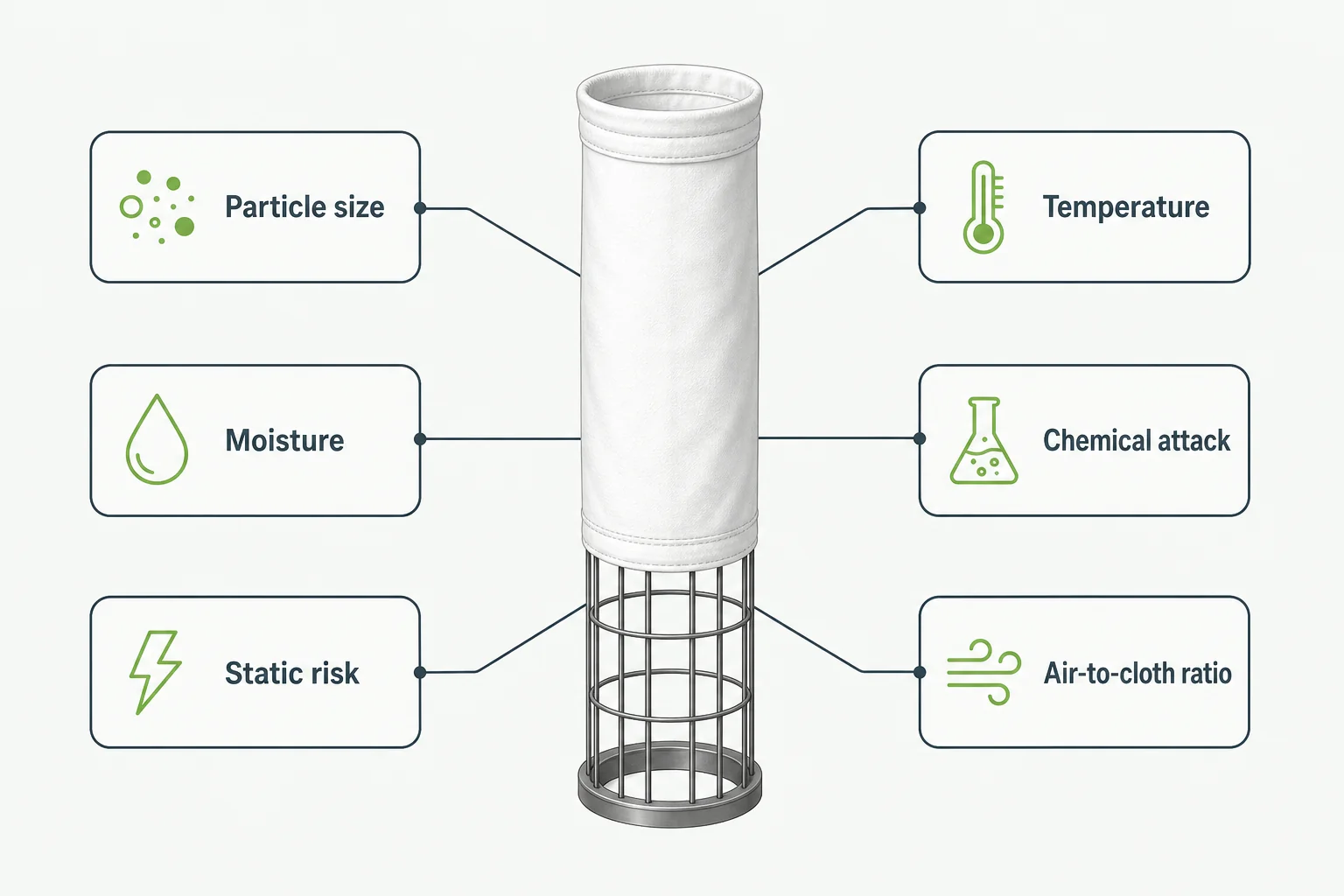
Particle size, moisture, chemical exposure, temperature, static risk and air-to-cloth ratio decide the right filter bag before brand or price.
These conditions also decide whether a bag collector is the right equipment at all. AIER supplies industrial dust collection systems across baghouse, pleated bag, cartridge and sintered plate designs, so the review can stay neutral about which filter element actually fits the dust. The full map of those platforms is in our types of dust collectors overview.
Pulse Jet Cleaning, Pressure Drop and Filter Bag Life
In a pulse jet collector, bag life is a balance between filtration and cleaning. Each pulse removes the dust cake, and each pulse also flexes the fabric against the cage. Too little cleaning lets pressure drop climb; too much cleaning wears the bags and pushes fine dust deeper into the felt.
Differential pressure across the bags is the single most useful health indicator. A typical pattern after new bags are installed:
- Break-in: pressure drop rises from very low values as a base dust cake forms. Filtration efficiency actually improves during this stage.
- Stable operation: pressure drop cycles in a steady band between cleaning pulses. Most collectors operate well in a range of roughly 750 to 1,500 Pa across the bags, depending on design.
- End of life: pressure drop stays high even right after cleaning, or the cleaning interval becomes very short. The felt is blinded with embedded dust or the cake no longer releases.
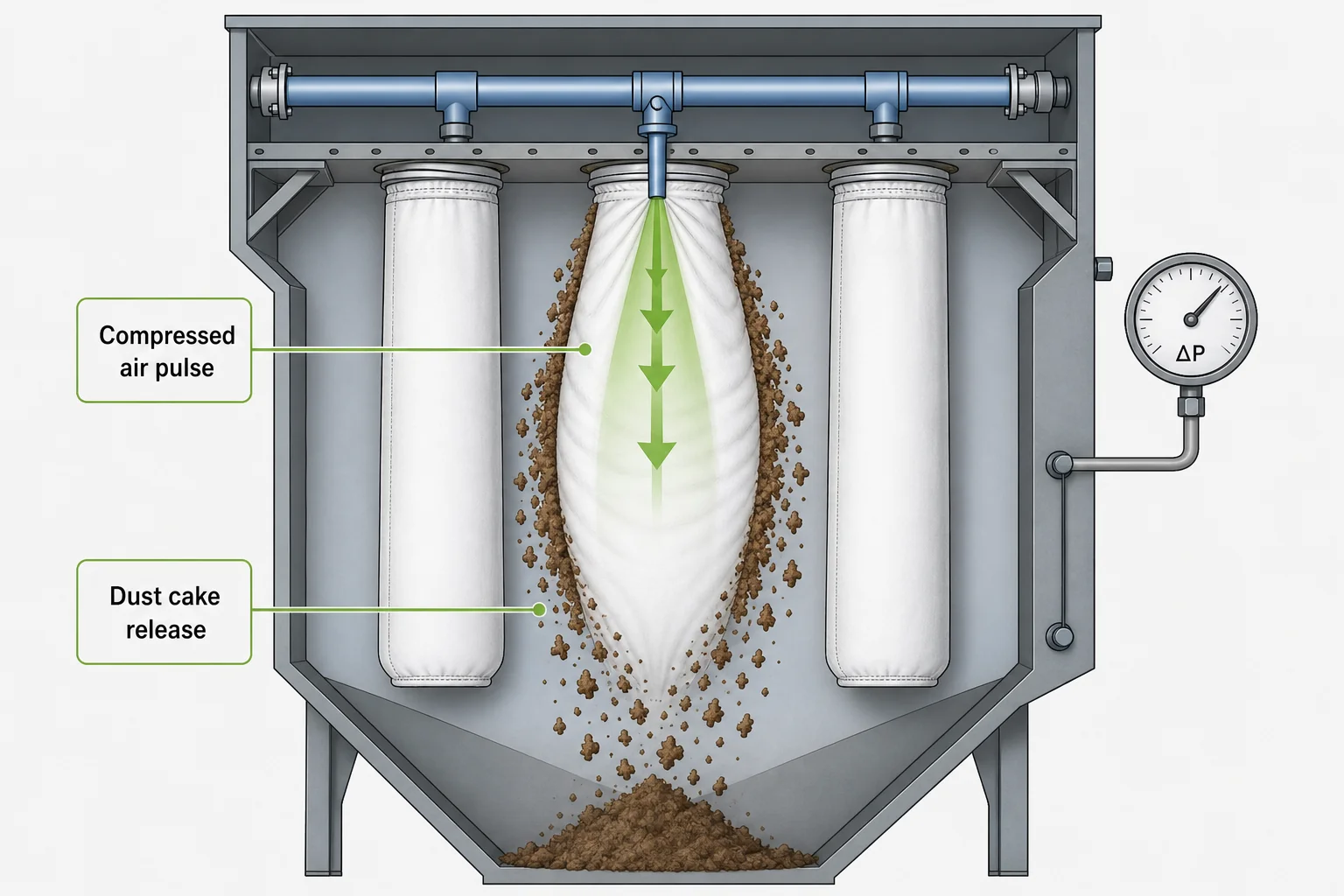
Compressed air pulses release the dust cake from each bag row. Differential pressure trends show whether cleaning still works or bags are blinding.
Keeping records matters more than any single reading. A slow upward drift of the after-cleaning pressure drop over months is normal aging; a sudden change usually means a mechanical problem such as a stuck pulse valve, compressed air loss, or a broken bag. Regulatory guidance treats bag leak monitoring and pressure drop trending as core practice for fabric filters, as described in the US EPA monitoring knowledge base for fabric filters.
When Should Dust Collector Bags Be Replaced?
There is no honest fixed lifetime for dust collector filter bags. The same bag can last six months in hot abrasive service and five years in clean ambient dust. Instead of a calendar, watch for these replacement signals:
- Pressure drop stays high after cleaning and cleaning cycles keep getting shorter: the felt is blinded.
- Visible dust at the stack or outlet: one or more bags are torn, or bags are loose at the tube sheet.
- Rising emissions on a broken bag detector or opacity monitor, even before dust is visible.
- Physical damage on inspection: holes, worn spots against the cage, burned or glazed fabric, acid damage, wet dust crusting.
- Falling airflow at the hoods: capture velocity drops because the fan can no longer pull design airflow through blinded bags.
- After an upset event: temperature spike, moisture carryover or a process leak that hit the whole bag set.
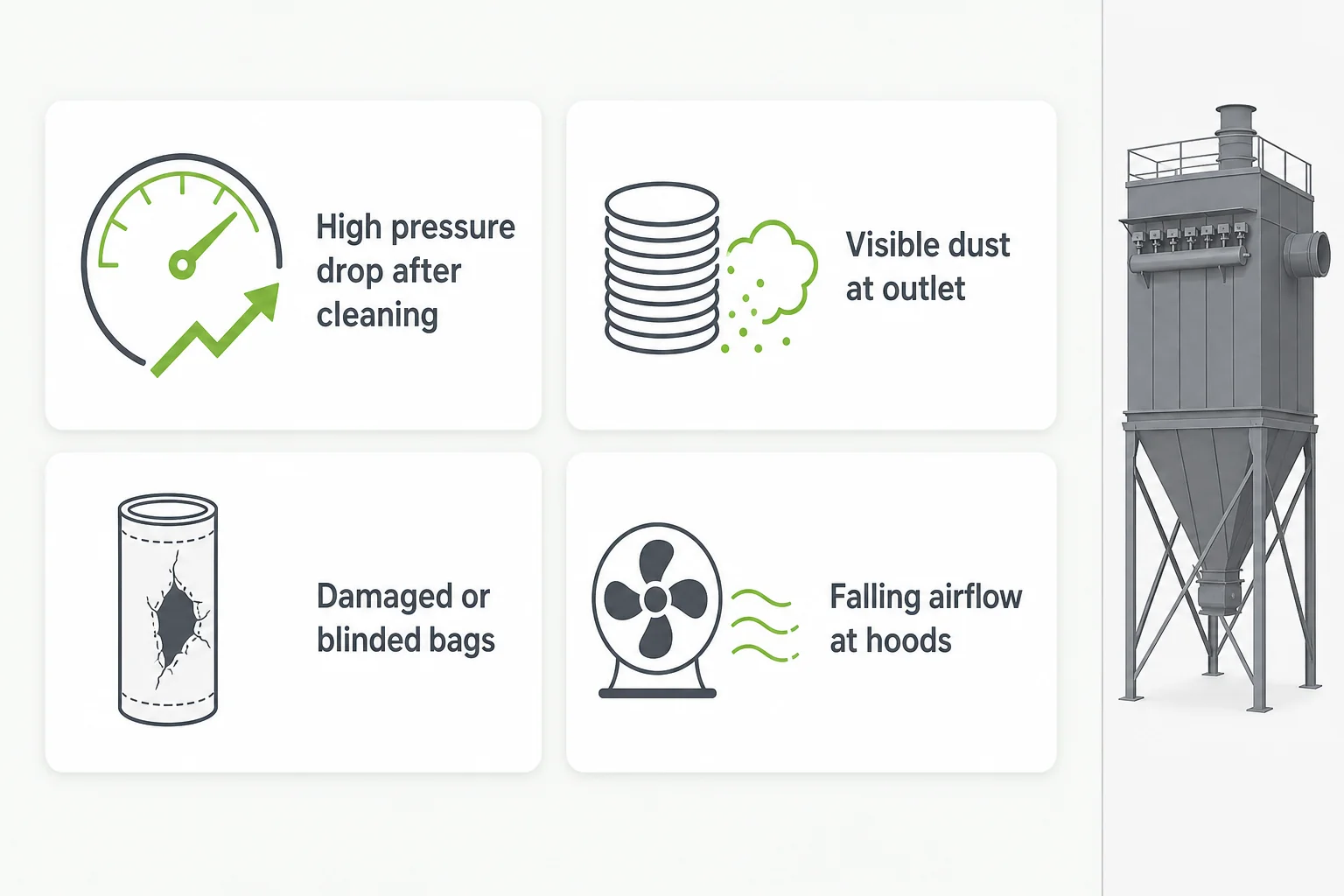
Replace filter bags on evidence, not on a fixed calendar: pressure drop behavior, outlet dust and inspection findings tell the real condition.
When one section of bags fails early and the rest look fine, the cause is usually mechanical: pulse pressure set too high, damaged cages, a misaligned blow tube, or inlet gas hitting one bag row directly. Replacing bags without fixing the cause repeats the failure at the same position. A full dust collector bag replacement is also the right moment to reconsider the fabric: if the old bags blinded early, a membrane finish or different fiber often pays for itself in the next cycle.
Filter Bags vs Pleated Bags vs Cartridges vs Sintered Plates
Round filter bags are not the only filter element. The same dust collection duty can often be solved with different element types, and the choice affects footprint, filtration area and maintenance cost.
| Filter Element | Best Fit | Limitations | AIER Product |
|---|---|---|---|
| Round filter bags | High dust loads, high temperature with the right fabric, fibrous or abrasive dust | Largest housing for a given filter area | Bag dust collector and round bag dust collector |
| Pleated bags | More filter area in the same housing, retrofit capacity upgrades, high dust concentration | Very sticky or fibrous dust can bridge pleats | Pleated bag dust collector |
| Flat / envelope bags | Height-limited installations, compact hoods and bins | Smaller single-unit airflow range | Flat bag dust collector |
| Cartridge filters | Fine dry dust at moderate loads, compact systems, welding and laser fume | Not for high humidity, sticky or heavy coarse dust | Cartridge dust collector |
| Sintered plates | Very long element life, wet or sticky fine dust, high-value process powder recovery | Higher initial investment | Sintered plate dust collector |
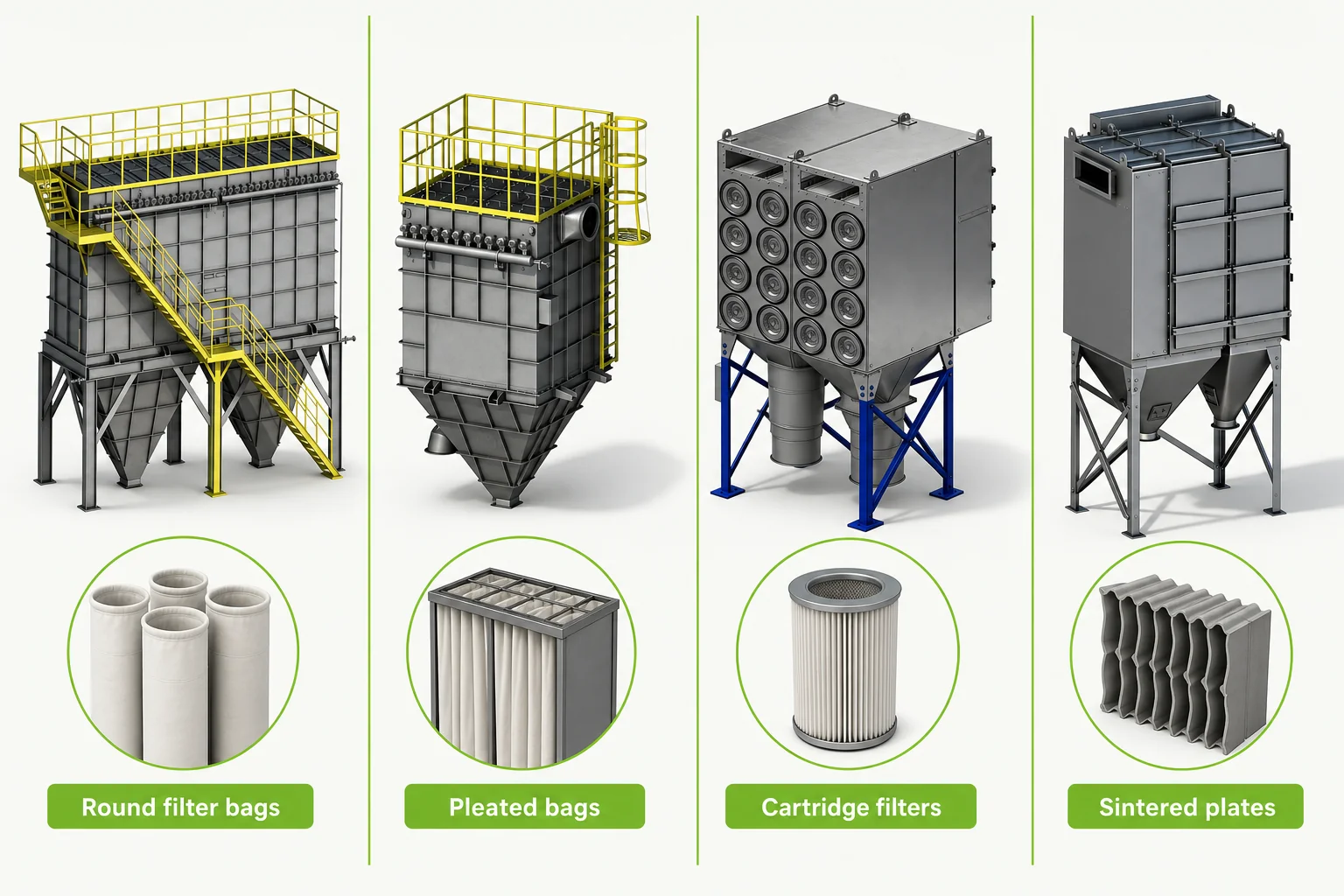
Round bags, pleated bags, cartridges and sintered plates each fit different dust loads, space limits and life expectations.
A useful rule: when an existing baghouse struggles, first check whether better bags solve it; when a new system is being planned, compare element types before locking the collector design. Dust collector filters are a consumable, but the collector around them is a 20-year decision.
Information Needed Before Asking for Replacement Bags or a New Collector
Whether you need one set of replacement bags or a complete collector, a supplier can only quote accurately with real operating data. Prepare this list:
- Dust type, source process and, if available, particle size range.
- Gas temperature: normal, peak, and whether moisture or condensation occurs.
- Any chemical exposure: acid gas, alkali, solvents, oil mist.
- Airflow and current pressure drop readings.
- Bag dimensions, quantity and current material, from the collector nameplate or old bag labels.
- Cleaning system type and compressed air pressure.
- Combustible dust status and any explosion protection requirements.
- What went wrong with the last bag set: blinding, tearing, burning, chemical attack.
AIER Environmental Protection designs and manufactures pulse jet bag collectors and complete dust collection systems, and supplies matching filter bags in polyester, aramid, PPS, P84, fiberglass and PTFE with membrane options. If you send the data above, our engineers can review your current bags, recommend a material, or size a new collector for the duty. Contact AIER with your dust and gas conditions to get a specific recommendation.
FAQ
How do I choose dust collector filter bags?
Start with dust type and continuous gas temperature, then check moisture, chemical exposure, static risk and the collector’s air-to-cloth ratio. Match those conditions to a fiber (polyester, aramid, PPS, P84, fiberglass or PTFE) and decide whether a PTFE membrane finish is justified by fine or sticky dust. Confirm bag dimensions and cage fit from the existing collector before ordering.
How often should dust collector filter bags be replaced?
There is no universal interval. Bag life depends on dust abrasiveness, temperature, moisture, cleaning intensity and material choice, so the same bag can last from months to several years. Replace bags when pressure drop stays high after cleaning, outlet emissions rise, or inspection shows damage, and track differential pressure trends to plan the change before a forced shutdown.
How do you clean dust collector filter bags?
During operation, the collector cleans the bags automatically with compressed air pulses; no manual action is needed. Washing or manually beating used industrial bags is generally not worth it: blinded felt rarely recovers its permeability, and handling dusty bags creates exposure risk. If cleaning pulses no longer restore pressure drop, plan a bag replacement instead.
What causes high pressure drop in filter bags?
Common causes are blinded fabric from fine or moist dust, a failed cleaning system (stuck pulse valves, low compressed air pressure, misaligned blow tubes), airflow above the design air-to-cloth ratio, or dust re-entrainment from an overfilled hopper. Check the cleaning system and operating data first; replace bags when the felt itself is saturated.
When are PTFE filter bags worth using?
Full PTFE bags are justified in chemically aggressive or hot humid gas where other fibers degrade quickly. PTFE membrane finishes on standard bags are worth it for fine dust emission limits, sticky or hygroscopic dust, and applications where stable low pressure drop saves fan energy. In mild ambient dust, standard polyester bags usually remain the economical choice.
What information does AIER need to review my filter bags?
Send the dust type, gas temperature and moisture, any chemical exposure, airflow, current pressure drop, bag dimensions and quantity, current bag material, and how the last bag set failed. With this data AIER can recommend a bag material and finish, or evaluate whether a different collector type fits the duty better.