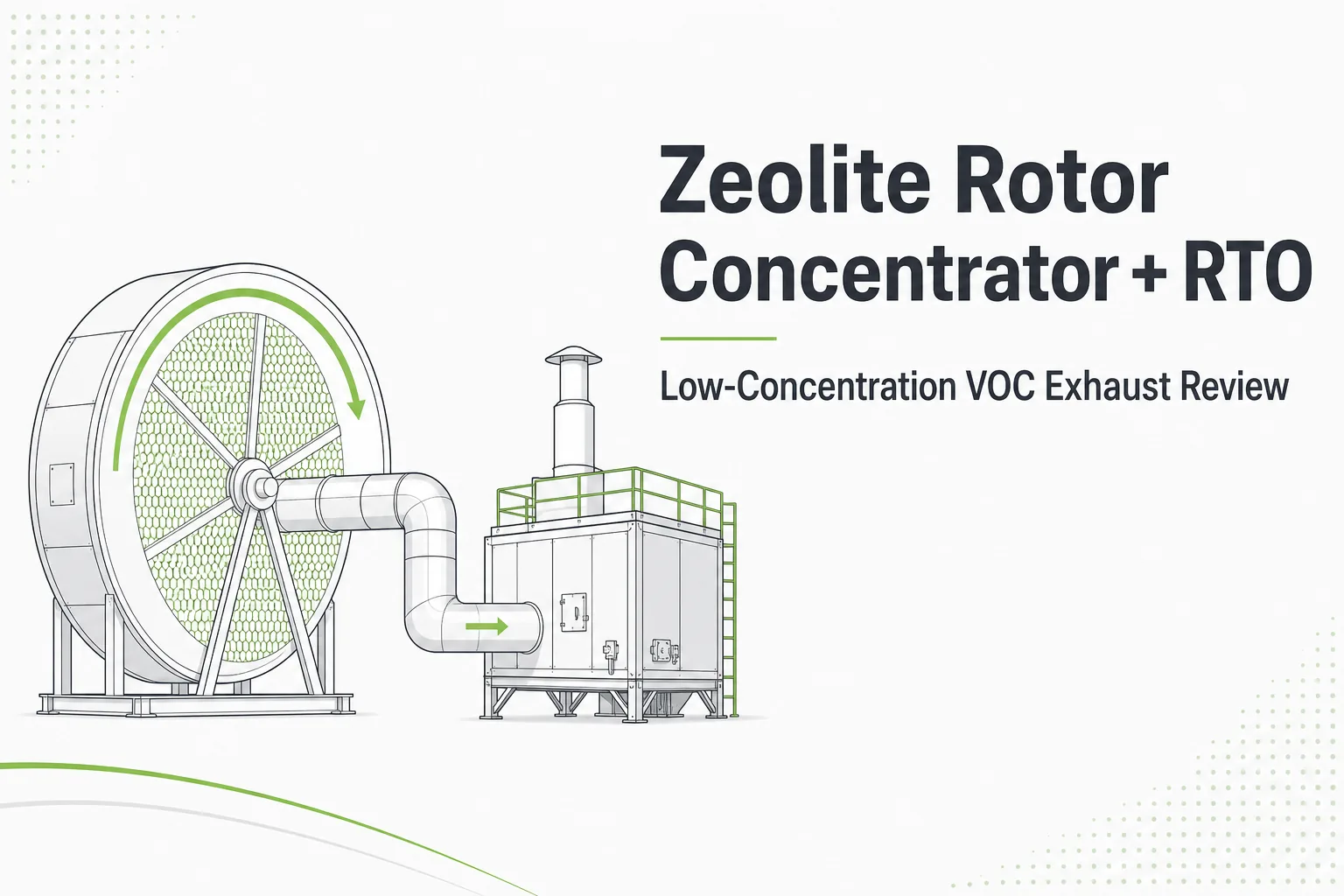
Some of the hardest VOC exhaust streams to treat economically are not the dirty ones — they are the huge, clean-looking ones. Coating lines, electronics plants and battery factories often move enormous air volumes carrying VOC concentrations too low to sustain combustion but too high to release. Oxidizing that stream directly means heating mostly air, and the fuel bill shows it.
The zeolite rotor concentrator exists for exactly this case. This article explains how the rotor works, why it is combined with a regenerative thermal oxidizer, where the combined route fits and where it does not, how it compares with other VOC treatment routes, and what data AIER needs to review a project. It is written for plant engineers, project buyers and EPC teams planning exhaust gas treatment systems. AIER’s catalog describes rotor concentration technology as part of its exhaust treatment scope; specific project configuration is a route review question, and this article does not replace engineering design or local emission requirements. Where the combined route sits among the other air pollution control equipment options is mapped in our overview.
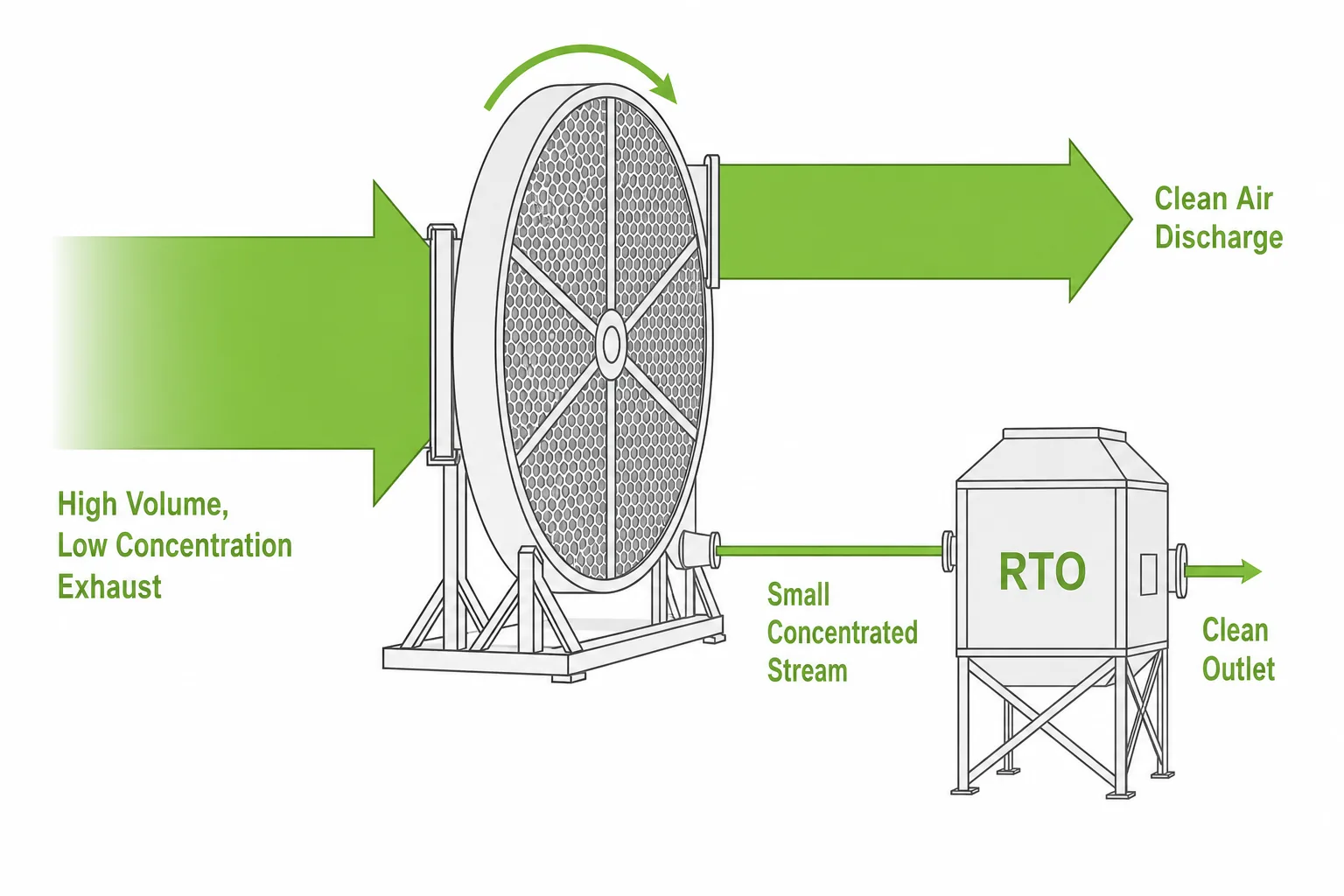
A zeolite rotor concentrator turns a large, dilute VOC exhaust stream into a small, concentrated stream that the downstream RTO can treat economically.
What Is a Zeolite Rotor Concentrator?
A zeolite rotor concentrator is a VOC pre-treatment device that concentrates high-volume, low-concentration exhaust into a high-concentration, low-volume stream, using a slowly rotating honeycomb wheel coated with zeolite adsorbent.
The same equipment appears under several names — VOC concentrator, rotary concentrator, rotor concentrator or zeolite wheel — and they all describe the same idea: instead of treating the full process airflow, capture the VOCs onto a wheel and hand the downstream equipment a stream that is a small fraction of the original volume.
The wheel itself, per the AIER catalog description, is made of a corrugated mineral fiber substrate synthesized with zeolite. The honeycomb structure gives the airflow a uniform, low-speed path with low pressure drop, the media tolerates temperatures up to 300°C and does not react with corrosive substances such as strong acids, and the system has few moving parts with no loose adsorbent to wear out — which is what allows continuous long-term operation.
How the Rotor Works: Adsorption, Desorption and Cooling Zones
The rotor turns slowly and continuously through three sealed zones, so every part of the wheel cycles through the same sequence: capture, release, cool down, repeat.
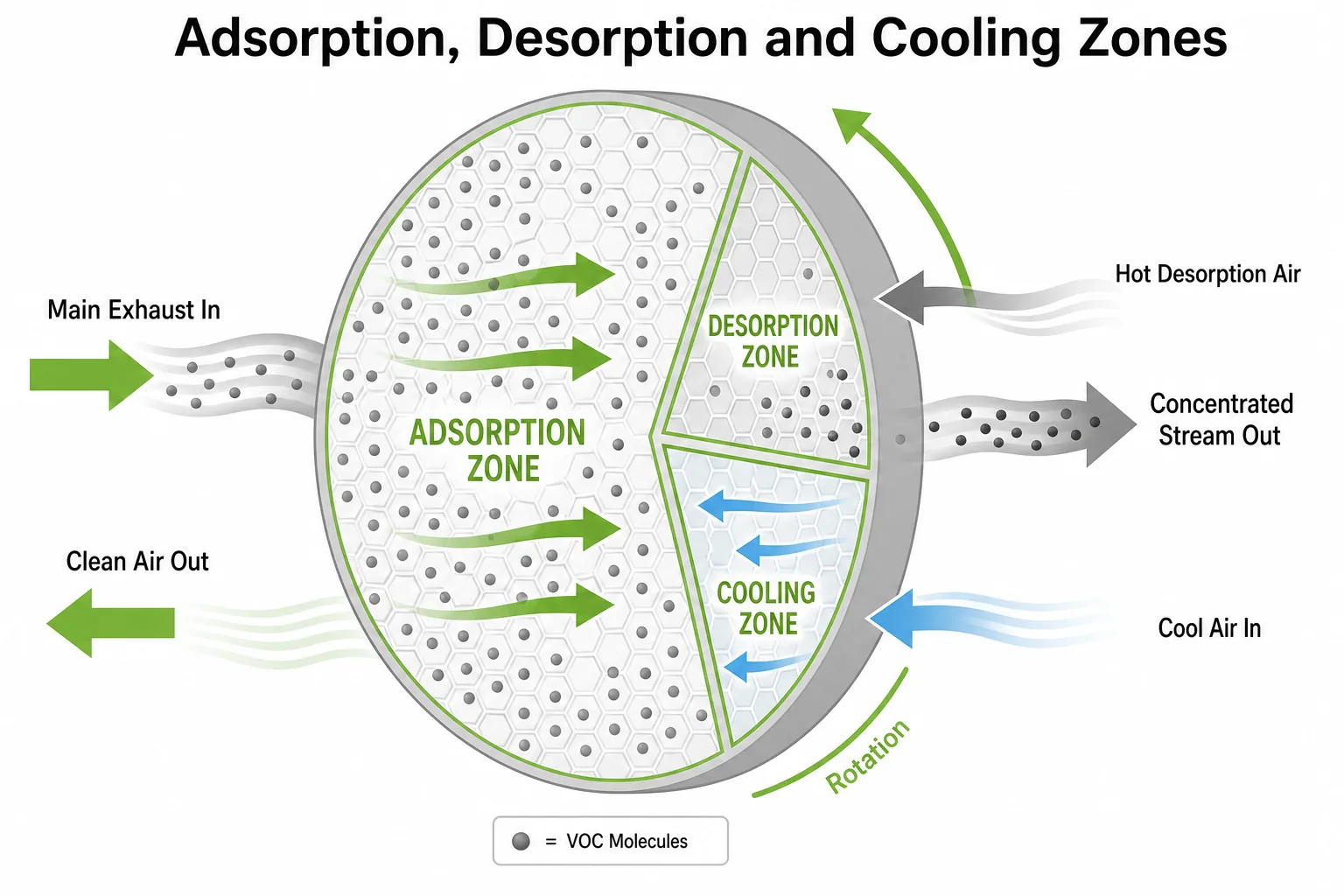
The rotor cycles continuously through adsorption, desorption and cooling zones, capturing VOCs from the main airflow and releasing them into a small hot stream.
- Adsorption zone: the main process exhaust passes through the largest section of the wheel. VOC molecules are retained on the zeolite surface, and the cleaned air is discharged.
- Desorption zone: a much smaller, heated airflow passes through a sealed sector in the opposite direction. The heat releases the adsorbed VOCs into this small stream, which leaves as the concentrated exhaust for downstream treatment.
- Cooling zone: before rotating back into adsorption duty, the hot media passes a cooling sector so it returns to a temperature where adsorption works again; the cooling air is typically reused as preheated desorption air.
Because the wheel rotates continuously, the system runs steady-state: the main airflow never stops for regeneration, unlike fixed carbon beds that must switch between adsorption and desorption. The actual zone proportions, rotation speed and desorption temperature are engineering decisions set for the specific solvent mix — they are project parameters, not numbers to copy from an article.
Why Combine a Concentrator with an RTO
A regenerative thermal oxidizer destroys VOCs reliably, but it must raise whatever airflow it receives to oxidation temperature. On a large, dilute stream, most of that heating effort goes into air, not pollutants — the fuel consumption question covered in our thermal oxidizer cost factors article.
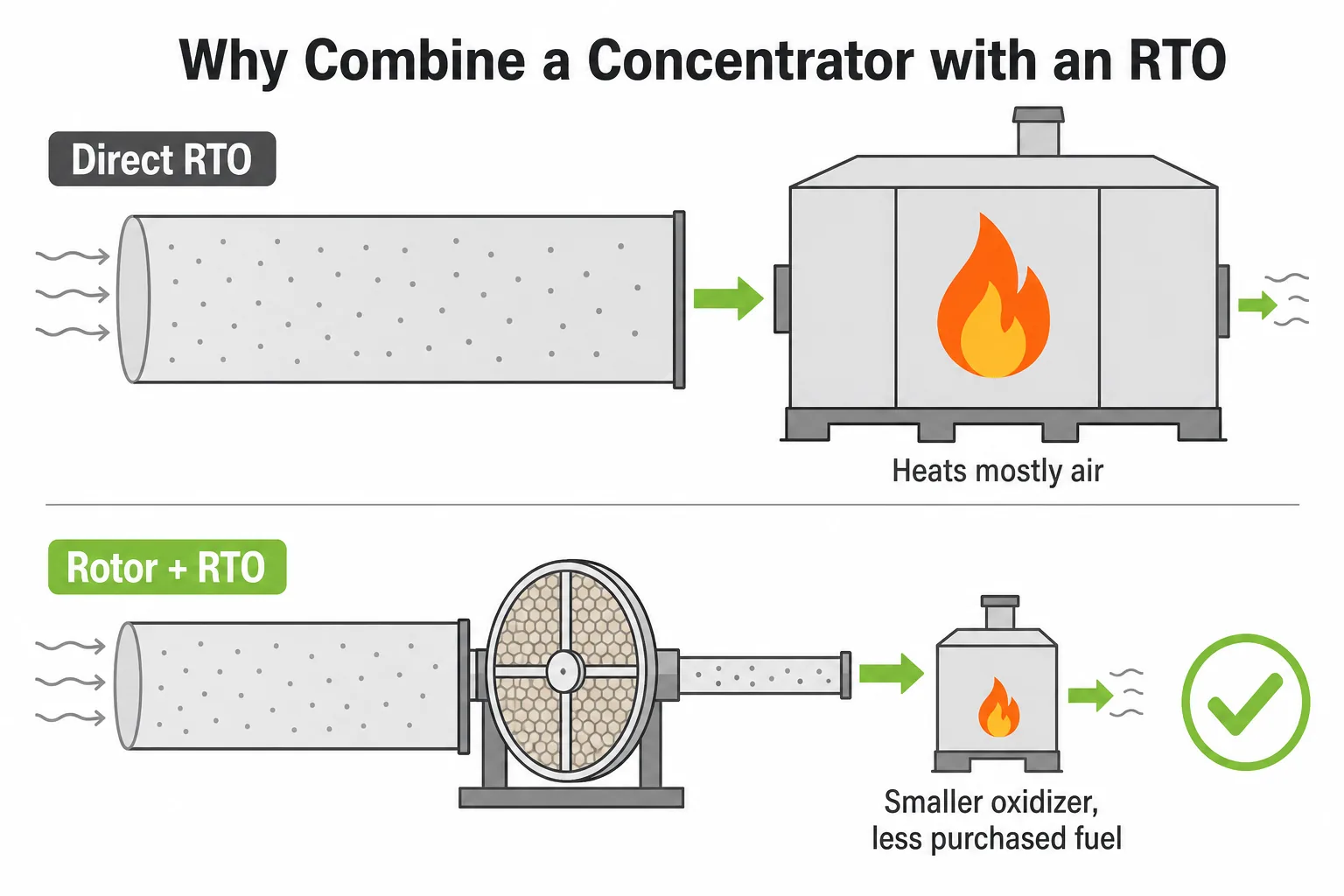
Concentrating the stream first means the RTO treats a fraction of the airflow at a higher concentration, which changes both the equipment size and the fuel demand.
Putting a zeolite rotor ahead of the oxidizer changes the arithmetic in two ways.
- Smaller oxidizer: the RTO is sized for the small desorption stream instead of the full process airflow, which reduces the equipment scale for the same duty.
- Richer stream: the concentrated exhaust carries far more VOC per cubic meter, so more of the oxidation heat comes from the pollutants themselves and less from purchased fuel.
This combined arrangement — sometimes abbreviated RCTO, for rotor concentrator plus thermal oxidizer — is why the zeolite rotor RTO pairing has become the standard review direction for high-volume, low-concentration VOC duty. The rotor does not destroy anything by itself; it reshapes the stream so the destruction step becomes economical.
Where the Combined Route Fits
The zeolite rotor RTO route earns its place where three conditions meet: large airflow, low VOC concentration, and continuous or long-shift operation that makes running cost matter.
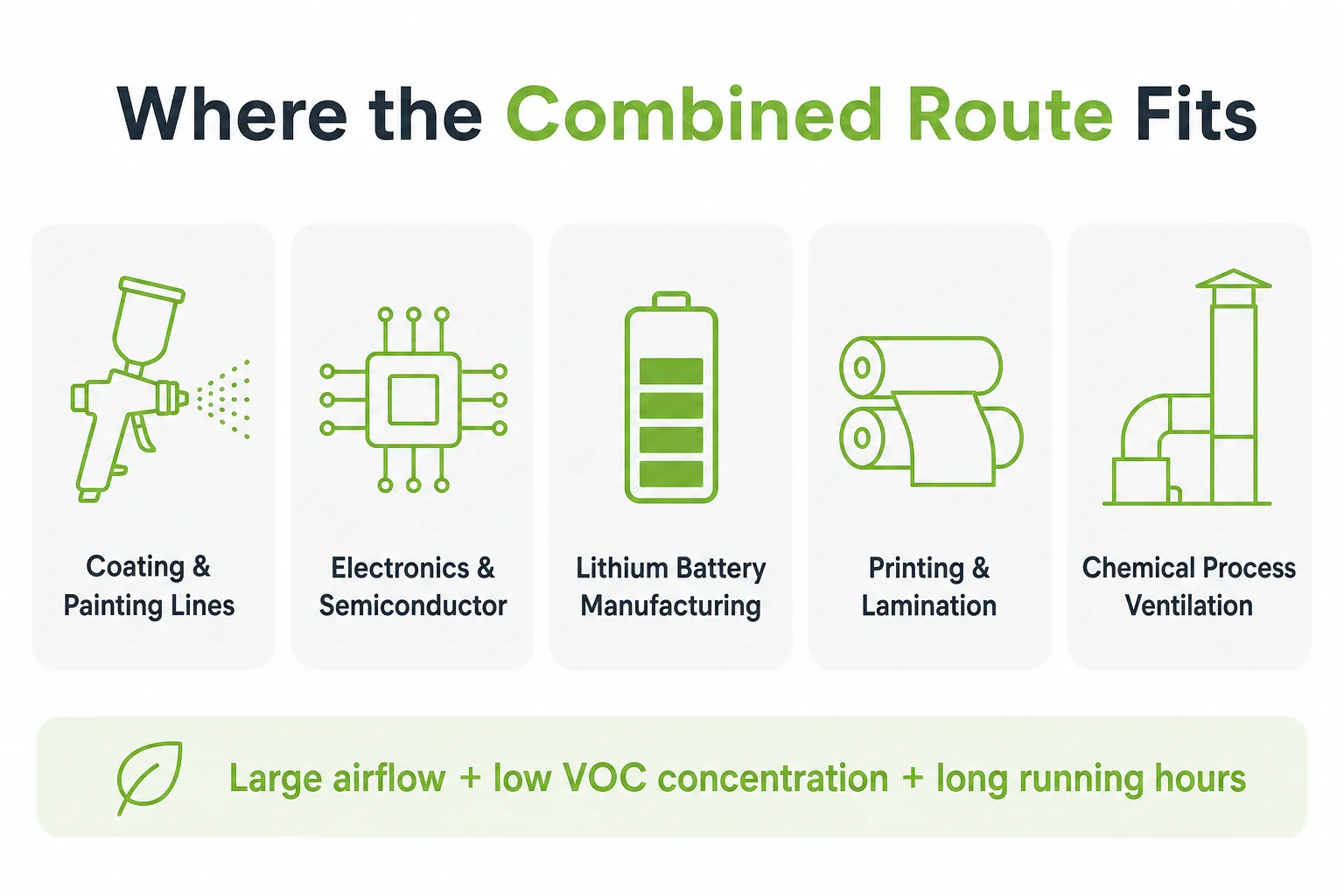
Typical applications include coating and painting lines, electronics and semiconductor exhaust, lithium battery manufacturing and printing — large airflows with dilute VOCs.
| Application | Why the Route Fits |
|---|---|
| Coating and painting lines | Spray booths and drying sections move large air volumes with dilute solvent vapor |
| Electronics and semiconductor plants | Continuous, high-volume ventilation exhaust with low but regulated VOC levels |
| Lithium battery manufacturing | Coating and drying exhaust in lithium battery manufacturing, where recoverable NMP duty is reviewed separately from general VOC duty |
| Printing and lamination | Long-running lines with steady, dilute solvent emissions |
| Chemical process ventilation | Room and tank ventilation streams too dilute for direct oxidation economics |
When a Zeolite Rotor Is Not the Right Fit
The rotor is a specialist, not a default. Several conditions push the review toward a different route, and they are all visible in the exhaust data before purchase.
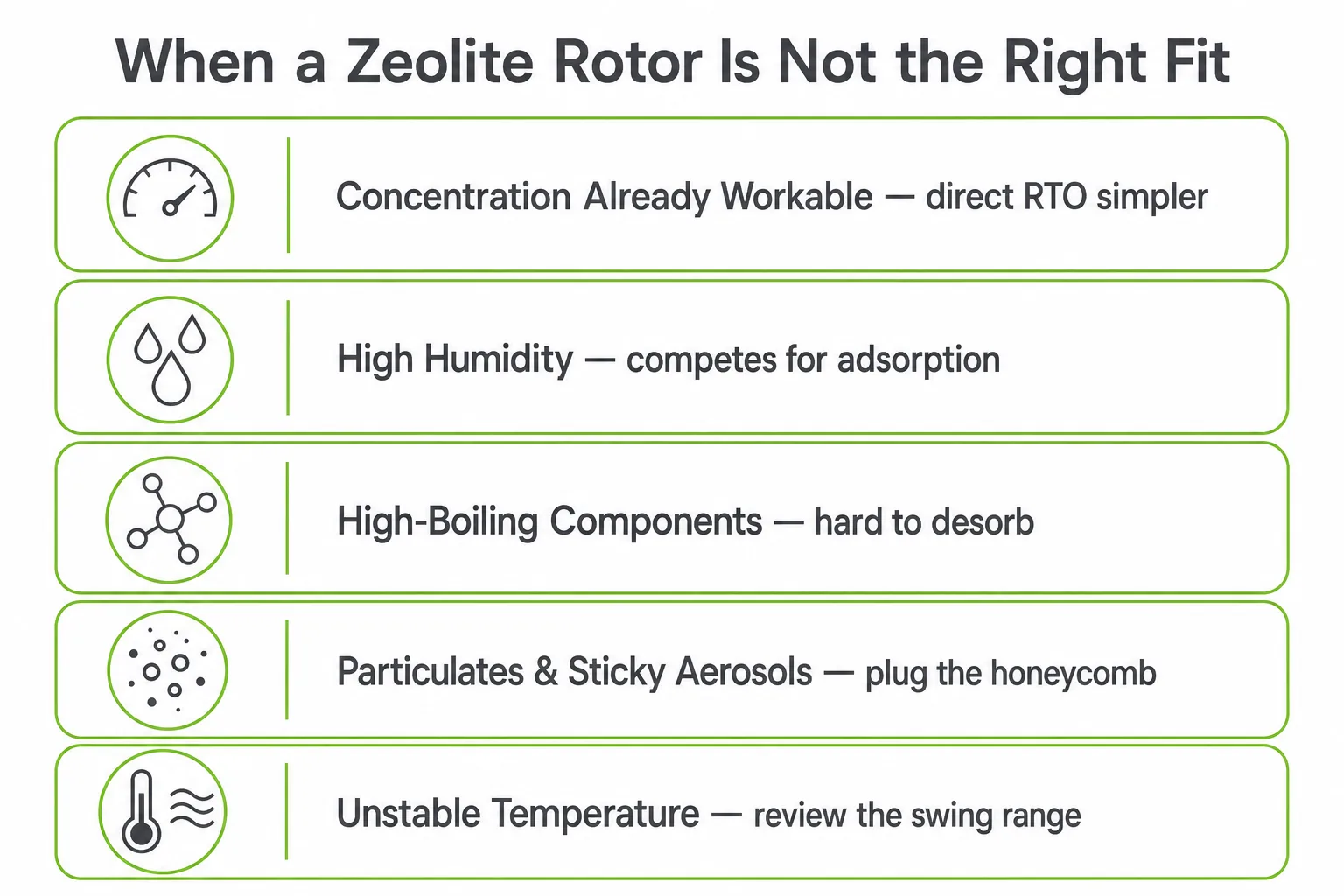
Higher concentrations, humid gas, high-boiling components and particulate load are the usual reasons a rotor route is reconsidered.
- Concentration is already workable: medium and higher VOC concentrations can go to the RTO directly — adding a rotor buys nothing when the stream already supports economical oxidation.
- High humidity: water vapor competes for adsorption capacity; very humid streams reduce the rotor’s effectiveness and belong in the review, not in a surprise after startup.
- High-boiling components: heavy solvents and plasticizer-like compounds desorb poorly and can accumulate on the media over time; the solvent list decides this, not the airflow.
- Particulates, oil mist and sticky aerosols: the honeycomb face plugs like any fine structure; these streams need pre-filtration or a different route entirely.
- Strong temperature swings: adsorption performance depends on inlet conditions; unstable processes need the swing range reviewed against the design point.
None of these rule the rotor out automatically — pre-treatment, conditioning or hybrid arrangements handle many of them — but each one must be declared and reviewed with the actual gas data.
Concentrator + RTO vs Other VOC Routes
The rotor route competes with three other standard answers to VOC exhaust, and the right choice follows the concentration, airflow and solvent value — the same comparison logic as our solvent recovery system vs RTO vs activated carbon review.
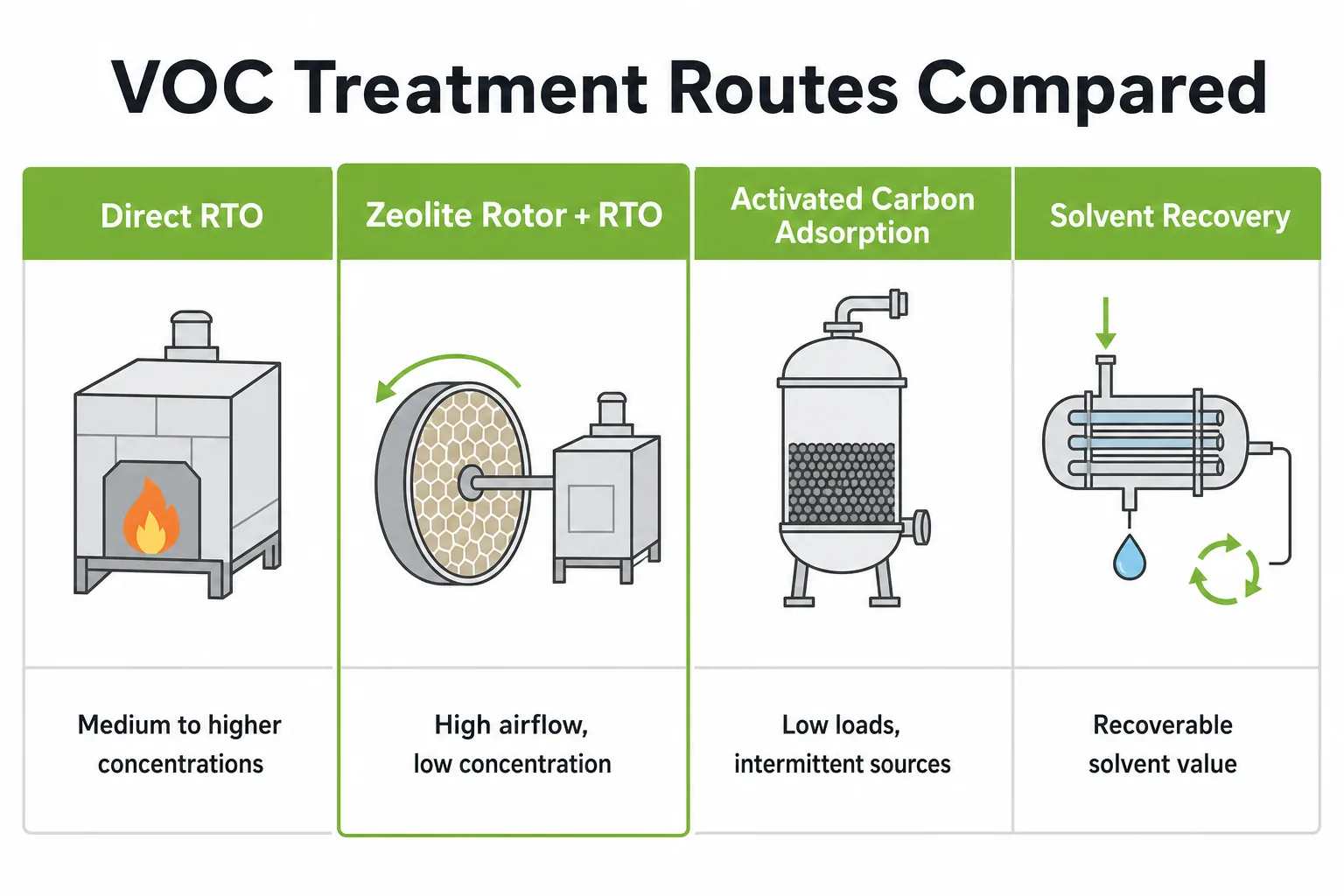
Route selection follows concentration, airflow, load stability and solvent value — the rotor plus RTO combination owns the high-volume, low-concentration corner.
| Route | Where It Fits | Review Points |
|---|---|---|
| Direct RTO | Medium to higher concentrations, stable continuous load | Fuel demand at the actual concentration, heat recovery use |
| Zeolite rotor + RTO | High airflow, low concentration, continuous operation | Humidity, solvent boiling range, particulate pre-treatment |
| Activated carbon adsorption | Low loads, intermittent sources, odor polishing | Media replacement pattern, humidity limits — see our activated carbon adsorption capacity review |
| Solvent recovery | Recoverable, valuable solvent such as NMP at usable concentrations | Solvent reuse value, stream consistency, recovery route review |
In practice the routes also combine: a rotor can feed a recovery step, and carbon polishing can follow an oxidizer. The comparison should be run against real exhaust data — concentration range, composition and run pattern — rather than equipment preference.
Common Mistakes When Reviewing a Rotor Concentrator Project
Most rotor disappointments AIER hears about trace back to review-stage gaps rather than the technology itself.
- Sizing on airflow alone: the concentration range and its swings decide whether the rotor helps; a nominal average hides the peaks and idle periods that break the economics.
- Ignoring humidity: the water content of the stream belongs in the first data request, not the commissioning report.
- Skipping the solvent list: one high-boiling component in an otherwise easy mix changes the desorption review; “mixed solvents” is not a specification.
- No pre-filtration plan: paint aerosols and dust reach the honeycomb face unless something stops them first.
- Treating the rotor as a standalone purchase: the rotor, desorption heating, RTO and fans are one system; buying them as separate line items invites mismatches.
- Skipping the route comparison: if nobody checked direct RTO, carbon or recovery against the same data, the project is choosing equipment, not solving the exhaust problem.
Information AIER Needs for a Rotor Concentrator Review
A zeolite rotor review moves fastest when the inquiry includes the exhaust picture instead of only an airflow number. This is the information AIER uses to judge whether the rotor RTO route — or a different route — fits the project.
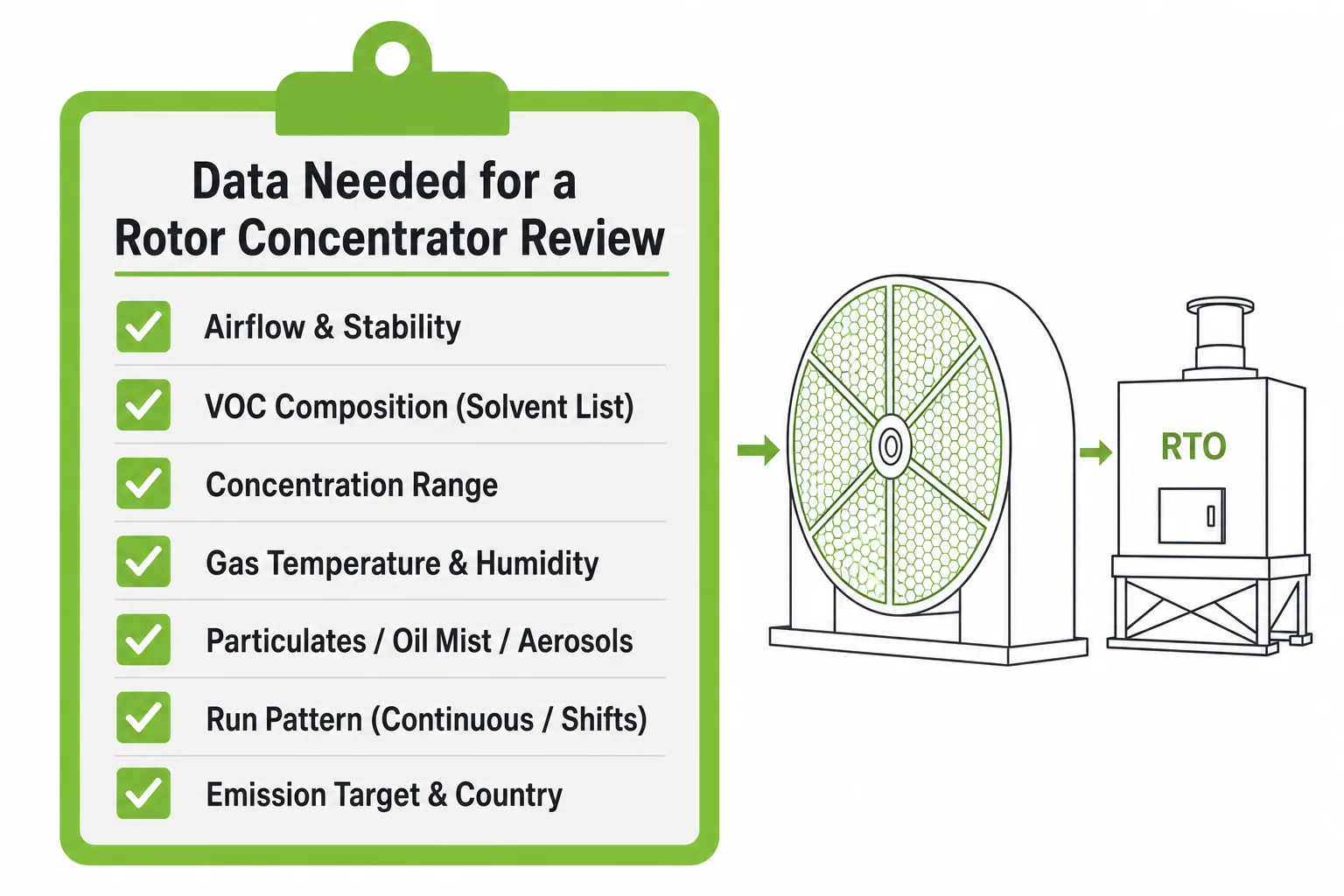
AIER reviews airflow, VOC composition, concentration range, temperature, humidity, particulate load and the emission target before recommending a route.
| Data to Prepare | Why It Matters |
|---|---|
| Airflow and how stable it is | Sets the scale and the turndown behavior of the whole system |
| VOC composition (solvent list) | Decides adsorption and desorption behavior, flags high-boiling components |
| Concentration range, not one number | Decides whether concentration helps and what the RTO actually receives |
| Gas temperature and humidity | Humidity competes for adsorption; temperature affects the design point |
| Particulates, oil mist or aerosols | Defines the pre-filtration stage in front of the wheel |
| Run pattern (continuous, shifts, batch) | Drives the running-cost comparison between routes |
| Emission target and installation country | Defines what the treated stream must achieve and project requirements |
If your plant moves large air volumes with dilute VOCs, contact AIER with your airflow, solvent list, concentration range, temperature, humidity and emission target. AIER will review whether a zeolite rotor with an RTO, a direct oxidation route, adsorption or a recovery arrangement fits your exhaust condition — with the reasoning shown.
FAQ
What is a zeolite rotor concentrator?
A zeolite rotor concentrator is a VOC pre-treatment device built around a slowly rotating honeycomb wheel coated with zeolite adsorbent. It captures VOCs from a large, dilute exhaust stream and releases them into a much smaller heated airflow, turning high-volume, low-concentration exhaust into a low-volume, high-concentration stream for downstream treatment.
How does a VOC concentrator work with an RTO?
The rotor adsorbs VOCs from the main airflow and desorbs them into a small hot stream, and the RTO oxidizes that concentrated stream instead of the full process volume. The oxidizer can be sized smaller, and because the concentrated stream carries more VOC per cubic meter, more of the oxidation heat comes from the pollutants and less from purchased fuel.
When is a rotor concentrator worth adding before an RTO?
When the exhaust combines large airflow, low VOC concentration and long running hours. In that corner, direct oxidation spends most of its fuel heating air, and the rotor changes the economics. At medium and higher concentrations, a direct RTO route is usually simpler and the rotor adds little.
What exhaust conditions are difficult for a zeolite rotor?
High humidity competes with VOCs for adsorption capacity, high-boiling solvent components desorb poorly and can accumulate on the media, and particulates or sticky aerosols plug the honeycomb face without pre-filtration. These conditions do not always rule the route out, but each must be declared and reviewed with real gas data.
Does AIER supply zeolite rotor concentrator systems?
AIER’s exhaust gas catalog describes rotor concentration technology with a zeolite wheel as part of its treatment scope, alongside RTO, scrubber and activated carbon systems. Specific project configuration is handled as a route review: AIER evaluates the exhaust data first and recommends the arrangement, rather than quoting a rotor as an off-the-shelf item.
What information is needed for a rotor concentrator quote?
Provide the airflow and its stability, the solvent list, the VOC concentration range, gas temperature and humidity, any particulate or aerosol load, the run pattern, the emission target and the installation country. AIER reviews the rotor RTO route against direct oxidation, adsorption and recovery on the same data before recommending a configuration.