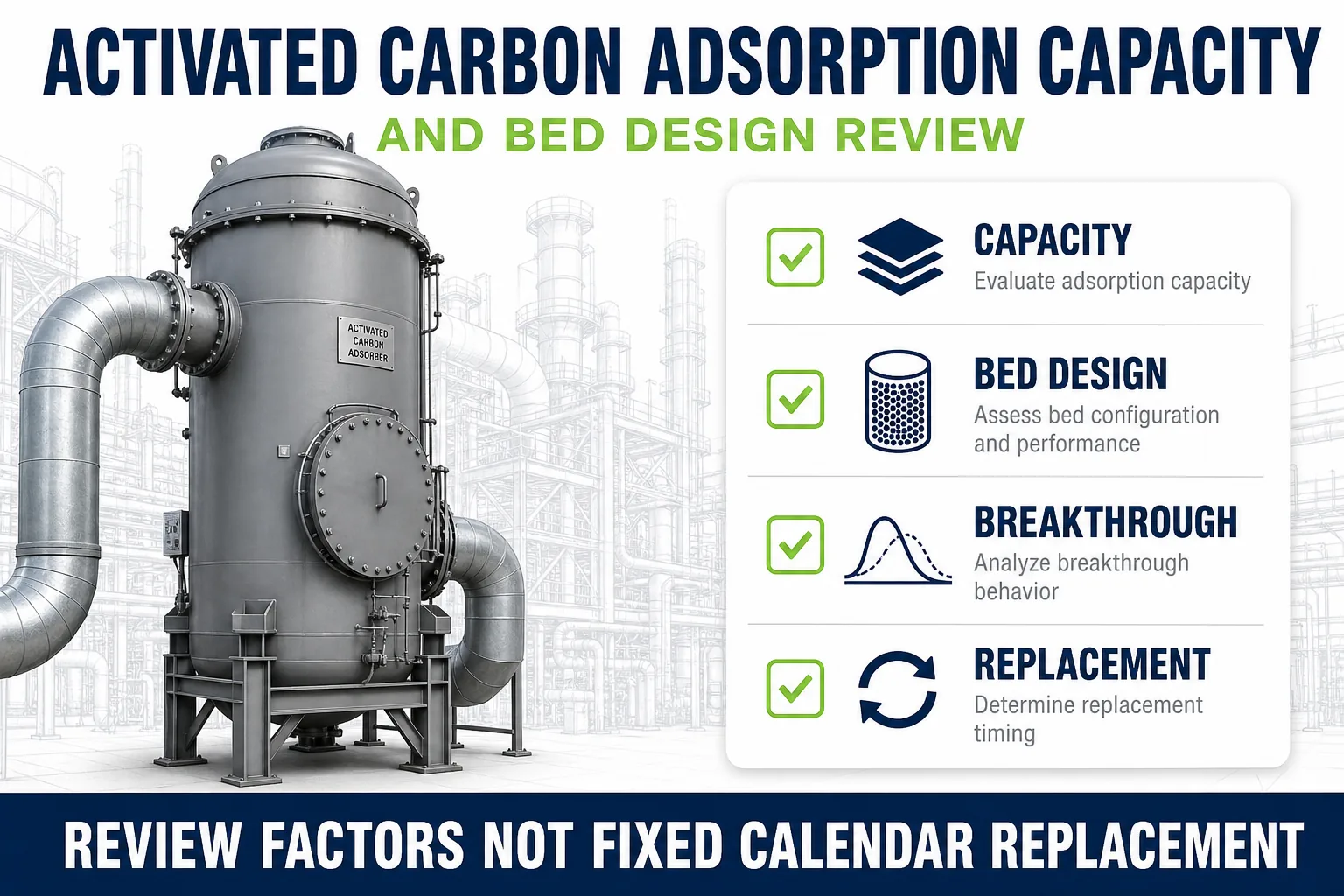
Activated carbon adsorption capacity is one of the first technical questions buyers ask when reviewing low-concentration VOC or odor exhaust, but useful answers start with bed design and operating factors rather than one published capacity value. Bed depth, face velocity, carbon type, humidity and run hours all change how much usable capacity a carbon bed adsorber delivers in real plant operation.
This article explains activated carbon bed design, loading review, breakthrough signals and replacement review points for industrial VOC and odor exhaust. It is written for plant engineers, project buyers and EPC teams reviewing exhaust gas treatment systems. AIER supplies activated carbon adsorption units with optimized airflow distribution, granular or honeycomb media options and safety-related design features, but does not publish fixed replacement intervals or guaranteed adsorption capacity numbers. Where carbon adsorption sits among the other treatment routes is mapped in our air pollution control equipment overview. This article does not replace project quotation, local codes or site-specific engineering review.
What Affects Activated Carbon Adsorption Capacity?
Activated carbon adsorption capacity is the amount of pollutant a carbon bed can retain under specific exhaust conditions before performance drops—not a single material property that applies to every VOC stream without review.
An industrial activated carbon adsorption system passes exhaust through a porous carbon bed where VOCs and odorous compounds are retained on the media surface. Effective voc adsorption capacity therefore depends on how the bed is sized, how uniformly gas flows through the carbon and how demanding the actual exhaust composition is. Buyers who compare systems using only equipment price or catalog airflow often miss the factors that control replacement timing and outlet performance.
| Capacity Factor | What It Changes | Review Question |
|---|---|---|
| VOC species and concentration | How strongly each compound adsorbs and how fast the bed loads | Is the review based on average, peak or worst-case concentration? |
| Humidity and temperature | Competition for adsorption sites and overall loading behavior | Does the stream stay within the intended operating range? |
| Bed depth and carbon volume | Contact time and total media available for loading | Is the bed sized for the actual duty, not only nominal airflow? |
| Face velocity and distribution | Whether all parts of the bed work evenly | Is flow uniform enough to avoid early local breakthrough? |
| Operating hours | How quickly cumulative loading builds over time | Is replacement planning based on run hours and loading together? |
According to the EPA overview of adsorption for VOC control, adsorber performance depends on exhaust characteristics, bed design and operating conditions—not on one universal capacity label.
Activated Carbon Bed Design Factors
Activated carbon bed design factors are the physical layout choices that control contact time, flow uniformity and the amount of media available for loading in a carbon adsorber.
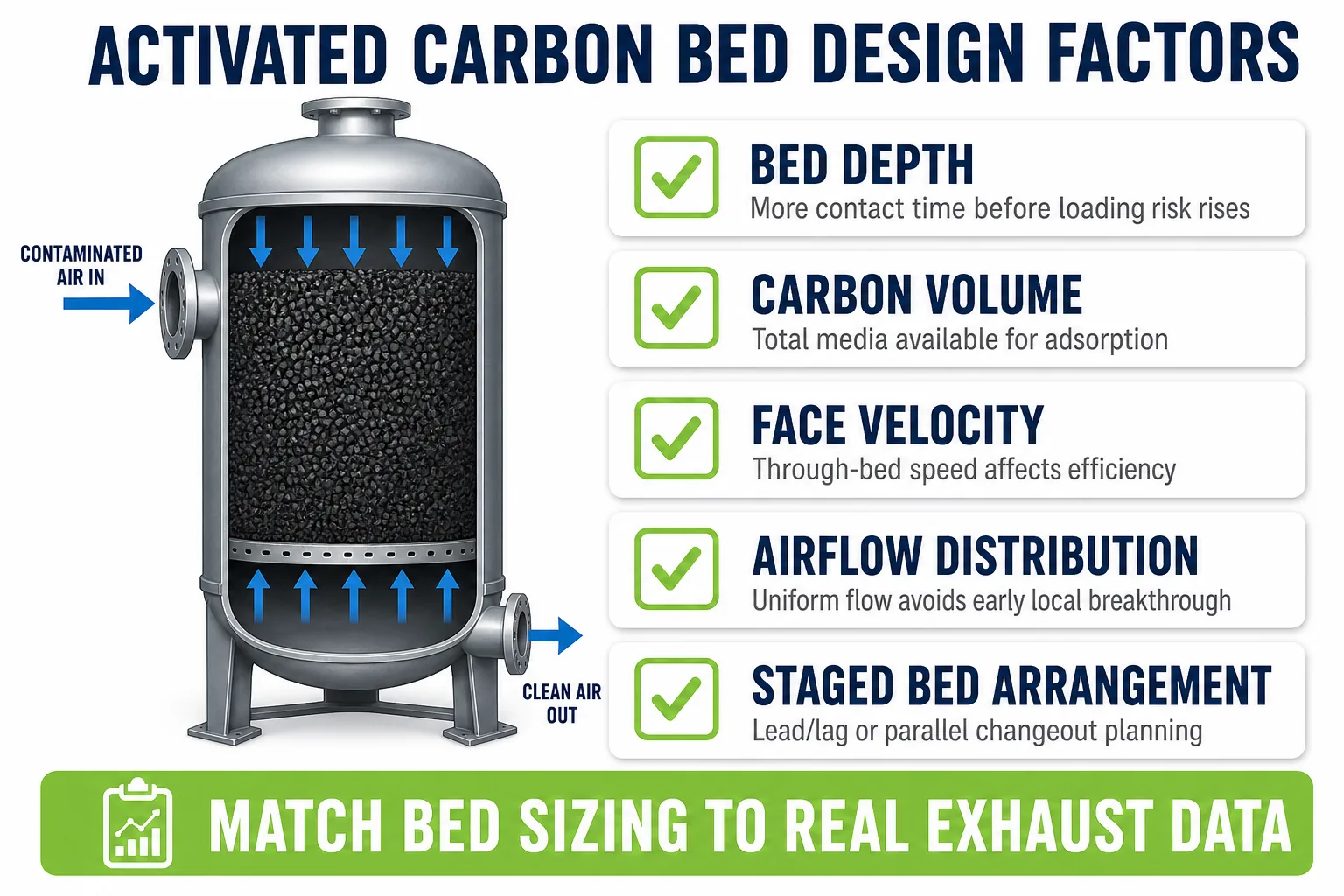
Bed depth, face velocity, airflow distribution and carbon volume are core activated carbon bed design factors for industrial VOC exhaust.
| Bed Design Factor | What It Affects | Why Buyers Should Review It |
|---|---|---|
| Carbon bed depth | Residence time and total loading volume before breakthrough risk rises | Shallow beds may load out faster under the same airflow |
| Carbon loading volume | Total media available for adsorption in the vessel | AIER AR-AC units are sized with defined carbon volumes for each airflow class in project review |
| Face velocity through the bed | Contact efficiency and channeling risk | AIER catalog data uses through-bed wind speed of ≤0.6 m/s as a design reference for AR-AC units |
| Airflow distribution | Whether the full bed area is used evenly | Poor distribution can cause early local breakthrough while average readings still look acceptable |
| Single bed vs staged beds | Operating flexibility and changeout planning | Lead/lag or parallel arrangements can extend effective service when one bed is changed out |
Catalog airflow for AR-AC units is expressed in m³/h, which should be matched to actual exhaust volume during review rather than assumed from generic sizing rules alone.
Adsorption Capacity and Loading Review Points
Adsorption capacity review points compare how much loading the carbon bed can accept under real exhaust conditions versus what a nominal material rating might suggest on paper.
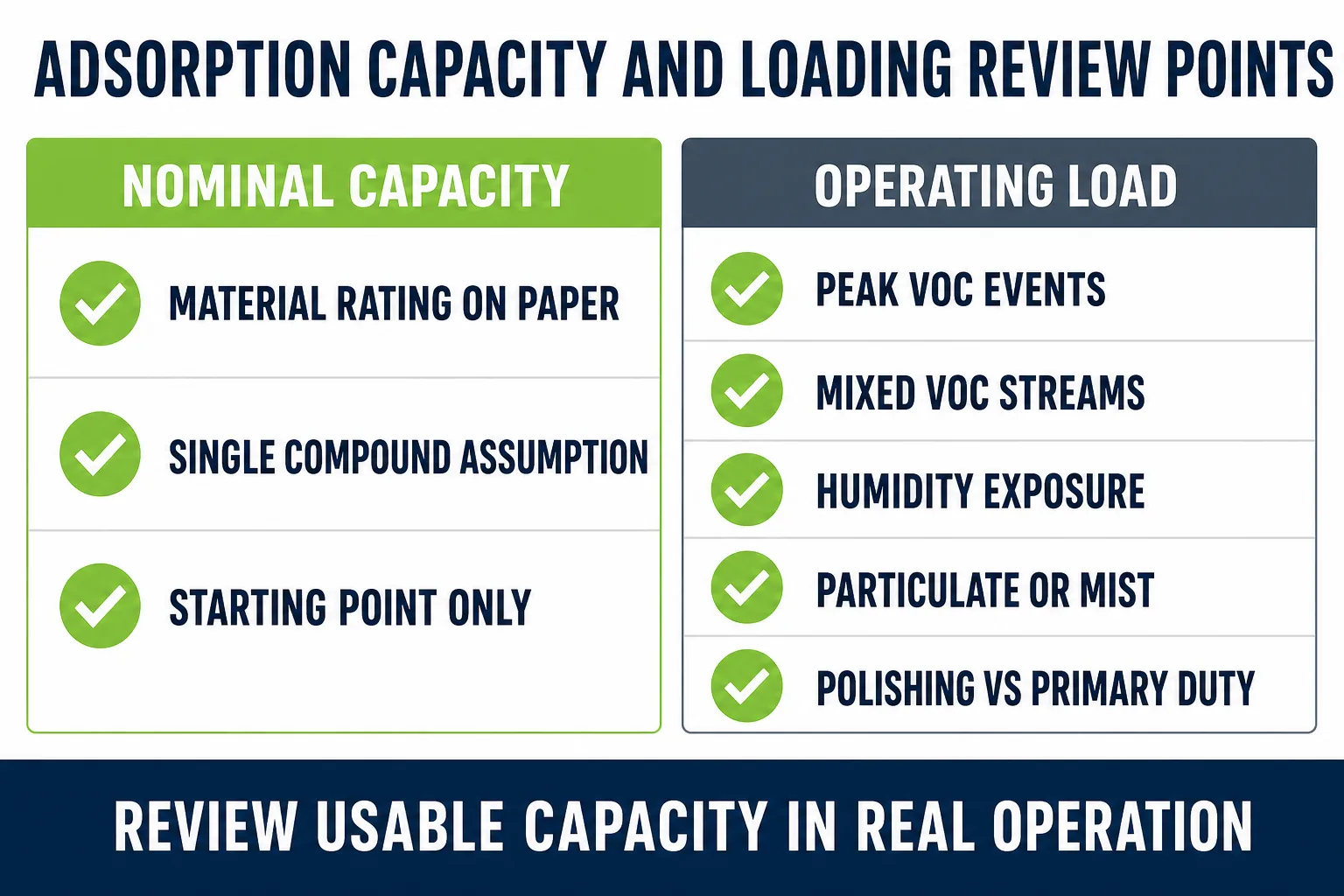
Nominal capacity is only a starting point; humidity, peak loading and mixed VOC streams change usable adsorption capacity in operation.
| Review Point | What to Check | Why It Matters |
|---|---|---|
| Nominal vs operating load | Whether review uses average or peak VOC loading | Peak events can drive breakthrough sooner than average data suggest |
| Single-compound vs mixed VOC | Competition between adsorbing species in the same bed | Mixed streams can reduce effective capacity for the target compound |
| Humidity exposure | Moisture uptake competing with VOC adsorption sites | Humid exhaust often reduces usable VOC capacity |
| Particulate or mist carryover | Whether upstream protection is included | Fouling can block flow paths and shorten effective bed life |
| Polishing vs primary treatment duty | Whether carbon is the main route or final stage | Polishing duty may fit carbon better than high-loading primary treatment |
Activated carbon voc removal performance should be reviewed as a system outcome—bed design plus operating data—not as a standalone media claim.
Breakthrough Signals Buyers Should Watch
Breakthrough signals are the operating changes that suggest the carbon bed is nearing the end of useful adsorption capacity for the current loading duty.
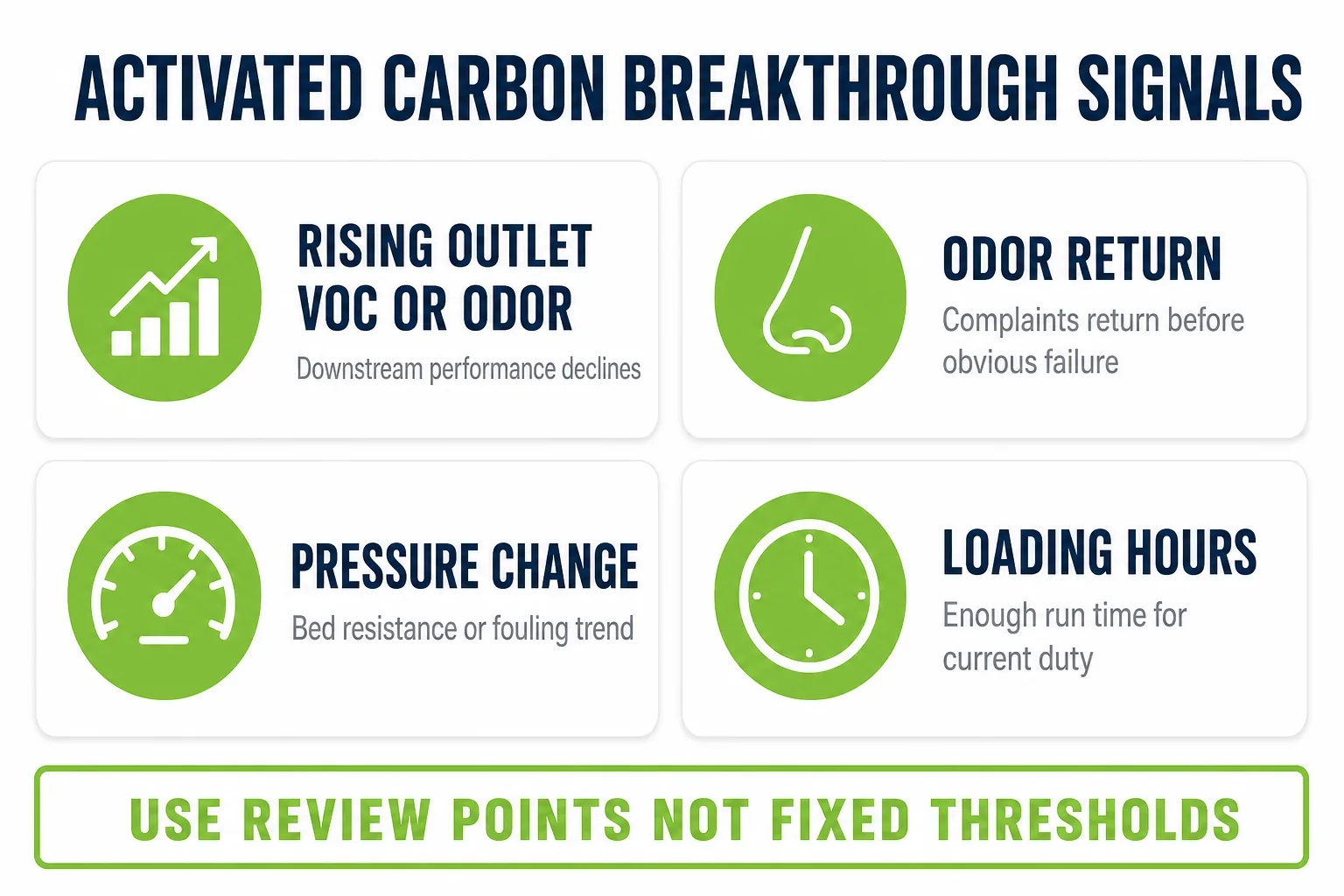
Breakthrough often appears as rising outlet concentration, odor return, pressure behavior change or enough loading hours for the current duty—not on a fixed calendar alone.
| Breakthrough Signal | What Buyers May Observe | Recommended Response |
|---|---|---|
| Rising outlet VOC or odor | Downstream concentration or odor intensity increases | Compare against inlet conditions and confirm whether loading has increased |
| Odor return in occupied areas | Complaints return even though the unit still runs | Review whether odor breakthrough is occurring before visible VOC trend changes |
| Pressure drop change | Bed resistance rises as pores fill or fouling builds | Check whether the change is loading-related or maintenance-related |
| Longer run hours at higher load | Cumulative exposure increases without a changeout plan | Plan review based on loading history, not calendar guesswork alone |
| Uneven bed use | Local breakthrough before average bed exhaustion | Review distribution, velocity and vessel internals during inspection |
Buyers should treat breakthrough as a review trigger, not as one fixed numeric threshold that applies to every VOC application without data.
Granular vs Honeycomb Activated Carbon Selection
Granular and honeycomb activated carbon selection depends on exhaust composition, allowable pressure drop, changeout access and the type of loading duty the bed must handle.
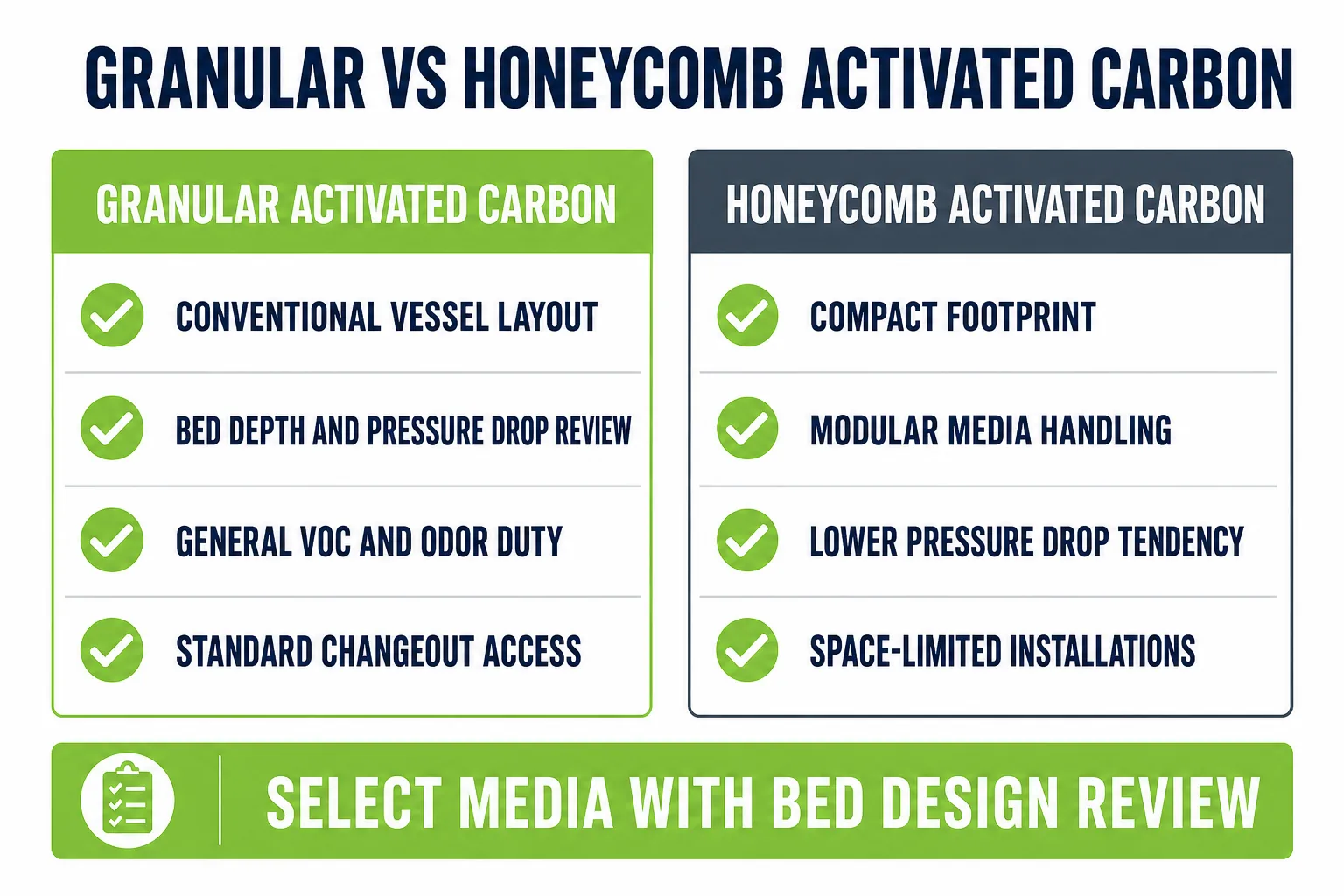
Granular, honeycomb or customized adsorption media can be selected according to exhaust composition and treatment requirements.
| Media Type | Typical Review Focus | When It Often Fits |
|---|---|---|
| Granular activated carbon | Bed depth, pressure drop, changeout method | General industrial VOC and odor applications with conventional vessel layouts |
| Honeycomb activated carbon | Compact footprint, lower pressure drop, module handling | Space-limited installations or modular changeout preferences |
| Customized adsorption media | Target compound compatibility and vendor review | Special VOC mixtures or project-specific treatment requirements |
Media selection should support the bed design review, not replace it. A better carbon type cannot fully offset insufficient bed volume or poor flow distribution.
Humidity, Temperature and Multi-Component Effects
Humidity, temperature and multi-component exhaust streams can reduce effective adsorption capacity even when nominal airflow and carbon volume appear adequate on paper.
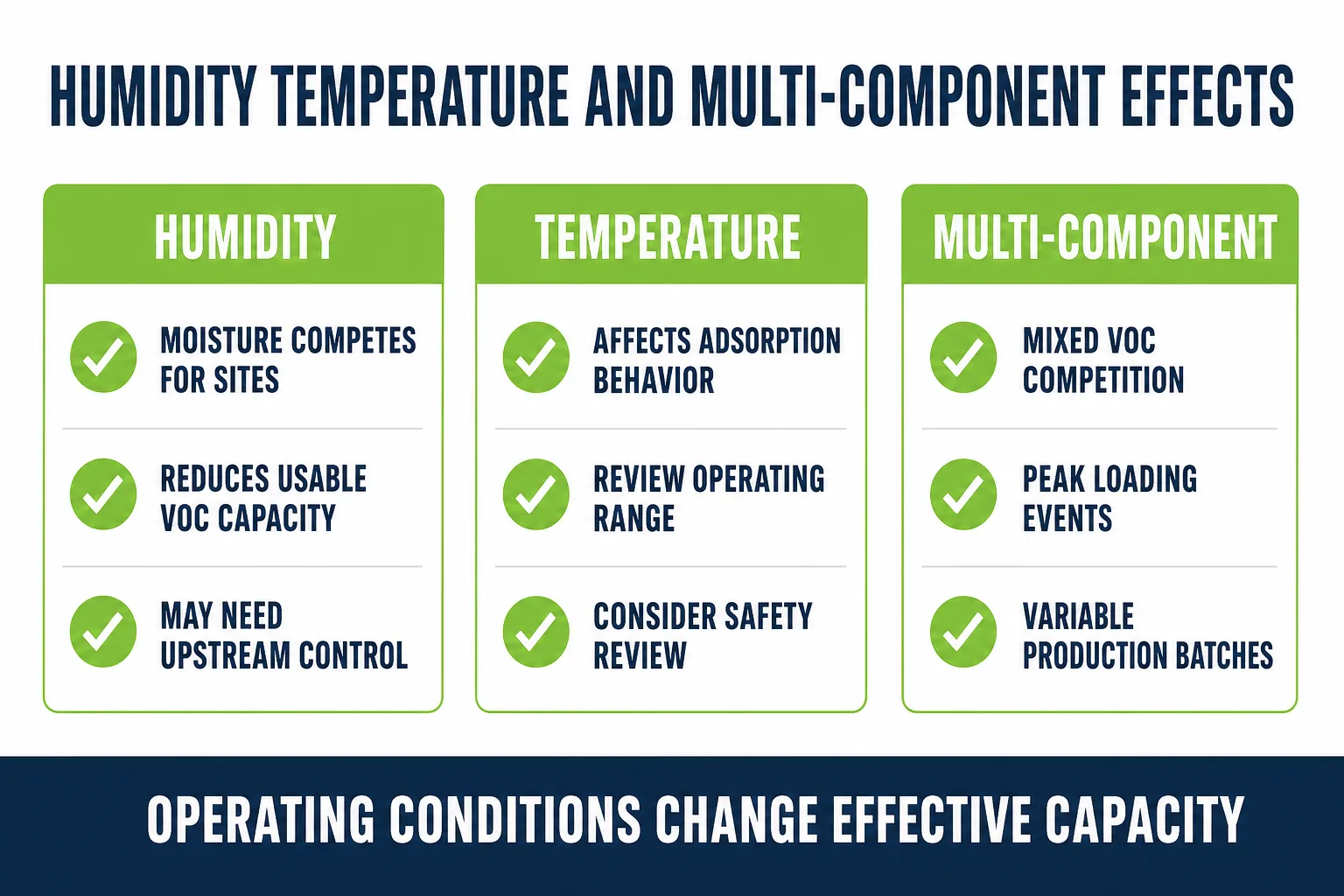
Humidity, temperature and mixed VOC composition can all reduce usable adsorption capacity and change replacement review timing.
- High humidity: moisture can occupy adsorption sites and reduce VOC retention efficiency.
- High temperature: may affect adsorption equilibrium and downstream safety review for some streams.
- Mixed VOCs: stronger or more volatile components can affect loading order and perceived bed life.
- Variable production: batch peaks may drive breakthrough faster than average concentration data suggest.
- Upstream moisture control: may be needed when the exhaust is consistently wet and carbon is the primary route.
These effects are why AIER reviews carbon consumption and replacement planning from exhaust condition and carbon loading volume rather than from one generic schedule.
When Activated Carbon Fits Better Than an RTO or Scrubber
Activated carbon often fits low-concentration VOC, odor control or polishing duty, while higher-concentration continuous VOC streams may need thermal oxidation and acid or soluble gas streams may need wet treatment instead.
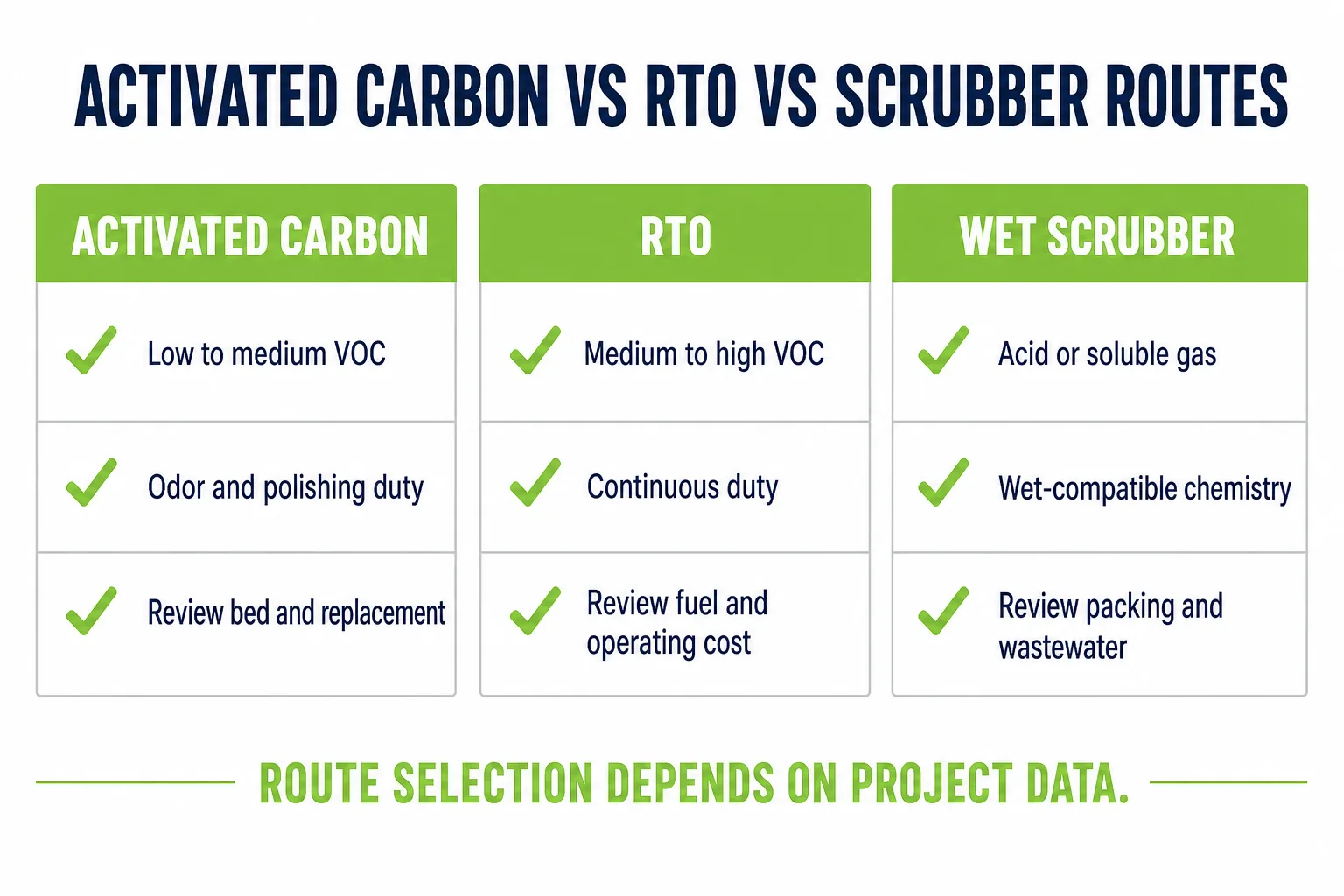
Route selection depends on concentration, chemistry, operating hours and whether carbon, oxidation or scrubbing is the primary duty.
| Route | Typical Exhaust Profile | Main Review Focus | AIER Direction |
|---|---|---|---|
| Activated carbon adsorption | Low to medium VOC, odor, polishing stage | Bed design, capacity, breakthrough, replacement | Activated carbon adsorption product page |
| RTO / thermal oxidation | Medium to high VOC, continuous duty | Fuel, heat recovery, operating cost, maintenance | Regenerative thermal oxidizer; see thermal oxidizer cost factors and regenerative thermal oxidizer maintenance |
| Wet scrubber | Acid, soluble or wet-compatible gas | Packing, chemistry, wastewater handling | Industrial wet scrubber; see wet scrubber vs dry scrubber |
Solvent recovery may fit high-value NMP or solvent streams in some battery or coating applications, but route selection depends on project data and product scope review rather than on one default technology choice.
For coating and painting exhaust with broader VOC emission control needs, review application conditions on the coating and painting industry solution page and compare whether carbon, RTO or a combined route is more appropriate.
Replacement and Changeout Review Points
Replacement and changeout review points help buyers plan when carbon media should be inspected, scheduled for changeout or reviewed for regeneration/disposal options without relying on a fixed public replacement interval.
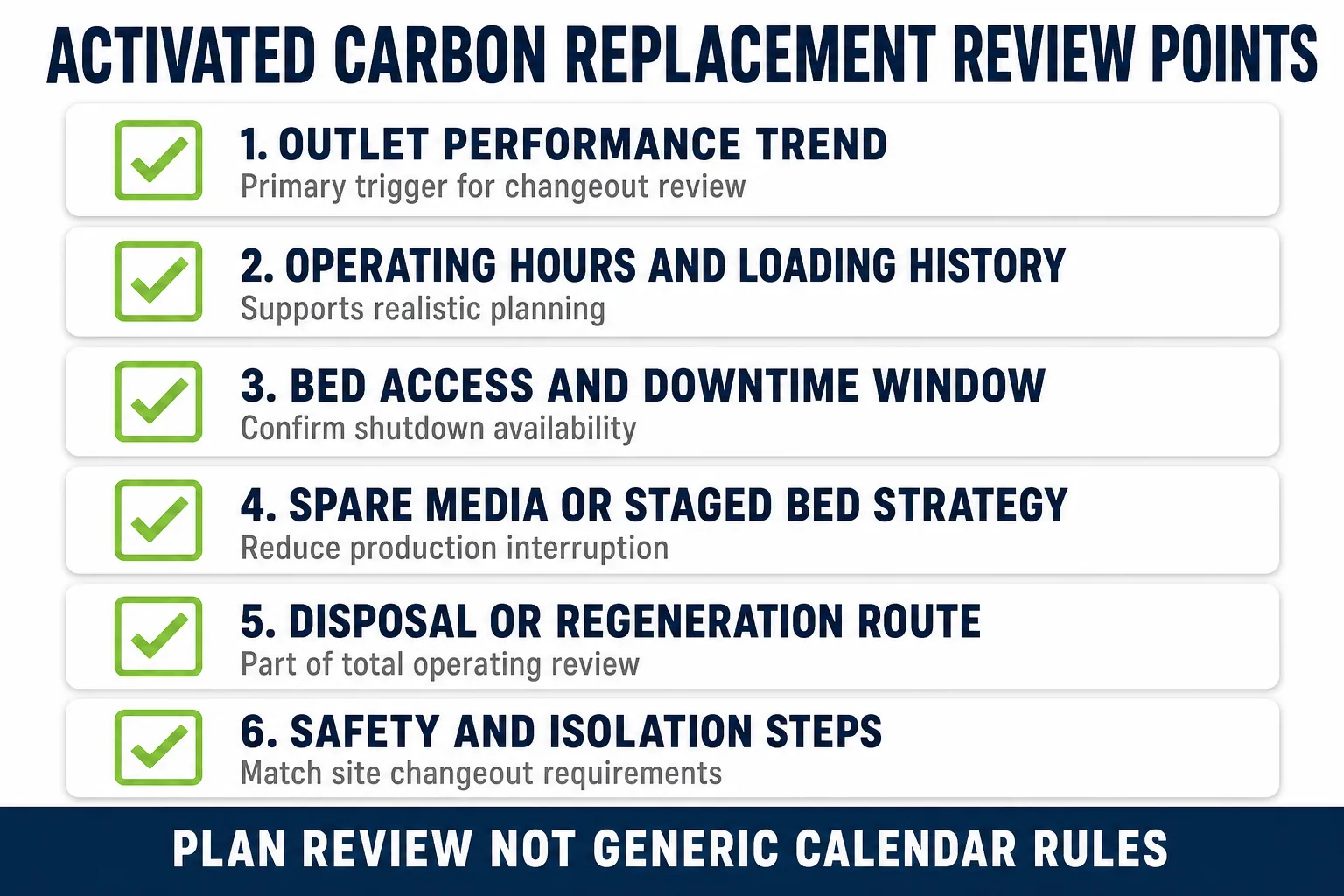
Replacement planning should combine breakthrough signals, operating history, bed access and disposal or regeneration options—not a generic calendar rule alone.
| Changeout Review Point | What to Confirm | Why It Matters |
|---|---|---|
| Outlet performance trend | Whether VOC or odor removal is declining | Primary trigger for replacement review |
| Operating hours and loading history | How long the bed has run at what concentration profile | Supports realistic changeout planning |
| Bed access and downtime window | Whether changeout can be done within available shutdown time | Affects spare-bed or staged-bed strategy |
| Spare media or vessel strategy | Whether a lead/lag or spare module arrangement exists | Reduces production interruption during changeout |
| Disposal or regeneration route | How spent carbon will be handled after removal | Part of total operating review, not only media price |
| Safety and isolation steps | Whether changeout procedures match site requirements | Important for VOC-laden beds and confined-space work |
Common Activated Carbon Buyer Mistakes
Common buyer mistakes in activated carbon projects usually come from treating carbon as a simple filter change rather than as a bed design and loading review problem.
- Using equipment price alone: a lower-cost vessel with insufficient bed volume may need earlier replacement.
- Ignoring face velocity and distribution: poor bed design can cause early breakthrough even with adequate nominal carbon volume.
- Underestimating humidity: wet exhaust can reduce usable VOC capacity and change replacement timing.
- Expecting carbon to replace an RTO: high-concentration continuous VOC streams often need thermal oxidation instead.
- No outlet monitoring plan: without trend data, breakthrough is discovered only after complaints or compliance issues appear.
- Applying HVAC filter logic: industrial exhaust carbon beds need process data, not residential filter replacement habits.
Data Needed for an Activated Carbon Adsorption Review
Before asking AIER to review activated carbon adsorption capacity, bed design or replacement timing, collect process and project data instead of requesting a generic media life estimate.
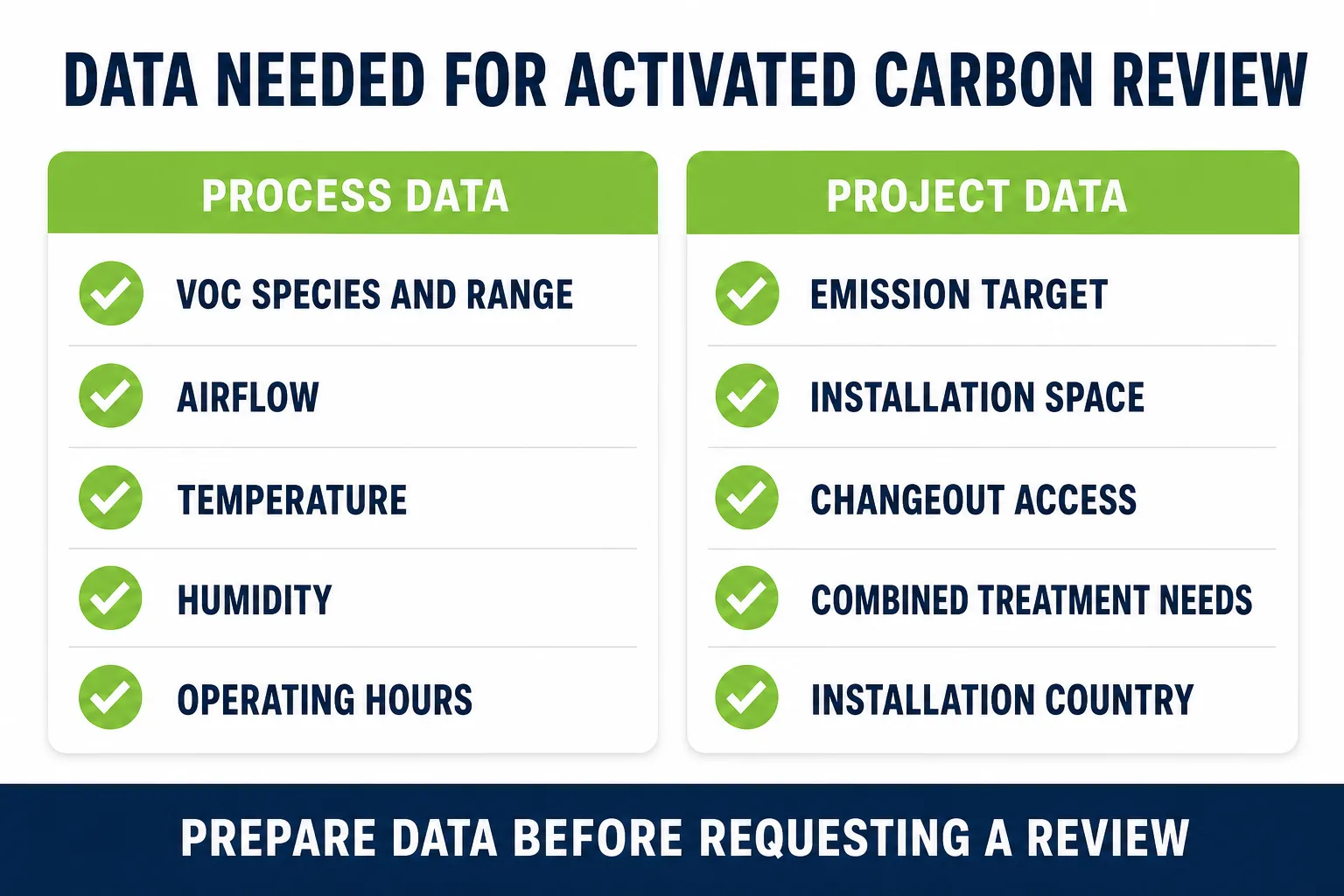
AIER reviews activated carbon adsorption more accurately when VOC species, concentration range, airflow, temperature, humidity, operating hours and emission targets are provided.
| Data to Prepare | Why AIER Needs It |
|---|---|
| VOC species and concentration range | Drives adsorption capacity and media selection review |
| Treated airflow and temperature | Sets vessel class, bed sizing and operating range review |
| Humidity or moisture level | Affects usable capacity and pretreatment needs |
| Operating hours and production pattern | Supports replacement and changeout planning |
| Target emission requirement or odor goal | Confirms whether carbon is appropriate as primary or polishing duty |
| Installation space and access for changeout | Affects vessel layout and maintenance strategy |
| Need for combined RTO, scrubber or polishing stage | Clarifies whether carbon stands alone or follows another route |
If you are reviewing activated carbon adsorption capacity, bed design or replacement timing for an industrial exhaust project, contact AIER with VOC type, concentration range, airflow, temperature, humidity, operating hours and the target emission requirement. AIER can review whether an activated carbon route fits the application and what data still needs clarification before quotation. This is an adsorption route and replacement review invitation, not a published replacement schedule.
FAQ
What affects activated carbon adsorption capacity in industrial exhaust?
Activated carbon adsorption capacity is most affected by VOC species, concentration, humidity, temperature, bed depth, face velocity, airflow distribution and operating hours. Effective capacity is a system result, not one fixed media number for every exhaust stream.
How do you know when activated carbon is reaching breakthrough?
Breakthrough often appears as rising outlet VOC or odor, odor return in occupied areas, changing pressure behavior or enough loading hours for the current duty. Buyers should use operating trends and review points rather than one fixed numeric threshold without data.
How often should activated carbon be replaced?
There is no single public replacement interval for industrial activated carbon because timing depends on VOC type, concentration, humidity, operating hours and carbon loading volume. Buyers should prepare process data for a project-specific replacement review rather than relying on generic calendar rules.
What bed design factors matter for a carbon adsorber?
Bed depth, carbon volume, face velocity, airflow distribution and vessel arrangement matter most. Uniform flow through the bed and enough contact time are essential for usable adsorption capacity in real operation.
When is activated carbon a better route than an RTO?
Activated carbon often fits low-concentration VOC, odor control or polishing duty where thermal oxidation would be unnecessary or costly. Higher-concentration continuous VOC streams usually need a regenerative thermal oxidizer or another oxidation route instead.
What data is needed for an activated carbon adsorption review?
Prepare VOC species, concentration range, airflow, temperature, humidity, operating hours, emission target, installation space and any combined treatment needs. These details help AIER review bed design, capacity and replacement planning more accurately.