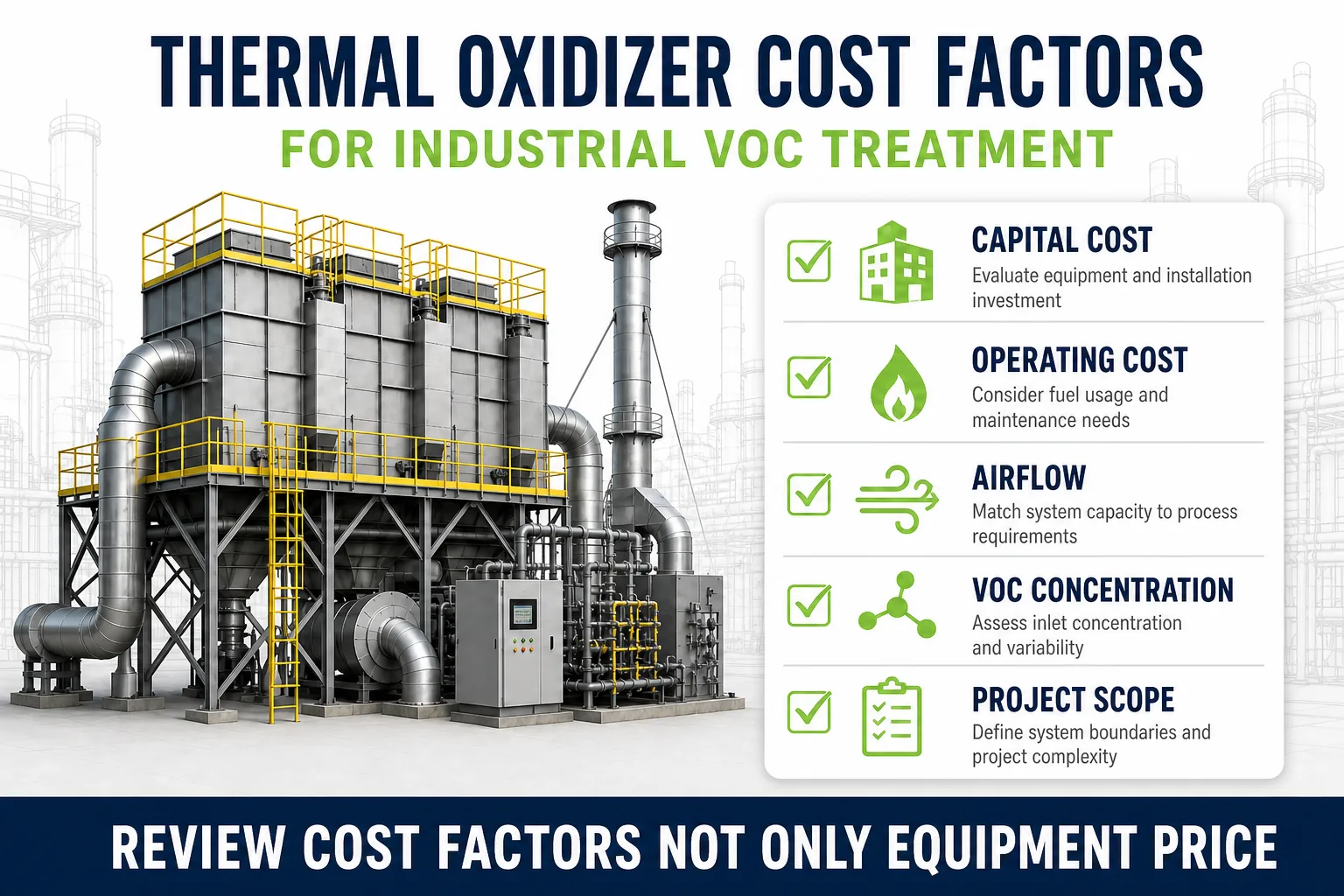
Thermal oxidizer cost is one of the first questions project teams ask when reviewing VOC treatment, but a useful answer starts with cost factors rather than a single equipment price. Capital cost, operating cost, installation scope and long-term maintenance all change the total project picture for an industrial plant.
This article explains thermal oxidizer cost factors for industrial VOC treatment, with emphasis on regenerative thermal oxidizer (RTO) applications. It is written for plant engineers, project buyers and EPC teams reviewing exhaust gas treatment systems; where oxidation sits among the other treatment routes is mapped in our air pollution control equipment overview. AIER supplies regenerative thermal oxidizer systems with ceramic heat recovery, PLC control, variable frequency drives and multi-chamber configurations, but does not publish fixed public pricing. This article does not replace project quotation, local codes or site-specific engineering review.
What Drives Thermal Oxidizer Cost?
Thermal oxidizer cost is the combined effect of equipment scope, installation work, operating energy use and long-term maintenance over the service life of the system—not a single catalog number for the oxidizer alone.
A regenerative thermal oxidizer destroys suitable VOCs through high-temperature oxidation and uses ceramic beds to recover heat between flow reversals. That makes regenerative thermal oxidizer cost sensitive to airflow, concentration, materials, configuration and how many hours the unit runs each year. Buyers who compare quotes using equipment price alone often miss the largest part of the project economics.
| Cost Category | What It Includes | Why Buyers Should Review It |
|---|---|---|
| Capital cost | Oxidizer scope, materials, controls, pretreatment and related hardware | Sets the initial project budget but not the full life cost |
| Operating cost | Fuel, electricity, fan power and supplemental energy over run hours | Often accumulates over many years of continuous duty |
| Installation and commissioning | Civil works, rigging, electrical, controls integration and startup | Often quoted separately from the base equipment package |
| Maintenance and downtime | Media, valves, burners, instrumentation and lost production during outages | Affects total cost of ownership after startup |
According to the EPA guidance on incinerators and oxidizers, oxidizer selection and cost depend on exhaust volume, pollutant properties, control requirements and operating conditions—not on one universal price point.
Capital Cost Factors for an RTO or Thermal Oxidizer
Capital cost factors are the one-time project elements that define the size, materials and configuration of the oxidizer package before the system enters long-term operation.
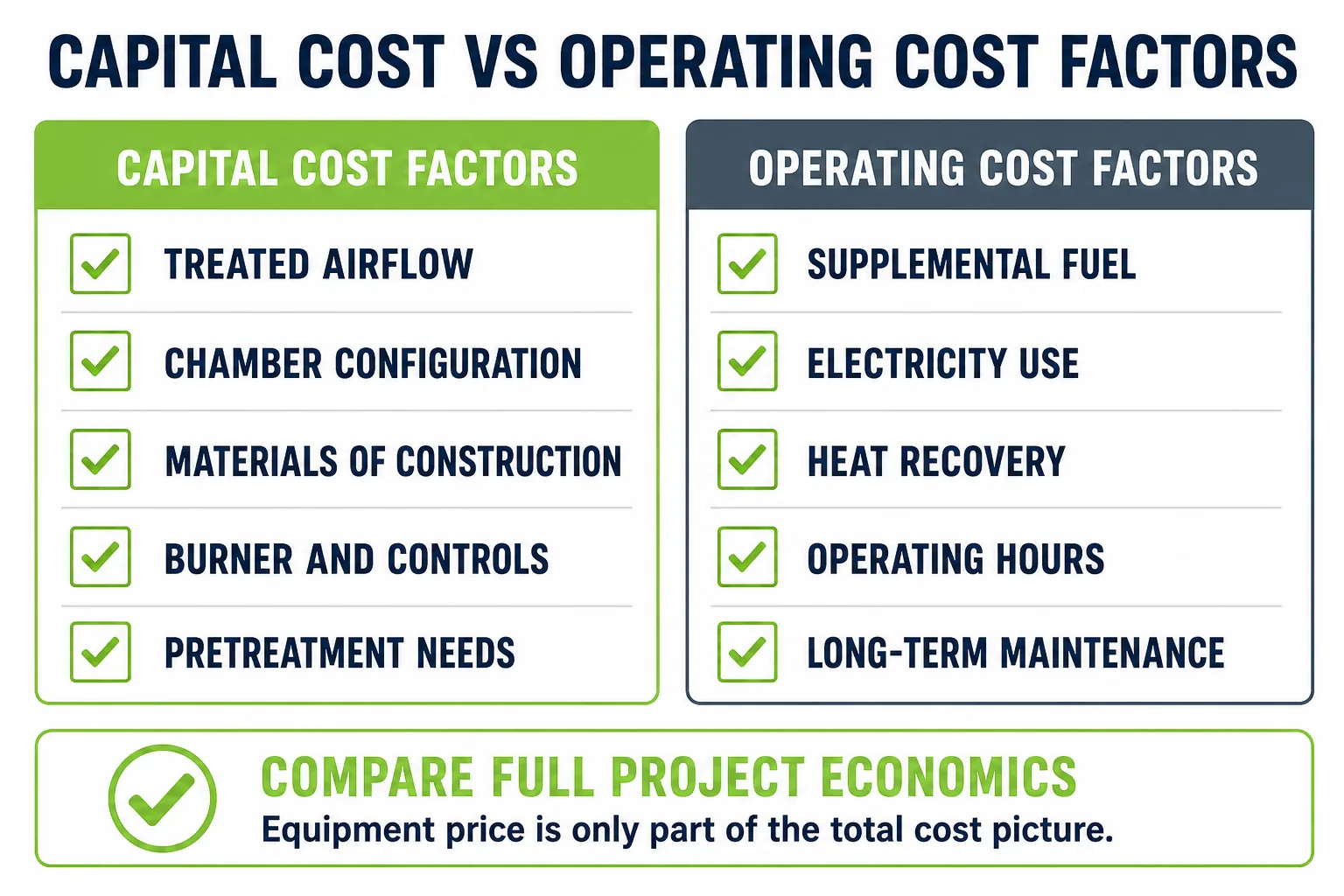
Capital cost covers equipment scope and configuration; operating cost covers fuel, electricity and long-term energy use over the service life.
| Capital Cost Factor | What Changes | Review Question |
|---|---|---|
| Treated airflow | Oxidizer size, valve count, duct and fan scope | Is the quoted system sized for actual peak and normal flow? |
| Chamber configuration | Number of beds, switching arrangement and control complexity | Does the layout match uptime and control needs? |
| Materials of construction | Shell, internals and corrosion-resistant options | Does the exhaust chemistry require special materials? |
| Burner and control scope | Low NOx burner, PLC, VFD, safety systems and monitoring | Are controls included in the equipment scope or listed separately? |
| Pretreatment needs | Particulate removal, condensate handling or upstream protection | Is pretreatment part of the oxidizer quote or a separate package? |
Operating Cost Factors Over the System Life
Operating cost factors determine how much energy the oxidizer consumes after startup. For many continuous-duty RTO projects, these recurring costs deserve as much attention as the initial equipment quotation.
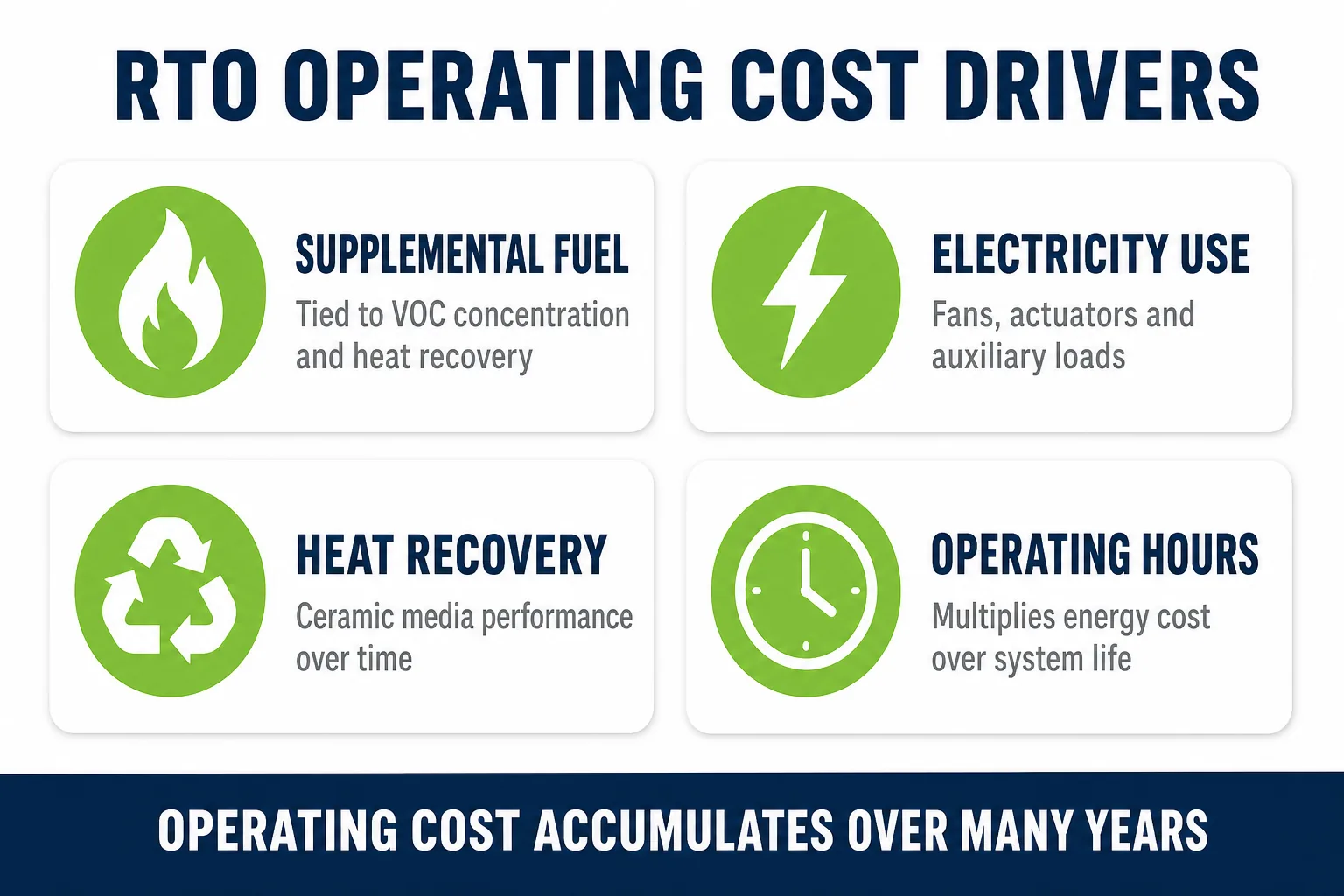
Fuel, electricity, heat recovery performance and annual run hours are the main long-term operating cost drivers for an RTO.
| Operating Cost Factor | What It Affects | Why It Matters |
|---|---|---|
| Supplemental fuel use | Combustion support when process heat input is insufficient | Directly tied to VOC concentration and heat recovery performance |
| Electricity use | System fan, actuators, controls and auxiliary loads | Rises with airflow and pressure drop across the system |
| Heat recovery efficiency | How much combustion heat is stored and reused in ceramic media | A core reason many VOC projects compare RTO with other oxidizer types; see thermal oxidizer heat recovery system design in project review |
| Operating hours | Annual runtime, shift pattern and production schedule | Multiplies every fuel and power cost over the project life |
AIER RTO systems are designed for high heat recovery and long-run industrial duty, but the actual operating cost still depends on the buyer’s gas composition, concentration range, runtime and site energy conditions.
How Airflow and System Size Affect Project Cost
Airflow is one of the strongest drivers of both capital and operating cost because it sets the physical size of the oxidizer, ductwork, valves, fans and structural scope.
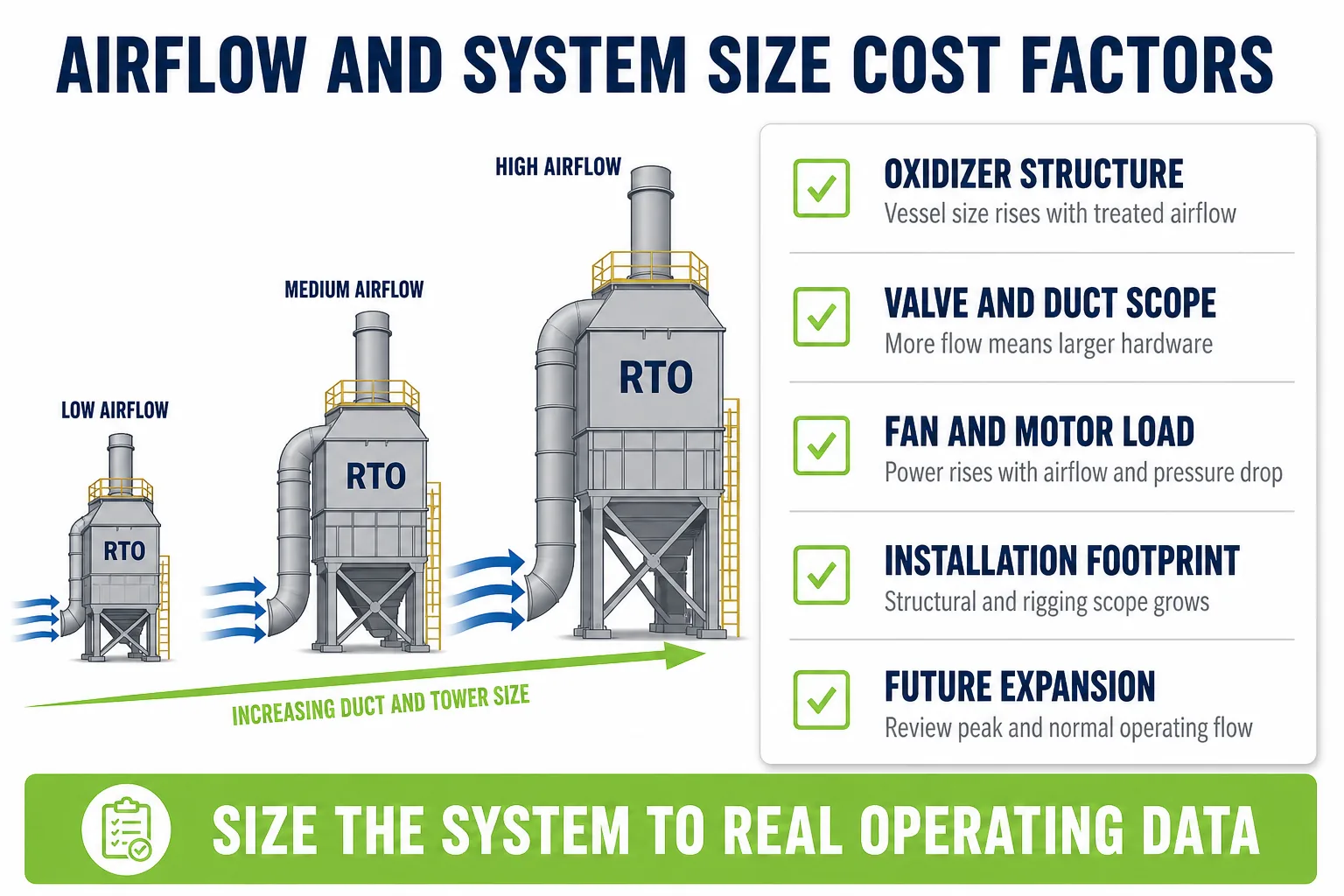
Larger treated airflow usually increases oxidizer structure, valve scope, duct size and fan power requirements together.
- Higher airflow increases vessel size, steel scope, valve count and installation footprint.
- Fan and motor power rise with airflow and system pressure drop.
- Future production expansion should be reviewed early because undersized systems create repeat capital spending.
- Oversizing without justification can increase both equipment scope and idle energy burden.
- An rto system quote should state the design airflow basis clearly so buyers can compare scopes consistently.
How VOC Concentration Affects Fuel and Operating Cost
VOC concentration does not always change the basic equipment footprint as much as airflow does, but it strongly affects supplemental fuel demand and therefore operating cost.
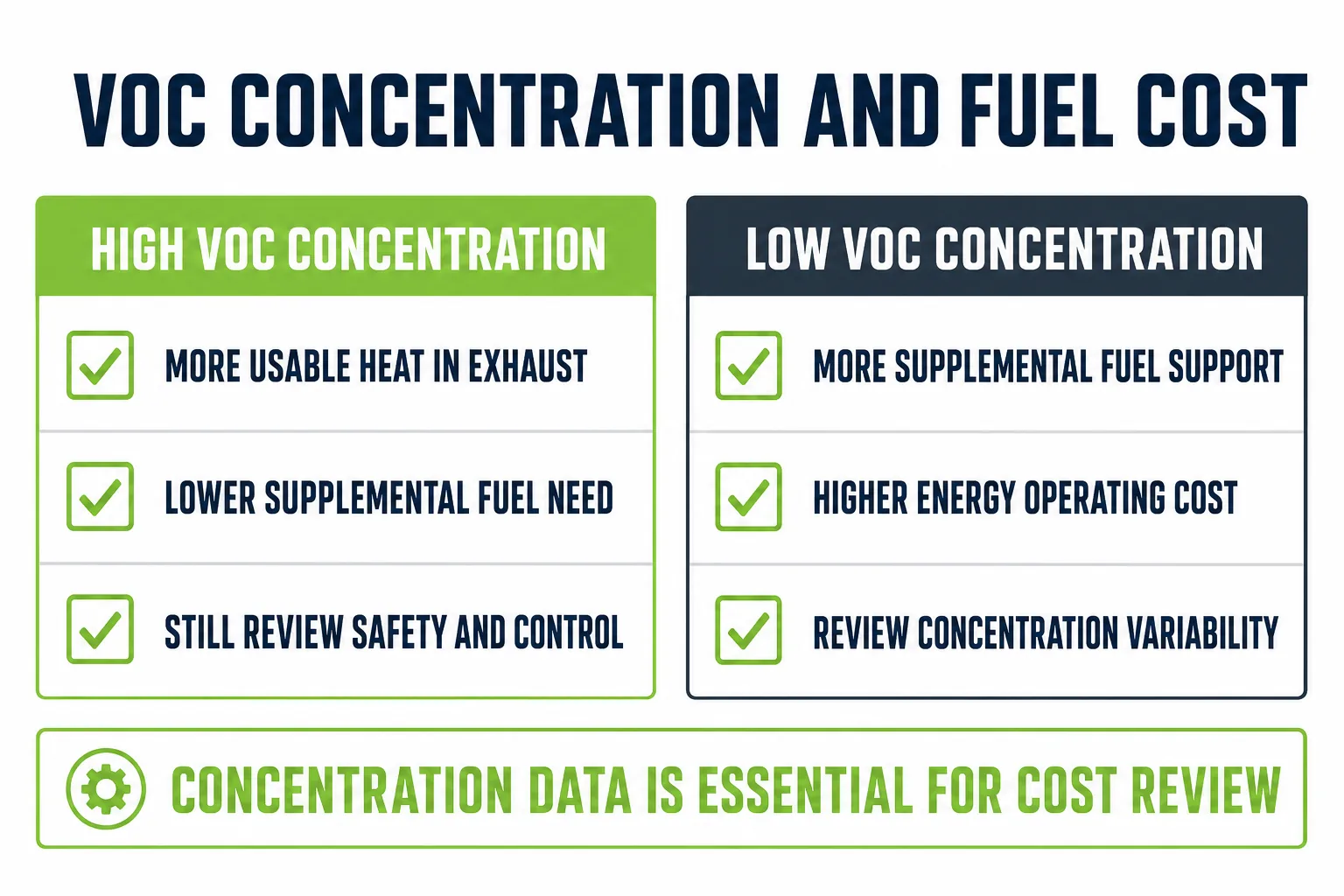
Higher VOC concentration can provide more usable heat in the exhaust stream, while low-concentration streams usually need more supplemental fuel support.
| Exhaust Condition | Typical Operating Cost Effect | Review Direction |
|---|---|---|
| Higher VOC concentration | More usable heat in the stream; often lower supplemental fuel need | Confirm stability across normal and peak production |
| Lower VOC concentration | More supplemental fuel or support energy required | Compare RTO economics with adsorption or other routes if loading is very low |
| Variable concentration | Operating cost swings with production mode | Review turndown, control strategy and worst-case operating point |
| Dilute continuous stream | Energy cost may dominate project economics | Do not compare equipment quotes without concentration data |
Materials, Configuration and Application Requirements
Application requirements can change capital cost even when airflow stays the same. Exhaust chemistry, particulate load and reliability expectations all influence the final oxidizer scope.
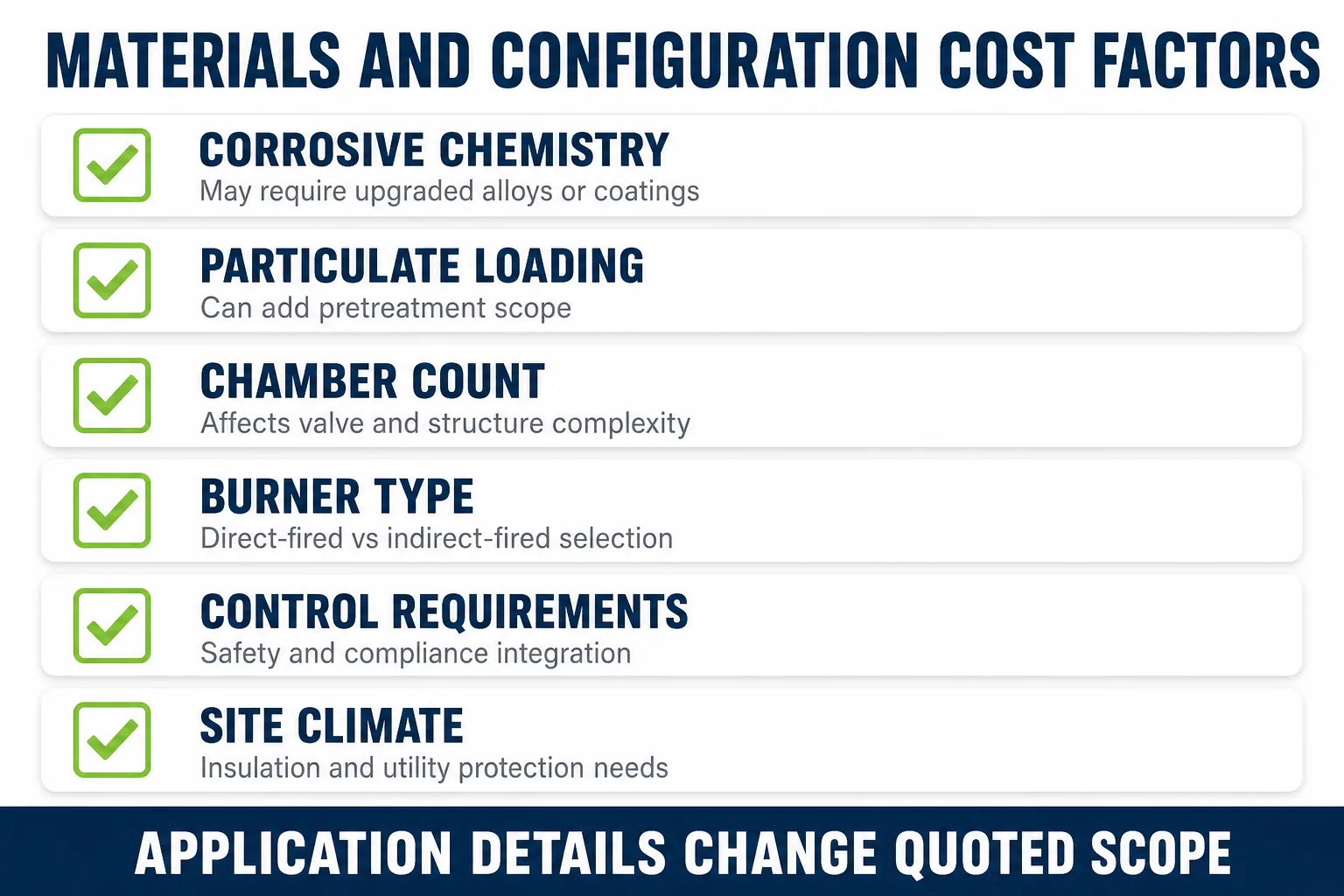
Corrosive chemistry, particulate loading, chamber count and control requirements can all change the quoted oxidizer scope.
| Application Factor | Typical Cost Effect | Example Review Point |
|---|---|---|
| Corrosive or halogenated components | Higher material grade and maintenance sensitivity | Confirm compatibility with exhaust chemistry |
| Particulate or mist load | May require pretreatment or protected layout | Check whether upstream protection is included |
| Multi-chamber RTO design | More valves, controls and fabrication scope | Review whether redundancy or uptime needs justify the configuration |
| Low NOx burner requirement | More specialized combustion hardware | Confirm burner scope in the equipment package |
| Remote monitoring and controls | Additional instrumentation and integration work | Clarify what is included in supply versus site integration |
Installation, Commissioning and Project Scope Beyond Equipment Price
Many budget surprises come from treating the oxidizer equipment quote as the full project cost. Installation, commissioning and site integration often sit outside the base equipment price.
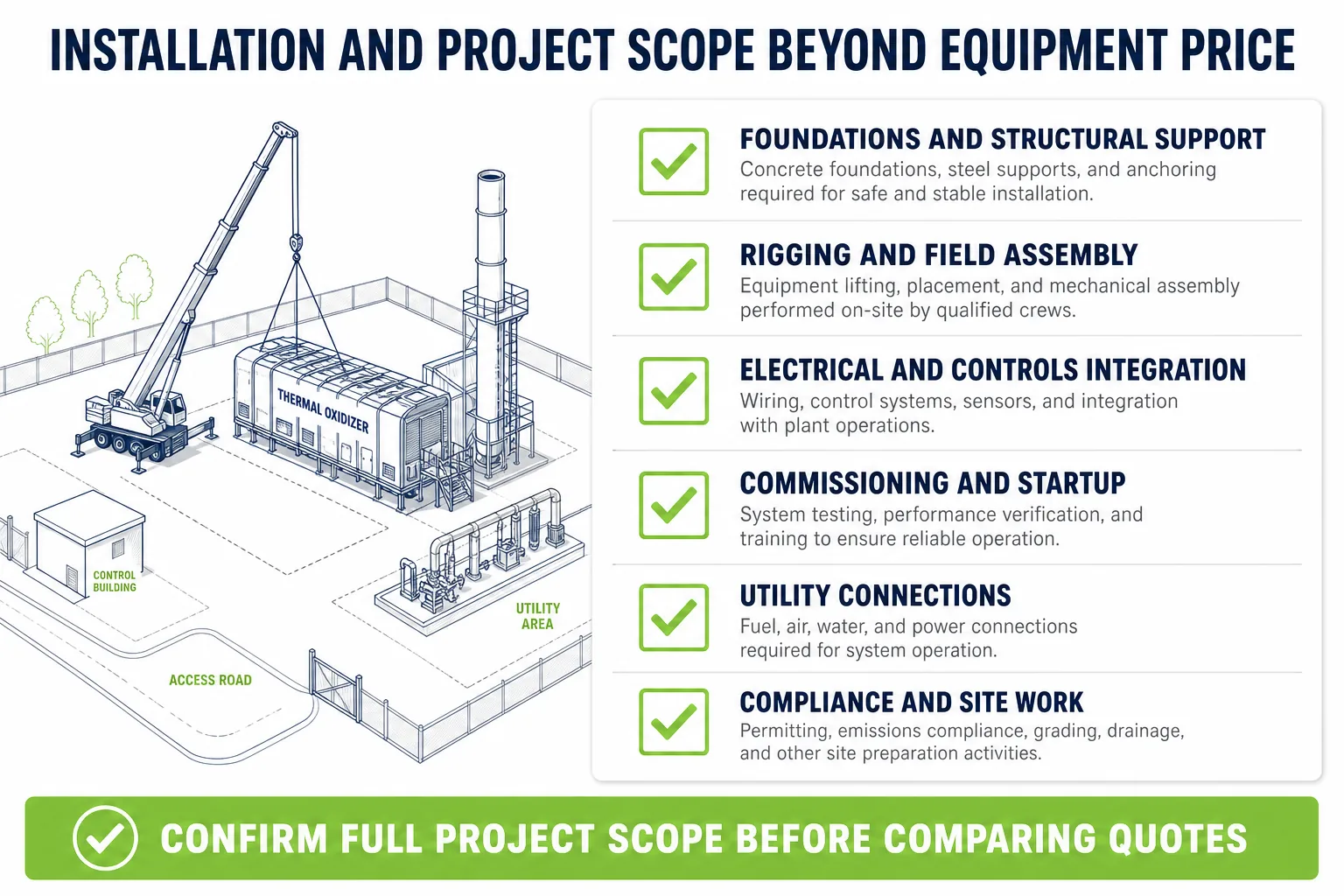
Foundations, rigging, electrical integration, controls startup and compliance activities are often quoted separately from the oxidizer package.
- Civil foundations and structural supports for the oxidizer and duct interface points.
- Mechanical rigging, assembly and alignment of large vessels and duct connections.
- Electrical power, controls integration, safety interlocks and startup support.
- Commissioning, performance verification and operator handover activities.
- Permit support, site safety requirements and local inspection coordination.
Buyers should ask what is included in the equipment quotation and what remains in installation, utility, structural or commissioning scope before comparing vendors.
Maintenance and Downtime as Hidden Cost Drivers
Maintenance and downtime belong in any serious thermal oxidizer cost review because they affect total cost of ownership after the system is running. Ceramic media condition, valve reliability, burner service and instrumentation drift all influence uptime and energy performance.
These topics are covered in more detail in the article on regenerative thermal oxidizer maintenance. From a cost perspective, the main review points are:
- Media fouling or damage can raise fuel use and pressure drop before a visible failure occurs.
- Valve leakage or poor switching increases energy waste and unstable operation.
- Unplanned downtime can exceed the value of short-term savings from lower-spec equipment.
- Planned maintenance access and spare-part strategy should be reviewed during project selection.
A lower capital quote is not always lower total cost if the system needs more frequent service, longer outages or early component replacement.
When RTO Is Not the Only Route to Compare
Thermal oxidizer cost review should also ask whether RTO is the right route for the exhaust stream. Cost comparison only makes sense when the technology matches the pollutant type and loading.
| Exhaust Condition | Route Often Reviewed | Cost Review Note |
|---|---|---|
| Continuous VOC loading suitable for thermal oxidation | Regenerative thermal oxidizer | Compare capital and operating cost over full runtime |
| Low-concentration VOC or odor polishing | Activated carbon adsorption | Media replacement cost may dominate economics |
| Acid or soluble gas instead of VOC oxidation duty | Industrial wet scrubber | See also wet scrubber vs dry scrubber for route context |
| Coating or painting exhaust with VOC control needs | RTO, carbon or combined route | Review against VOC emission control application conditions |
Data Needed for a Thermal Oxidizer Cost Review
Before asking AIER to review thermal oxidizer cost or regenerative thermal oxidizer cost, collect process and project data instead of requesting a generic price. This helps compare scope consistently and avoids mismatched quotations.
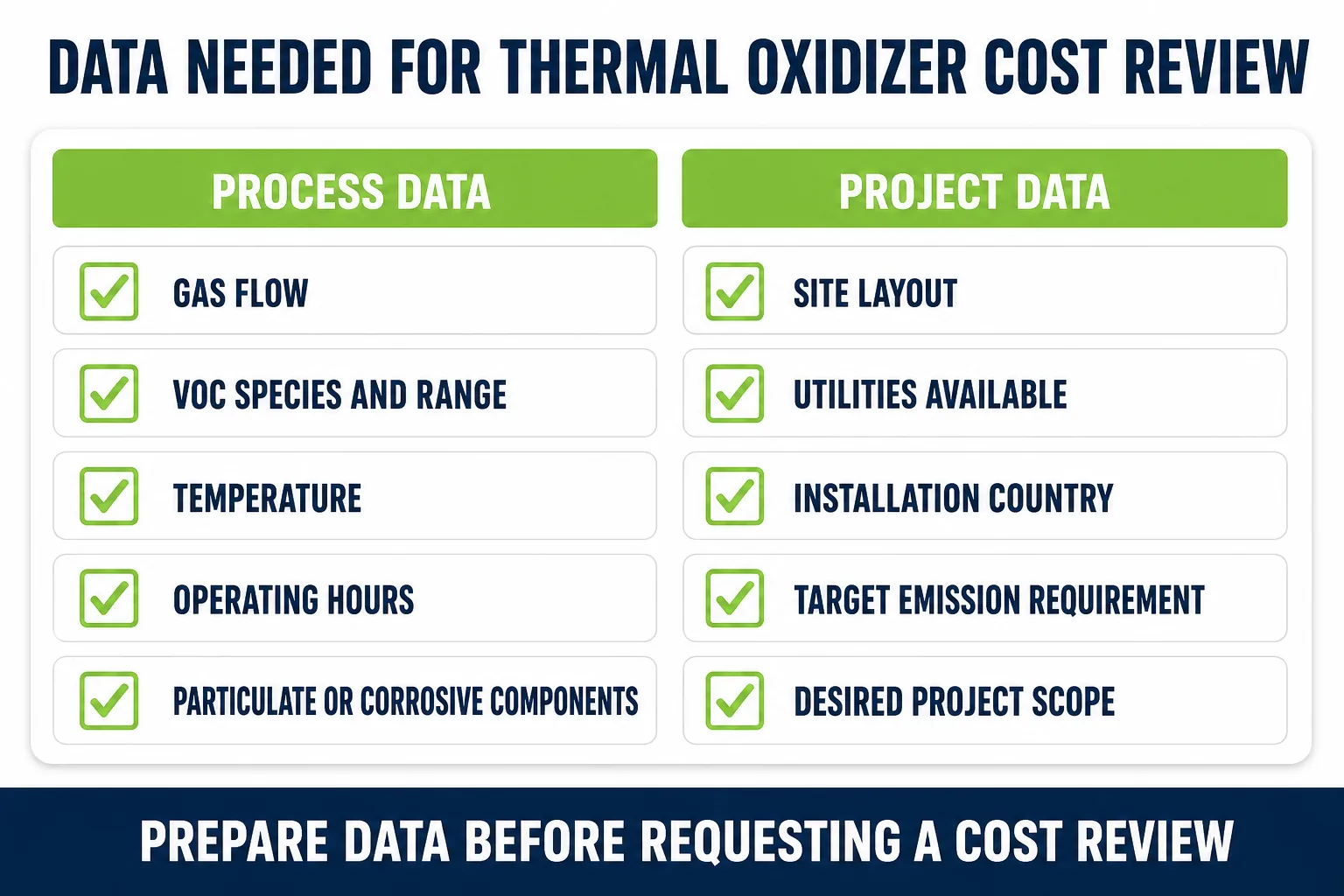
AIER can review thermal oxidizer cost more accurately when flow, VOC range, temperature, run hours and project scope are prepared.
| Data to Prepare | Why AIER Needs It |
|---|---|
| Treated gas flow and temperature range | Sets oxidizer size, fan scope and material review |
| VOC species and concentration range | Drives operating cost review and technology fit |
| Operating hours and production pattern | Converts equipment scope into life-cycle economics |
| Particulate, mist or corrosive components | Identifies pretreatment and material requirements |
| Site layout, utilities and installation country | Affects installation scope and project integration |
| Target emission requirement or permit basis | Helps confirm whether RTO scope is appropriate |
| Existing duct, fan or upstream equipment data | Clarifies what is new supply versus reuse |
If you are comparing thermal oxidizer cost for an industrial VOC project, contact AIER with gas flow, VOC concentration range, temperature, operating hours, site conditions and the intended project scope. AIER can review whether an RTO route fits the application and what data still needs clarification before quotation. This is a cost review invitation, not a published price list.
FAQ
What affects thermal oxidizer cost the most?
Thermal oxidizer cost is most affected by treated airflow, VOC concentration, materials and configuration, installation scope, operating hours and long-term maintenance. Equipment price alone does not define the full project cost for an industrial VOC treatment system.
How much does a regenerative thermal oxidizer cost?
There is no single public price for a regenerative thermal oxidizer because cost depends on airflow, VOC loading, materials, chamber configuration, pretreatment needs, installation scope and operating conditions. Buyers should prepare process and site data for a project-specific cost review rather than relying on generic online price ranges.
Why is operating cost often more important than equipment price for an RTO?
An RTO often runs for many years at high annual hours, so fuel and electricity can accumulate into a larger total cost than the initial equipment quotation. VOC concentration and heat recovery performance strongly affect that long-term operating cost.
How does VOC concentration affect RTO operating cost?
Higher VOC concentration can provide more usable heat in the exhaust stream and reduce supplemental fuel demand, while lower or highly variable concentration usually increases energy support requirements. That is why concentration data is essential for operating cost review.
What project costs are often missing from an equipment quote?
Foundations, rigging, electrical and controls integration, commissioning, pretreatment equipment, utility connections and compliance-related site work are often quoted separately from the base oxidizer package. Buyers should confirm full project scope before comparing vendors.
What data is needed for an RTO or thermal oxidizer cost review?
Prepare gas flow, VOC species and concentration range, temperature, operating hours, particulate or corrosive components, site layout, utilities, installation country and the target emission requirement. These details help AIER review scope and cost drivers more accurately.