
Most buyers do not start a dust collection project knowing which collector they need. They start with a dust problem — welding fume drifting through a workshop, powder losses at a conveyor transfer, a silo venting dust at every filling — and meet a market that answers with equipment names instead of selection logic.
This article is the map. It explains what an industrial dust collector is, how the common designs work, what each of the main types of dust collectors does well and badly, and how to move from dust properties to a shortlist of platforms. Each type covered here has its own deeper article or product page on this site; this overview connects them. It is written for plant engineers, EHS owners and buyers comparing equipment for the first time, and it supports the selection review rather than replacing project engineering.
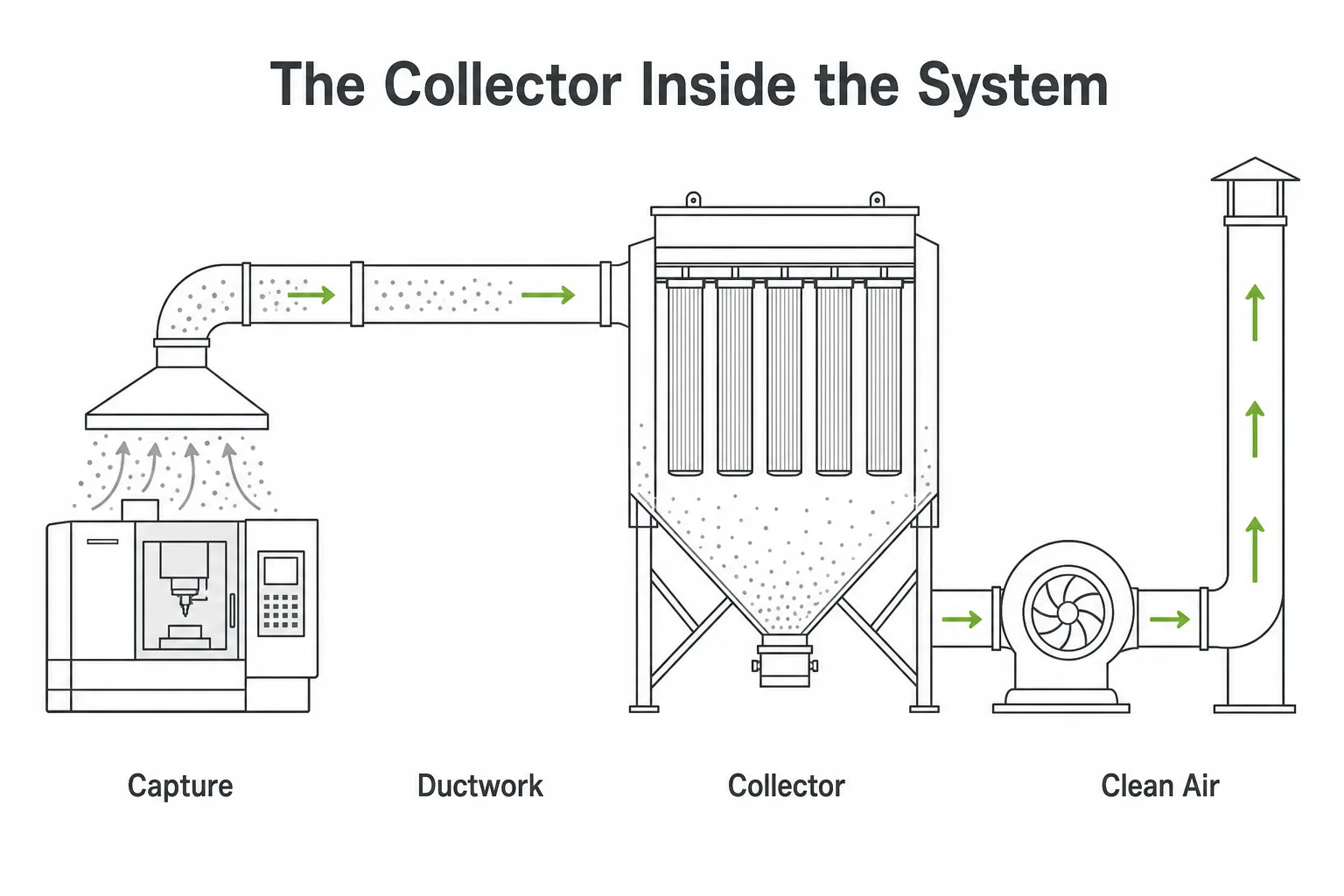
An industrial dust collector is the filtration stage of a larger system: capture points and ductwork bring the dust-laden air in, the collector separates the dust, and the fan discharges cleaned air.
What Is an Industrial Dust Collector?
An industrial dust collector is equipment that separates dust from a process air stream and collects it for discharge or recovery, protecting workers, products and equipment from airborne particulate.
Two points frame everything that follows. First, the collector is one stage of a system: hoods and capture points, ductwork, the collector itself, the fan and the discharge path all have to work together, and a well-chosen collector inside a badly designed system still fails. Second, industrial dust collectors are a different equipment class from workshop vacuum units sold under the same name — the machines reviewed here serve continuous production duty across industrial dust collection applications from metalworking and casting to food, chemical and new energy plants.
How Dust Collectors Work: The Shared Platform
Almost every collector type in this article works on the same four-step cycle, and understanding it once explains the whole family.
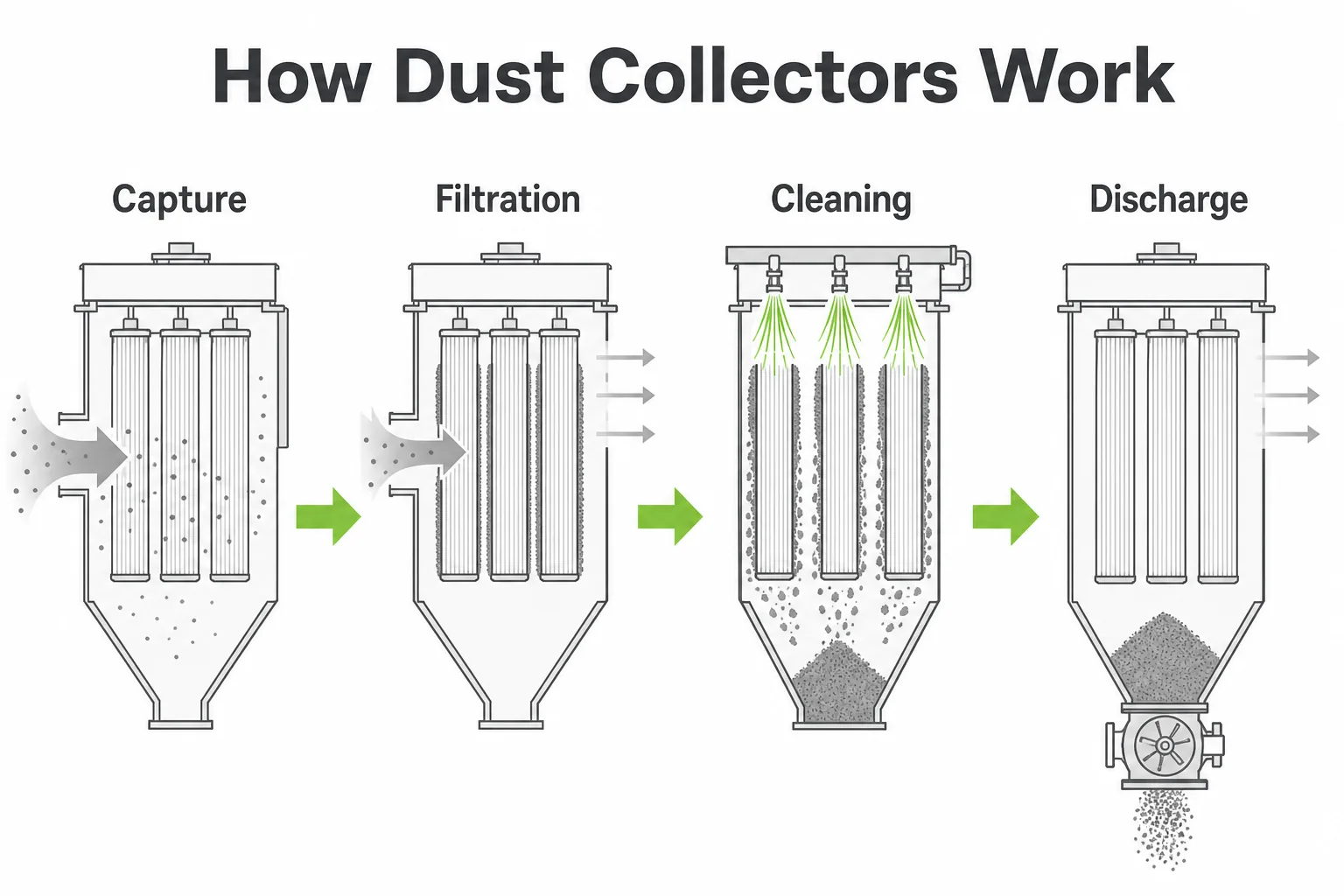
Capture, filtration, cleaning and discharge: the four-step cycle shared by bag, pleated bag, cartridge and sintered plate collectors.
- Capture: dust-laden air is drawn from the process into the collector housing.
- Filtration: the air passes through filter elements — fabric bags, pleated media or sintered panels — and the dust stays on the dirty side as a cake.
- Cleaning: timed or pressure-triggered compressed air pulses knock the accumulated cake off the elements so airflow resistance stays workable.
- Discharge: the dislodged dust falls into a hopper and leaves through the discharge system for disposal or recovery.
The pulse cleaning mechanics — valves, blowpipes, pressure drop behavior — are covered step by step in our pulse jet baghouse working principle article. What separates the types below is mostly the filter element itself: its shape, its media and the dust behavior it tolerates.
The Main Types of Industrial Dust Collectors
Across the types of dust collectors used in industrial plants, five fabric filtration platforms cover the large majority of duties. The table maps the family; the sections after it describe each platform.
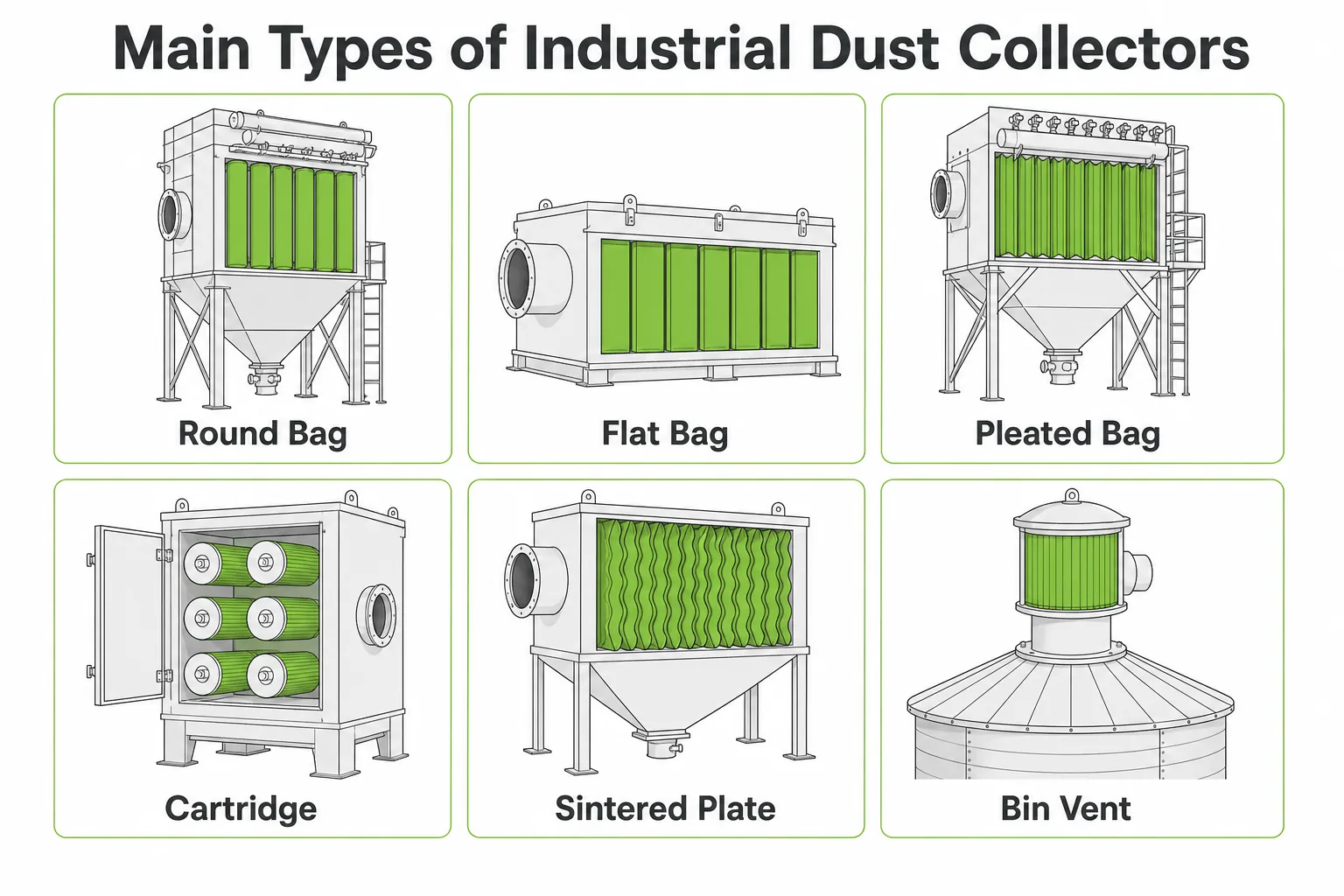
Round bag, flat bag, pleated bag, cartridge, sintered plate and bin vent designs — different filter elements on a shared pulse cleaning idea.
| Type | Filter Element | Strong At | Watch Out For |
|---|---|---|---|
| Bag collector (round bags) | Long round fabric bags on cages | Heavy dust loads, wide fabric and temperature range, big airflows | Largest footprint of the family |
| Flat bag collector | Flat fabric bags | Height-limited installations, compact hoods and bins | Smaller single-unit airflow range |
| Pleated bag collector | Pleated fabric bags | More media area in the same housing; duties too hot or dust-heavy for cartridges | Pleats still dislike sticky, fibrous dust |
| Cartridge collector | Pleated cylindrical cartridges | Fine dry dust, welding and laser fume, compact layouts | Not for high temperature or high dust concentration |
| Sintered plate collector | Rigid sintered panels | Very long element life, moist or sticky fine dust, product recovery | Higher initial investment |
| Bin vent unit | Flat or round bags on a vessel roof | Silo and hopper venting during filling and conveying | A venting device, not a central collector |
Bag Dust Collectors: Round and Flat Bags
The baghouse is the workhorse of industrial dust collection. The AIER bag dust collector platform uses round fabric bags supported by cages, cleaned by pulse jets, and serves power, metallurgy, building materials, chemical, food and new energy duty. Because bags are sewn from a wide range of fabrics, the baghouse carries the widest temperature and chemistry envelope of the family — the media logic is covered in our dust collector filter bags article.
Two structural variants earn their own place. The round bag dust collector uses a pressure-resistant circular body with a cyclone-style inlet that drops coarse dust before it reaches the bags — the catalog design for pneumatic conveying and material recovery duty. The flat bag dust collector packs its filtration area into a low housing for height-limited installations.
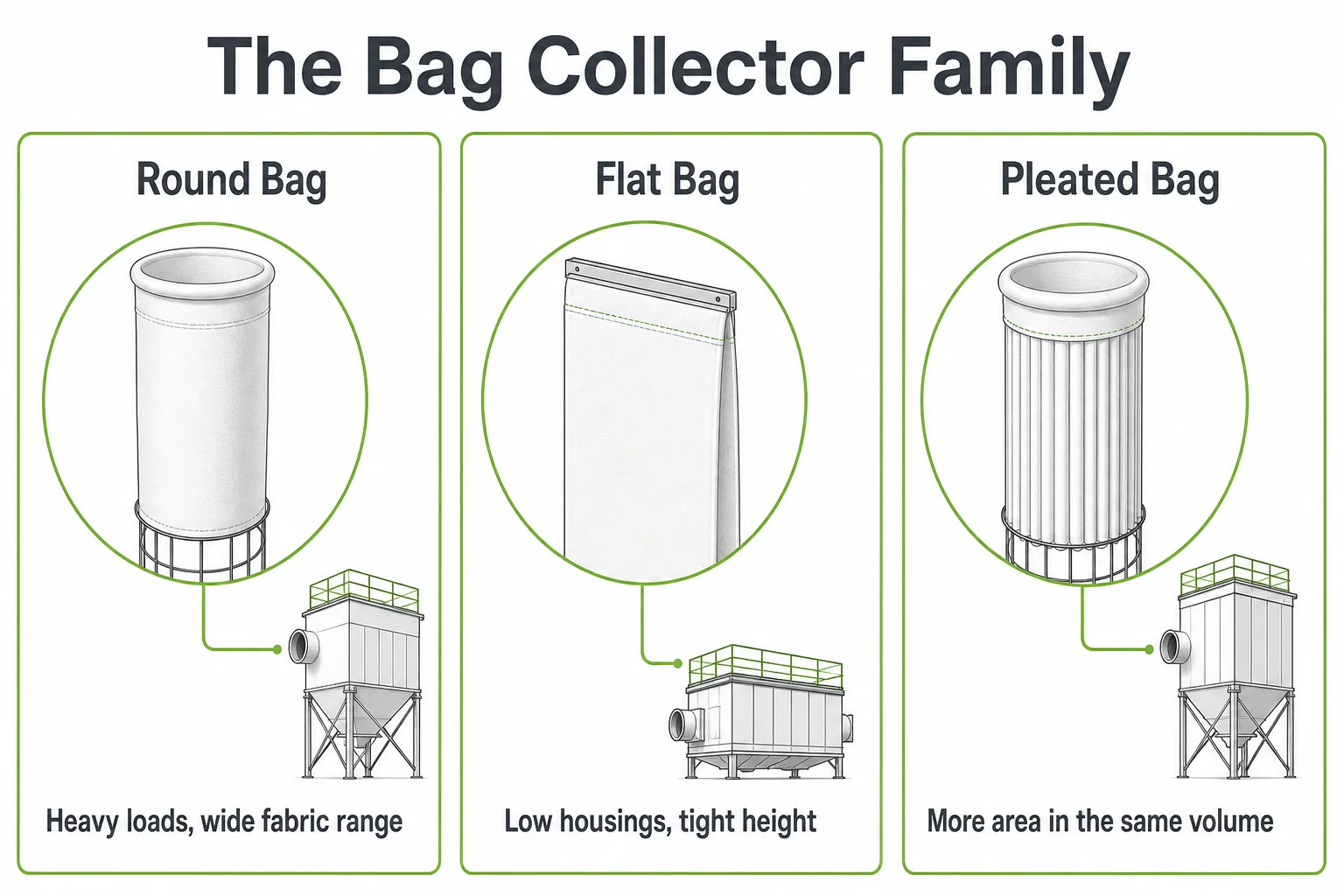
One fabric platform, three element shapes: round bags for heavy general duty, flat bags for low housings, pleated bags for more area in the same volume.
Pleated Bag Dust Collectors
The pleated bag dust collector folds the bag media into pleats, and per the AIER catalog the same filtration area then fits in a housing more than 40 percent smaller. The catalog also states its other role plainly: pleated bags apply to the high-temperature, high-concentration duties that cartridge collectors cannot serve. That makes this platform the bridge of the family — cartridge-style compactness with fabric-bag durability, and a common retrofit route when an existing housing needs more filter area.
Cartridge Dust Collectors
The cartridge dust collector uses cylindrical pleated elements that pack several times more media area into the same volume, which keeps the collector compact enough to sit next to the production line. Fine, dry dust is its territory: welding and laser fume, grinding dust and light powders across new energy, automotive, casting, tobacco and pharmaceutical plants. The element itself — media choices, replacement signals, cleaning limits — is covered in our dust collector filter cartridge article, and the platform-level comparison with baghouses in our baghouse vs cartridge dust collector review.
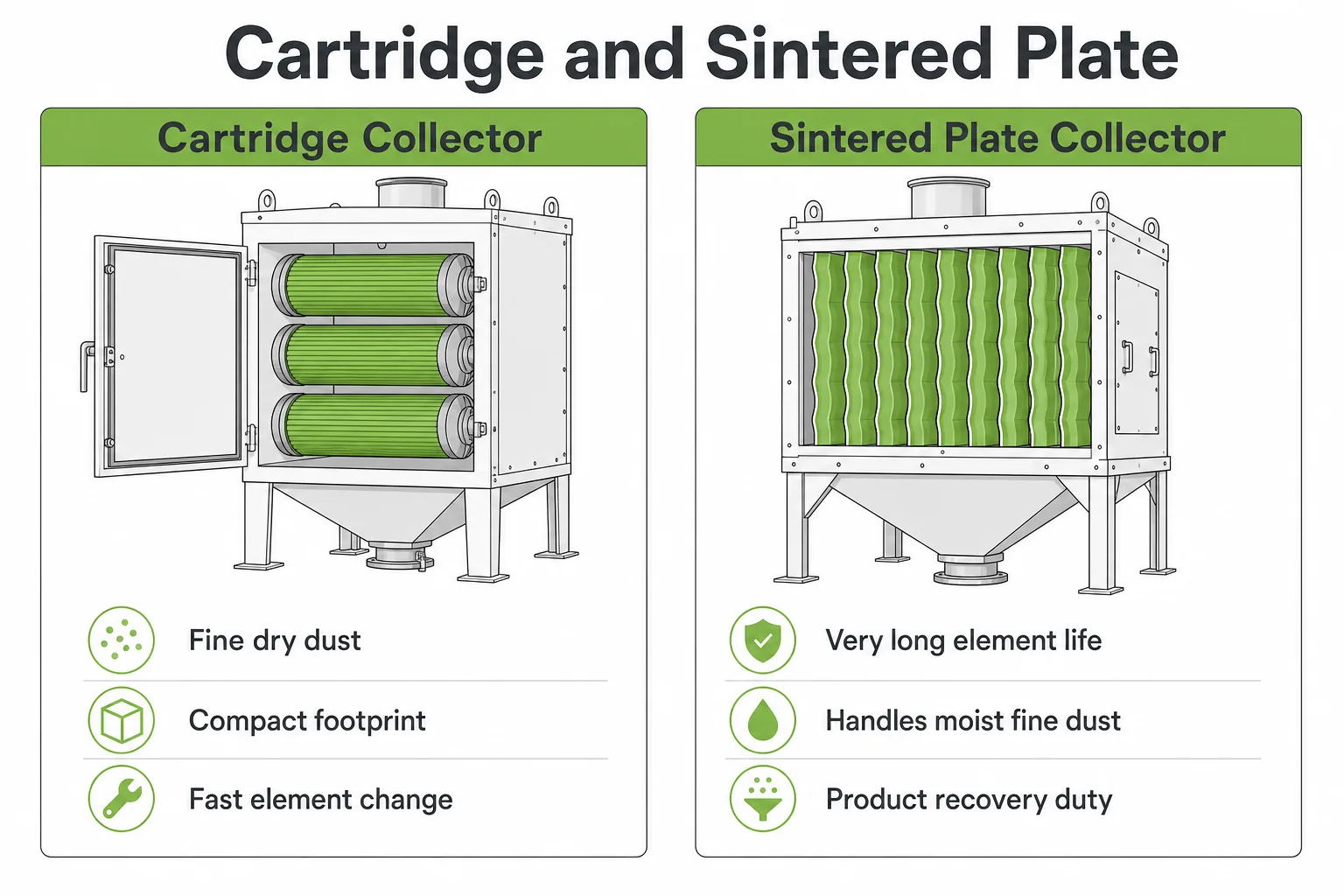
Cartridges trade a compact footprint for dust-behavior limits; sintered plates trade a higher initial investment for element life and washable rigid panels.
Sintered Plate Dust Collectors
The sintered plate dust collector replaces fabric with rigid sintered panels whose surface sheds dust rather than embedding it. The payoff is element life measured in years, stable pressure drop and tolerance for moist or sticky fine dust that would blind fabric — which is why it appears where filter changes are unwelcome or where high-value process powder is being recovered. The trade is a higher initial investment, so the review is a life-cycle comparison rather than a purchase-price one.
Bin Vent Dust Collectors
A bin vent is not a central collector but a venting device: a compact filter unit mounted on a silo, bin or hopper roof that cleans the displaced air pushed out during filling and conveying, and drops the captured dust straight back into the vessel. It reuses the flat bag and round bag platforms in roof-mounted form. Where it fits, how it differs from a ducted system and what data its review needs are covered in our bin vent dust collector article.
Other Types You Will Meet in the Market
Three other names come up in almost every search, and honesty about them matters more than coverage.
- Cyclone separators spin coarse dust out of the air stream by centrifugal force. In industrial service they mostly work as pre-separators ahead of a fabric collector rather than as final filtration — fine dust passes through.
- Wet dust collectors scrub dust into a liquid. They serve specific duties — certain sticky, hygroscopic or reactive metal dusts — and bring water treatment along as a consequence.
- Electrostatic precipitators (ESP) charge particles and collect them on plates, mostly in large utility and process gas applications.
AIER does not supply these three types; its dust collection range is the fabric filtration family described above. They are listed here because a fair type overview should say what exists — and because if your dust genuinely points to one of them, that is worth knowing before any fabric collector quote, not after. And when the problem is gases rather than particulate, the equivalent route map — scrubbers, oxidizers, adsorption and recovery — is in our air pollution control equipment overview.
Matching the Collector Type to the Dust
Choosing between types of dust collectors is dust characterization wearing a different name. The same starting questions sort most projects onto a shortlist.
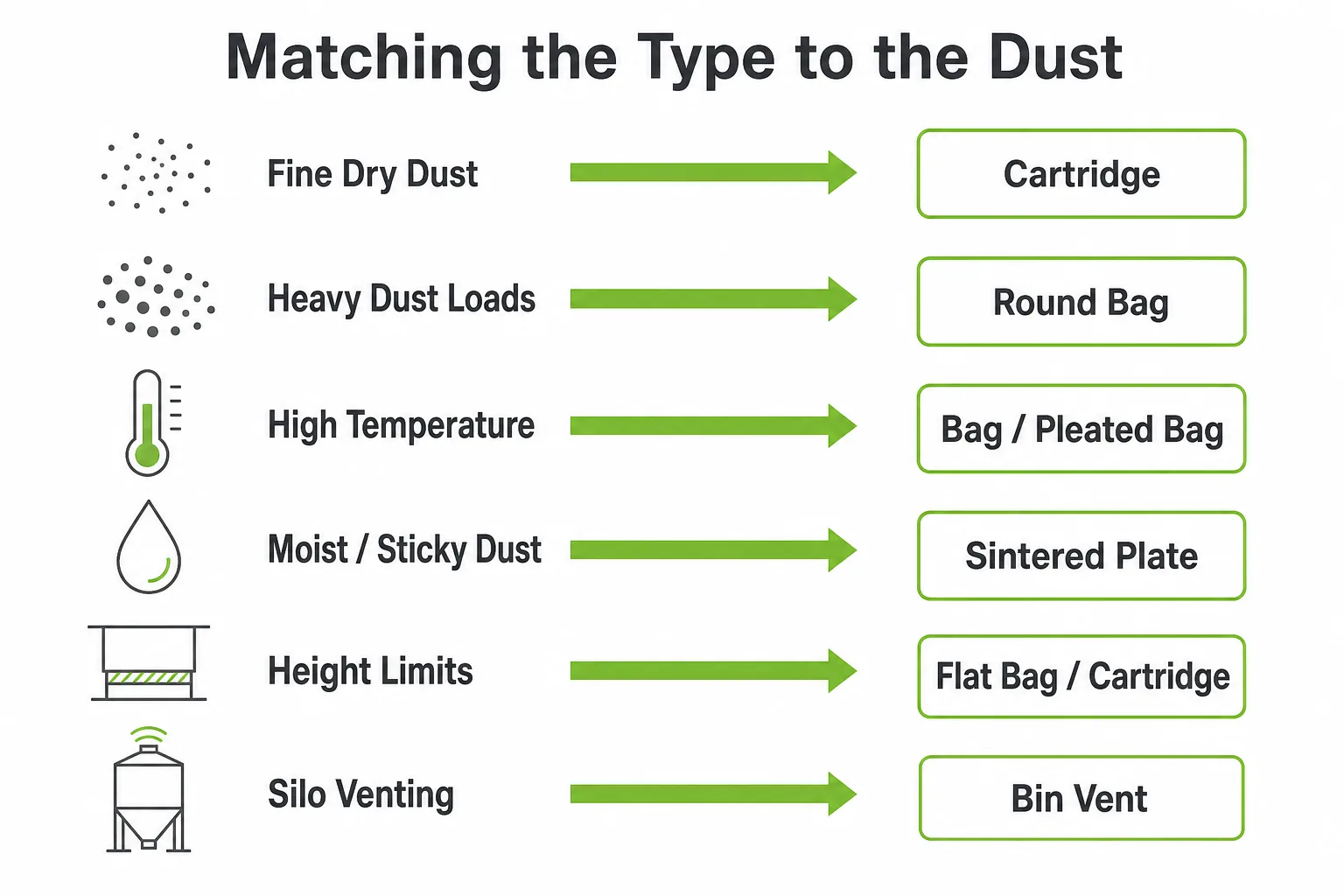
From dust properties to platform shortlist: particle behavior, load, temperature, moisture and the venting question decide the type before any brand does.
| If the Duty Looks Like | The Shortlist Starts With |
|---|---|
| Fine, dry dust — welding fume, laser smoke, light powders | Cartridge collector; pleated bag where conditions exceed cartridge limits |
| Heavy or coarse dust loads, bulk handling | Round bag baghouse, often with cyclone-style inlet |
| High temperature or high dust concentration | Bag or pleated bag platforms with media selected per the gas condition |
| Moist, sticky or blinding-prone fine dust | Sintered plate review; fabric routes need careful media and pretreatment review |
| Height-limited or space-limited installation | Flat bag or cartridge platforms |
| Silo, bin or hopper venting | Bin vent unit on the vessel roof |
| Combustible dust anywhere in the picture | Safety review first — type selection follows it |
Real plants usually end with more than one platform: a central baghouse on the heavy process dust and compact cartridge units at welding or finishing stations is a standard pattern — our baghouse vs cartridge article walks through that split, and the metal dust collection system article shows it applied plant-wide in metalworking.
Beyond the Collector: System and Safety Review
Choosing the right type is necessary and not sufficient. Three reviews around the collector decide whether it performs.
The system review. Capture points, duct velocities, fan sizing and discharge arrangements decide whether the collector ever sees the dust it was bought for. That logic — and the sizing questions like airflow that this article deliberately does not answer — is covered in our dust collection system design and sizing article.
The safety review. If the dust can burn or explode when dispersed, a dust hazard review comes before procurement, and it changes the equipment specification: our dust hazard analysis article explains what buyers need to declare and ask.
The operating review. Every type in this article lives or dies by pressure drop trends, cleaning system health and element condition once it is running — the routine is in our dust collector maintenance and troubleshooting article.
Common Mistakes When Choosing a Dust Collector Type
- Choosing by price before dust: the cheapest collector for the wrong dust becomes the most expensive one in service.
- Sizing by airflow alone: two duties with identical airflow and different dust behavior can need different platforms entirely.
- Ignoring the temperature and moisture envelope: the cartridge-versus-bag boundary is a real equipment limit, not a sales preference.
- Skipping the combustibility declaration: finding out the dust is explosible after procurement reopens the whole design.
- Expecting one unit to serve the whole plant: mixed duties usually justify mixed platforms.
- Confusing venting with collection: a silo needs a bin vent on the roof, not a duct run to a distant central collector.
Information AIER Needs for a Type Review
A type recommendation is only as good as the project data behind it. This is what the review starts from.
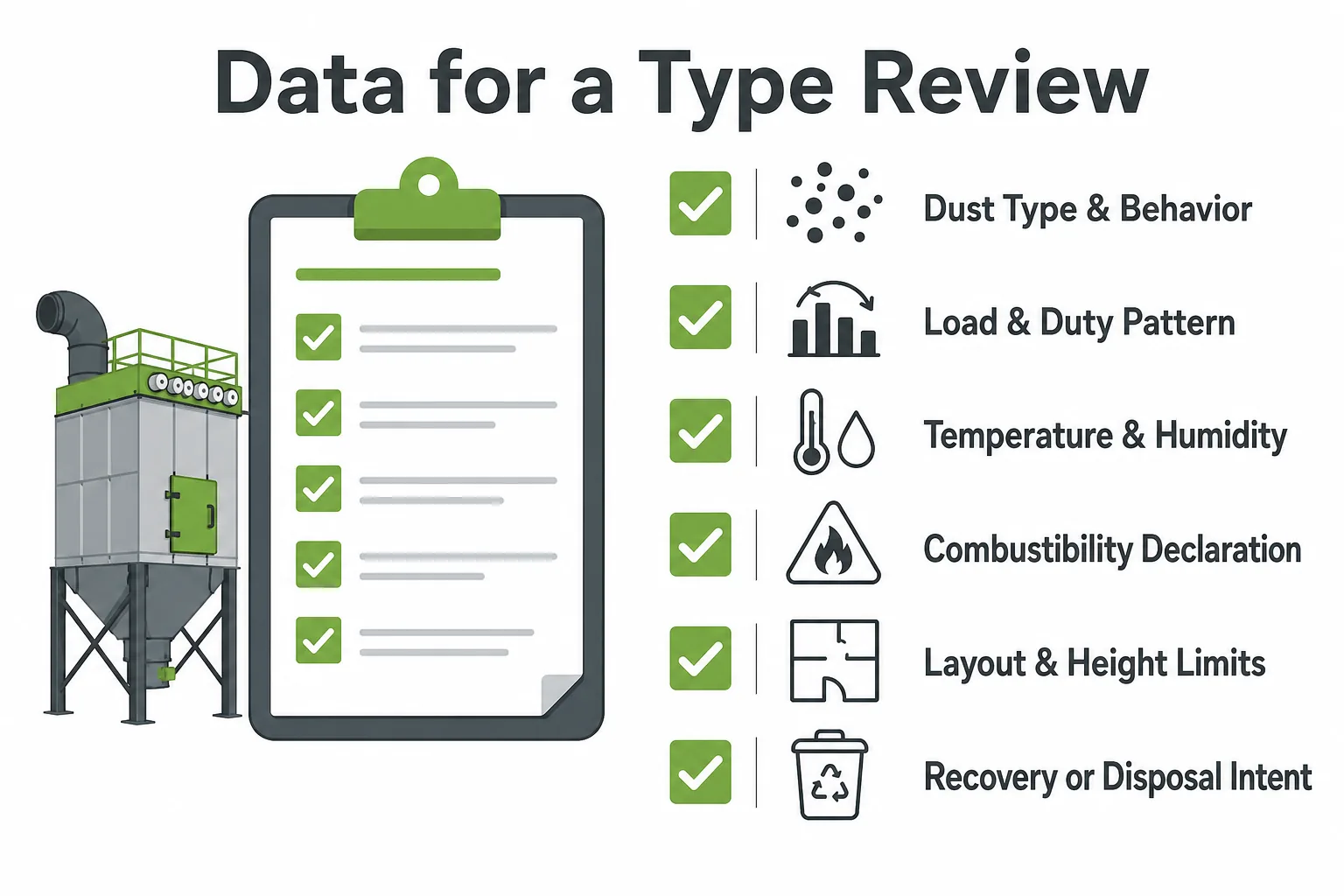
Dust properties, process duty, gas conditions, layout constraints and the combustibility declaration are the data AIER reviews before recommending a collector type.
| Data to Prepare | Why It Matters |
|---|---|
| Dust type, source process and behavior | Particle character, stickiness and abrasiveness drive the platform choice |
| Dust load and duty pattern | Heavy continuous loads and light intermittent duties point to different types |
| Gas temperature and humidity | Sets the fabric envelope and the cartridge boundary |
| Combustibility declaration | Changes the review order and the equipment specification |
| Layout, height and access limits | Decides between full-height, flat bag and compact platforms |
| Recovery or disposal intent | Product recovery duties favor certain platforms and discharge designs |
| Installation country | Defines project and delivery requirements |
If you are starting a dust collection project — or replacing equipment that never quite fit — contact AIER with the dust type, duty pattern, gas conditions and layout constraints. AIER supplies the full fabric filtration family, so the type review can follow the dust instead of defending a single product.
FAQ
What is an industrial dust collector?
An industrial dust collector is equipment that separates dust from a process air stream and collects it for discharge or recovery. It works as the filtration stage of a dust collection system, together with capture points, ductwork, a fan and a discharge path, and it is a different equipment class from workshop vacuum units sold under similar names.
How does a dust collector work?
Most industrial dust collectors work on a four-step cycle: dust-laden air is captured from the process, filtered through elements such as fabric bags, pleated cartridges or sintered panels, the accumulated dust cake is cleaned off the elements by compressed air pulses, and the dust falls to a hopper for discharge. The main types differ chiefly in the filter element, not the principle.
What types of dust collectors does AIER supply?
AIER supplies the fabric filtration family: bag dust collectors with round bags, round bag collectors with pressure-resistant bodies, flat bag collectors for height-limited installations, pleated bag collectors, cartridge dust collectors and sintered plate dust collectors, plus bin vent configurations for silo and hopper venting. Cyclones, wet collectors and electrostatic precipitators are not part of the range.
Which dust collector type is best for fine dust?
Fine, dry dust such as welding fume, laser smoke and light powders is classic cartridge collector territory, with nanofiber or membrane media improving capture and release. When the same fine dust comes with high temperature or high concentration, pleated bag platforms take over; when it is moist or sticky, a sintered plate review is worth adding. The dust behavior, not the fineness alone, makes the call.
What size dust collector do I need?
Size follows the system, not the collector type: airflow requirements come from the capture points and ductwork design, and the collector is then sized to filter that airflow at a workable resistance. That sizing logic — capture, duct velocity, fan and filter area — is covered in our dust collection system design and sizing article, and it is project engineering rather than a lookup table.
Can one plant use more than one collector type?
Yes, and most larger plants do. A typical pattern pairs a central baghouse on heavy process dust with compact cartridge units at welding, grinding or finishing stations, and bin vents on storage silos. Mixed duties justify mixed platforms; forcing one type to serve every duty is one of the most common selection mistakes.